
Everything’s banal: Mohammad Shawky Hassan’s new short hits home
In recent years, living in Egypt, there have been many moments in which mundane normalcy is juxtaposed with the spectacularly dramatic, in which everyday life continues amid the grand narratives of revolution, coup and “war on terror.” Spaces where nothing happens and yet everything happens at the same time.
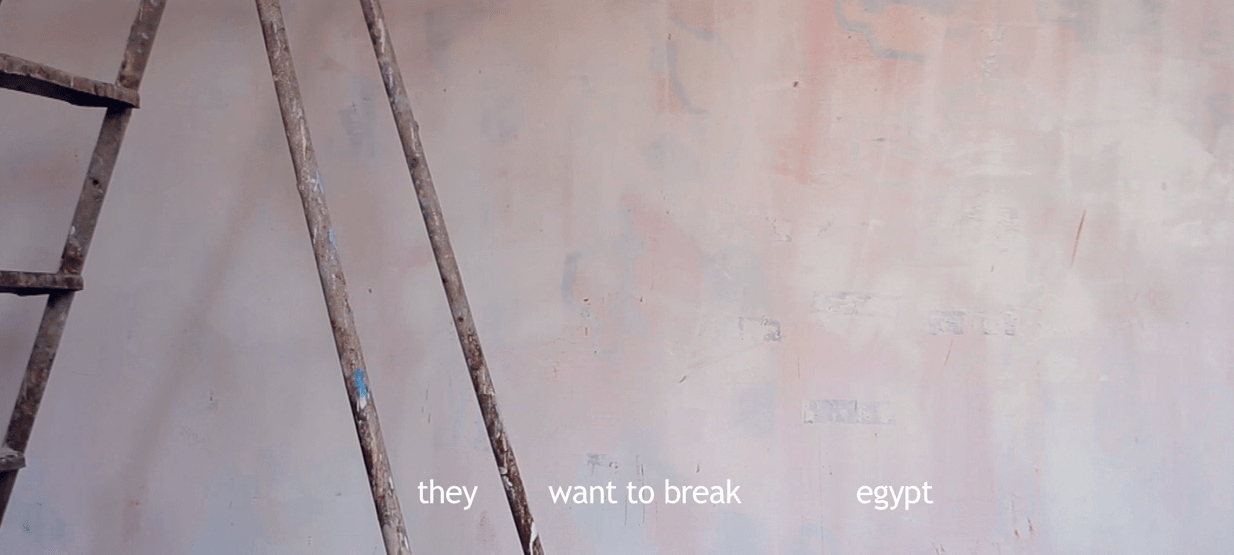
This is one reason why Mohammad Shawky Hassan’s 24-minute film, Waala Saeeden Akhar (And on a Different Note, 2015), is so powerful. Quiet, largely static images from everyday life are paired with audio clips from Egyptian news, prime-time political talk shows and films, alongside sometimes seemingly unrelated diary-like subtitles.
“What have you done with the symphony? I don't know, but I think I found the beginning,” we hear at the start. A man then whistles an emotive tune that feels like reminiscing or longing. This exchange, probably from an old Egyptian film, is paired with a frosty image of slow-moving traffic in a foreign, snowy city.
“Today the plumber came,” writes the protagonist in white on a black screen, while the mellow whistling is still audible.
The many layers that make up the film are part of its genius. It’s mainly in Arabic but some written parts are in English, and the two languages don’t often match up. Shawky Hassan doesn’t translate the Arabic dialogue into English word for word, but abbreviates the gist, picking out only certain words in English subtitles.
The blank spaces left seem to imply that not many of the words actually matter, and that there is something formulaic about them anyway. This, as well as the selection of the clips themselves, lends the film a wryly humorous aspect.

Sometimes there is no direct correlation between the text, visuals and subtitles as they’re layered on top of each other, enabling bilingual viewers to get the most out of the film. But even then, there’s a sense of feeling bombarded with visual and audio content to the extent that it’s hard to focus on everything at once. Not just in the film, but in everyday life.
As a viewer you’re bombarded, bemused and unaided, same as our mysterious protagonist. And this means that each time you watch the film, you notice something new in its rich layers, and block something else out to focus on it.
A bicycle, a pile of clothes and two posters for Egyptian movies, I’m No Angel and Wolves on the Road, clutter the corners of what seems like an apartment in a city elsewhere.
“No, no, no, no … no, no, no … stop right there … in the army we trust … nobody interferes in military affairs,” screams TV host Mahmoud Saad in response to a guest's suggestion that the military budget be monitored.
Piercing audio recordings continue to be paired with cloudy, dim and almost lifeless footage of a faraway land, signalling detached melancholy. Presenter Lamis al-Hadidi broadcasts an alleged leaked phone call featuring former President Mohamed Morsi. Saad interviews notorious lawyer and football executive Mortada Mansour — who hangs up on him. A female caller tries to relay information from a protest, but Saad starts flirting with her on air.
The missing protagonist keeps appearing momentarily through brief written notes. A typed chat slowly appears on a black screen, with references to quinoa and porn. At other points he seems to talk to himself: “Now I eat regularly, sleep regularly, masturbate regularly and talk to no one.”
When paired with scenes shot in a foreign country, this suggests homesickness. But the overwrought patriotism we hear from Egyptian TV presenters, and their focus on the flimsiest of conspiracy theories against the state, does not recommend a homecoming.
Hassan Shawky’s approach is minimal, organic and rough at points. The early footage is shot analogue (in New York), for instance, while the material filmed in Cairo, which appears later, is digital and has a noticeably wider frame. The filmmaker decided against removing this discrepancy, and the visual twist adds substance to the bewildering experience.

Moreover, the Cairo part has a different visual quality — the image is still soft but free of the foggy quality that characterizes the previous footage. Overall, there’s something of a very precise home movie about it, and despite — or because of — the bewilderment, a sense of familiarity is created.
A final hazy shot of a construction worker making a hole in a wall sums up the journey. The scene is shot through a transparent plastic curtain. The act of destruction is stronger than anything, although the persistent media dialogue suggests triumphant rebuilding and starting over.
The film spreads out two worlds through its dissimilar material: New York and Cairo, internal life and the world of media. It makes us wonder what has become more banal — the everyday and relational, or the grand political narrative? What is spectacle and when do we embrace, perform, or ignore it?
There is no real subversion to the “grand narratives” presented here, and the context and chronology of conversations are absent. Patriotism and the depressing status quo in Egypt take center stage, and the drama of it all is at once repulsive and addictive.
Through precise visuals and a messy maze of media noises, a filmmaker thus depicts his life. Although the result forces you to hear the clips you’ve probably tried to avoid over the past few years, in its ambivalence And on a Different Note doesn’t push you down a specific path, and is all the more effective for it.
And on a Different Note is playing at Zawya at 6.30pm on April 18 as part of the AFAC film week.

Amany Ali Shawky
Amany is a Lifestyle and Society Reporter with Mada. With 10 years in journalism and publishing, she has written for everything from news to culture, environment and fashion, street politics…

Laura Bird
Laura has been working with Mada Masr since December 2013. She edits the opinion section and occasionally writes. Laura has an MA in Middle East Politics from SOAS, and worked…
تقارير ذات صلة

Avant-titre | Our bread, our dignity: Bread in Egyptian cinema
This episode of Avant-titre is part of Mada Masr's Bread politics, an eight-part series that takes an in-depth look at bread subsidies in Egypt in the context of recent talk…

Video | Privilege and responsibility: A letter from Carol Mansour
Carol explains why allowing the voices of others to be heard helps to make the world a better place

Video | The archivist
Over decades of collecting, Makram Salama has turned his home into a cinema archive.
Your support is the only way to ensure independent, progressive journalism survives.
You have a right to access accurate information, be stimulated by innovative and nuanced reporting, and be moved by compelling storytelling. Subscribe now to become part of the growing community of members who help us maintain our editorial independence.
Join us