
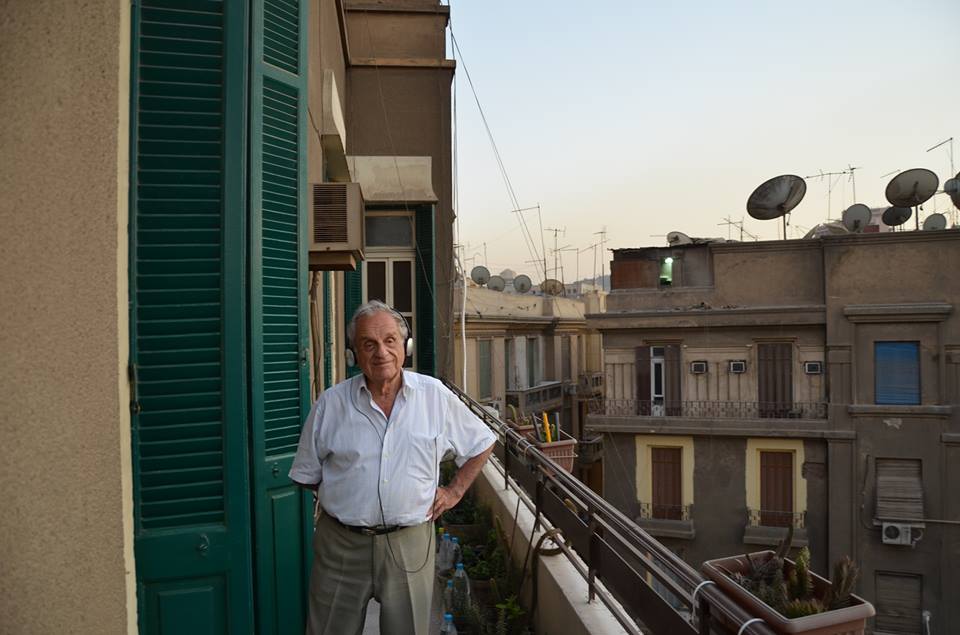
At Titi’s Balcony: A former political prisoner reflects above Tahrir
Albert Arie gets a chance to talk about being an Egyptian activist, not just an Egyptian Jew
Perhaps the best decision Yasmina Benari took in making a documentary about 86-year-old former activist Albert Arie was to not make it about his most exotic aspect: being Jewish in Egypt.
At Titi's Balcony is a crowd-funded portrait of Arie set entirely in his downtown Cairo apartment, from which a sliver of Tahrir Square is visible through a gap in neighboring buildings. Shifting between protests in the aftermath of 2011, as seen from the balcony and Arie pottering about inside, it focuses on conversations carried out in French between the filmmaker and Arie, known as “Titi.” These mostly concern his political activism in the 1950s and resulting 11-year imprisonment in 1953 under Gamal Abdel Nasser's regime.
At no point is there reference to his Jewish background. We only know about it from the film's synopsis, which is available on the filmmaker’s website, and from Arie’s previous appearances to talk about Egypt’s dwindling Jewish community, a subject which has featured prominently in the media in recent years. Arie appeared in Amir Ramsis' two important documentaries, released in 2013 and 2014, which follow Egyptian Jews in Egypt and in exile. There was also the historically contested Ramadan series The Jewish Alley (2015) written by Medhat El Adl. The formidable leader of Egypt's Jewish community, Magda Haroun, has also been interviewed frequently on television.
During a Q&A after the film’s premiere at Zawya last week as part of the ninth Panorama of the European Film, 37-year-old Benari said she originally intended to make the film, her second documentary, about Arie’s religious background. Her own father was an Egyptian Jew from a wealthy Mezrahi family who left to France before she was born, and she came to Egypt five years ago to rediscover her roots and artistically document Jewish Egyptians. But Arie was much more interested in talking about his activist history, especially given the current post-revolutionary moment, than his religious heritage.
People in the audience insistently asked Benari and Arie, who was also present, why his religion wasn't part of the film as a reference to “Egypt's pluralistic cosmopolitan past.” Arie responded that he always lived on the margins of the Jewish community and does not identify as Jewish or Muslim, though he converted in the 1960s to be able to marry his wife. He identifies with the national movement in Egypt, he said, and with being Egyptian.
The focus on Arie as a former activist who dropped politics after his release from prison to focus on his family is refreshing, but even though there are several poignant moments and Arie himself is charming and eloquent, the film is just not engrossing enough. The narrative of Arie’s story doesn't flow smoothly throughout the film’s 94 minutes, making several scenes boring and hard to follow. The grainy image, given the low indoor lighting and zoomed-in shots of protests from the balcony, doesn't give the film the visual appeal needed to compensate for restricting shooting to one location.
Ahmed Nabil's 32-minute documentary 17 Fouad Street, which like At Titi’s Balcony chooses one location — an aging Armenian Alexandrian's shoe shop — is an example of a portrait paying homage to a disappearing past in a more visually interesting and coherent way.
That said, there are many compelling scenes in At Titi's Balcony, such as Arie retelling his family's history while showing photographs from when his parents immigrated to Egypt around 1900. I also appreciated hearing Arie explain how his generation was politicized due to war, Marxism and occupation, and describe what happened next. On January 15, 1953, Nasser dissolved all political parties and communists like Arie fell into a clandestine resistance, and then, 13 years later in November 1965, all political prisoners were amnestied and Arie’s criminal record was wiped.
“It's a bit depressing to witness your own disappearance,” he says. “No fusion operated between generations. We must also be responsible for that.” In admitting the “old” left's failure to pass their experience to the youngsters now leading the political struggle, there’s a sadness in Arie’s account. Chants of “leave!” waft in from Tahrir, and Arie can only participate by observing from an elevated distance, wondering if there’s any point in even telling his stories, if things will ever change.
The director is very much present, asking questions and answering Arie's questions. We only glimpse Arie's family twice: during a short visit from his son and when his wife is arguing with him so he asks Benari to switch the camera off. So the film is primarily about Arie and Benari and their time together. The camera lingers as he gazes affectionately at her, and he calls her a scanner, an X-Ray.
Yet the memories Benari has fondly captured are worth watching for what they are. In one scene, Arie holds leg shackles tied to a belt, telling her that they were forced to wear them for years in prison. He holds the chains up and shakes them. “They make music,” he laughs. This moment moved me painfully. The oppressed can find laughter even in the cruelest times, and most Egyptians will relate to that. And so Arie laughs, and we laugh, and makes jokes knowing that these moments of laughter are what get us through.

Rowan El Shimi
Rowan El Shimi is a culture journalist from Cairo, but she often finds herself working on stories all over the country, especially Alexandria. She covers a range of topics in culture, mostly…
تقارير ذات صلة

Avant-titre | Our bread, our dignity: Bread in Egyptian cinema
This episode of Avant-titre is part of Mada Masr's Bread politics, an eight-part series that takes an in-depth look at bread subsidies in Egypt in the context of recent talk…

Video | Privilege and responsibility: A letter from Carol Mansour
Carol explains why allowing the voices of others to be heard helps to make the world a better place

Video | The archivist
Over decades of collecting, Makram Salama has turned his home into a cinema archive.
Your support is the only way to ensure independent, progressive journalism survives.
You have a right to access accurate information, be stimulated by innovative and nuanced reporting, and be moved by compelling storytelling. Subscribe now to become part of the growing community of members who help us maintain our editorial independence.
Join us