
One great thing about art generally, and cinema specifically, is how it can give you a few moments of unification with a character or situation you’d never be able to experience in normal life.
When you watch Batman jump off a skyscraper then land with a fist of steel on some villain’s face you feel joy as though it was you who did this heroic act. Also, when the Joker burns a pile of money and laughs hysterically you feel for a moment — if the scene was made well enough — that it was you who burnt that money, even though you’re probably going through a financial crisis most of the time and doing everything you can to get few more pounds to keep you alive, so burning a gigantic pyramid of dollars is as far as it could get from your normal life path.
The more complicated part of this equation is that the movie, as well as being a fictional tale or a delusion of an unrealistic adventure, is a performative artwork. Robert De Niro made lots of millions for his extraordinary ability to convince you in Scorsese’s Casino that he is Sam and not Robert De Niro. Scorsese also earned fewer millions and a lot of admiration and importance for being able to tell the story of Casino in an unconventional, shocking, entertaining way. He dove inside the components of the film — script, plot, image as well as political, social and historical context — dismantles them, discusses them, then puts them back together like puzzle pieces, naively sometimes and ingeniously at others. The movie is good because it’s well made, not only because what’s happening in it is good.
If consuming movies for you is a bit more than killing time, being entertained or learning about the world, maybe you’re a viewer eager for the tricks of directors, writers and actors. You long for a movie full of surprising artistic choices that reform your relationship with cinema as you watch.
Under some very rare conditions movies create a state of reincarnation — instead of feeling that you’re the protagonist and that their heroic jumps off skyscrapers are projections of your own jumps, you unify with the filmmaker and feel like it’s you who created the scene. The camera is your eye and it’s looking at things the way you want to look at them, and if fate made you the director of this film you’d have probably made it the same exact way, choosing the same lens for the camera and adding the same soundtrack. Unfortunately, just as it’s impossible for most humans to fall off a skyscraper with a fist of steel landing on a villain's jaw, it’s impossible for most humans to make a lot of the movies they like watching. So luckily, we have people like Scorsese and Tarantino making our movies for us, and allowing us to feel like super filmmakers for few seconds.
If I wanted to excessively encapsulate all the reasons that made great filmmakers great into one reason, I’d probably say it was the ability to create. Many people sit in their houses for too long thinking about how silly their ideas are but only very few leave home and convince a large group of people to leave home on the same day and help them turn their silly fantasies into a solid thing that exists in the real world, something that can be watched and felt. Maybe Scorsese was influenced by the book Casino: Love and Honor in Las Vegas, which existed in the real world before his movie did, but when he made the film he created a collection of sounds, images and moments that weren’t there before. Some of them might be reformulations of prior cinematic moments, but the fusion of all of them in the sequence of a movie titled Casino, which is what we are talking about now, is the result of a series of decisions Scorsese and his team took to make it happen.
Many film lovers have the ability to talk for hours about the works of their favorite filmmakers, how their cinematic vision developed and the differences between their first and last films. Tarantino’s fragmentation and his work as rebellious pop art, the meanings of angles in Spielberg movies and how he shoots faces, Hitchcock changing watching habits when he killed the main character in the first five or 11 minutes, linear narrative and lack of plot in Scorsese masterpieces. Hours of watching, studying and reading that the movie buff will enthusiastically convey, you gotta admire all that time this person spent gaining all this knowledge. But is it that knowledge that makes an interesting filmmaker? Does being a good fan mean you can be a good artist?
There are endless answers to the question of why artists make art. Most are cliched and cheesy and some are just trying to stand out and sound smart. The answer I like the most is childish and simple: “I make art to express myself.” Christopher Nolan’s upcoming movie is what the caveperson was trying to do when he or she wanted to record their existence through a drawing on a wall to show others what he or she saw, hoping that fellow humans who can tell the difference between art and nature would one day walk past and see the lines put together in the shape of a gazelle and say: There was a human being here. There must have been far fewer humans at the time and the possibility of them communicating must have been a bit fragile.
The problem is the reality we live in now is heavily controlled by a very systematic and boring structure. We no longer live in jungles full of secrets, and our world, despite its vastness, is designed so we watch only what grown-ups think we should, and a lot of it. Seeing a video of a gazelle or any other thing will not affect us the same way the caveperson was affected seeing a gazelle for the first time. Probably a lot of people live and die without experiencing the caveperson’s feeling on first seeing a gazelle, except for some magical moments in art that can create that feeling.
The economy makes algorithms that control the components of artworks with guaranteed success. Hollywood has standards according to which movies are put together the same way iPhones or burgers are, precise, easy to copy and repeat. All Scorsese’s works are in one torrent file somewhere on the internet and you can watch them in two days. What’s ordinary today is not what was ordinary 20 years ago. The ability to copy an American movie, TV show or program means nothing more than the fact that you spend so much time watching these things and you like them a lot.
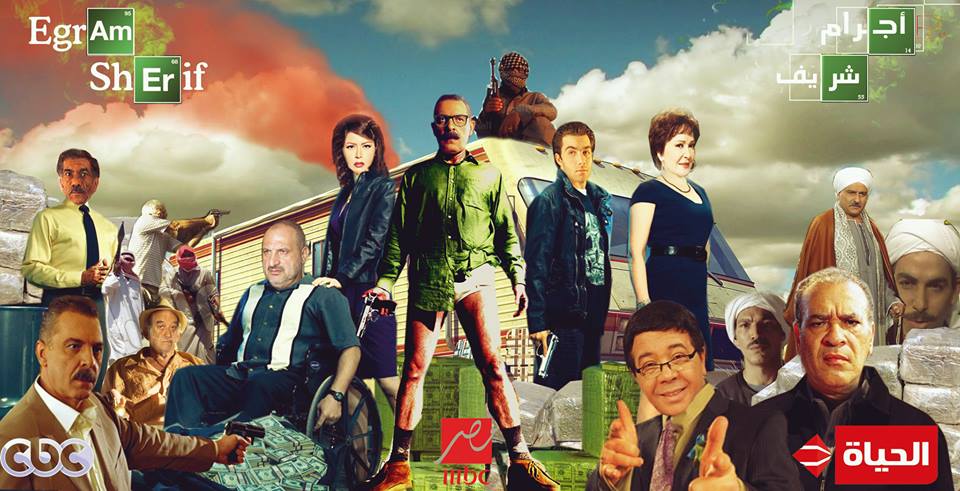
People make movies, I guess, to tell others that they exist, they see stuff and they want to see if others see it as well. Maybe what people see is just meaningless remarks, maybe what they see is a commentary on what they see, maybe what they see is nothing more than hallucinations that are not even connected or easily consumed, and all of that’s fine. But after the caveperson drew the gazelle many people must have seen it, and a lot of them might have tried drawing their own gazelles, and surely if people did nothing other than copy the first gazelle as precisely as possible since then we would have been living in a very boring world. Boring like Awlad Rizk (The Sons of Rizk) by Tareq Al-Aryan, which I didn’t mind watching on an airplane on a small screen with a bad headset and I didn’t mind that it hadn’t yet finished when the flight ended.
When the movie-watching experience ended though it made me think of things I found more interesting than the movie itself, though I put the movie’s name in the title to get people to read it, because that’s how algorithms and the economy works.

Andeel
Andeel was born in Kafr al-Sheikh in 1986. His uncle told him that his paternal grandfather was a filmmaker who made a feature film called “Horses,” which he took to…
تقارير ذات صلة

Avant-titre | Our bread, our dignity: Bread in Egyptian cinema
This episode of Avant-titre is part of Mada Masr's Bread politics, an eight-part series that takes an in-depth look at bread subsidies in Egypt in the context of recent talk…

Video | Privilege and responsibility: A letter from Carol Mansour
Carol explains why allowing the voices of others to be heard helps to make the world a better place

Video | The archivist
Over decades of collecting, Makram Salama has turned his home into a cinema archive.
Your support is the only way to ensure independent, progressive journalism survives.
You have a right to access accurate information, be stimulated by innovative and nuanced reporting, and be moved by compelling storytelling. Subscribe now to become part of the growing community of members who help us maintain our editorial independence.
Join us