
Before October 7, when the officials in charge of foreign policy in the administration of US President Joe Biden talked about their mission in public, there was often a performance of their awareness of their place as actors on the stage of history.
Of course, the United States, as the globe’s lone superpower, is a world historic actor, and aspirational comments about reshaping the international sphere are commonplace for any hegemon.
But while the Biden administration was surely partaking in this genre, it was also speaking to a deeper ideological anxiety that has been at the heart of current American politics in the last decade: is the US in decline? It is a narrative punctuated by a variety of factors: the rise of China, the 2008 financial crisis, unprecedented inflation and costly, failed wars in Afghanistan and Iraq.
For many of those that have been captured by Make America Great Again sloganeering within the US, the answer is already clear. Living conditions are abject amid soaring inflation. Wages have stagnated since the early 1980s. Outsourcing to cheaper labor markets has immiserated the average blue collar worker, both white and black. The political and economic elite, trading in fictive assets, have gotten rich by circling the globe. For those who believe in MAGA, the chauvinism of “America First” is a salve for a neoliberal world in crisis.
While Biden’s team did not mobilize the same right-wing populist rhetoric, their prognosis was much the same. “Under Biden, Washington has been committed to reversing years of decline apparently brought on by excessive favor shown to China. The US has tried to stop China’s development in tech [...] Bidenomics is Maga for thinking people,” economist Adam Tooze wrote in a recent article trying to assess US foreign policy.
The newness of the Biden foreign policy saw some of its clearest articulation just a week before Hamas breached the siege wall surrounding Gaza and advanced into Israeli-held territory on October 7 last year in an essay by National Security Adviser Jake Sullivan titled “The Sources of American Power: A Foreign Policy for a Changed World.” The essay knows that it is a kind of manifesto, the kind of writing that wants to go beyond the partisan politics of a particular administration’s four-year sprint to seep into the very pillars of establishment ethos. Peppered throughout the essay is talk of “inflection points” and preparation for a “new era.”
Sullivan’s central argument is that US foreign policy is becoming ill-suited for an evolving world. “US foreign policy,” Sullivan writes, “was developed in an era that is fast becoming a memory, and the question now is whether the country can adjust to the main challenge it faces: competition in an age of interdependence.”
“Competition in an age of interdependence” is the essay’s euphemistic way of talking about the US competition with China and the overarching focus of the essay. And for Sullivan, writing at the time, the diagnosis was simple: recreating a broader tent was the best way to ensure a power bloc against Chinese expansion.
“Officials [...] largely assumed that the world would coalesce to tackle common crises, as it did in 2008 with the financial crisis, rather than fragment, as it would do in the face of a once-in-a-century pandemic. Washington too often treated international institutions as set in stone without addressing the ways in which they were exclusive and did not represent the broader international community.”
While presented in idealist terms, Sullivan’s argument is an argument fundamentally rooted in the preservation of American power.
What is striking about Sullivan’s essay, however, over a year later, on the cusp of the end of Biden’s term in power, and after over 40,000 Palestinians in Gaza have been killed by American-supplied weapons, is how much this high-flown manifesto has given way to the exact opposite.
Sullivan’s essay is of course infamous for its ill-timed appraisal of the Middle East as “quieter than it has been for decades,” an appraisal Sullivan would scrub from the online version of the essay that was published as Israel began to bomb Gaza.
But in the initial telling of things, the region got short shrift in Sullivan’s manifesto. In the few places he does mention it, he argues that a new-fangled policy in the Middle East should focus on “deterring aggression, de-escalating conflicts and integrating the region through joint infrastructure projects and new partnerships, including between Israel and its Arab neighbors.” The crowning example of this policy, in his opinion, is the trade corridor announced during the G20 Summit last year that connects India to Europe through the United Arab Emirates, Saudi Arabia, Jordan and Israel.
Nowhere in this articulation of US foreign policy is there a politically bold if fraught proposition of the likes of a Camp David, an Oslo Accords or even the Trump boardroom theatrics of the Abraham Accords and “Deal of the Century.” No, where the Palestinian question had once been the central issue in the Middle East for decades, the issue barely receives mention in Sullivan’s policy manifesto. Palestine has been replaced by a trade corridor.
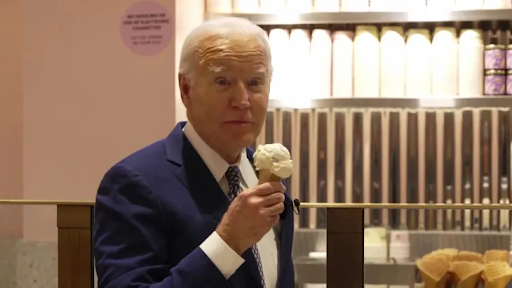
And yet, it is the genocide of Palestinians who were not even worth mentioning in Sullivan’s grand formulation that will define American foreign policy morally and pratically for decades to come. For if there is a side of American policy making that has begun to think actively about a return to “great power competition” and a preservation of resources and force for a showdown in the eastern Pacific as an end goal, the policy hammered home by Biden, a man coolly licking an ice cream from a cone while hundreds of people were killed on a daily basis, has given rise to the other, perhaps resurgent, face of American foreign policy: a belief in pure domination.
Over the last two decades, US foreign policy has navigated between these two poles. And the war on Gaza and the brutality it has unleashed has given the US and policymakers a dark path forward.
No matter who steps into the Oval Office in January of next year, whether Vice President Kamala Harris or former President Donald Trump, it is the path that the ice cream man has set as he watched Gaza burn that they will have to navigate.
***
The dual currents of contemporary US foreign policy find expression at the beginning of the century with the emergence of the War on Terror logics.
“Post 9/11, Americans, really from grassroots political opinion to well versed security policymakers, switched to this paradigm of fear and trying to preempt terrorist and militant threats to the US,” says Thanassis Cambanis, the director of Century International.
And this paradigm came with clear implications for how “security” interacted with foreign policy through the concept of the “forever war,” which Cambanis defines as “the securitization of foreign policy and the execution of a global foreign policy that is based on perpetual militarized engagement across a wide spectrum of sectors, and in most countries as a way of maintaining American security as defined as safety from ‘terrorist threats’ and an attempt to secure security through domination.”
“Traditionally I would expect major powers to seek security through cooperative arrangements — alliances, partnerships — based on the understanding that no state, no matter how powerful, can fully dominate any space, especially not an international space. So you have to find security through some kind of interactive arrangements which include shared sovereignty,” Cambanis says. “The post 9/11 framework that continues to this day has set aside that more pragmatic and cooperative approach and it seeks security through complete domination, which is not only counterproductive and impossible — it creates more of the problems that it purports to solve.”
This shift in US foreign policy created new dynamics in the region.
“After America decided it wanted to be a praetorian militaristic state, it looked to Israelis as experts in how to do this and it brought them in to help set up a forever war architecture,” Cambanis says. “It looked at what Israel was doing in the West Bank and Gaza admiringly as a model for how to set up architectures of surveillance, detention systems, torture and interrogation regimes and so on. It subcontracted the interrogation of suspects to Egypt and Syria even. There was [an] opening to human rights abusers and occupiers who had real field experience in the sort of practices that the US was suddenly newly interested in either moving into or expanding.”
Israel also benefited ideologically from this shifting ideological terrain.
While the Zionist project has been shot through with internationalism since its inception, the more recent characterization of it can be described best by the “no surprises rule,” the outcome of a long-secret 1975 letter from US President Gerald Ford to Israel, in which Ford promised the US would ‘‘coordinate with Israel … with a view to refraining from putting forth proposals that Israel would consider unsatisfactory.''
This rule effectively gave Israel informal veto power over any US proposal related to the question of Palestine, historian Rashid Khalidi writes. But more important than the existence of the rule itself is that, in many instances, the “no surprises rule” was relegated to secondary importance where it concerned matters of “Cold War strategic considerations or other important interests [that] were seen by US policymakers to be in play.”
“In such instances, both domestic political factors and the usual reluctance to confront Israel became far less salient. This was the case for the War of Attrition along the Suez Canal in 1968–70, the case for Secretary of State Henry Kissinger's mediation efforts during the 1973 war and in the ensuing Sinai and Golan disengagement agreements of 1974–75, and the case for the Israeli-Egyptian Camp David Accords and subsequent peace treaty in 1978–79,” Khalidi writes in an article outlining US-Israel relations from the 70s until the early 2010s.
But September 11 changed that calculus.
“The Bush administration bought into Ariel Sharon’s doctrine that Palestinian resistance or the Second Intifada is similar to America’s war on terror,” says Tareq Baconi, the president of the board of Al-Shabaka.
In effect, that decentered the Palestinian cause in international politics, according to an Egyptian researcher of American foreign policy toward the Middle East. “The US scholarship community had identified the Palestinian question, or the Arab-Israeli conflict, as the central issue of the Middle East for decades. But in the 2000s, the region witnessed three major events that were used by Israel to change this hypothesis: the war on terrorism, the invasion of Iraq in 2003 and the emergence of the Iranian nuclear program,” says the researcher. “Many factors helped Israel to change the narrative, including intra-Palestinian disputes, labeling resistance as terrorism and finally, the Arab Spring revolutions. The Palestinian question wasn’t a priority anymore and the Iranian deal, elimination of the Islamic State and the future of the Arab revolutions or civil wars were the new agenda items.”
Baconi agrees, saying that the equivocation of terrorism withall forms of Palestinian political mobilization as the logic of the war on terrorism spread meant that “the only Palestinian expression of self determination that was accepted was within a concept of Israeli domination and Israeli apartheid. So really, rather than sovereignty, having Palestinians confined to visions of autonomy where they exist as Bantustans or self-governing authorities under overarching Israeli rule. That focus on Israeli superiority or Jewish supremacy as prioritized ahead of Palestinian rights has been the way that the diplomatic community has engaged with the question of Palestine. Palestine just gets invisible-ized. It is removed from the diplomatic agenda.”
***
But even as a foreign policy of maximal domination played out, it began to give way to a second current: an anxiety that the US was in over its head, having fought costly wars without making headway in its stated aims and being beset by an economic crisis of its own making.
“There was a big difference in the world's perceptions of the US role and the world order it dominated between the second Gulf War to liberate Kuwait in 1991 and the invasion of Iraq in 2003. Allies before enemies rejected the American move in 2003,” the Egyptian foreign policy researcher says. “The war exhausted US resources and invited questions of its leadership, credibility, judgment ability and morality. Acting unilaterally under an umbrella of a willing coalition, the Fallujah battle, Guantanamo prison and the Abu Ghraib torture scandal harmed acceptance of the American Dream universally. The failure of the regime change experience in Iraq and leaving the country prey for Iran raised big questions about the strategic planning of the US in its world order.”
But that wasn’t just at the level of international opinion. Those inside the US also felt a course reset was necessary.
The election of Barack Obama in 2008 was, in the researcher’s estimation, a defining point for US foreign policy, as the new president “needed to deal with economic, political and moral failures that limited American hegemony.”
In 2008, the United States was in the midst of trying to rally international allies to face the economic crisis brought on by the neoliberal system. In an awareness of the failure of its initial plan, the Bush administration had been forced to scale down its Iraq military strategy in 2007.
Militarily and economically, US projection of power was wrought by crisis.
“In world politics, Obama had a broad vision to reform US relations with Muslims and restructure multilateralism with allies. The only specific goal he had was the withdrawal from Iraq before the following elections in 2012. That one specific goal was executed disastrously and left Iraq under a corrupted Shiaa regime which was the trigger of the Islamic State’s emergence in 2014,” the researcher says.
It was clear that the Middle East had become a quagmire for the US, and, by the end of his second term in office, Obama had formulated a doctrine based on a single idea: “the US does not have enough power to stretch its forces around the world, and it needs to focus on its main threat coming from the East,” the researcher says. “The pivot to Asia was Obama’s plan for [presidential hopeful Hillary] Clinton after 2016.”
To illustrate the downplaying of the region, the researcher points to a 2015 interview between New York Times opinion columnist and presidential confidant Thomas Friedman and Obama. When Friedman asked Obama, the researcher recounts, “if Iran was a threat to Arab countries, Obama responded that Middle East countries have external threats but also internal threats with their new ambitious generations looking for future prosperity. This answer reflected Obama’s vision of the Middle East as a source of problems. His intention to conduct a pivot toward Asia was serious, so he made a deal with Iran, returned to Iraq to fix what he had broken by the withdrawal in 2011, and rejected any ideas to intervene in Libya or Syria with boots on the ground, and finally made a serious bid to solve the Palestinian question.”
In many ways, the election of Trump undid many of Obama’s tenets, even as it advanced others in different ways.
The Trump administration oversaw a series of provocative moves that heightened tensions in the region and undid Obama’s attempt to pivot toward China, even as the administration tried to operate on several fronts at once, antagonizing China included.
First, Trump, in lockstep with Israel, withdrew from the Iran nuclear deal in 2018. The move was followed up by further terrorism-related decisions targeting Iran. In 2019, the Trump administration listed Iran’s elite military Islamic Revolutionary Guard Corps as a foreign terrorist organization.
But Trump was intent on continuing the invisibilization of the Palestinian cause and withdrawing from the region to allow for Israeli supremacism to reign. This took the form of the “Deal of the Century,” his economized “settlement of the Israeli-Palestine problem.”
And then, nearing the close of his term in office, Trump, with the help of the UAE, brokered a wave of normalization deals under the banner of the Abraham Accords. Sudan, Morocco, Bahrain and the Emirates all signed on to the treaty. And the UAE began working on a new regional power bloc alongside Israel and the US.
If the thought was that the Abraham Accords might fade with Trump’s departure from office, the Biden administration proved that wrong. For Matt Duss, the executive vice president at the Center for International Policy and the former foreign policy advisor to US Senator Bernie Sanders, while the Biden administration was at pains to distance itself from the Trump administration’s policies, they eventually “embraced [the Abraham Accords] as a formula for regional normalization and peace and stability, because they decided that could serve the larger goal of strategic competition. That is what is driving this Saudi-Israeli normalization deal, which is basically a US-Saudi security deal which they need to present as peace with Israel in order to sell it to skeptical Democrats.”
"All of these countries are very happy to try to get the most they possibly can from the US while trying to get the most they possibly can from China or Russia. The decision to allow China to ‘broker’ the Saudi-Iran detente was a brilliant move by Mohammed bin Salman,” says Duss. “Because he was bargaining with the US by showing he had other options, asking ‘what else you got, Biden?’ And Biden was like: let me show you."
But with the onset of the genocide in Gaza, Biden found himself in his foreign policy wheelhouse and took the reins.
“Joe Biden is the primary author of Biden’s foreign policy. He is the first president since George Herbet Walker Bush who is a genuinely confident expert in international affairs —in my view, he is often wrong — but he knows the files. He has informed opinions. He has preferred policies. He has sharpened them over decades of public life, directly preoccupied with international affairs,” says Cambanis. “On Israel and Palestine, he knows what he thinks. He is wrong. This is one of the issues he is most wrong. But he is not looking for advice nor is he advisable. He is the top authority in his administration on every major foreign policy issue. And that is a departure from modern history. He has the least interactive policy making process of any president in modern times, including HW Bush, who despite his knowledge and expertise, had an actual team of people that had real inputs.”
There are voices in the administration, Cambanis says, who represent a more nuanced approach. “[CIA Director Bill] Burns seems like a wise student of international affairs and recent history. He is certainly someone in his diplomatic career and his autobiography seems to have a keen understanding of the limits of American power, both the vastness of American power but also its limits, and the utility of multilateralism and the need to manage tensions with China in a way that is neither naive nor unduly confrontational,” Cambanis says.
But Burns is not in the president’s inner circle, according to Cambanis. “It has been Jake Sullivan, Brett McGurk and to a lesser extent Antony Blinken who have been the implementers of the president’s policy. They are not shapers of it. They don’t have independent input, much less dissenting views. They are there to be like a chief of staff implementing the principal’s views. And that is why we have had such a rigid policy since October 7. Even if you’re just looking at this in a clinical way, normally there would have been some evolution in the approach over the course of the year. And there has been none. There has been zero change, no deviation. And that’s because the president is entirely committed to the course of action that the president set.”
Not only has there been no deviation, but the State Department has directly intervened to prevent a change in course. Last week, The Washington Post reported that the Biden administration has received nearly 500 reports, some of which have reached the State Department, alleging Israel used US-supplied weapons for attacks that caused unnecessary harm to civilians in Gaza, but it failed to comply with its own policies requiring swift investigations of such claims.
Much of Biden’s concern in Gaza has been about potential PR fallouts. For example, earlier this year, amid anticipation that Israel would launch a deadly invasion into the border city of Rafah, where hundreds of thousands of displaced Palestinians were sheltering, Biden said he would withhold weapons if Israel did not show proper restraint.
“Civilians have been killed in Gaza as a consequence of those bombs and other ways in which they go after population centers,” Biden told CNN. “I made it clear that if they go into Rafah — they haven’t gone in Rafah yet — if they go into Rafah, I’m not supplying the weapons that have been used historically to deal with Rafah, to deal with the cities — that deal with that problem.”
But that was far from the truth, according to an Egyptian official in a Western capital.
“The Americans never opposed the invasion of Rafah. They just don’t want images of bloodshed that will haunt Biden during his electoral campaign and prevent them from going to Michigan,” where a large Muslim voting bloc has consistently refused to meet the president, the official said at the time. (Biden had yet to drop out of the race for reelection.)
And in a perverse way, Biden’s blinkered commitment to his own policy of force has allowed for a synthesis of the two trends in recent US foreign policy: finding a way out of American decline and pursuing continued domination.
“At a stage in which the global system is undergoing transformations that reduce the status of American unilateral hegemony and in which the status of the United States has become threatened and is now weakened, Washington has an interest in preserving its status and will continue to defend it desperately,” says Mudar Kassis, a professor at the Department of Philosophy and Cultural Studies at Birzeit University. “One of the defensive tools that allows preventing the creation of a possible environment for change or radical transformation is: wars and instability, which is exactly what prevents and helps postpone any change in the global system.”
And after over 40,000 people have been killed in Gaza and Israel has opened a new front in the south of Lebanon, killing more than 3,000 people since October 8, 2023, and displacing around one million people, American policymakers feel little trepidation about the path forward.
“The lesson that I think US policymakers are taking right now, and this is very hard to grapple with — the lesson they’re taking is that even the Americans in government now who did not like what Israel was doing have seen Israel go ahead and do it anyway without the US paying a price. And they are concluding that the US can go participate in a genocide and essentially benefit in international geopolitics, which I think is the wrong lesson, but on what basis do I think that? Because I think it is morally repugnant and awful and I don’t want to live in a world in which we commit genocide and normalize war crimes. But I can’t win the argument by saying: America has really paid a big price for doing this. Because in fact America hasn’t paid a big price. The price it has paid is to its soul. And geopolitics doesn’t operate on the condition of the polity’s soul,” Cambanis says.
“I have been hearing echoes of this argument in Washington as well with regards to Iran or Hezbollah or other scenarios where the US’s lesson from the War on Terror and from Vietnam is that it needed to apply more force, that the mistake was that it didn’t hit hard enough. This is a crazy lesson from that history, but I think that is the lesson that leading decision makers have taken.”
Any talk of great power competition, as well as the political realism it would entail then, has been superseded, by a feeling within the American halls of power that domination is at hand.
***
On Tuesday, Americans will head to the polls to elect a new president to steer US imperial power and fill the shoes of the ice cream president.
But regardless of who is elected, there is very little hope for significant change from the path Biden’s policy has set forth, the solution it has provided for the internal contradictions and logics of US power projection.
“By the time a new president is in the White House early next year, none of the crucial or for that matter chronic problems in the region will have moved an inch forward compared to where they were when Biden was inaugurated,” says an Egyptian diplomat who was stationed in a Western capital as the war on Gaza played out.
Even if Trump might want to differentiate himself from Biden, as the Egyptian diplomat says, the situation he has created on the ground has received the praise of former president’s son-in-law Jared Kushner.
“Moments like this come once in a generation, if they even come at all,” Kushner wrote on Twitter recently. “The Middle East is too often a solid where little changes. Today, it is a liquid and the ability to reshape is unlimited. Do not squander this moment. Let’s all pray for success, for peace and for the good judgment of our leaders.”
The foreign policy researcher is similarly pessimistic about the potential election of Harris, even if her election to the presidency would mean a transfer of power from what he says is the right-wing of the Democratic Party to its center.
“A Harris administration will follow policies closer to the Obama administration toward the region by trying to reactivate the nuclear deal with Iran, stop military operations as soon as possible in Gaza and Lebanon, and revive the normalization process, especially between Saudi Arabia and Israel. This may involve a degree of disagreement with the Israeli government, similar to what happened between the second administration of Obama and Netanyahu,” the researcher says. He points to potential Harris appointees Phillip Gordon, who holds “a pragmatic vision of the limits of American power” and Rebecca Leissner, “arguably Harris’s closest aid whose focus has been on tracking the impact of American military interventions,” as drivers of this new policy.
“But we should not expect an immediate change in US policy toward the region in January, as two main obstacles will prevent this change from happening,” the researcher adds. “Harris will be very careful with national security and foreign policy files, especially with her modest experience in this field, as well as her not being assigned foreign policy files during her time as vice president. The second obstacle is the realism of a number of team members who will avoid any external clash, especially with Israel, during the current period of instability in the Middle East.”
For Cambanis, there is a transpartisan convergence on the central tenets of US foreign policy that won’t change whoever is elected. “Neither Trump or Harris is interested in surrendering the idea that America is the dominant, preeminent, indispensable power. They both share that view and they both share a view that the way in general in which the US is using force abroad to pursue its interests is generally a useful cornerstone of US power projection,” he says.
But in the end, it is clear that “no one powerful has Palestinian self-determination and political rights on their agenda,” Cambanis underlines. What has happened in the last year “is a disaster for Palestinians. It is a disaster for peace in the region because you can’t have peace until Palestinians have self-governance and a state,” he says. “That’s a loss. That’s a net loss. We are not at the bottom. And I pray that this war stops before it gets worse and worse. But what has already happened is a catastrophe of the sort of proportions that is going to change the dynamics of the Middle East for many generations to come.”

تقارير ذات صلة
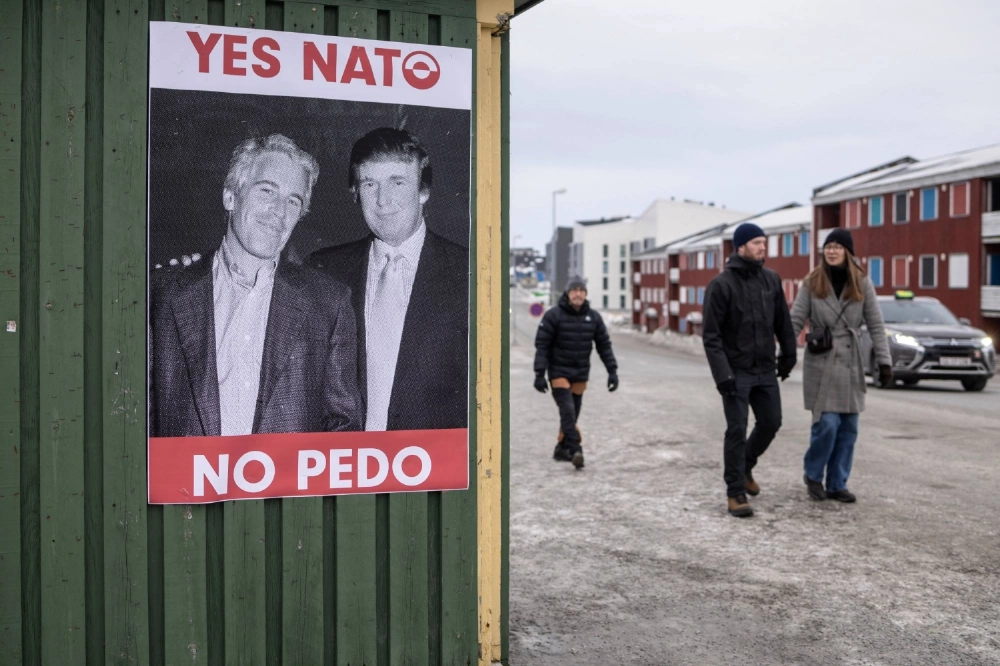
How to make friends, by Jeffrey Epstein
power begets power, even if just by association
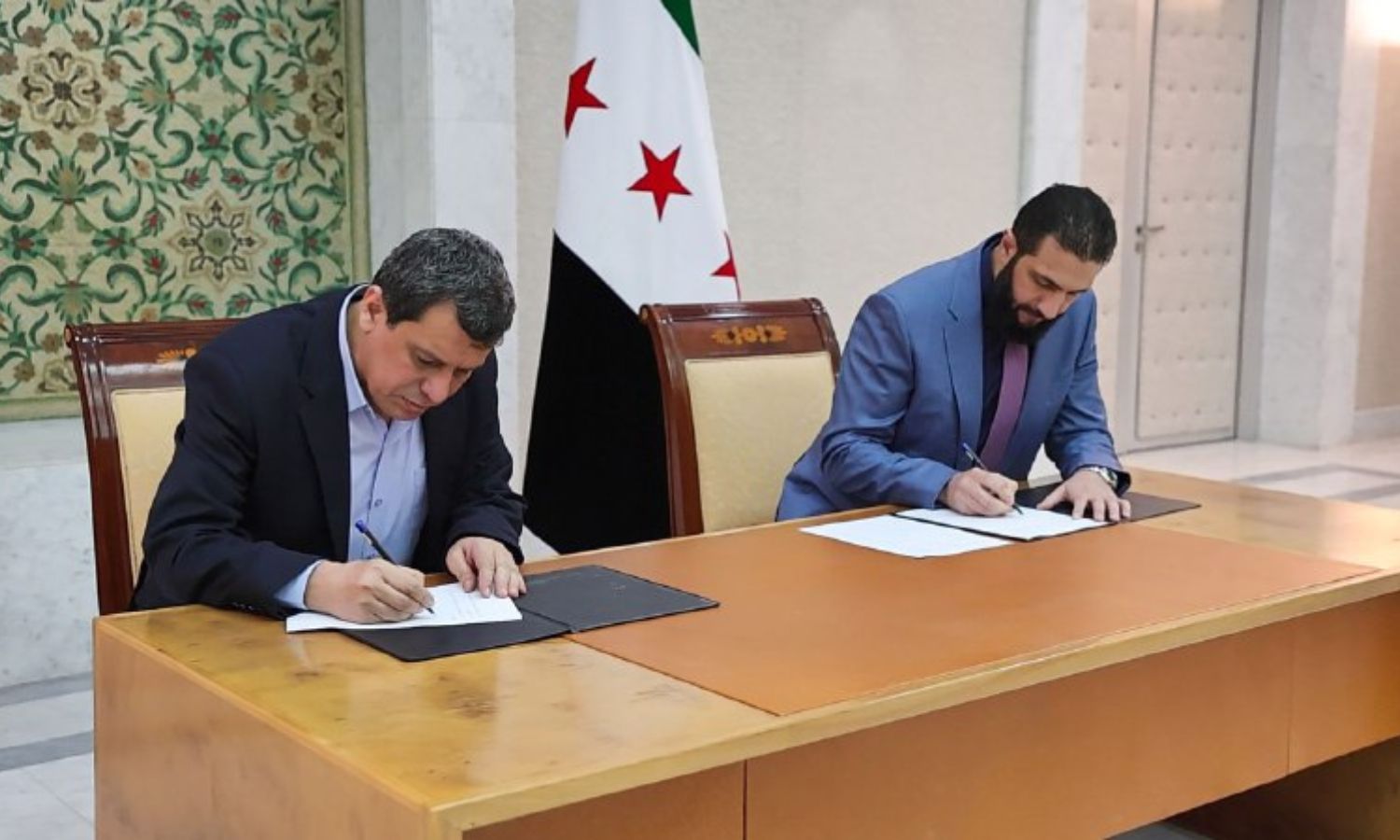
Ending ‘autonomy’: How the SDF-Syrian govt talks broke down into a fight
Mada Masr spoke with sources in the SDF, the Syrian government, Turkey and regional diplomats
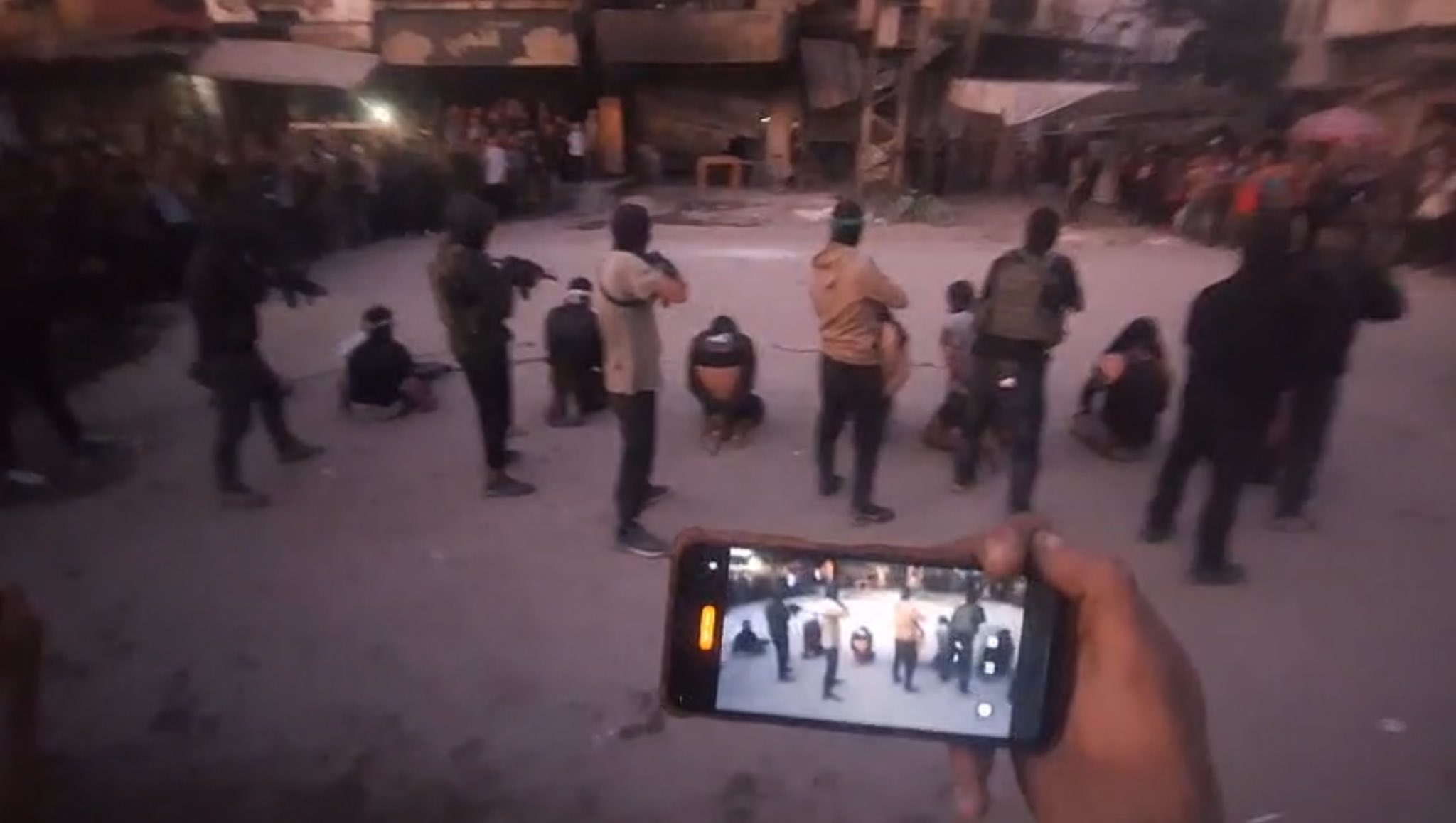
The fate of the ‘fallen’
How the ceasefire has prompted recalibration between Gaza families and Hamas
Your support is the only way to ensure independent, progressive journalism survives.
You have a right to access accurate information, be stimulated by innovative and nuanced reporting, and be moved by compelling storytelling. Subscribe now to become part of the growing community of members who help us maintain our editorial independence.
Join us