
Ending ‘autonomy’: How the SDF-Syrian govt talks broke down into a fight
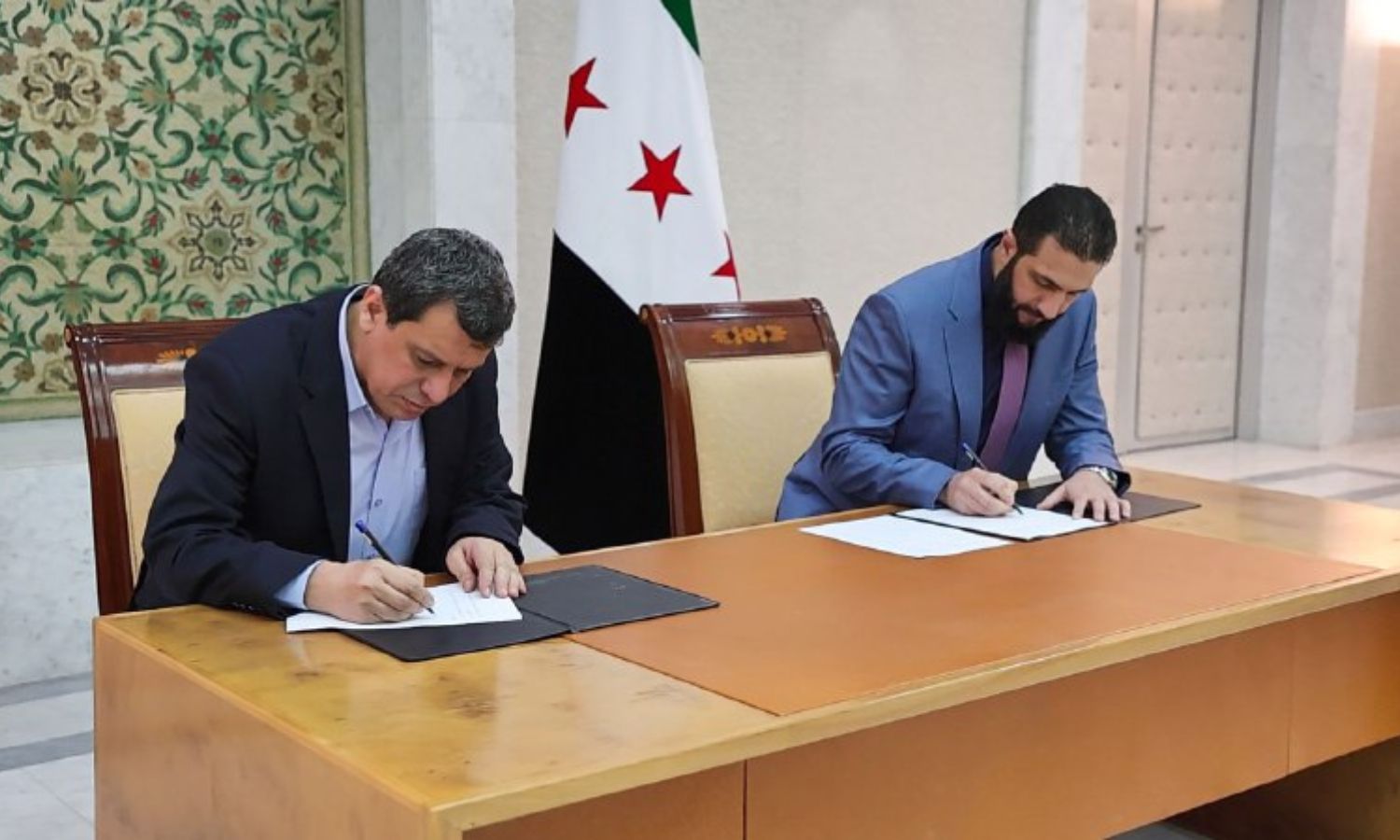
Ahmed al-Sharaa, the president of Syria’s interim government, stood before a pool of reporters on Sunday evening. He had just spent several contentious hours in a meeting with Syrian Democratic Forces head Mazloum Abdi and United States Special Envoy for Syria Tom Barrack in which the parties had hammered out a deal to bring an end to days-long clashes between the government and the SDF and integrate the Kurdish-led coalition into the central government.
By that time, the Syrian government had already made sweeping gains into SDF-held territory over the previous 48 hours. Arab members of the SDF coalition had switched alliances, clearing the way for a stunning advance. And the US, which was reportedly considering sanctions on the central government if it advanced into SDF held territory in the country’s southeast only days before, stood alongside Sharaa in the meeting.
Sharaa was brimming with confidence.
When asked by one of the assembled reporters if the agreement would end the Democratic Autonomous Administration of North and East Syria “as both civil and military institutions,” the former militant-turned-defender of national unity did not shy away.
“Certainly. The Syrian state is a unified state, and decisions are centralized. Therefore, Syrian institutions will enter every part of Syrian geography and manage all affairs in those regions. However, there are certain sensitivities in some areas. Coordination will involve security elements from the local residents of these areas themselves to ensure that no friction occurs," Sharaa said.
And Sunday’s deal matched Sharaa’s confidence.
But within 24 hours, the ceasefire broke down, and the SDF put out a call for mass mobilization to fight “the Turkish state and its ISIS-minded gangs,” and the Syrian government resumed its push into SDF-held territories.
Throughout Tuesday, fighting between the two sides ensued until another deal was struck, with the Syrian presidency announcing on Tuesday night that it had “agreed to grant the SDF four days for consultations to develop a detailed plan for the practical mechanism of integrating the Hasakah Governorate.”
If an agreement is reached, Syrian forces will not enter the centers of the SDF-controlled cities of Hasakah and Qamishli and will remain on their outskirts, with discussions to follow on the timetable and details of the peaceful integration of both cities into the Syrian state, the presidency’s statement outlined.
Under the accord, Damascus would assume responsibility for Islamic State detainees and their families currently held by the SDF, and Abdi would propose “an SDF candidate for deputy defense minister, as well as a candidate for Hasakah governor, names for parliamentary representation and a list of individuals for employment within Syrian state institutions.”
As news of the latest ceasefire broke on Tuesday, Kurdish outlet Rudaw quoted Abdi as saying that the Syrian government was still conducting intensive attacks on the city of Hasakah and its surroundings, as well as the city of Kobani.
Over the last two days, Mada Masr has spoken to sources in the SDF, the Syrian government and Turkey as well as regional diplomats to understand how the situation reached an impasse that threatens to plunge Syria back into war.
For the Kurds, sources told Mada Masr, the matter has reached existential proportions, as they read the Syrian government’s actions as nothing short of an attempt to pull apart the social, cultural and political unity fostered in northeastern Syria over the last 10 years. Meanwhile, intent on reining in the disintegration caused by the civil war, the Syrian government is in an increasingly strong position as it has made itself part of a US-led order in the region.

After the fall of Bashar al-Assad in December 2024, the SDF has maintained caution toward the central authority that took over Syria under Sharaa’s leadership, especially in light of the new government’s links to Turkey, which has long been hostile toward the Kurdish forces.
Proponents of the SDF say it was ready to integrate with the new government from day one as part of its quest to unify a country shattered by decades of civil war and Assadist oppression. Kurdish journalist Sirwan Haji Barko tells Mada Masr that after the fall of the regime, the SDF waited for the promised comprehensive national conference “because we are part of this country.”
The initial wait yielded the March 10, 2025 agreement between the SDF and the Syrian government, stipulating the integration of the former’s civilian and military institutions, while bringing the northeastern part of Syria under state control. The agreement established a ceasefire across Syria, called for the return of displaced Syrians, and affirmed the preservation of Kurdish rights. It was set to be implemented by the end of 2025, but collapsed just ahead of the deadline.
In hindsight, Barko believes, this agreement merely bought time for Sharaa’s government, while the SDF was compelled to sign by fears of violence after the massacres committed against the Alawites on Syria’s coast..
The two sides were continuing talks until January 4, according to SDF representative in Egypt Leyla Moussa, which would have seen the SDF integrated into the Syrian army across three divisions.
But, on January 6, the government reneged on the agreement, Moussa says, and instead struck SDF positions in eastern Aleppo.
Though clashes between the two sides had flared up over the course of the past year, the confrontations in eastern Aleppo represented a crescendo.
Barko says the current clashes started in eastern Aleppo, precisely in the two areas with predominantly Kurdish residents, Ashrafeya and Sheikh Maqsoud. “Neither the authorities in Damascus nor their main backer, Turkey, liked [the autonomous administration model in Aleppo]. The regime wanted to end this special status in Aleppo and remove the armed groups from it,” Barko says.
After a week of fighting, the interim government took control of the area. Syrian troops bussed dozens of people out of SDF-held areas, saying they would be taken to displacement shelters. More than 140,000 people have already been displaced by the fighting.
In a post on X, Abdi said the SDF had secured a ceasefire and safe passage guarantees for the evacuation of civilians and fighters from Aleppo’s Ashrafeya and Sheikh Maqsoud neighbourhoods to northern and eastern Syria.
In the meantime, the clashes didn’t stop in Aleppo, and the momentum spilled over to other SDF-controlled areas in the northeast.
By Sunday, the central government had already taken control of the Omar oil field, the country’s largest, and the Conoco gas field in the eastern Deir al-Zor province, dealing a major blow to the SDF’s main source of revenue.
On that Sunday, and from that position of advance by the Syrian government, talks were held with the SDF in the presence of Barrack.
A Syrian government official, speaking on condition of anonymity, says the Sunday talks focused on the future of governance in Hasakah.
“During the talks, Abdi insisted that the governorate’s administration remain in the hands of the SDF, while Sharaa noted that he could move toward a military solution,” the official says. “Sharaa offered Abdi the post of deputy defense minister and the nomination of a governor for Hasakah in exchange for distancing the SDF from the Kurdistan Workers' Party.”
A deal was reached between the two sides. It stipulated the handover of key SDF areas to the Syrian government, including Deir al-Zor and Raqqa, as well as border crossings, oil and gas fields in the region. Heavy SDF military presence in Kobani would also cease.
While previous tentative agreements in the nearly year long discussions between the two sides would have seen SDF forces integrated into the Syrian military as full units — akin to what happened with other paramilitary groups that fought in Syria’s protracted civil war — Sunday’s agreement saw that monument fall before a promise to integrate individual forces without any continued guarantee of a cohesive Kurdish-led command structure.
This was a major blow for the SDF. According to Moussa, “the SDF’s demand has always been for it to enter the military as a unified bloc, not as individuals. But the government in Damascus insists on fragmentation. In the early stages, the regime in Damascus rejected any political entity and insisted on integration as individuals, yet all factions that joined under the Victory Conference were integrated as blocs not as individuals.”
A regional diplomat informed on developments in Syria agrees. “In the case of radical militant groups, Sharaa agreed that they would be integrated as factions. But in the case of the Kurds, they will only be integrated as individuals. And this is a clear sign from the point of view of the SDF, both the leadership and other members, that whatever integration would happen would be very limited and that the Kurds will continue to be excluded even if they get some compensation every now and then.”
Moussa adds that the SDF was trying to adopt a gradual approach, in anticipation of a constitutionally backed regime in Syria, while the current government wanted a quick resolution. “The SDF’s demands are well known and clear,” she continues. “Integration can only take place gradually. Administrative, political, military and security integration would take place gradually, up until the announcement of a constitution. However, the government in Damascus operates according to a “you deliver, you receive” logic.”
Even with their main aims secured, according to Barko, the Syrian authorities, swept along in the euphoria of their victory, tried to impose conditions without guarantees and the deal broke down within a day.
Barko adds that a significant portion of residents in Raqqa and Deir al-Zor wanted the SDF to withdraw and join the government in Damascus. The SDF withdrew accordingly, remaining only in Kobani and Hasakah, where Kurds make up the majority of the population, alongside Christians and Muslims.
Defections from the SDF were reported, but were described as exaggerated by Moussa, who says that the Syrian government issued deliberately misleading information about the matter. Barko says that SDF members who defected were Arabs who chose to join the Syrian military. The fighters who stayed are primarily Kurds, with a small number of Assyrian Christians and Arabs.
The Syrian government official tells Mada Masr that the majority of Arab tribes are on the side of the state and await a signal from the Syrian government to intervene. “This came about with the launch of the military operation. The clans quickly issued statements and mobilized militarily, which facilitated the state’s work in asserting control over Deir al-Zor, for example,” they say.
***
While the SDF and interim government were locked in cycles of clashes and talks, the geopolitical situation around Syria was changing.
First, Israel had occupied new areas in southern Syria, both an expansionist move and a ploy for normalization and talks over a settlement for the occupied Golan Heights.
Sources previously told Mada Masr that Syria has been able to hide in the shadow of Saudi Arabia, which has so far refused to normalize relations with Israel, but the Syrian government has shown an appetite to move toward normalization.
According to the regional diplomatic source informed of US-Israel-Syria talks, Sharaa has gained favor with the US administration because he gave “his word that he is on board with the plan for the region. And they are confident that he is on board.”
But Washington’s doubling down on Sharaa has seen it sideline its allies from the regional order of yesterday.
For the last decade, the US’ primary goal in Syria has been the fight against the Islamic State, and, in that aim, the SDF has been its longstanding partner.
Writing in the Washington Institute for Near East Policy immediately after the fall of Assad, researcher Ido Levy gave voice to the convention in foreign policy quarters at the time. “The SDF is America’s only reliable and capable counterterrorism partner in Syria.”
Thus, Washington would need to help the group halt the advances of the Turkish-backed Syrian National Army and Hayat Tahrir al-Sham, and keep the Islamic State down, wrote Levy. “Turkey and its proxies have faced allegations of abuse against Kurdish populations, and Washington has previously sanctioned SNA figures for such crimes. Moreover, neither Turkey nor the SNA has played a major role in combating IS in Syria,” he concluded.
However, that reality changed in November of last year, when the interim Syrian government signed up to join the Global Coalition to Defeat ISIS.
This relationship was put to the test after an Islamic State gunman ambushed a US-Syrian patrol near Palmyra in December. Two American soldiers and a civilian interpreter were killed in the attack and the US launched Operation Hawkeye Strike, a series of large-scale retaliatory airstrikes against ISIS targets in Syria, in the aftermath.
In the wake of the attack, Syria’s Interior Ministry initiated raids targeting the Islamic State in several provinces, including operations it said swept up several leaders in Damascus province and in the country’s southwest.
For the regional diplomat, it is clear that “the Americans sold the Kurds out. The Kurds had to succumb and sign and to retreat on the ground.”
As recently as last week, however, the American press was reporting that US officials were prepared to reinstitute sanctions on the Syrian government if they proceeded with their advances into northeast Syria. This was followed by a statement from US CENTCOM that called on the Syrian government “to cease any offensive actions in areas between Aleppo and al-Tabqa.”
“It is no secret that the US administration was apprehensive about military action. But after negotiations and promises from the Syrian state, represented by Sharaa, as well as from guarantor states through political mobilization — particularly Saudi Arabia, Masoud Barzani and even the French president, who held a direct call with Sharaa right before the military operation — these efforts bore fruit and secured the green light, accompanied by promises that losses would be few and that no transgressions would occur,” the Syrian government source explains.
Over the course of the last year, “the SDF were backed by the US, and promises had been made to them. But over the course of this year, political mobilization led to major shifts, politically and on the ground,” the source tells Mada Masr.
The Syrian government has also benefited from lobbying with Turkey, a powerful regional ally that has fashioned itself into a key US partner on other regional files, from the post-war management of Gaza to talks on Iran and Ukraine.
The regional diplomat, a Turkish official close to President Recep Tayyip Erdoğan and the Syrian government source all say that Ankara was instrumental in securing the greenlight for the recent military mobilization in SDF-controlled areas.
“What has taken place is the result of understandings and a long process that Turkey initiated since Erdogan’s visit to Trump [in September],” the Turkish official tells Mada Masr. “Trump promised Turkey to resolve the northeastern Syria file at the lowest cost. Meaning, what happened was coordination between the Turkish, American, Erbil and Syrian governments.”
The Syrian government official confirms the coordination with Turkey, saying Ankara “played a major role in exerting political pressure on the US to scale back its support for the SDF.”
While the Syrian government official says that Damascus has not been as keen to pursue a military solution to the SDF autonomy as the Turks were, the government decided to seize the opportunity provided by clashes in Aleppo to try to force talks.
“The SDF must adapt to the circumstances,” the Turkish source says. “Global circumstances are not in its favor. Social and tribal circumstances are not in its favor. The demographic circumstances are not in its favor. Whatever cards they may have, the Turkish and Syrian governments hold much stronger ones, like pressure on Israel, the US and France.”
But if the Syrian government continues to pursue a military solution, the Kurds will fight, Moussa says. “A military solution won’t be beneficial, and Syria is heading toward civil war. The Syrian people are facing the risk of real extermination.”

تقارير ذات صلة
The New Syria, under Israeli-American construction
Syria’s future is tied to a broad regional plan, but the US and Israel are in the driver’s seat.
From Aleppo to Damascus, on how Assad fell and what’s next: An interview with Yassin Suweiha
Suweiha takes us through ten tumultuous days that began with Hayat Tahrir al-Sham entering Aleppo.
Scenes from liberated Homs
On December 7, my eyes are fixed on the TV screen and the stream of breaking news banners. The factions advanced. The factions retreated. What is happening? Where were we,…
Your support is the only way to ensure independent, progressive journalism survives.
You have a right to access accurate information, be stimulated by innovative and nuanced reporting, and be moved by compelling storytelling. Subscribe now to become part of the growing community of members who help us maintain our editorial independence.
Join us