
The fate of the ‘fallen’
On the night of October 13, a few days into a tenuous ceasefire in Gaza, videos began to flood the Palestinian telegram channels that are the main thoroughfare for information sharing in the strip.
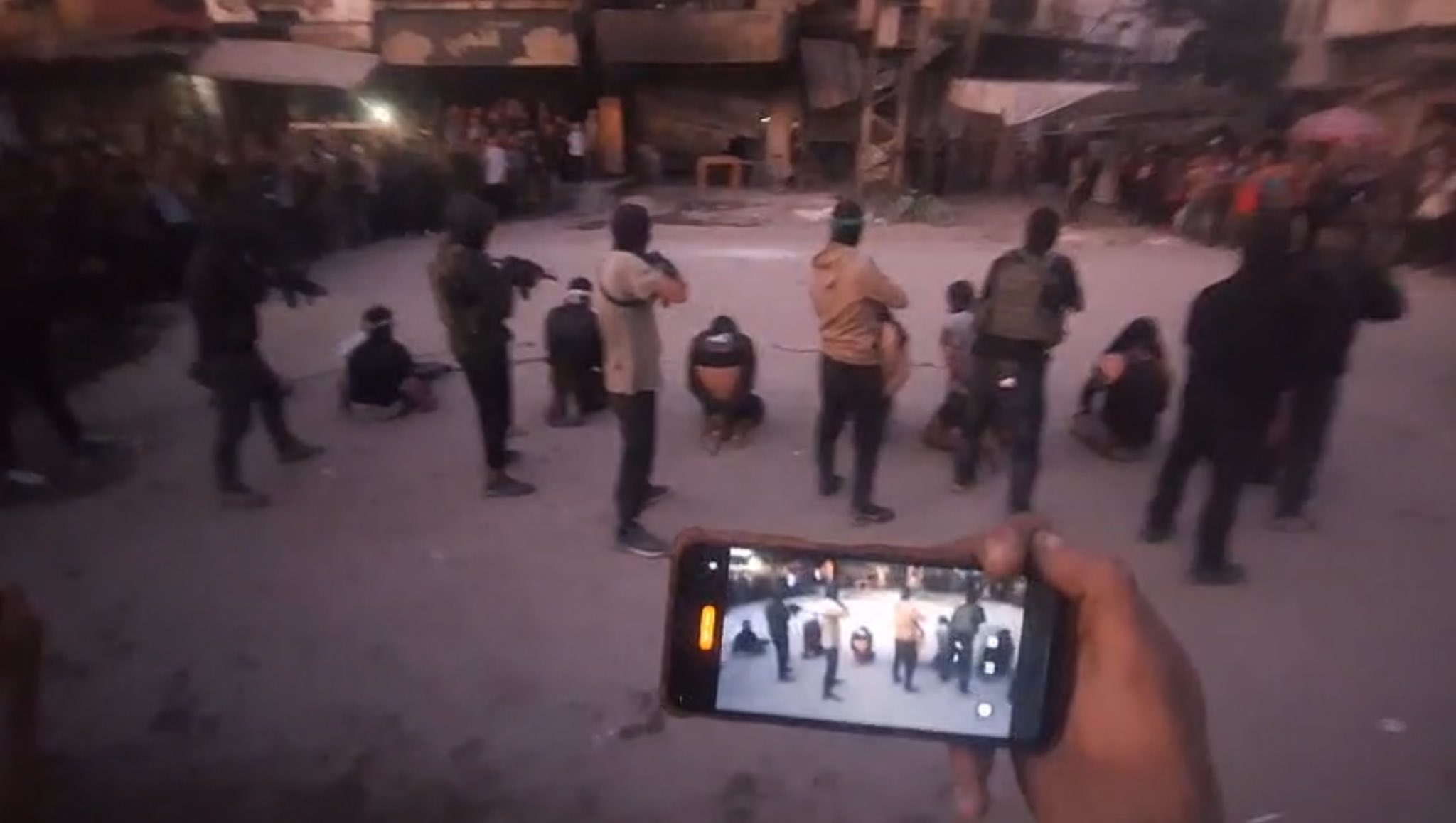
Filmed from different vantage points within a visibly assembled crowd, the videos show a dusk-lit Gaza City street. Eight people are dragged into the center of the ground, their faces covered and made to kneel in the same direction. Behind them stand men holding guns. These men are wearing black hoods underneath the Hamas green headbands.
The stage setting of the video makes it clear what is going to happen: this is a public execution. But when the sudden burst of light from the guns comes, it is still startling. The men with guns have opened fire. Those kneeling on the ground slump over, but the gunfire does not stop for a few more seconds.
As the videos are shared, a narrative begins to emerge: these are retribution killings against families that collaborated with Israel over the course of its genocidal war in Gaza. And in the public imagination, the executions are paired with mysterious clashes that erupted in the days prior that left several dead, including a prominent journalist.
This narrative eventually reaches the White House. When asked about “reports of Hamas rearming, instituting themselves as a Palestinian police force — shooting rivals,” United States President Donald Trump gave a tacit endorsement of the violence.
“We’re understanding, because they do want to stop the problems, and they’ve been open about it, and we gave them approval for a period of time. You have to understand. They’ve lost probably 60,000 people. That’s a lot of retribution. They’ve lost 60,000 people,” Trump said on October 13. “And we are having them watch that there’s not going to be big crime or some of the problems that you have when you have areas like this that have been literally demolished. You know, you have 2 million people — and probably it’ll be less than that — but you have close to 2 million people going back to build buildings that have been demolished. And a lot of bad things can happen. So we want it to be safe. I think it’s going to be fine.”
That endorsement became more explicit a few days later. “They did take out a couple of gangs that were very bad, very, very bad gangs,” Trump told reporters. “And they did take them out, and they killed a number of gang members. And that didn’t bother me much, to be honest with you. That’s OK.”
But the US line has shapeshifted in recent days. On October 18, the State Department warned of an “imminent ceasefire violation by Hamas against the people of Gaza.”
"Should Hamas proceed with this attack, measures will be taken to protect the people of Gaza and preserve the integrity of the ceasefire," the statement said.
For the US and Israel, the redeployment of Hamas across Gaza stands in stark contrast to the “disarmament” mandate outlined in the later stages of the 20-point White House plan released at the close of September, whose finer points are yet to be negotiated.
Inside Gaza, the situation is more complex. Over the course of the past week, Mada Masr has spoken to security sources of different affiliations, Hamas officials, members of prominent families and eyewitnesses in the strip to understand what has played out between Hamas and “the fallen,” members of prominent families that have cooperated with Israel.
While various sources expressed concern about the extra-judicial nature of Hamas’s violence, they characterized the movement’s actions as necessary to counteract Israel’s “partition plan” and a sign that Hamas will not be so easily displaced from the strip.
***
Days after announcing the ceasefire in Gaza, security forces affiliated with the Hamas-run government began deploying in areas vacated by the Occupation military. But they also took what a security source in Gaza’s Interior Ministry described as a “swift and necessary step:” clashing with armed groups said to be affiliated with Gazan families that have gained influence and control over parts of the strip throughout the war.
The most violent of these clashes took place in Gaza City with an armed group affiliated with the Doghmush family, one of the largest families in the strip.
After the armed group kidnapped security members, a Hamas security force surrounded the group, an eyewitness told Mada Masr. The two exchanged fire for two days, leaving several killed on both sides.
The Interior Ministry source tells Mada Masr that the Doghmush-affiliated group was responsible for massacres of aid seekers in eastern Gaza City and for looting aid trucks since Israel imposed a full blockade in March. Security forces, the source adds, had been expected to move against them as soon as possible.
The spark for Hamas’s move to settle scores with the groups, however, was the killing of the son of a Qassam Brigades field commander in Gaza City by members of the Doghmush family, just days before the clashes. The incident was followed by a wave of kidnappings and killings targeting members of other families affiliated with Hamas, prompting a sweeping security campaign that left dozens killed and led to the arrest of others wanted by the authorities.
The Doghmush family, specifically in Tal al-Hawa and Sabra, includes Momtaz Doghmush, who was previously accused in Egypt in terrorism cases. After leaving the Preventive Security Organization and Hamas, he went on to found several groups in Gaza.
The tension between the family and Hamas dates back to 2007, when, after Hamas took control of the strip, it fought fierce battles with several families seen as extensions of the Palestinian Authority’s influence in a bid to impose its security dominance. The Doghmush family was among the most prominent of these, according to the Interior Ministry source.
A source in the Palestinian Presidential Guard tells Mada Masr that Moataz Doghmush formed a small militia to safeguard the family’s power from Hamas, whose ascension to power in 2007 ended the influence of families traditionally aligned with Fatah.
This militia has close ties to security agencies in Ramallah and has always had an abrasive relationship with Hamas, even if it has never reached the point of a deadly clash, the source adds. “This family loves weapons, but Hamas has been working to seize their arms since taking control of Gaza, following the principle of keeping the strong in check to instill fear in the weak.”
“Part of the motivation for the recent confrontation dates back to 2007,” the Interior Ministry source tells Mada Masr. “Some members of the family exploited the state of chaos brought about by the war to settle old scores with the movement.”
But for a leading Fatah official, one cannot talk about whole families “collaborating” with Israel.
There are individuals collaborating with the Occupation, the official tells Mada Masr. But the idea that an “entire family” is implicated is “impossible.” Even families hostile to Hamas can’t be collectively accused of that. What unfolded recently, the source says, was a clash between the Doghmush family and Hamas, who attempted to arrest several members of the family. The clash escalated into an armed confrontation, during which around 30 people were killed and others executed on charges of “collaborating with the Occupation.”
The Presidential Guard source notes that problems often start on an individual basis and later become tribal confrontations. The source says that “individual” doesn’t necessarily mean one person, but could also be small groups within families acting on their own without formal tribal cover.
That doesn’t mean that everyone believes the issue comes down to isolated groups.
Media activist Fady al-Sheikh Youssef tells Mada Masr that it would be difficult to describe the weapons of these wartime armed groups as “family arms.” The level of armament and coordination clearly points to Israeli involvement, he says, by which it seeks to create a new security reality.
But the Doghmush family has been careful to distance itself from accusations of collaboration.
A Palestinian Authority security officer affiliated with the Popular Front for the Liberation of Palestine — speaking on condition of anonymity due to the sensitivity of the situation and his belonging to a prominent family — says that Israel attempted to recruit members of the Doghmush family who were involved in the looting of aid and homes throughout Israel’s genocidal war on Gaza. When some refused to collaborate, the Israeli military bombed around 20 of the family’s homes, according to its head Nezar Doghmush.
Doghmush, speaking to the media, said that 10 family members at most may have collaborated with the Occupation, but only three were identified by Hamas, and a tribal statement was issued to disown them. However, he condemned carrying out executions without trial, a view echoed by the PA security officer and two other Fatah sources.
Pointing to Hamas’s hasty turn to executions, Nezar noted that the eight executed on October 13 had turned themselves in only an hour and a half earlier. “Is this enough time to interrogate them and prove their involvement in collaboration?” he told Al-Arabiya.
Fatah had hoped Hamas police “would deal with suspects through legal channels — by arresting them and handing them over to the judiciary,” Monther al-Hayek, a spokesperson for Fatah in Gaza, tells Mada Masr. “Opening fire in this way does not build social peace. The security approach was flawed from the start, and the attacks were carried out haphazardly.”
Even with these criticisms, the PA source says that what Hamas is doing — despite his political differences with the group — has a measure of logic. The only group capable of enforcing security in the strip is Hamas, the source says, noting that Israel seeks to fuel internal conflicts among Palestinians so that Gaza remains a quagmire of chaos.
***
But even if the field trials that Hamas has resorted to “may lead to injustice for some of the defendants,” in the words of the Fatah leader, the hardline stance has begun to ripple through other families.
Hamas, the Presidential Guard source says, is using the ceasefire to reassert control by eliminating symbolic adversaries, sending a clear message that “if members of a prominent family rebel, they will be broken.”
In the aftermath of the clashes with the Doghmush family, several other families sought reconciliation with Hamas and the security apparatus, agreeing to hand over their weapons and surrender wanted members — including individuals from the Mujaida family in south Gaza’s Khan Younis, according to the Interior Ministry source.
The Mujaida family had previously engaged in wide-scale clashes with Hamas police forces, which ended with Israel striking Hamas positions and killing 20 officers. The source says this is clear evidence of the groups’ affiliation with the Occupation military.
And where there has not been outright subordination to Hamas, fissures have appeared among some rival groups.
One of those is an Occupation-aligned militia led by Ramy Halas.

Since the ceasefire agreement, Israel has divided the Gaza Strip into two zones: one within the “yellow line” — which it defined in the ceasefire agreement and warned Palestinians not to approach — and another outside it. Within the yellow line, Israel maintains direct control alongside the militias it has formed over the course of the war led by four figures: Yasser Abu Shabab and Hossam al-Astal in the south, and Ramy Halas and Ashraf al-Mansy in the north, according to the Interior Ministry source.


These groups operate in areas under Israeli military control and coordinate with the Occupation. They are authorized to train their members in the use of weapons, receive Israeli facilitation in accessing food and military supplies and act as parallel authorities. They also participate directly in Israeli military operations in various parts of the Gaza Strip.
According to the PA security source, Halas leads a group of 100 to 150 in the northern Shujaiya neighborhood, with their headquarters established in destroyed schools, such as the Hittin School, as well as in areas along Shaaf Street, given its proximity to the Gaza-Israel border.
The source describes the group as among the “fallen,” meaning those disowned by their families. Halas, the source adds, relies on certain figures such as Hassan Abu Ajwa, Ahmed Jundiya and members of the Harazin family to organize his militia.
After the ceasefire, a Hamas official contacted Jundiya and offered a pardon in exchange for the handing over of “spies,” the source says. Jundiya, a former PA intelligence officer, handed over three collaborators, who were then “eliminated” without their faces being shown, the source adds.
The source says this was done perhaps to protect their families’ reputations given that they did not publicly declare their collaboration with Israel and perhaps because those killed were members of Hamas, which would have faced embarrassment by the exposure.
A second Fatah source says that treason is unacceptable and unjustifiable, stressing that what unfolded for families like Halas, Doghmush and Abu Shabab was the result of Israel protecting them with the aim of spreading chaos and igniting a civil war.
The Presidential Guard source agrees, describing Abu Shabab, Halas and Astal as merely tools being exploited amid the security vacuum.
"Collaboration with the Occupation is completely unacceptable within Gazan families, even those at odds with Hamas. For them, that is a red line," a source in a prominent Gaza family says.
***
The new model of division and control, sponsored by the Israeli military seeking to consolidate it, is what prompted Hamas to act quickly after the ceasefire — an attempt, according to the Interior Ministry source, to restore security and dismantle Israel’s partition project. The source emphasized, however, that this does not necessarily mean Hamas seeks to resume governance of the strip.
Hamas spokesperson Hazem Qassem said the group “does not wish to take part in any administrative arrangements related to Gaza’s governance in the day after the cessation of the aggression.” He added that Hamas has “agreed to form a community support committee to assume governance in Gaza.”
Nonetheless, it doesn’t seem like Hamas’s exit is imminent.
The leader in Fatah tells Mada Masr that there is unannounced understanding between Hamas and the US administration that Hamas will not suddenly disappear from Gaza’s landscape.
A Hamas official based in Lebanon tells Mada Masr that Israel’s withdrawal from parts of Gaza necessitated “a party capable of enforcing the law and maintaining security.”
The movement has “the personnel capable of securing aid and its distribution, as well as securing the operations of international organizations” the official says, “and, at this stage, the party capable of enforcing order is Hamas, and clearly so.”
“Nature abhors a vacuum,” the official adds.
The question in the coming weeks, as Israeli Prime Minister Benjamin Netanyahu insists on the complete disarmament of Hamas, is whether the Occupation shares nature’s view.
تقارير ذات صلة

Gaza’s phase two arrives. Kind of …
Consensus over key questions lags behind the United States' announcement of progress.

Kings of famine
How a network of businessmen made over US$1 billion in “goods coordination”
A walk through the ruins of Zeitoun
Thaer Abu Aoun looks for any trace of the Gaza City neighborhood in the wake of Israeli withdrawal
Your support is the only way to ensure independent, progressive journalism survives.
You have a right to access accurate information, be stimulated by innovative and nuanced reporting, and be moved by compelling storytelling. Subscribe now to become part of the growing community of members who help us maintain our editorial independence.
Join us