
On December 7, my eyes are fixed on the TV screen and the stream of breaking news banners. The factions advanced. The factions retreated. What is happening? Where were we, and where are we now?
By the night of December 8, news of the factions taking over the city poured in. I switch between Al-Arabiya, Al Jazeera, and Al-Araby channels, between Twitter, Facebook, and Telegram. Everything seems surreal. The entire city’s population is in their homes. "If you drop a pin in the street, you’ll hear it ring."
The factions' takeover of Hama wasn’t easy. The clashes lasted for a week. How would it be for us in Homs? I thought it would take at least a month, given the city's size, its countryside, and especially because of its sectarian sensitivities. A friend sends me a mobile app to track the factions’ progress, but I can’t use it — my fingers are actually shaking. I return to the stream of news reporting the liberation of the northern countryside, parts of the eastern countryside, and the city's outskirts. The roar of military warplanes is relentless, accompanied by the sounds of shelling and gunfire, followed by moments of calm then broken by the sounds of intermittent gunfire.
Telegram channels announce that the city is free of regime units. It’s 10 minutes past 2 am. Mosques and men begin chanting “Allahu Akbar” while women ululate in celebration.
Only now do I believe it.
The city is finally free.
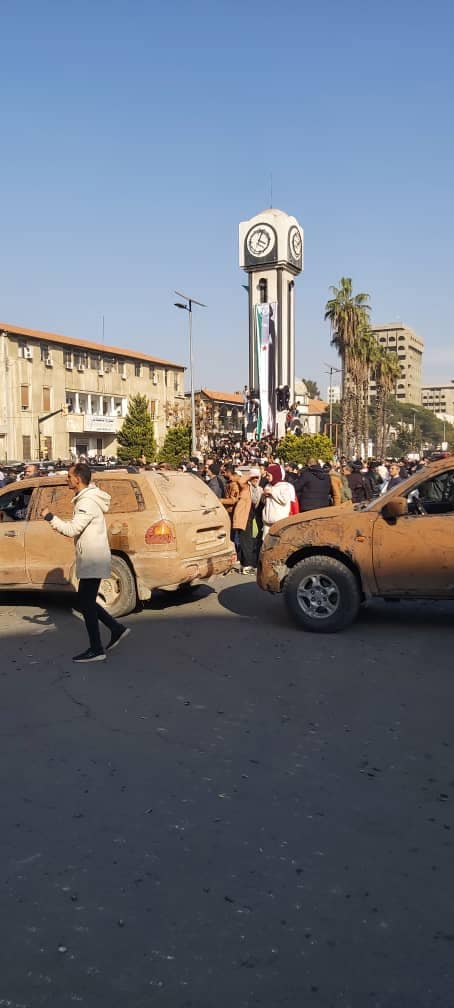
It’s now December 9, the second day since the regime fell. It’s 2 in the afternoon and I am standing in the infamous Saa Square, celebrating with the people for the second consecutive day. I look around and see armed militants carrying weapons, which I know by no other name than "Baroda." We smile at them and give the victory sign. They smile back and return the gesture. A few are masked, but most show their faces. People gaze at them and men hug them, saying, "May God grant you victory. We were waiting for you."
Militant cars pass by, and I, for my part, give them the victory sign. A car with Aleppo plates stops, and one of the militants asks me and the people beside me if we are happy that they are here. We respond positively with a wide smile, and the militant returns the smile, telling us that if we don’t want them here, they will immediately return to where they came from.

Everything seems too perfect, but is it really?
I look at the city’s new clock — broken but adorned with the revolution’s flag. A woman tells another, who is chanting against Bashar al-Assad, “Hush, they’ll hear and arrest you.” She then bursts into laughter until she starts crying — an indescribable fear, the pure kind of terror.
A satirical post on Facebook says, "Imagine if what we’re living now is a lie and they arrest all of us." The prisons: one of my deepest fears. I was always ready to die, but not to be taken into one of those prisons — many others like me felt the same.
I walk a little, moving away from the celebratory center. The security centers of the city cross my mind, all of which have fallen into the hands of the militants, the closest to me now being the State Security Center. As I approach the center, a shiver runs through my body, and I feel the urge to cry. One day, my mother was called in for questioning. After spending an entire day in an isolated room and then being interrogated for two hours, she came out. The reason? A relative of hers was wanted by security. In front of the gates sits a militant in a military uniform with friendly eyes. I ask him if I can enter. His eyes smile before his mouth as he says, “It’s denied, sister, but try your luck and ask those inside.” Trembling, I step into the hellish building. A few meters in, I come across a military vehicle with three militants inside. They ask me what I want. I closely examine their faces, especially their eyes, searching for the evil I was used to seeing in those who once stood in their place. I tell them I want to take a tour. They politely apologize, saying, “Trust me, you don’t want to see what’s inside.” I leave the damned place and walk away, unfazed by their rejection. At this moment, I am simply not ready to enter.

I walk back home, tears streaming down my face. Revolutionary songs play from passing cars, and the revolution’s flags adorn the shops. Ahead, I see a huge picture of Bashar al-Assad placed on the ground for passersby to step on. I step on it too, and something inside me trembles. I glance around to see who noticed. Many had. Has the fear truly been broken? Has the fear of more than 50 years been broken?
I continue on my way home, my gaze empty, lost in thought about everything that has happened — the celebrations, the militants, the prisons, the security centers, freedom, freedom, freedom. I hear someone call my name from the road. I think I’m imagining it, but then I hear it again. I turn around and see a young, skinny, dark-skinned man. He asks if I remember him. I don’t, so I lie, saying I do, so that I don't hurt his feelings. He tells me he’s coming back from Idlib and congratulates me on the independence. He says we’ll meet again soon, and I promise him we will. Many displaced people from northern Syria are flocking to the city. I watch people hug each other happily and greet one another without even knowing each other. Everyone is joyful and hopeful. But we are also still fearful.
تقارير ذات صلة
Ending ‘autonomy’: How the SDF-Syrian govt talks broke down into a fight
Mada Masr spoke with sources in the SDF, the Syrian government, Turkey and regional diplomats
The New Syria, under Israeli-American construction
Syria’s future is tied to a broad regional plan, but the US and Israel are in the driver’s seat.
From Aleppo to Damascus, on how Assad fell and what’s next: An interview with Yassin Suweiha
Suweiha takes us through ten tumultuous days that began with Hayat Tahrir al-Sham entering Aleppo.
Your support is the only way to ensure independent, progressive journalism survives.
You have a right to access accurate information, be stimulated by innovative and nuanced reporting, and be moved by compelling storytelling. Subscribe now to become part of the growing community of members who help us maintain our editorial independence.
Join us