
The New Syria, under Israeli-American construction
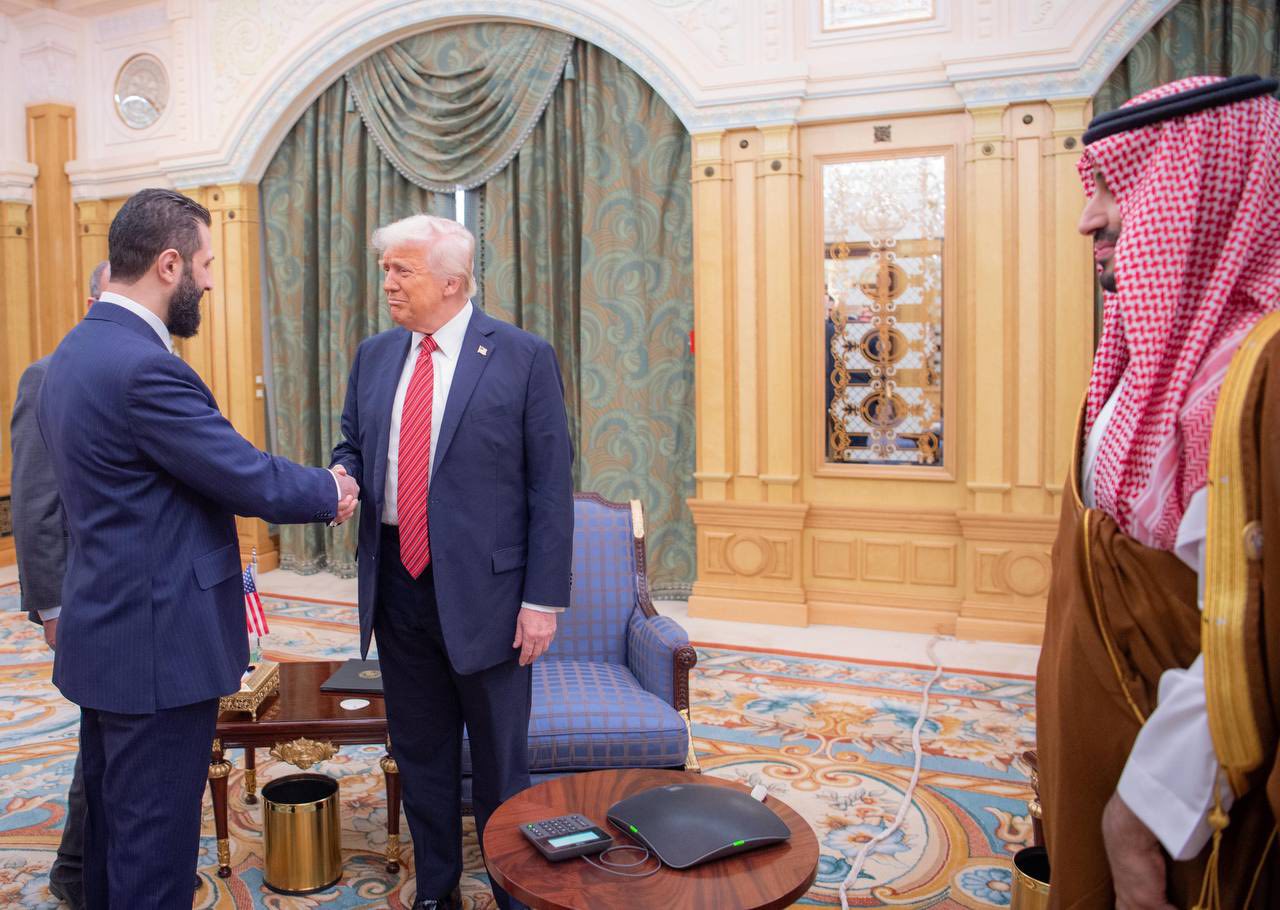
With a shake of a hand in the Saudi capital of Riyadh in mid May, Syrian Interim President Ahmed al-Sharaa completed his political transformation.
Gone was the man who once had an American bounty of US$10 million on his head. Gone was the moniker that had marked his existential opposition to Israel, his diluted jihadi branding, itself the rebrand of a rebrand.
Sharaa was now a man who could stand in front of the US president, shake his hand and discuss the “New Syria” after decades of civil war, sanctions and authoritarian rule had fractured and immiserated the country.
And like him, Syria seems to be on the pathway to being born anew. Gone are Iranian and Lebanese commandos and Russian jets. Gone is the ruthless tyrant, son of a ruthless tyrant, and his henchmen. And now, Syria has relief from the sanctions that decimated its economy for so long.
But the line dividing the old and the new is not so easily made.
After Sharaa met US President Donald Trump during the American leader’s glitzy, made-for-TV tour of the Gulf, he took to national television to celebrate Trump’s verbal promise to lift sanctions but also to underscore the hurdles facing the transition.
“The window of hope overlooks and supervises a promising future. However, Syria is burdened by the weight and sorrows of the past,” Sharaa said.
In his address, Sharaa made it clear that the solution to Syria’s ills would be a mix of coexistence but also, crucially, a sharp pivot toward a free market economy after years of Syria existing as a pariah state.
“We welcome all investors from our people at home and abroad, as well as our brother Arabs, Turks and friends around the world, and we invite them to take advantage of the opportunities available in various sectors,” the interim leader said.
And the money has begun to flow in, at least in promise. Emirati port operator DP World pledged $800 million to develop Tartus port. Saudi Arabia and Qatar have paid Syria’s debt at the World Bank, clearing the way for a new debt cycle. A host of other investors are practically salivating to bring money back into the country.
Sharaa enjoyed a lavish Gulf tour, “living his best life,” as some commentators noted.
In the high of the moment, and after repeated encounters with the Americans and mixed signals from the Israelis, Sharaa misread the messages and thought he was greenlit to take control of all of Suwayda, the city tucked away in the country’s south with a population predominantly made up of Druze, according to multiple sources.
And thus in just a few weeks’ time, Sharaa’s high of highs came crashing back to the earth.
On July 11, clashes broke out between Bedouin tribesmen and Druze figures on the Damascus-Suwayda road. This was exactly the pretext that the Sharaa government had been looking for to move into the governorate as peacekeepers and impose de facto control over the southern city that had seen autonomy during the Syrian Civil War.
But what followed was a significant escalation of violence. Government troops have been shown to have been implicated in extrajudicial killings, often filming the attacks as threatening messages to those who don’t fall in line.
By July 16, Israel began bombing Syrian forces in Suwayda, declaring that they would protect the religious minority from the overreach of the new government. Underscoring the fast evolving situation, a video of men standing atop a building in Suwayda raising an Israeli flag went viral.

"Damascus ignored repeated Israeli warnings to withdraw. Sharaa feared that the withdrawal would be seen as a humiliating retreat. Instead, he doubled down. Israel responded in turn,” says a Druze source from Suwayda. “[Sharaa] appears to have overestimated the strength of pro-government Druze factions, while underestimating the support of anti-government Druze leader Sheikh Hikmat al-Hijri. He may have received poor advice from his defense and foreign ministers, who were eager to make quick gains in their positions.”
While Israel and Syria did reach a ceasefire on July 18, the transitional government has continued to impose a siege on the governorate. “While a small number of Syrian Arab Red Crescent food deliveries are being allowed to enter Suwayda, most humanitarian convoys have been turned away by Damascus-backed fighters, particularly along an officially designated ‘humanitarian corridor’ between Busr al-Harir in eastern Daraa and Dour in western Suwayda,” writes Syrian civil society organization Etna.
“The crisis [in Suwayda],” the Druze source says, “has revealed the limits of Sharaa's state-building project. His strategy of integrating minorities, not through political means, but through coercion, is drawing international scrutiny. What was intended to assert sovereignty has damaged his credibility abroad. The already deep skepticism of the Syrian Democratic Forces (SDF) in Damascus has deepened. In Ankara, frustration is growing: Turkish officials believe Sharaa's mistake has given Israel a pretext to expand its political and operational influence inside Syria."
Today, gone is the cautious and deliberative approach toward national unity of those early months, replaced by a much more callous stance from the transitional government.
How did we get here?
Much of the answer rests on the complex web of relations that have slowly engulfed the new Syria, the web of relations that has downplayed the once prominent Turkish influence immediately after the fall of Bashar al-Assad and, according to several sources, seen a push toward Syrian-Israeli normalization and a settlement to the occupied Golan Heights. For one regional diplomat, it is clear that Syria’s future is tied to a broader regional plan that is being negotiated in parallel, between Jordan, Lebanon, Gaza and the Gulf, and it is the United States and Israel that are in the driver’s seat.
In recent months, Mada Masr has spoken to regional diplomats, sources from Turkey and political actors across Syria to understand the fight to secure the position of architect of the New Syria from foreign parties and local actors alike.
***
Almost as quickly as the fixtures of the old Syria began to crumble late last year did Israel, the spearhead of the broader plan for a New Middle East around which the US and several Gulf countries have gathered, begin to assert itself.
On December 8, hours after Assad was forced out of the country, the Israeli military moved into the buffer zone between the occupied Golan Heights and Syria, which was created by the 1974 Agreement on Disengagement between the two countries.
“Together with the defense minister, and with full backing from the Cabinet, I directed the IDF yesterday to take control of the buffer zone and the dominant positions near it,” Netanyahu said while visiting the occupied Golan Heights on December 8, announcing that the 1974 deal had “collapsed.”

While Netanyahu claimed that the move would be “temporary until a suitable arrangement was found,” by mid February, Israeli officials were saying that they planned to stay in Syria “indefinitely” and acknowledged that they had built nine military posts in the buffer zone. Satellite imagery shows that they have also built watchtowers, prefabricated housing modules, roads and communication infrastructure throughout the buffer zone.
But Israel also moved beyond the buffer zone. Israeli officials said it is necessary to create a "sphere of influence" extending 60 km into Syria, under Israeli intelligence control, to monitor and prevent potential threats from developing.

In addition to bombing more than 500 sites across Syria, including the capital of Damascus and the port of Latakia, Israel also began to expand its ground invasion into the Daraa countryside, to create a new 15 kilometer security zone. In early April, Israeli troops moved into the forest of the Jbeiliya Dam, about 8 kilometers into Syrian territory from the UN buffer zone, and began shelling the area, killing at least nine people, according to the Daraa governorate.Civilians from the city of Nawa and nearby villages confronted the Israeli incursion, but the raids on villages continued, with Israeli forces detaining residents and destroying agricultural land.


For Israel, its offensive was as much an opportunist military campaign to seize land and establish an extended "buffer zone" as it was a mechanism to open renewed diplomatic negotiations toward varying strategic aims. These aims range from determining new rules of engagement with Turkey — a primary backer of the new Syrian government — and recasting the 1974 agreement to weakening any new Syrian government and pushing for normalization between the two countries.
Read more about Turkey's role in supporting the ouster of Assad and its plans for the New Syria here.
First was Turkey. As the pace of the Israeli attacks continued unabated after the ouster of Assad, several diplomatic pathways emerged, the most public of which have been the talks between Turkey and Israel in the Azerbaijani capital Baku aimed at creating a “technical mechanism” to reduce “unwanted incidents” in Syria.
According to a former Syrian diplomat, the Israeli attacks in the south of Syria are in part driven by a concern about Turkey’s potential influence near Israeli-held territory.
“After Iran's withdrawal from Syria, Turkey is looking to fill the vacuum by striking understandings with the new leadership in Damascus,” the diplomat says. “This Turkish trend is worrying for Israel, which believes that Ankara's influence, even if directed against Iran, will give Sunni political Islam a foothold near the Golan Heights.”

According to the former diplomat, Israel is trying to create a demilitarization zone in the south of Syria extending from Suwayda and Daraa to Quneitra through coordination with Druze leaders in Suwayda. This would prevent any Turkish military or factional presence near the Golan Heights and bide time until Israel can find a reliable local partner in the future as an unofficial line of defense, the diplomat says.
This concern was echoed in Israel.
Writing for an Israeli think tank focused on “Israel’s northern border with Lebanon and Syria,” authors Tal Beeri and Boaz Shapira spell out the concern in blunt terms in a March article: “A scenario in which Turkish Air Force jets operate in Syrian airspace against Israeli Air Force jets is a possible one.” And in equal measure, they proffered a threat: “Israel must set the rules of the game in the region. Any threat to Israel’s security will be met with an independent Israeli response, and other ‘players’ must take this into account. They, in turn, need to manage the risks concerning this Israeli principle,” they wrote.
For Turkey, Israel’s military attacks upset its own designs for the "New Syria," which it saw as a way to extend its own economic influence and help solve what it sees as a "refugee problem."
A Turkish political source close to the Turkish presidency told Mada Masr earlier this year that Turkey could see Syria as nearing a phase of reconstruction and Ankara wants to facilitate the return of refugees. Thus, the country needs a climate of stability. "This requires an end to the repeated Israeli escalations. From this perspective, Ankara may be a gateway to bringing the views of Damascus and Tel Aviv closer," the source said at the time.
But where stability is the gateway for Ankara's designs for Syria, instability is the gateway for Israel.
For another way Israel's military offensive can be understood, according to the Syrian diplomat, is through the prism of the "cantons plan," which would see Syria devolve into a series of federal states.
Discussing a paper written before the ouster of Assad on Syria's "cantons" formed during the civil war, researcher Michael Young defines a canton as "a space that lies beyond the control of the center, in other words the regime in Damascus, and necessarily has channels to the outside world. This includes, for instance, access to cross-border humanitarian aid and to global markets."
Equally, "the canton is very much part of a broader regional security framework, at the expense of the national framework," Young says, pointing to Hayat Tahrir al-Sham-ruled Idlib and the Kurdish-dominated Autonomous Administration of North and East Syria (AANES) as examples.
In January, reports emerged in the Israeli press that Israel was mulling calling for an international summit that would divide Syria into cantons.
The canton "approach serves Israel's strategic interests by weakening the central Syrian state and transforming the country into a mosaic of competing entities unable to pose a future threat to Israel," the diplomat says. "With some international and local powers now adopting federal or decentralized models, Israel believes the time is right to apply military pressure to consolidate this model, particularly in the south, as a first step toward sharing influence and ensuring secure borders to strengthen influence in the northeast with the Syrian Defense Forces."
Aware of the fragility that Sharaa's government faces from the multiplicity of actors vying for control, however, Turkey has worked to strengthen the central government by using its own political card with Kurdish political factions to try to bring a close to any fragmentation of the Syrian state, even if it sees Erdogan drop a long held ideological mainstay.
Underlining Ankara's seriousness, the first foreign visit to Syria after the fall of Assad came from Turkish intelligence chief Ibrahim Kalin in December. A Turkish political source informed of the aims of the visit told Mada Masr at the time that Kalin was looking to provide state-building assistance to the transitional government while also addressing Ankara's longstanding concerns about armed Kurdish groups in Syria. Turkey, the source said, has opened discussions with US-backed Kurdish forces and the US in an attempt to facilitate Kurdish disarmament and integration into the Syrian military in return for civil liberties. If those talks fail, however, Turkey is prepared to take the matter into its own hands, the source said.
These efforts came to a head in late February when jailed Kurdish leader Abdullah Ocalan called on the militant Kurdish Workers Party to lay down its arms and dissolve itself as part of a bid to end a four-decade long conflict with Turkey’s government.
Speaking after Ocalan's announcement, a senior military source with the SDF told Mada Masr that “Turkey was quick to negotiate with Ocalan for Turkey’s political interests in Syria and not to effect any real political reform vis a vis the Kurdish question in Turkey. Ankara wants to put pressure on the SDF and the Kurdish question in Syria to contain it. This is the reason behind its negotiations with Ocalan.”
And right in lockstep, just two weeks after Ocalan's announcement, Sharaa and Mazloum Abdi, the commander of the SDF, signed an agreement on the integration of the Kurdish forces into the Syrian state apparatus.

However, little progress was made on the ground after the deal as both sides are making the integration and disarmament deal contingent on further shows of good will.
On the Kurdish side, the SDF is skeptical Turkey will make good on its promises, let alone Syria. “We are hopeful today, after the dissolution of the PKK and with the Kurdish-Turkish agreement, that Turkey would grant us cultural and political rights, in addition to releasing dozens of imprisoned Kurdish members of Parliament. Will Turkey actually implement this?” an SDF official in the organization’s Cario office told Mada Masr.
On the other side, Turkey has the intention of acknowledging their cultural, humanitarian and political rights, but makes it contingent on disarmament and ensuring that no factions or militias operate within Turkey, where only the military holds authority, not factions, said a Turkish parliamentary source. For Turkey, Kurdish politics must subordinate itself to the Syrian and Turkish nation-states rather than pursue its own homeland.
This is a major roadblock for many in the SDF, who still hold onto a model of governorance that will see significant decentralization. "I believe that it is still a little early to talk about the dissolution of the forces in Syria because we have one demand, which is the establishment of a decentralized authority for the Kurds in northern Syria," the SDF military commander says.
Nearly three months after the agreement was signed, Turkey's patience was wearing thin.
In a meeting between Sharaa and Erdogan on May 24, the two sides discussed the formulation of a common vision to end "the ongoing threat" posed by the Kurdish forces to Syria's territorial integrity and Turkey's national security, through direct field and security coordination, says the source close to the Turkish president.
***
Speaking after a round of technical talks in Baku in April between the Turkish and Israeli negotiating teams, Turkish Foreign Minister Hakan Fidan tried to downplay what was on everyone’s mind. "Of course, it is normal to have contacts at the technical level to establish [a deescalation mechanism]," he said. But, Fidan added, this did not mean there would be a normalization in ties strained over Israel's war against Hamas in Gaza.
But in reality, normalization between Syria and Israel and the benefits of being the party to facilitate it is one of the main prizes for all diplomatic parties vying for control in the “New Syria.”
And this was no different for Ankara.
The political source close to the Turkish presidency said that Ankara believed Turkish-Israeli understandings could later develop into peace negotiations between Syria and Israel under Turkish and American auspices.
But Israel’s invasion into the south also allowed it to decenter Turkish influence in another way: by multiplying the mediators at the table for normalization.
Enter the Gulf.
The first inlet for the Gulf came in Israel’s insistence on revising the 1974 agreement on the demilitarization zone established under UN monitoring.
According to the regional diplomat, Israel wants a deeper disarmament line than the 1974 agreement stipulates, and Syrians want an end of attacks and a retreat of all Israeli forces that have crossed into Syrian territory since December 8.
In a way to chip away at Turkish influence, the Israelis declined to allow Ankara to mediate the talks on the revision of the agreement, the diplomat says. Syria, in turn, declined to have the UAE mediate the talks. And in the end, both sides agreed to have the matter handled by Saudi Arabia and Qatar.
This was the first of several wins for the Saudis over Turkish influence.
While there were whispers in activist quarters as early as April that a Syrian delegation would travel to Saudi Arabia to meet with an Israeli delegation that would be present for Trump’s planned visit to the region, in the weeks leading up to the visit, Sharaa and government officials began angling for a one-to-one meeting between the two heads of state. The pitch included promises for a Trump Tower in Damascus to hosting Jonathan Bass, a pro-Trump Republican activist and CEO of Argent LNG, a natural gas company based in Louisiana, to discuss developing the country’s energy resources with Western firms and a new US-listed Syrian national oil company.
In the weeks leading up to the US summit, it was clear what the US and Israel wanted: normalization between the Syrian regime and Israel.
For countries with sway in Damascus, the question was who would take the lead.
The United Arab Emirates, the architect of the Abraham Accords, was and is applying significant pressure to bring about normalization. The regional diplomat says that the UAE has offered significant financial support and to rally other countries to invest in Syria in exchange for normalization. And to that point, Sharaa has shown a willingness to consider the deal, the diplomat adds.
Qatar has also made itself a pliable trojan horse for Israeli gas — de facto economic normalization — signing a tripartite agreement with Syria and Jordan under which Qatar will supply Syria with gas shipments "through Jordanian territory," according to the Qatar Fund For Development. But Qatar cannot feasibly provide gas to Syria due to the limitations of the current pipeline infrastructure, according to industry expert Mona Sukkarieh. Currently, Sukkarieh explains, gas is flowing from Israel’s Leviathan field to Rihab in Jordan and then southward to Jordan’s power stations and onward to Egypt, where some of it is used in Egypt’s national grid and some is exported. It would thus be impossible for Qatari gas to flow northward from the floating storage regasification unit in Aqaba, because gas can only flow one way at a time. Instead, the only place gas could be redirected to Syria would be at the Rihab station in northern Jordan, “which means gas will effectively flow from Israel, not from Aqaba,” Sukkarieh says.
There has even been direct Syrian-Israeli coordination, which the regional diplomat acknowledges has happened and which has become an open secret with the return of long-dead spy Eli Cohen’s belongings to Israel in a bid to ease Israeli hostility.
But it was ultimately Saudi Arabia that was able to cement itself as the key interlocutor for both sides.
According to the regional diplomat, early talks for the meeting between Trump and Sharaa would have seen the two leaders convene in Turkey. But Saudi Crown Prince Mohamed bin Salman intervened, promising Turkish President Recep Tayyip Erdogan economic aid and the ability to host talks between Ukraine and Russia, after Riyadh hosted the last round in March.
Saudi Arabia also secured a promise from Turkey to rein in its economic ambitions. According to a Syrian government official, Ankara cleared the way for Gulf investments in southern Syria, contenting itself with Aleppo, where it will look to continue to repatriate Syrians living in Turkey and Syrian factories currently operating in the Turkish city of Gaziantep. “What concerns Turkey, today, is primarily the city of Aleppo,” the source says.
But whatever role Saudi Arabia was playing behind the scenes came right out in the open by the time Sharaa and bin Salman were shaking hands with the US president looking on.

It was Saudi Arabia, a Syrian political source, close to Hayat Tahrir al-Sham, says that those in Damascus were calling “Washington’s reconciliation Godfather.” Keen to cement a lucrative defense agreement with the kingdom, long thought to be the carrot to induce Saudi-Israeli normalization, the US was willing to accommodate what the regional diplomat says was a desire to be seen “as the card holder of the Syrian situation in the region.”
And that accommodation went so far as securing a promise from Trump to lift all sanctions on the Syrian regime, the regional diplomat adds — a promise that bucked a widespread belief in the American capital of a “cautious, incrementalist approach."
For Sharaa’s government, weak as it is, a turn to Riyadh allowed them to hide behind the much more powerful actor in Saudi Arabia, who has thus far refused to accept a move forward with normalization with Israel.
“It's no secret that the US intends to encourage Saudi Arabia to join the Abraham Accords convoy alongside the UAE, Bahrain and Morocco. Trump extended this invitation directly to Sharaa,” the Syrian political source said after the Trump-bin Salman-Sharaa threeway. "But Syria is, at this stage, unlikely to move into normalization agreements until Saudi Arabia — Washington and Damascus’s reconciliation godfather — does so first. And Syria will not be alone — Lebanon must be with it. There’s no normalization without Lebanon.”
***
Even without the grand announcement of normalization that many thought would come from the Trump-Bin Salman-Sharaa meeting, the post-Riyadh landscape marked a turning point for the transitional government. It now firmly found itself in the same grey area that Saudi Arabia — which has maintained de facto political and economic normalization with Israel for years — has held for years in dealing with Israel but in a much more vulnerable position.
This could be seen most clearly in the Suwayda clashes.
A Syrian governmental source and a source from the Druze community both say that the outbreak of violence there was the result of a “misunderstanding” about confidence-building measures between Israel and the transitional government about moving into Suwayda to consolidate control.
According to the government source, Syrian and Israeli officials held in July a face-to-face meeting in the Azerbaijani capital of Baku, which focused on the possibility of reaching a future peace agreement. At that meeting, Syrian transitional authorities proposed resuming the 1974 ceasefire agreement, along with a series of confidence-building measures, as a prelude to a comprehensive peace agreement over five years.
"Israel rejected this framework, insisting that the 1974 agreement was now null and void. It demanded a new security arrangement that would include an Israeli military presence beyond the Golan Heights for a transitional period of five years. Israel also pushed for quiet normalization similar to its agreements with the UAE, Bahrain and Morocco, including the opening of embassies and trade relations,” the source says.
However, transitional authorities categorically rejected these conditions.
Despite the stalemate, the Syrian delegation suggested the possibility of further progress if Israel reciprocated the confidence-building measures already offered by Damascus, including the transfer of intelligence files on executed Israeli agent Eli Cohen and the withdrawal of heavy weapons from southern Syria. “They specified that Israel must give the transitional authorities the green light to fully integrate Suwayda into the Syrian state structures and Israel agreed," the source says.
A Syrian source from the Druze community in Suwayda echoes this account. "President Ahmed al-Sharaa believed, after repeated meetings with the US envoy and the Syrian-Israeli meeting in Baku, that Israel had given him the green light to take control of all of Suwayda," the source said. "President Sharaa believed that strong US support, particularly in the wake of US Special Envoy for Syria Tom Barrack's recent statements regarding the future of the SDF and his rejection of federalism, would protect him from a violent Israeli reaction.”

When Israel began bombing Syrian forces in Suwayda, it became clear that it did not intend to honor its pledge to allow Syrian forces to enter Suwayda, either underscoring a misunderstanding on the Syrian government’s part or manipulation by Israel to undermine Sharaa.
The Suwayda clashes had immediate reverbations for the rest of Sharaa’s state-building project.
In early August, small clashes broke out between SDF members and the transitional government, according to a Kurdish official in the SDF in northern Syria.
"Our forces exercised their right to repel an attack on their positions in the village of Imam in the Aleppo countryside at 3 am on [August 4]. Factions affiliated with the Syrian transitional government launched an attack against four of our positions in the village of Imam in the Deir Hafer area. Our forces responded to the attack and responded as necessary to defend their positions and fighters. Clashes erupted that lasted for 20 continuous minutes,” the official says.
The clashes undermine the Sharaa government’s stated commitment to inclusive political transition, the source argues.
"After the bloody events witnessed on the Syrian coast and then in the Suwayda Governorate, the SDF is now committed to retain its weapons in order to protect its people, because it lacks trust in a government that has failed to protect the Druze and Alawites,” the official adds. “The previous agreement explicitly stipulated the integration of all military and governmental institutions affiliated with the SDF into the current Syrian government. The goal was for SDF members to integrate with the new Syrian government, but not to hand over all their institutions to the government.”
***
And even while this grey area of the post-Riyadh meeting led to deadly violence inside Syria, Israel wasn’t going to give up on pushing for official normalization. On June 30, Israeli Foreign Minister Gideon Saar told journalists his government wanted more normalization agreements with Arab countries.
"Israel is interested in expanding the Abraham Accords circle of peace and normalization," Saar said. "We have an interest in adding countries such as Syria and Lebanon, our neighbors — to the circle of peace and normalization, while safeguarding Israel's essential and security interests."
But Saar also underlined that the occupied Golan Heights "will remain part of the State of Israel."
According to four sources — the regional diplomat, a political source close to Syrian decision makers, a Syrian government official and an Egyptian diplomat briefed on regional affairs — Syria and Israel are engaged in talks about a settlement for the Golan Heights.
While the Egyptian and regional diplomats both stated that the broad outline of the deal on the table would see Israel and Syria jointly manage Golan as a shared security zone that would not force Israeli settlers to leave and would allow Syrians to live in the territory, the political source was less certain of the details.
However, the political source noted that Sharaa has told those around him that “he would not give up a single inch of the Golan Heights and would not sign any agreement with Israel if the promises he received were not implemented."
The two sides were set to further discuss the occupied area at direct talks held in Paris on August 19, the political source adds. Speaking before the meeting, the source estimated that in the talks, Israel may try to obtain Syria's agreement on the fate of the Golan Heights in exchange for certain privileges.
The political source believes that Israel may return to bombing Syria under the pretext of protecting minorities, but in reality, it is doing so to pressure Sharaa to come to the table.
The next step may come in New York in September, when world leaders gather for the UN General Assembly, according to the government source. The source tells Mada Masr that arrangements have recently begun in Washington to bring Sharaa together with Benjamin Netanyahu in New York.
“The meeting could be the cornerstone in building relations between Syria and Israel, but both have some reservations on some points, most notably Syria’s adherence to the disengagement agreement signed by Hafez al-Assad in 1974, while Israel insists on keeping some areas and points in the Golan Heights,” the source says.
During a press conference held on August 24, Sharaa said there was progress toward bilateral agreements with Israel, stressing that he "will not hesitate to make any agreement or decision that serves the country's interests."
But there are still worries about this pathway for those inside Sharaa’s government. For another Syrian government source, conceding the Golan Heights could be a flash point for the transitional government.
“Even if the current government decides to give up the Golan Heights after some of its demands are met, such as withdrawing from territories Israel has controlled since the fall of the regime, halting raids and incursions into Syrian territory, and officially recognizing the legitimate government,” the official says. “The most important point the current government will not be able to confront is the will of the people, who will neither remain silent nor agree to this matter.”
To take such an “unlikely” step, according to the source, “could be the first stage of a loss of confidence in this transitional authority, and perhaps the beginning of demands to replace it.”
The regional diplomat agrees, saying that “The Golani [Sharaa’s nom de guerre] team is not opposed to the idea, but he has a problem because this will not go well with the more politically radical segments of his constituency.”
***
Syria is on the pathway to being born anew. Gone are Iranian and Lebanese commandos and Russian jets. Gone is the ruthless tyrant, son of a ruthless tyrant, and his henchmen.
The American flag was raised again in Damascus at the close of May in celebration of the US president’s decision to lift the “onerous sanctions to allow Syria to determine its own future and has empowered [US Secretary of State Marco Rubio] to weave a new tapestry of foreign policy in the Middle East,” Barrack posted on X.

The coming economic revival will be printed in the UAE and Germany, where Syrian money will be minted, a safeguard against money laundering and a chance to benefit from German and Emirati anti-inflationary expertise, according to a source in the Syrian central bank. The bank notes will certainly not have Sharaa’s face on them, the source adds, in order to avoid associations with the former regime.
But, according to the regional diplomat, Syria today remains at the center of geopolitical determinations. Where the Assad regime ensured regime survival by placing itself at the center of Iranian and Russian projections of power, Sharaa has increasingly turned to the Americans and Israel.
And as such, the regional diplomat says, what happens in Syria will be part of a larger deal that the Americans, Israelis and Saudis are advancing for the region.
That deal will be increasingly complicated by Israel’s push to displace Palestinians, Hezbollah’s steadfast refusal to disarm, and disputes between Lebanon and Syria over border demarcations.
But there is a push to see advances on the Lebanese side, according to the regional diplomat, who says the Lebanese President Joseph Aoun and Prime Minister Nawaf Salam are influenced by lavish promises for reconstruction of the war-torn country and the Saudi, UAE and Egyptian push to begin seeking a normalization deal as the Syrian-Israeli talks are advancing.
A source close to the Lebanese prime minister notes that the country is open to the possibility.
“Lebanon will be the last Arab country to normalize relations because the internal decision is not unified like Syria and Saudi Arabia. We have several parties and viewpoints, but there will be peace with Israel,” the source says. “The decision to normalize is a sensitive issue in Lebanon and requires national consensus, but nothing prevents it from happening. However, it is certain that Lebanon will come after Syria and Saudi Arabia, not before.”
The clock is ticking, for everyone, however. Hezbollah has been given until the end of the year to disarm. Or else.
Israel is about to launch yet another military operation on a densely populated area amid continued media reports of a final displacement plan. Instead of Rafah, this time it is Gaza City, and now people in the strip have been made even more desperate, pushed to the brink of starvation.
In Syria, Sharaa has taken the plunge into violent coercion and the murky waters of normalization. And there doesn’t seem to be any coming back. This is the New Syria.
تقارير ذات صلة
The fate of the ‘fallen’
How the ceasefire has prompted recalibration between Gaza families and Hamas
Doha summit: Arab unity in image
Sources tell Mada Masr why the Arab Summit failed to galvanize Arab unity
Iran after Israel: Apocalyptic regime, everyday opposition
A conversation with Fatemeh Sadeghi
Your support is the only way to ensure independent, progressive journalism survives.
You have a right to access accurate information, be stimulated by innovative and nuanced reporting, and be moved by compelling storytelling. Subscribe now to become part of the growing community of members who help us maintain our editorial independence.
Join us