
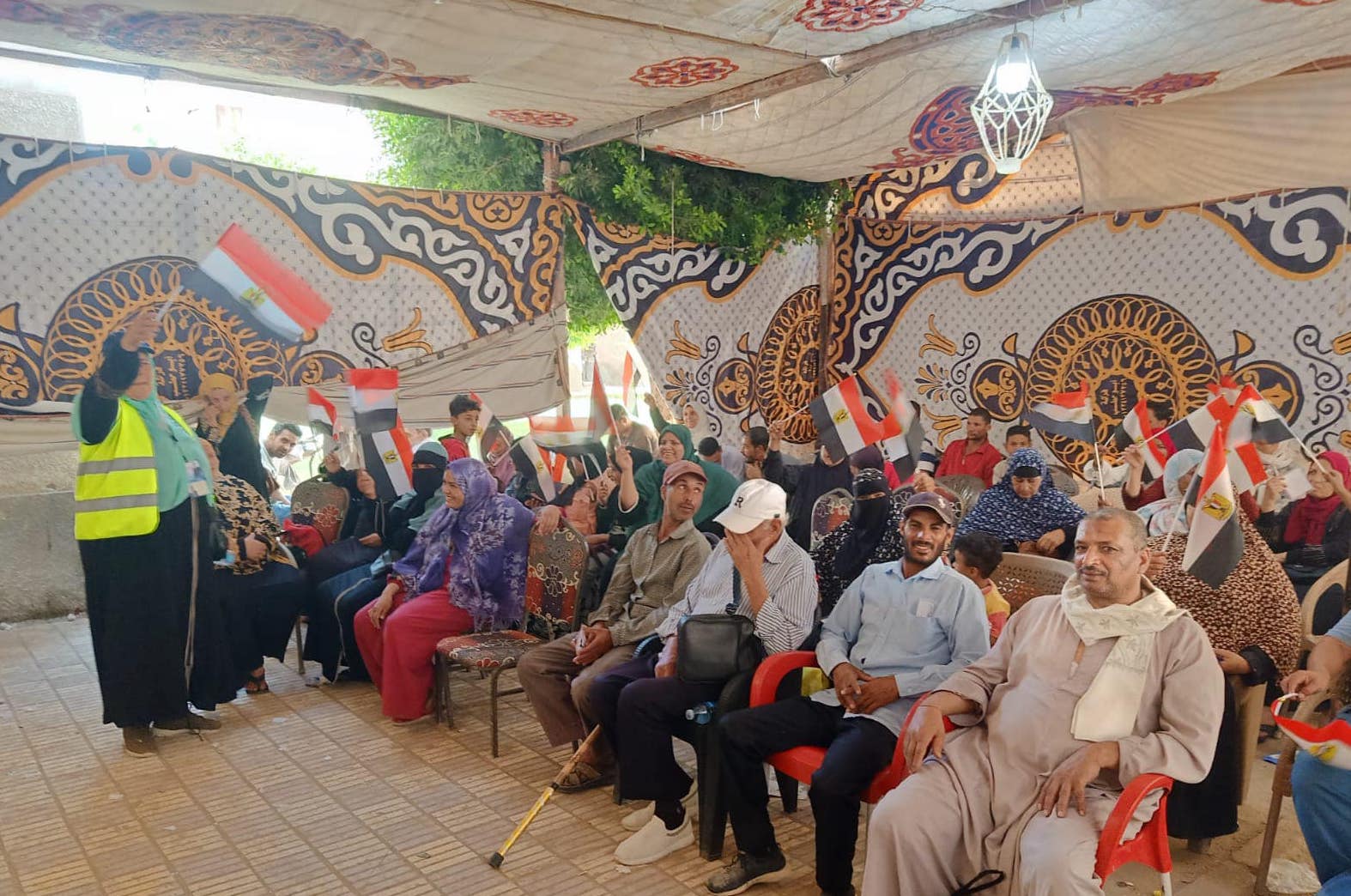
Phase one: The ‘battle’ for presidential endorsements
In his office in the government district of the new administrative capital, Khaled* began work on the morning of September 26. After logging into the digital government system, he received a message from the WhatsApp group for employees of the ministry he works for. The message informed him of instructions from the ministry’s undersecretary to go to the real estate registration office to submit a nomination petition for the president within a week, and to bring the form to his superiors, who were keeping a list of who complied.
As Khaled continued reading the message, his colleagues in the office expressed their discontent with the instructions, wondering what the undersecretary of the ministry could do to those who refused to submit nominating petitions, whether for President Abdel Fattah al-Sisi or other candidates. As Khaled and his colleagues discussed their options, a director at the ministry sent another message from the undersecretary on the same WhatsApp group, which answered their inquiries: “Anyone who refuses to submit a nominating petition will have it noted next to their name that they declined,” with another message indicating that there will be "strict security follow-up on this matter."
Government employees were mobilized in various areas to back Sisi for a new presidential term. This marks the latest step in a series of preparations initiated by security agencies since mid-August, forcing heads of NGOs, shop owners, factory owners, coffee shop owners, and tuk-tuk drivers, along with party leaders, unions, and syndicates to prepare detailed lists of citizens whose participation in the elections they can guarantee, either in exchange for financial compensation, in-kind assistance, or even without any compensation.
This mobilization manifested in queues and crowds in front of the real estate registration offices and in public squares of people waiting to register popular support for Sisi as a prelude to the major task of standing in lines planned to extend in front of the polling stations across the country from December 10–12.
Mada Masr documented testimonies of citizens, heads of NGOs, employees, and drivers in Cairo, Giza, and Gharbia, and spoke with a source in the real estate registration authority to outline how authorities mobilized popular support and the state’s method of implementing the first steps of the presidential elections.
The effort looked like part of an elaborate plan to create an image of outstanding popular support for the sitting president, collecting unprecedented numbers of Egyptians endorsing him. Coordination between several government institutions, police departments and state-affiliated political parties made it possible. Here is how.
***
The first phase is the endorsements collection, which authorities saw as needing tighter control, with Ahmed Tantawi, the most prominent presidential hopeful outside of Sisi, beginning to appear more and more like a serious contender.
According to the constitution and the presidential election law, in order to qualify for candidacy, a candidate must be nominated by at least 20 members of the House of Representatives or the support of 25,000 members of the public in at least 15 governorates through notarized nominating petitions submitted at real estate registration offices.
So, in a press conference on the afternoon of September 25, the National Elections Authority announced the timeline for all procedures related to the presidential elections and gave the green light to real estate registration offices across the country to start registering nomination petitions for candidates.
But this came with a twist. The elections authority designated only 217 offices for presidential nominating petitions, significantly fewer than the 389 that were open for the 2018 election.
Fewer offices meant easier control. Since the first day, complaints continued to arise about preventing supporters of other candidates, including Tantawi, from accessing the public endorsement system.
Tantawi announced on the second day of the endorsement process that his supporters in all governorates of the country were only able to submit more than two endorsements after thousands of attempts in various registration offices due to attacks and arrests by the National Security Agency. This was reiterated by former would-be candidate Gameela Ismail on the third day, stating that a number of her supporters were prevented from submitting endorsements in several real estate registration offices in Cairo, Menoufia, and Daqahlia, due to stalling, pushbacks, and even harassment and physical violence towards a woman.
Dozens of citizens documented their experiences through video clips on social media platforms, depicting the harassment and intimidation by Sisi supporters toward people who wanted to endorse opposition candidates, especially Tantawi.
In response, Tantqwi filed police reports and court legal challenges before the Supreme Administrative Court, demanding that the National Elections Authority subject public endorsement procedures to judicial oversight, similar to voting and vote counting procedures. They also demanded an increase in the number of nomination sites, all of which the court rejected.
In response, he visited a large number of governorates and spoke with members of the public, asserting that blocking his path to the presidential candidacy under the pretext that he could not obtain adequate public endorsements is “playing with fire.”
He also urged Egyptians abroad, who were able to file hundreds of public endorsements in embassy and consulate premises on October 6, to continue their support and document endorsements as an alternative solution to the difficulty of documenting endorsements within the country.
But not for Sisi. Shortly after the announcement, thousands flocked to most of these offices to submit nominating petitions for him.
This was no easy endeavor. An informed source at the Real Estate Registry Authority told Mada Masr that priority was given to processing endorsements for Sisi. The source explained that notaries at real estate registry offices are ultimately Justice Minister employees, and their work is limited to authenticating the forms of those who make it to their desks, pointing out that they must first make it past the security personnel stationed at all 217 nomination sites.
The source defined the security threshold as the presence of plainclothes police officers inside and outside the real estate offices, as well as someone known as a “contractor.” Each contractor, he added, comes with a group of people who hand over their ID cards to the police officers at the office, who then deliver the cards to the Justice Ministry employees. The contractor organizes the entry of each ID card holder for the signing process.
According to the source, police officers had complete control over access to the public endorsement phase and managed the crowding in front of each office. When a queue is about to end, a new one materializes, ensuring continuous crowds, he said.
For him, the scene of endorsements gathering felt like an attempt by “the ruling candidate to flex their muscles by registering a record number of public endorsements, far greater than what he obtained in the previous election.”
This is why the source, who spoke to Mada Masr before Sisi submitted his candidacy papers, anticipated that the president would receive more than a million endorsements. And so he did.
In contrast to the 161,707 public endorsements he got in 2018, Sisi’s campaign announced last week that they were able to collect 1.13 million (in addition to 424 endorsements from members of the House of Representatives) within 12 days.
After this, the crowding and turnout at the Real Estate Registry Authority offices decreased. Supporters of other candidates were allowed to submit nomination petitions, but only to the extent deemed appropriate by the authorities.
"They can open or close as they see fit," the source said. He pointed out that the digital system used to document endorsements instantly shows the total number of nomination petitions received by each candidate, along with detailed information for each governorate. The Real Estate Registry Authority, the National Elections Authority, the Justice Ministry, and the State Information Service, all have access to the database.
According to dozens of testimonies gathered by Mada Masr, it was difficult to know which offices would be open on a given day. Offices would be open on certain days and closed on others.
"We [are struggling to] get endorsements one-by-one from the real estate offices," Ahmed Abdeen, the political coordinator of Tantawi's campaign, told Mada Masr.
At first, the National Elections Authority's response was aggressive, iterating that the allegations were "baseless", and “fabricated by the imagination of some,” threatening legal action. Later on, among rising criticism the authority’s tone softened in a statement issued on October 1 in which they announced providing more trained staff with additional digital tablets to expedite work.
But practically nothing changed. This led Tantawi to encourage citizens to fill out nominating petitions for him and hand them over without notarizing them. He said his campaign would personally take them to the authority. But an arrest campaign targeting 11 of form holders ensued, all of them charged with forging official documents, with a bonus of the standard charge of “joining a banned group.”
On October 13, Tantawi’s campaign announced the end of his presidential bid after falling short of the threshold of 25,000 public endorsements, with only 14,000 nomination petitions for Tantawi officially registered.
Gameela Ismail, the former potential candidate, characterized the endorsement phase as “the most important battle” in which “the political will of the regime for fair elections” will be revealed. For some, it did.
***
In preparation for this moment, a parallel operation to manufacture strong public support kicked off as early as August all over the country, according to multiple sources.
In the low-income neighborhood of Manshyet Nasser, located in central Cairo, Hussein*, the head of an NGO that provides assistance to widows and divorced women, said that preparations for the presidential elections began on September 1 when he was called in by the chief of the police department. Hussein was ordered to prepare a list of all the employees and beneficiaries of his organization, including their personal phone numbers and national ID card photocopies, which he was required to hand over to a junior police officer responsible for following up with him all through the period of elections. Hussein complied with the instructions the next day. "No one can say no to the police,” he said.
The same process was carried out with coffee shop owners, who were asked to submit a list of all their employees and their families, as well as with shop owners and factories.
Tuk-tuk drivers were stopped on the main roads of the neighborhood, and their national ID cards were confiscated and held for them at the station until they went at night to retrieve them. According to Hussein, when most of the tuk-tuk drivers went to the station, a police detective told them that each of them was expected to bring a list of 10 names along with their national ID card photocopies. Each group would be assigned a junior police officer to follow up with them, at a price that would be determined once the businessman who would finance the purchase of electoral votes was determined.
Hussein confirmed that all the national ID card photocopies collected by the police department staff and detective were used to sign nominating petitions for Sisi at real estate offices near Manshyet Nasser (in Khalifa and Moqattam) even though the holders of those IDs were not present — a violation of election regulations that require the presence of the endorser to authenticate the form — or any financial compensation for them. The police officer told him that the money would be disbursed during the election period, he said.
Mada Masr asked an official at the Justice Ministry office for real estate affairs
When asked by Mada Masr about the possibility that nominating petitions were being submitted with citizens’ ID cards when they were not physically present, Ehab Sarour, an official at the Justice Ministry office for real estate affairs, declined to comment and said to contact the ministry’s spokesperson. Mada Masr tried to contact the spokesperson by phone and text message but received no response.
This was not unique to the residents of Manshyet Nasser. According to Said*, the head of an NGO in Marg district, northeast of Cairo, the police station in his area has been overseeing the process of collecting national ID card photocopies for a large number of residents since mid-August, along with preparing a list that includes their data, phone numbers, and addresses and the person responsible for bringing them to the polling stations during the election.
Said pointed out that the notable thing about this election campaign is the insistence on having the largest possible number of citizens. "They want long lines of allegiance,” he said.
He also added that all payments were postponed until the elections. But at least, for them, the price was set. He mentioned that the price of an electoral vote was set at LE250, while the tuk-tuk driver would receive LE60 for transporting each voter to their polling station. He estimated that more than LE7,000,000 was collected from traders, businessmen, shop owners, and factory owners in the area to finance the purchase of votes.
Complaints about collecting ID cards have been repeated in several areas. A security guard for a building in the Dokki area told Mada Masr that the owner of a store for government-subsidized goods asked him for a photocopy of his ID card and his phone number, and informed him that the police station requested information about the holders of the ration cards who purchase from his store. This was also repeated with a number of beneficiaries of the Takaful and Karama cash support programs, according to two beneficiaries from Giza who spoke to Mada Masr on condition of anonymity.
Alongside this grassroots effort led by police stations everywhere, political parties close to the state led a parallel effort.
Hussein said that the Nation’s Future Party in Manshyet Nasser mobilized many residents of the area to go to the real estate offices in Khalifa and Mokattam, in exchange for LE200 pounds. The secretary of the party’s women’s committee also transported a number of women in microbuses to the same real estate offices to endorse Sisi in exchange for distributing school bags and uniforms for their children, according to him.
The same thing happened in other governorates.
The Nation’s Future Party in Gharbiya Governorate provided buses to transport residents of villages to the real estate offices in the governorate, allocating two days per village, in exchange for LE200 and food boxes, according to a citizen from one of the villages in the governorate.
In Giza governorate, a charity organization run by the deputy House speaker Mohamed Aboul Enein distributed Prophet's birthday sweets and food supplies to the residents of the Nile islands of Dahab and Qursaya and Giza’s Monib district, who were mobilized to submit nominating petitions for Sisi.
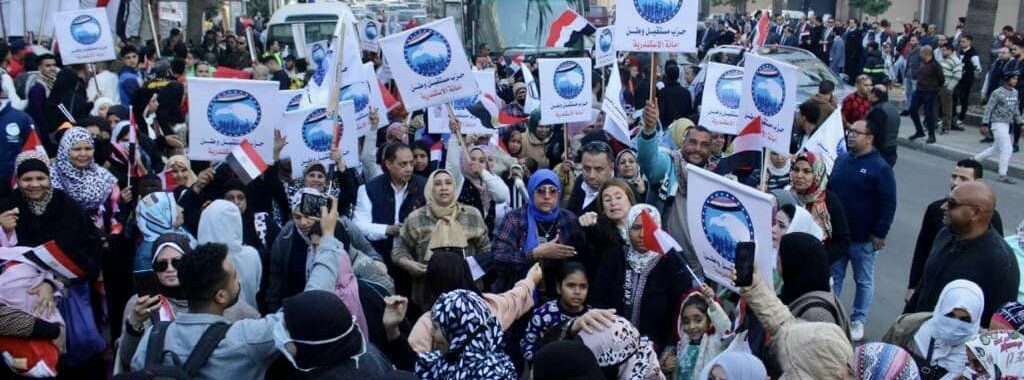
Participants in the marches organized to demand Sisi's candidacy for a new presidential term were also given LE200 each before being transported by cars from in front of the organization on Al-Bahr Al-Azam Street in Giza to Galaa Square in Dokki.
Similar marches were organized in almost every major city all over the country, all at the same time. The following day, and in what state media characterized as an acceptance of the pressing popular demand, Sisi announced his candidacy. Operation endorsements complete. Next comes campaigning and voting.

تقارير ذات صلة
The turnout behind Sisi’s reelection
“There are no obstacles, sir. Voting is proceeding smoothly,” one of the judges supervising polling sites told National Elections Authority director Ahmed Bendari during a conference call, one of many…
Presidential elections: Seasonal oppositional division
9 of 12 political groups associated with the Civil Democratic Movement urged the public to abstain.
Presidential elections: An opportunity for the opposition to come out of the margins?
Now, there are three members of the Civil Democratic Movement who have stated their intention to run
Your support is the only way to ensure independent, progressive journalism survives.
You have a right to access accurate information, be stimulated by innovative and nuanced reporting, and be moved by compelling storytelling. Subscribe now to become part of the growing community of members who help us maintain our editorial independence.
Join us