
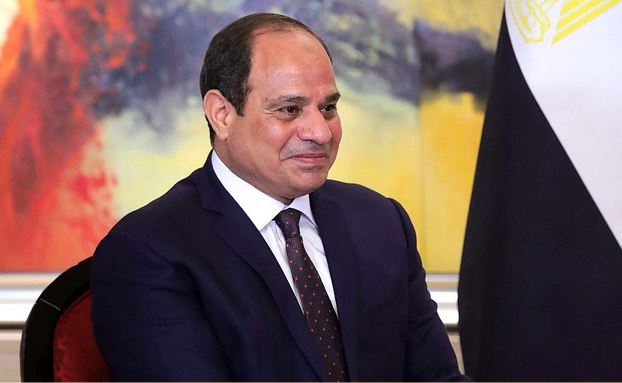
Presidential elections: An opportunity for the opposition to come out of the margins?
At the end of last week, several prospective opposition candidates took the plunge into the presidential election pool after months of behind-the-scenes deliberations around what running for Egypt’s highest political office in the current political climate would mean.
On Wednesday night, Constitution Party head Gameela Ismail announced that she would run. Less than 24 hours later, Farid Zahran, the head of the Egyptian Social Democratic Party, followed suit.
Now, there are three members of the Civil Democratic Movement, a liberal-left coalition that also includes Nasserist parties, who have stated their intention to run for president once registration opens: Ismail, Zahran and Ahmed al-Tantawi, the former head of the Karama Party and a former MP for an Alexandria constituency.
Mada Masr spoke with some of the key opposition figures to unpack what has gone into the thinking behind the decisions to mount bids against the yet unannounced campaign of President Abdel Fattah al-Sisi, who pushed through constitutional amendments in 2019 that paved the way for him to stay in power until 2030 and has won successive presidential bids in highly orchestrated votes but now faces a crumbling economy and rocky relations with former allies in the Gulf.
***
In an interview with Mada Masr before announcing his intention to run in the elections, Zahran explained that there are two cohorts within the administration managing the presidential elections.
The first cohort believes that any move toward democracy would lead to the dismantling of the country. This cohort, Zahran says, tends to be “cautious” and would prefer to reiterate on the staging of previous elections that saw Sisi run against state-picked candidates. They would therefore like to facilitate the nomination of Wafd Party head Abdel Samad Yamama and limit talk of presidential elections in the media to avoid any controversy or discussion about the elections on the street: “A safe scenario that would not foster an electoral atmosphere,” Zahran says.
Zahran considers this cohort to be the strongest, but he also notes that the danger of this scenario is the possible occurrence of “a spontaneous, non-political eruption by the people,” along with “the possibility of the return of the Muslim Brotherhood through a back door. The Yamama scenario would accelerate this eruption."
Backers of the second cohort, according to Zahran, see the importance of building a “safe, well-engineered public sphere that is not prone to eruption,” in which the opposition could make political moves but would be under control. This would involve nominating a serious candidate to run against Sisi, with promises from those in power not to interfere. These elections would still end with Sisi’s victory, but not by a 97 percent margin as in the previous cycles.
Before announcing he would run, Zahran said that his party’s participation would be conditional on the political forces representing the state agreeing with the opposition on a political document that provides for measures to govern the elections and the implementation of subsequent political reforms, at the top of which would be securing a commitment that Sisi’s presidency would not be extended or renewed via amendments to the Constitution after the end of the next presidential term in 2030. In addition, Zahran would want to see the state commit to provide spaces for the opposition in the media, release political prisoners and amend the remand detention law. However, the Egyptian Social Democratic Party head did not specify a mechanism by which to make these demands binding on the state or the president after his re-election, though he affirmed that allowing the presence of serious candidates in the presidential elections — even if the ballot is predetermined in favor of Sisi — would mean, among other gains, the opening of the public sphere “and a negotiation path with a higher ceiling than that of the National Dialogue.”
Akmal Kortam, the head of the Conservative Party and a leader in the Free Current Movement, which includes the liberal parties in the Civil Democratic Movement, began his conversation with Mada Masr by emphasizing Sisi’s announcement in 2017 to commit to only two presidential terms. Sisi had previously affirmed that he did not wish to lead the country for more than two presidential terms amounting to eight years, before amending the constitution to allow him to double that in total.
“The military institution is the one that nominated the current president. Will it put him forward again?” Kortam asks, noting the need to emerge from the current state of failure represented by “an economic elite exploiting politics for its own purposes, a political elite trying to get rich and a cultural elite trying to gain fame." For Kortam, there is a necessity of reviving a state that “can achieve strategic development opportunities that balance the current requirements of the people and the future ones of the nation."
In this context, Kortam does not support entering into any agreements with the state, and he insists that if his party were to put forward or support a candidate, that candidate must be a serious one “and not some sort of supporting actor." Kortam also sees that the next president could be transitional, and he notes the possibility for this person to be of military background, if allowed by the military council to run for presidency. Kortam also talks about some options that his movement is considering, including forming a presidential team.
Kortam’s thinking does not differ from what his colleague in the Free Current Movement, Mohamed Anwar al-Sadat, the president of the Reform and Development Party, previously proposed. In March, Sadat announced that he was in talks with a civilian figure of a military background, whom he referred to as the “surprise candidate” at the time, over a potential run for the presidency, before backing out in June of talking about supporting this candidate. Some predicted that this candidate would be one among other former military leaders, including the former Chief of Staff Mahmoud Hegazy, who was dismissed from his position in October 2017. Sadat said at the time that this candidate would not be able to run for the presidency for several reasons, some of which are “beyond his control," expecting that one of those reasons would be the difficulty of obtaining approval from the military to run in the elections.
According to legislative amendments issued by Sisi in 2020, Armed Forces officers, whether in service or retired, are not allowed to run for the office of the presidency, Parliament, or even local councils without the approval of the Supreme Council of the Armed Forces.
The previous election cycle saw a number of security crackdowns on prospective military candidates for the 2018 presidential elections, including former Chief of Staff Sami Anan. After Anan announced his intention to run, Sisi said in a public speech that there were individuals known for their corruption, who would not be allowed to reach the office of the presidency. Shortly afterward, Anan was arrested in January 2018, and two military court rulings were issued against him sentencing him to six years in prison on charges of forging military documents and announcing his candidacy to run for president without securing approval from the military, in addition to another three-year sentence for violating military rules and regulations by publishing comments on social media. The implementation of the two rulings was suspended in December 2019 after Sisi refused to ratify them.
Similarly, UAE authorities arrested Ahmed Shafik, the former prime minister and Egyptian Air Force commander, in December 2017, hours after he broadcasted a video announcing his candidacy in the presidential elections. He was deported from the UAE to Egypt, where he was placed under house arrest.
Colonel Ahmed Konsowa was also arrested, and he was sentenced to six years in prison by a military court after announcing his intention to run in the 2018 presidential elections. He remains in detention.
Others from the Free Current Movement have also spoken about the difficulty of holding fair elections if the current president is to participate. Hisham Kassem, the chair of the current’s board, has said that any competitor in the presidential race would only be complimenting the scene. Kassem spoke to Mada Masr before his August detention and subsequent sentencing on charges of defaming former Labor Minister Kamal Abu Eita, charges stemming from a Facebook post in which Kassem accused Abu Eita of causing waste of public money and being involved in in a major embezzlement case. The Sayeda Zeinab prosecution opened investigations into the incident on August 20 and decided to release Kassem on bail, to which he objected. He was then referred to the Sayeda Zeinab police station, where officers later filed a report to the prosecution accusing him of insulting them during his detention. This report was added to Abu Eita’s case file, and the prosecution ordered Kassem’s detention for four days pending investigation, subsequently referring him to stand before an economic court.
While Hossam Badrawy, the former secretary general of the National Party and a current adviser to the National Dialogue, told Mada Masr “I will not run for the presidency,” a source close to Badrawy tells Mada Masr that his refusal to run is neither final nor absolute, but rather related to his concern about entering into a direct confrontation with Sisi if he were to run and the possible persecution that may follow, whether through imprisonment or the freezing of his assets. The source explains that Badrawy was seriously considering his own candidacy and in fact, has been working to form a strategy for his presidential campaign, describing himself as “someone who is seriously playing the elections game, not a mere supporting role.” However, the noise generated by an interview he gave to Independent Arabia made him lean toward not running. The source explains that his public comments generated over 1.3 million interactions on social media and private messages, the majority of which focused on his talk of demanding that Sisi not run for president in the upcoming elections, in addition to orchestrated online campaigns against Badrawy, as well as comments from citizens who are not convinced of the possibility of Sisi leaving power. According to the source, Badrawy regarded this as an indication of an absence of a serious climate and desire for discussion, or that “people are confused."
The source sees Badrawy’s biggest fear as being that his candidacy would act like a snowball, attracting many groups to participate in the upcoming presidential elections. “If the snowball grows, will the regime tolerate it?” the source asks. “Can it abide Sisi winning by 51 percent, for example? Will it tolerate the presence of a person who receives 49 percent of the votes with Sisi in the scene?”
The source emphasizes that Badrawy did not categorically reject participation in the upcoming presidential elections, stating that he is keen on political presence. That is why he prepared to launch a reformist political movement, with the nucleus being the Justice and Union parties, says the source, noting Badrawy’s desire to establish a new movement instead of aligning himself with existing political currents, be they the Civil Democratic Movement or the Free Current Movement.
Asked about the former head of the Karama Party, Ahmed al-Tantawi, Zahran says, “Tantawi has caused a rift in the Nasserist current.” Kortam, however, describes Tantawi as “a loyal man."
Journalist Anwar al-Hawary, on the other hand, regards the candidates proposed to run against Sisi, with the exception of Tantawi, as an elite group that is completely out of touch with the people and revolves in the orbit of the regime. He emphasized to Mada Masr that Sisi will win through popular endorsement of his nomination in the upcoming elections, explaining that he advised Tantawi to save his resources and energy for the next elections in 2030, because those who amended the Constitution to allow Sisi to continue ruling until 2030 will not risk holding truly free elections.
A political source close to the state told Mada Masr on condition of anonymity that they believe there is a faction within the regime that does not regard the current opposition and elite as posing any threat to Sisi in the elections, given electoral integrity. This is because it is a fragile opposition whose concerns are far removed from the needs of the citizens and whose members are divided among themselves and prone to splitting the vote should a group of them run, they explain. “Who's to say that a candidate like Tantawi won't receive one or two million votes, while another receives 500,000 and a third candidate receives a few thousand, so that Sisi can surpass the opposition with 80 percent, 70 percent, or even 60 percent of the total votes, especially since Sisi constantly reiterates to his close circle that he has sacrificed his popularity for the necessary economic decisions, which enables him to renew his legitimacy to continue at the helm of power for another term or more?"


تقارير ذات صلة
The turnout behind Sisi’s reelection
“There are no obstacles, sir. Voting is proceeding smoothly,” one of the judges supervising polling sites told National Elections Authority director Ahmed Bendari during a conference call, one of many…
Presidential elections: Seasonal oppositional division
9 of 12 political groups associated with the Civil Democratic Movement urged the public to abstain.
Phase one: The ‘battle’ for presidential endorsements
The effort seemed like part of a plan to create an image of massive public support for Sisi
Your support is the only way to ensure independent, progressive journalism survives.
You have a right to access accurate information, be stimulated by innovative and nuanced reporting, and be moved by compelling storytelling. Subscribe now to become part of the growing community of members who help us maintain our editorial independence.
Join us