
Overworked, overwhelmed at the International Film Festival Rotterdam
This month I was one of four “international young film critics” at the 45th International Film Festival Rotterdam. I applied because film is slowly becoming a beat of mine – and my main beat, art in public space, is sadly diminishing in Egypt.
Rotterdam was rainy and windy, but thanks to global warming not as cold as I had feared. The festival headquarters was the city center's 1960s-built convention venue, De Doelen, which was surrounded by most of the theaters hosting the festival's films – almost 600 over 12 days.
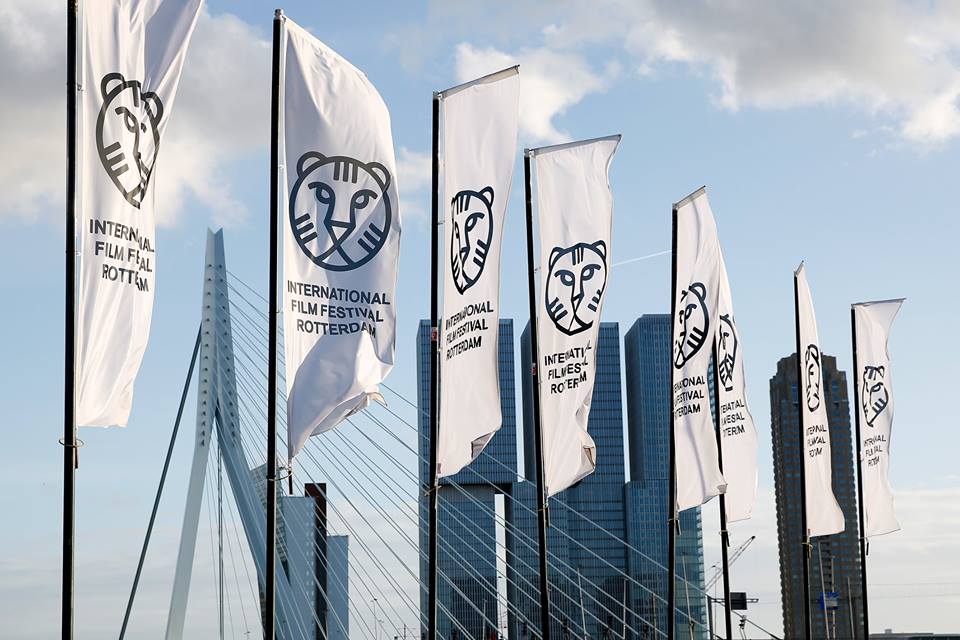
If you're in Rotterdam during festival time it's almost impossible to not know it’s happening. White flags with its Tiger logo flutter all over the city and posters and street projections of the festival fill areas near De Doelen.
The exciting – and daunting – aspect of IFFR is its focus on experimental and independent films by emerging talents from all over the world. While this means you get to see films that probably won’t be screened at other festivals or in art house cinemas, never mind commercially, some films are so experimental they’re really a challenge to sit through or even just stay awake for.
But IFFR successfully creates a space for audiences to really open their minds and consume all kinds of films. Almost all the evening screenings I attended were sold out, and even some early morning screenings too – despite the 12 euro ticket price.

The high turnout reflected some incredibly thorough programing. Most screenings were followed by Q&As with directors, and there were exhibitions, talks and even music that tied in with film selection. Plus, the parties never ran out of the festival’s signature gin and tonics or special edition Tiger beers.
My festival experience having been limited to the Cairo International Film Festival, of course I was hugely impressed by the level of organization – since let's face it, even in its best editions CIFF is quite a logistical mess. At IFFR, almost 800 staff and volunteers took care of even the smallest details, to the point that each visiting filmmaker had a so-called angel – staff assistant – to help them get around and coordinate interviews with the press desk, who were also (mostly) on top of their game.
The festival was laid back, but the opening and closing nights were spectacular. During the opening we were told security would be really tight because Queen Máxima of the Netherlands was attending, so we had to come on time and have our badges and invitations at hand. In Egypt, tight security means check points, metal detectors and the occasional accidental grope during a body search – but apparently in the Netherlands it means a relaxed, metal-detector-free environment, into which the queen arrives after everyone else, dressed in a simple overall. The festival's staff cracked up when I imagined out loud the security measures were President Abdel-Fattah al-Sisi to attend a festival opening: “He and his security would be the only ones invited!”
One downside of the program was that although the four of us were quite experienced journalists, most of our work for the festival newspaper, The Tiger Pro, was limited to short interviews and reports on the films and exhibitions. And there were lots of them during the first week, so there was little room to actually develop our critical writing. But we did get to meet up with critics like Neil Young and Clarence Tsui of the Hollywood Reporter and Jay Weissberg of Variety, who gave insight into the work and life of vagabond film critics hopping from one festival to the next.
While there were only a handful of Arabic films at the festival, they made an impact. Two of them, the Palestinian film The Idol by Hany Abu Assad and Tunisian film As I Open My Eyes by Leila Bouzid, had most screenings sold out and topped audience rating charts (with The Idol losing by a few decibels to Marin Zandvliet's World War II epic Land of Mine). We’re lucky that both films are getting Egyptian releases, with As I Open My Eyes already scheduled to release on March 9 at Zawya.

Tunisian actress Hend Sabry was a member of the jury giving out the festival's most prestigious award, The Tiger – the first Arab to be part of the jury since 1995 according to her promoters, the Cairo-based Mad Solutions. The winner was Iranian-American produced film Radio Dreams by Babak Jalali, about a San Francisco based Persian radio station hosting a jam session between Metallica and Iranian rock band Kabul Dreams.
Mad Solutions’ Arab Cinema Center (ACC) launched its 2016 activities at the festival's industry meet-up, CineMart. The ACC's mission is to create channels for Arab films to enter the international markets, and this year they plan on having a presence in 15 film festivals around the world and a year-long media partnership with Variety magazine to help promote the region's film industries.
Algerian documentary Bla Cinima by Lamine Ammar Khodja was a highlight for me. In it, Khodja goes to a square in Algiers where a renovated old cinema lays and has conversations about cinema with passers-by and people working in the square. It’s a fascinating film that cleverly uses cinema to reflect issues facing Algerian society – directly from its streets and people.
Unfortunately I didn’t catch the Moroccan feature Much Loved by Nabil Ayouch, which portrays the lives of prostitutes in Marrakesh, since it was only showing with Dutch subtitles and my understanding of Moroccan is minimal, but I heard great things about it – let’s hope it makes it to Cairo.
One Arab film that massively disappointed was the Lebanese Halal Love (and Sex) by Assad Fouladkar (who directed Egyptian sitcom Ragel wa Set Setat in 2007). By offering glimpses into the lives of three fictional couples in Beirut, it critiques conventions of Islamic marriage like polygamy, temporary marriages and divorce laws. A romantic comedy in essence, I enjoyed its quirks for the first 20 minutes until it became clichéd both in terms of Arab representation and gender stereotyping. But what really got under my skin was how it was being presented as “daring” for tackling topics that have been tackled widely in Arab cinema since at least the 1970s. Halal Love (and Sex) offered little cinematically beyond this claim.
To close, these are seven of my festival favorites that would be great to see in Cairo (hint, hint Zawya).
- Of Shadows: A Chinese documentary on the folk art of shadow puppetry and subtly hinting at China’s corruption and oppression. It felt close to home.
- The Plague at the Karatas Village: A film from Kazakhistan also highlighting government corruption through theater, especilly set design and absurdism.
- Bodkin Ras: A hybrid in which all the characters are real people from a small Scottish town except the lead, playing a fugitive looking for a fresh start. The elaborate mix of real stories and fictional narrative results in a uniquely interesting storytelling weave.
- Alba: An intimate fiction about a young, shy pre-teen girl living in Ecuador. Shot almost entirely in close-ups, it creates a level of closeness that really transmits the pressures of adolescence.
- Suntan: I want this to screen in Egypt mostly because it has the premise and feel of Youssef Chahine’s Bab al-Hadeed (Cairo Station). A Greek production, it follows a lonely middle-aged doctor who takes a job on a Greek island and becomes obsessed with a beautiful visitor who is simply leading him on.
- Tanna: Shot in the South Pacific island of Vanuatu the film tells a true love story from the 1980s where two young lovers rejected the local arranged marriage practices. It casts non-professionals from the community in question, which
- Harold and Lilian: A Hollywood Love Story: From the producers behind the documentary Searching for a Sugar Man comes a heart warming documentary about researcher Lilian Michelson and storyboard artist Harold Michelson, the couple who have been Hollywood’s behind the scene geniuses since the 1950s.
Photos courtesy IFFR.

Rowan El Shimi
Rowan El Shimi is a culture journalist from Cairo, but she often finds herself working on stories all over the country, especially Alexandria. She covers a range of topics in culture, mostly…
تقارير ذات صلة

Avant-titre | Our bread, our dignity: Bread in Egyptian cinema
This episode of Avant-titre is part of Mada Masr's Bread politics, an eight-part series that takes an in-depth look at bread subsidies in Egypt in the context of recent talk…

Video | Privilege and responsibility: A letter from Carol Mansour
Carol explains why allowing the voices of others to be heard helps to make the world a better place

Video | The archivist
Over decades of collecting, Makram Salama has turned his home into a cinema archive.
Your support is the only way to ensure independent, progressive journalism survives.
You have a right to access accurate information, be stimulated by innovative and nuanced reporting, and be moved by compelling storytelling. Subscribe now to become part of the growing community of members who help us maintain our editorial independence.
Join us