
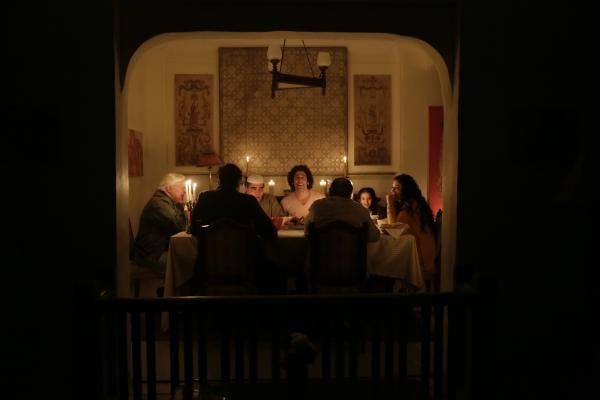
Out of the Ordinary: Daoud Abdel Sayed goes digital
Daoud Abdel Sayed’s Qudrat Ghayer Adya (Out of the Ordinary, 2014), released last month and still in cinemas, is visually and aurally enhanced using computer-editing software. Compared to his past films, which were all shot on celluloid, the digital image of Out of the Ordinary does not look or sound like anything he has done before.
Thematically, the 2001 drama A Citizen, a Detective and a Thief could be seen as a turning point in Abdel Sayed’s oeuvre. It introduced the alienated, conflicted upper-middle class figure that we see again with Yehia in Messages From the Sea (2010) and now Yehia in Out of the Ordinary.
In contrast to the downtrodden Sheikh Hussein and his son in Kit Kat (1991), or even Yehia in Land of Fear (1999), Selim (Khaled Abol Naga) in A Citizen, a Detective and a Thief is a struggling novelist who lives in the relatively affluent neighborhood of Heliopolis. Midway through, Selim learns that “belonging to a certain socio-economic class is a shell that protects,” as the voiceover notes, adding: “With a common lexicon and principles, the rules of the game become better known.” This lesson echoes through to Out of the Ordinary.
National identity, broadly defined, is in flux in the world the film presents, a fact that connects it back to some of the concerns underlying Abdel Sayed’s films from the very beginning. In Out of the Ordinary, Yehia (Abol Naga again) enters a stuffy Cairo social club with portraits of pashas on the walls and a bar with a 1940s décor occupying a corner. An Alexandria restaurant, which appears frequently on screen, seems to have been frozen in time. In one scene, an opera singer (Hassan Kamal) argues with an Azharite orator (Mahmoud al-Gendy) about Asmahan’s musical training. One believes she was trained in the western tradition, while the other assures him that such versatility in elocution could only result from training in the Arabic musical tradition.
A hotel on the coast of Alexandria with white and blue paint acts as the backdrop for Out of the Ordinary’s narrative. It is a refuge for a small group of people: Yehia, a doctor investigating supernatural powers in human beings, the opera singer, a professor in fine arts (Ahmed Kamal), the Azharite Quran reader who also sings in Arabic, and an Italian filmmaker. The hotel is managed by Haya (Naglaa Badr), a middle-aged femme fatale who lives in it with her daughter Farida (Mariam Tamer) and housekeeper Habib (Ehab Ayoub). After a short period of undisturbed tranquility, the outside world comes knocking at their door.
A triad of power between police, religious authorities and medicine plays out through the film. Farida’s supernatural abilities allow her to read the thoughts of those around her and to telepathically control people and objects. We learn the police are funding a research project to find people like Farida who offer the alluring, yet scary, possibility of knowing the secrets of people’s private thoughts. In Out of the Ordinary, a battle of bio-politics is waged around the body of a little girl with supernatural powers.
As one image collides with the next in Abdel Sayed’s montage, a question about sovereignty over one’s own body is raised. The fear underlying the film’s exploration of mind-reading powers is that of losing the body as a unit with a private inside beyond the reach of others, a fear that comes up when one is about to undergo brain surgery, for instance.
The digital image brought us the very first brain scans, and fMRI scans today are so intrusive that doctors can see synapses as they fire between neurons. Patricia Pisters’s book The Neuro-Image: A Deluezian Film-Philosophy of Digital Screen Cultures suggests that a theory of a cinematic neuro-image, in which the digital screen is thought of as a brain that can enable us to create new connections between phenomena, allows us to think more fruitfully about our contemporary relationship to the moving image and to screens. In Out of the Ordinary, through voiceover and camera work we as spectators gain access to the inner thoughts of characters. The camera gives us supernatural powers like Farida’s, allowing the film to extend concerns over bodily autonomy to include the spectator as well.
In a dinner table scene, the camera enters the room and becomes a roving, mutating phantom moving from one character’s point of view to the other, entering and exiting each character’s field of vision. In this scene, I got the feeling that the space on screen is a pulsating meta-mind with these characters existing within it. Our relationship to the images thus becomes as intrusive as that of the doctor to the fMRI scan. The use of voiceover, of course, helps develop this feeling throughout the film, as it takes us into the private thinking process of the characters.
A Citizen, a Detective and a Thief is in 35mm and so is Messages From the Sea. Out of the Ordinary is Abdel Sayed's first foray into digital filmmaking and as such it has secured itself as a milestone in his journey as director. Overall, however, the significance of Out of the Ordinary in relation to his films since the 1960s and those of his generation of filmmakers, like Mohamed Khan, for example, is yet to be fully discerned.
تقارير ذات صلة

Avant-titre | Our bread, our dignity: Bread in Egyptian cinema
This episode of Avant-titre is part of Mada Masr's Bread politics, an eight-part series that takes an in-depth look at bread subsidies in Egypt in the context of recent talk…

Video | Privilege and responsibility: A letter from Carol Mansour
Carol explains why allowing the voices of others to be heard helps to make the world a better place

Video | The archivist
Over decades of collecting, Makram Salama has turned his home into a cinema archive.
Your support is the only way to ensure independent, progressive journalism survives.
You have a right to access accurate information, be stimulated by innovative and nuanced reporting, and be moved by compelling storytelling. Subscribe now to become part of the growing community of members who help us maintain our editorial independence.
Join us