
Egypt’s cinematic gems: ‘Bouha’
This space is dedicated to writing about Egyptian cinematic experiences that we think are interesting. We write here about movies we like, movies we think are good, underestimated and worth seeing.
The question of what makes a movie a good movie has always provoked a complicated debate. Many film critics and cinema professors judge movies according to how much they fulfill the types of entertainment they promise to give. But every now and then there’s a surprising experiment in which a filmmaker finds a new way to communicate with the audience, forcing everyone to redefine what the promises of entertainment mean.
The act of making a movie, like any kind of art-making, is a reflection of the human beings behind it and their worldviews. Because movies are such a popular art form, a lot of money is invested in them all over the world. Movie-making is also a manufacturing process that needs the collaborative work of many people. Some of this work is purely creative and conceptual. So the finished product comes out as a reflection of how that group of people see the world. If a movie is very, very badly edited, that shows how the editor sees his job and the world, and the same applies to every single decision made in the process.
Maybe you like someone because of what they've done with their lives, because of an opinion they have that you find interesting, or maybe they have nothing positive about them at all, but you just like their company. The way they talk, what they remind you of, or any irrelevant thing that has nothing to do with a tangible evaluating factor. When I’m thinking of a movie to write about for this series, I imagine switching on the television at random and finding it. Would I want to watch it? For me, a cinematic gem is a movie that you’d want to watch, and want other people to watch.
An Egyptian-German friend was at my house. The television was on and it was showing Bouha (2005), a comedy written by Nader Salah Eddin and directed by Ramy Imam, starring Mohamed Saad. My friend, with his limited knowledge of Arabic, asked me to describe the main plot so he could follow. The plot of “Bouha” is quite simple. A guy from the countryside goes off to Cairo to collect a debt someone owed his father who has just died. The movie starts with a search that we are meant to follow. I briefly helped my friend out with the plot and carried on watching. Thirty minutes later he hit me with a question I’d never asked myself before, despite having watched this movie over and over.
“Why is he not searching?” my friend asked.
Bad movies are bad because they fail, they promise you something and break their word, and that’s disappointing. “Bouha” promises you things then very quickly forgets about them, but it’s not very disappointing. The events fall quickly into a series of arbitrary details that have nothing to do with the original plot, but I had never even seemed to notice this. The movie and I agreed that having a story was just a bureaucratic field it had to check for it to be a movie. We both know that it’s not about that, and neither of us cared.
Bouha, the main character who has a strange temper and extremely vivid accent, falls into the chaos of merciless Cairo and floats around a world of butchers and business tycoons. He somehow gets involved in a giant thriller in which he is relied on to help bring down an evil emperor of corruption. The way the script drifts in whichever direction the inside of Bouha’s brain is heading is quite amazing. You watch Bouha’s interaction with what he thinks is love, fear, ambition and conscience.
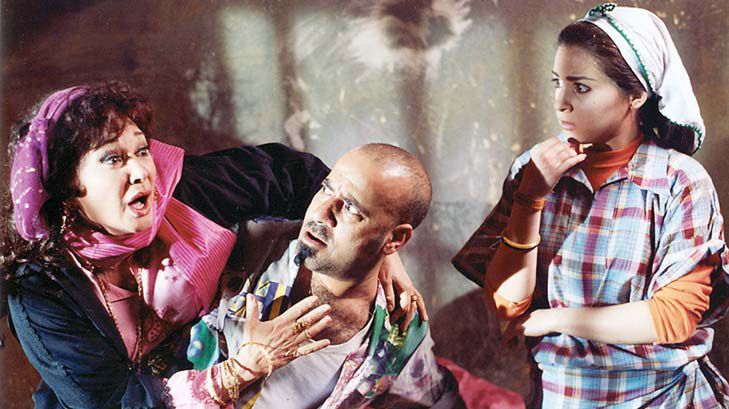
The movie is meant to be a comedy. It’s shot in deserted areas after midnight, and in clubs, prison cells, dirty allies and a slaughterhouse. Most of it consists of very creepy, badly lit night shots. Hilarious conversations between the characters echo in dark places of mystery and disgust. The things the filmmakers think are funny — mostly it’s Mohammad Saad’s taste, as this was his fourth box office hit after El Limby (2002, written by Ahmed Abdallah and directed by Wael Ihsan), Elly Baly Balak (2003, also directed by Ihsan) and Oukal (2004, Mohamad al-Naggar) — are really unusual for an Egyptian film. For example, a scene in which Bouha stays at the house of a man he met in prison who’s raising geese turns gory when his host wakes up to find Bouha plucking the geese, having slaughtered them all.
Later he has a WWF-inspired fight scene with his future mother-in-law and her daughter, with whom he is in love, to make them look beaten up enough to report a man who is harassing them in their area.
There are many spooky scenes in which people are conspiring. In Egyptian comedies, scenes of that sort are usually deliberately brightened up to comfort the audience. I don’t know if “Bouha” made a conscious decision not to brighten things up as an artistic interpretation of the feelings the characters are going through, or if it’s just a failing that resulted in a really amusing movie that asks questions about the contract between us and filmmakers, and how much we — the audience — get involved in the corrupt process of making a bad film.
Saad’s previous three movies were very similar. Elly Bally Balak seemed to have a bigger budget and (relatively) more careful scripting and direction. For Bouha, a lot of people believe that Saad was relying on the accumulative success he had built up through a new type of movie revolving around a well-acted unusual character — not very new approach. After Bouha, Saad kept playing the same card for a while before realizing that a good actor who can imitate unfortunate people with poor communication skills is not enough to make a movie.
Bouha is like the exciting moment when an actor on stage forgets his lines and starts making stuff up. The actor is not writing, he is borrowing or mimicking what he thinks writing is, and creates an illusion, just as a writer does, in a way that reveals the ridiculousness in the act of listening to a story. We all know that storytelling is a lie, but we respect it more when it’s a well-crafted lie. Saad’s Bouha is a very poorly crafted lie, mostly inspired by Saad’s way of seeing life and people. It’s also an important milestone in the career of an actor aspiring to create a good legacy for himself by being a movie star responsible for what a series of movies are like.
But most of all, Bouha is just a damn funny movie.


Andeel
Andeel was born in Kafr al-Sheikh in 1986. His uncle told him that his paternal grandfather was a filmmaker who made a feature film called “Horses,” which he took to…
تقارير ذات صلة

Avant-titre | Our bread, our dignity: Bread in Egyptian cinema
This episode of Avant-titre is part of Mada Masr's Bread politics, an eight-part series that takes an in-depth look at bread subsidies in Egypt in the context of recent talk…

Video | Privilege and responsibility: A letter from Carol Mansour
Carol explains why allowing the voices of others to be heard helps to make the world a better place

Video | The archivist
Over decades of collecting, Makram Salama has turned his home into a cinema archive.
Your support is the only way to ensure independent, progressive journalism survives.
You have a right to access accurate information, be stimulated by innovative and nuanced reporting, and be moved by compelling storytelling. Subscribe now to become part of the growing community of members who help us maintain our editorial independence.
Join us