
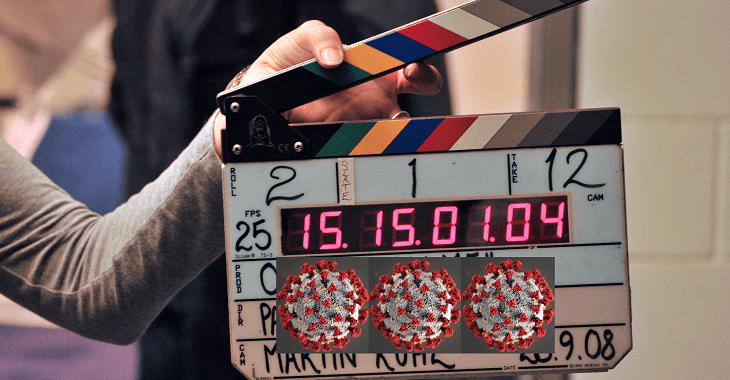
Corona on set: A nonstop horror show
In the beginning, Ahmed Ramzi*, an actor, wasn’t really threatened by the coronavirus, and never really saw it as a reason to stop going to work. He genuinely thought that filming for the show in which he’s starring could continue unperturbed, and he says he was honestly hoping that would happen, since he needed the paycheck he was supposed to receive a few days into shooting, among other reasons.
However, with the news spreading regarding the rapid increase of cases that have tested positive for COVID-19, the large number of fatalities in Italy, and after the Egyptian government started taking serious measures to control the spread of the virus, Ramzi joined the troupes of people in the film and TV industry who were steadily getting more afraid of being on location.
“I didn’t try to postpone or stall filming, but I felt it wasn’t right to keep going to set despite all the measures taken by production to sterilize the set and protect the cast and crew by providing disposable gloves that they replaced with new ones every hour. I quickly realized that effective sterilization is practically impossible,” Ramzi tells Mada Masr.
One of Ramzi’s scenes takes place inside a car. Right before he gets in, four people get out of it, one of whom hands him a phone that he’s meant to use after getting in. There are at least six spaces in this car that he is bound to touch, including the steering wheel, the seat and its adjustment lever. How can he be certain that all these surfaces are virus-free? Especially when, according to him, half the crew isn’t taking the coronavirus issue seriously — shaking hands and touching as if everything is normal.
Ramzi took his precautions; he visited his mother for the last time intending to stop seeing her throughout the filming period for her protection and made peace with the idea that he’s probably going to catch the virus at some point. Without reconciling with that, Ramzi says, his constant anxiety and thinking about whether or not things are sterile would have prevented him from being able to act, a process that requires a person to be relaxed.
COVID-19 anxiety swiftly spread to more and more areas of the film and television industry and raised many questions about what should be done to face the dangers of working in an environment that requires a huge number of people to be present in one place at the same time.
In a work WhatsApp group, Abdulaziz Fahmi* raised a question regarding work in the time of COVID-19. He was worried and felt that the nature of his and his colleagues’ work might endanger them, given the pandemic.
The nature of work in filmmaking requires constant physical contact between different crew members: sound crew members attach microphones — which are used by more than one person — on actors’ clothes; costume crew members are in contact with all actors and store all costumes in one place with people in and out all the time; make-up artists are always close to actors’ faces and use the same kits on all of them — not to mention that many scenes require the actors themselves to physically interact with one another.
The discussion on the WhatsApp group led to one pivotal question: What do we do? Do we demand stricter safety precautions on set, like sterilization, proper ventilation and taking the temperature of everyone who enters? Do we turn down any non-essential projects to avoid catching the disease? What projects are essential? Are Ramadan TV series essential? Or should we demand that producers halt work for a few weeks until we pass this critical stage of the outbreak?
In spite of the government taking many measures to prohibit large gatherings — the last of which was imposing a nightly curfew almost two weeks ago — including the reduction of the number of workers per workplace, prohibiting concerts and sporting events, closing down places where people gather such as parks, sporting clubs, and restaurants, production on TV shows and advertisements that has begun — as usual — only two months prior to Ramadan, has not stopped.
This created tension between crew members; among whom are actors, set designers, and writers on one side, and producers on the other. This tension is rooted in the nature of workplace relations between workers and business owners in the TV production field, and this current crisis has highlighted the dilemmas of workers’ rights, producers’ responsibility to protect them, and how to find solutions to overcome this crisis.
The coronavirus crisis worsened an already problematic situation in Egyptian television production. For the past few years, production of series has spanned over the shortest of timelines before airing in the Ramadan high season; networks only begin to sign deals with production companies about two months before Ramadan, says Egyptian film director Youssry Nasrallah.
Because television series begin filming right before Ramadan, Nasrallah says, production teams are forced to work for over 17 hours per day, filming episodes that are being written as they are filmed (since producers in turn don’t sign on writers until they’re provided funding from networks). All of this leads to the crew having virtually no time to prepare or work with actors before filming, which leads to them continuing to work throughout Ramadan itself as the show is being aired, sometimes in multiple units, in order to finish faster.
Nasrallah states that TV show production conditions in Egypt are inhumane, corona or not, and that it puts cast and crew members under “immense pressure” from producers, and places producers under the same amount of pressure from networks. He likens it to the state of chicken being held in “battery cages.”
Screenwriter Mariam Naoum, who has a series set to air in Ramadan this year, also used poultry farming as an analogy for this relationship between networks, production and filming crews. She expressed her frustration with the situation in a Facebook post, stating that producers view industry workers as “geese laying golden eggs” — that they were much more concerned with their profits than the lives of the people creating them.
She summarized the situation, saying: “Networks pressuring producers because they want to air, producers pressuring cast and crew members to film, cast and crew members forced to film out of a sense of responsibility and fear of losing their source of income in the future … and the syndicates, they watch us slave and can’t find it in them to release statements to halt production, even though they get dozens of phone calls from cast and crew members every day saying they don’t want to film anymore.”
One cast member who told the syndicate she doesn’t want to continue going to set is actress Sanaa Gamil*. It started with Gamil inquiring about safety procedures being taken on set to combat the spread of the virus, but even with all the reassurance from location managers that included photos of so-called “sanitation guards”—employees at the entrance of the set armed with disinfectants— Gamil decided that these precautionary procedures were not enough and that filming should be halted, a position shared by many other actors.
“All international protocols confirm the dangers of having many people in one place, and we’ve started to see our friends work from home, and workplaces reducing the number of employees for jobs that cannot be done remotely,” Gamil says. “How are we still filming on locations that require about 150 people to be in the same place, and that’s not including the scenes that require massive amounts of extras?”
Gamil informed her superiors of her decision not to come to work anymore, as did some of her co-stars. Producers’ attempts to change her mind failed, and their rejection of her decision and refusal to even consider halting production led her to ask for the intervention of the Actors’ and Cinema syndicates. She knew she had the right to refuse to work in the case of a pandemic, and that producers would not be penalized if they don’t have the episodes ready on time for the networks they signed with in light of the circumstances, so she did not quite understand why they remained insistent on endangering her and other members of the cast and crew.
Mahmoud Osman, an attorney specializing in intellectual property and creative rights at the Association for Freedom of Thought and Expression (AFTE), says that current civic law explicitly states that an artist’s contractual liability is null in the face of a “force majeure” — be it natural phenomena or disasters.
Osman reaffirms that a “force majeure” clause is included in any contract, and that in case of its occurrence, the contract is null until said force is over, with no compensation required for that period. So, in the case of TV production, this clause exempts an actor from any sort of compensation to the production company.
This is where syndicates are supposed to play a role, Osman says. He confirms that, according to the constitution, as well as Article 5 of Law 35 of 1978 regarding the Acting, Cinema and Music syndicates, any person who does work related to any of these three syndicates has to be a member or get a permit from them, and in return, their contracts are vetted by the syndicates to assure their best interest is being served. He reaffirms that this is an essential part of a syndicate’s job.
Asmahan*, another actress working on the same show as Ramzi, says she has finally made the decision to quit the production because she has a health condition that puts her in the higher risk category in case of contracting COVID-19. “I started staying home two weeks ago because I wasn’t feeling well, and it was related to the producers that the reason I wouldn’t be able to go back was medical; that’s why they sort of accepted it,” she elaborates.
Asmahan says she hesitated before quitting because she was worried about how it would reflect on her own financial situation, and also because she can’t help but feel that she — among other actors on the production — is responsible for a lot of other people’s livelihoods.
“We’ve been talking about actors and directors, who are very privileged here; but most crew members are paid a daily wage and can’t afford to even think about staying home without that security, and they have more reason to be worried about being passed over for future jobs if they’re not seen as reliable right now,” she says. But despite being trained “never to quit a production once she’s started working on it,” she says she didn’t really have a choice: “I’m high risk, I shouldn’t even leave the house.”
According to the actress, producers are still trying to find a “safe” way for her to continue filming, but despite the extra precautions she says they are taking on set — including having a doctor present at all times, mandatory masks and gloves for all crew members, and taking the temperature of everyone who enters the location — her doctor still strongly advised against it. “I’m just worried about everyone that has to continue filming, especially the older actors and crew members, and also everyone on set who might take this illness home to their families and facilitate more spread,” she says.
To this day, even after a nationwide curfew was imposed, the syndicate has not made any official move to halt the production of television series or advertisements, and, according to Osman, neither has the cabinet or any other authority that has the power to make such a decision.
The syndicate’s reaction to Gamil’s plea was to issue a memo with no legal power to bind any party in any way, and they did not reply to any of Mada Masr’s questions in regards to the situation. The series Gamil stars in continues being filmed in spite of the curfew, and Gamil says she is still being pressured by production every day to go back to set and film her scenes. She, however, insists on not quitting, even though she is sticking to her decision not to go to work: “This is my career and I shouldn’t have to lose it because they want to risk everyone’s life,” she says. “If they have a problem with me not going to set, they can fire me. It should be on them, not me.”
Nasrallah believes there should be at least a 14-day hiatus from filming and that everyone should stand together in the face of this crisis, since people’s safety is the number one priority now. This goes beyond physical safety, he states, but also financial security for those whose livelihoods solely depend on the Ramadan TV season. He believes that it is the duty of networks, producers and syndicates to halt production rather than wait for government decrees, and to take on the financial responsibility of said workers who have been “milked dry” for years by providing them their minimum wage — at least — until this crisis passes.
As for Osman, the attorney believes that full responsibility lies on officials; namely arts syndicates and the government, the latter of which should issue a decree forcing production companies to halt production on all films and TV shows, and to fulfill their financial responsibility toward the workers since their contracts would still be valid and they would not be able to stay home without pay. The state, he says, should make sure this happens.
Without such a decree, film and TV industry members are now working under circumstances even more difficult than usual. With the curfew in effect, scenes taking place in external locations that are now impossible to film in are being rewritten, and cast and crew involved in evening scenes often have to spend the night on location after they’re done, until the curfew is lifted in the early morning and they can go home.
“I was surprised. I think a lot of us assumed curfew would put an end to shooting,” Asmahan says. “But the general attitude is that the show will go on no matter what.”
*Names have been changed upon interviewees’ request

تقارير ذات صلة

Avant-titre | Our bread, our dignity: Bread in Egyptian cinema
This episode of Avant-titre is part of Mada Masr's Bread politics, an eight-part series that takes an in-depth look at bread subsidies in Egypt in the context of recent talk…

Video | Privilege and responsibility: A letter from Carol Mansour
Carol explains why allowing the voices of others to be heard helps to make the world a better place

Video | The archivist
Over decades of collecting, Makram Salama has turned his home into a cinema archive.
Your support is the only way to ensure independent, progressive journalism survives.
You have a right to access accurate information, be stimulated by innovative and nuanced reporting, and be moved by compelling storytelling. Subscribe now to become part of the growing community of members who help us maintain our editorial independence.
Join us