
Sharaa visit ‘historic’ step in friendship, says Erdogan, as presidents discuss Turkish military bases in Syria
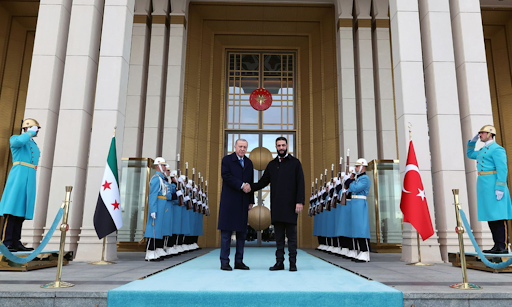
In his second visit to a foreign capital since assuming the position of interim president of Syria last week, Ahmed al-Sharaa arrived on Tuesday to Ankara looking to hammer out a defense pact to bolster the security of his still fragile new government.
If the agreement under discussion was to be finalized, a Syrian security source and a Turkish political source told Mada Masr, it would see Turkey establish military bases in Syria and train new cadres of security forces, reinforcing the role Ankara played as a key backer of the Hayat al-Tahrir offensive that Sharaa led to its conclusion in December with the stunning ouster of the embattled regime of President Bashar al-Assad.
“Turkey is working to establish airbases and air defense systems and may soon sign a mutual defense agreement with Syria. The agreement would allow Turkey to use Syrian airspace for military purposes,” the security source said. “The plan also includes training the Syrian army, especially as the defense and interior ministries have opened volunteer enlistment for Syrian youth willing to join their ranks, marking the beginning of a new phase of security and safety.”
Among the sites being considered for Turkish airbases are the city of Palmyra, particularly its military airport — formerly under Iranian control — and the T4 airbase in Homs, the security source said.
“These bases would enable Turkey to defend Syrian airspace in the event of future attacks,” the Syrian security source said, noting that the response from the West to Sharaa’s government remains tepid.
“While the US had previously indicated it might support and arm the new Syrian military, no country has yet taken the initiative to provide military or security assistance — an urgent need given the country’s dire circumstances. Turkey, being the closest to us and a militarily strong nation, can easily train our personnel.”
The Turkish political source agreed that there is a natural fit between Syria and Turkey. “It is only natural for Turkey to be the godfather to the birth of Syria’s new security order, given the geographical proximity and political alignment between HTS and Erdogan. The two countries share a 611,000-kilometer border — it’s Turkey’s fate to be Syria’s neighbor, and Syria, at present, has no structured defense institutions to protect itself from internal and external threats,” the source told Mada Masr.
If the deal is finalized, Turkey’s presence will provide Syria a significant boost for a militia force that now finds itself facing other state powers on a geopolitical stage.
The Turkish political source points to threats from “Kurdish groups such as the Syrian Democratic Forces and the Kurdistan Workers’ Party (PKK)” who seek to undermine security in northern Syria, spanning Deir ez-Zor, Hasakah and Qamishli, as well as ISIS factions and repeated Israeli breaches.
“Only Turkey is capable of deterring all the competing countries — including Iran, Russia and Israel,” the source added.
There has been no official announcement regarding the possibility of a defense pact by either Damascus or Ankara.
Turkish Presidential Communications Director Fahrettin Altun said on Monday that Sharaa and Turkish President Recep Tayyip Erdogan would hold discussions at the presidential complex in Ankara to review “the latest developments in Syria” and evaluate “the joint steps to be taken by the two countries for the economic recovery, sustainable stability and security in the country.”
In a joint news conference with Erdogan in the Turkish capital Ankara on Tuesday night, Sharaa underscored the closeness of Turkish-Syrian relations: “We affirm the transformation of our relationship with Turkey into a deep strategic partnership in all fields.”
The upcoming phase will focus on “boosting trade exchanges and joint investments, particularly in infrastructure reconstruction projects, aiming to achieve economic recovery and to support a better future for both countries,” the interim Syrian president said.
“By acting in solidarity with Syria, I believe we will fully establish a climate of peace and security in our shared region, free from terrorism,” Erdogan said from the podium, describing Sharaa’s visit as a “historic” step that will mark a period of “lasting friendship and cooperation” between the two countries.
Turkey exerted influence in northeastern Syria throughout the latter years of Assad’s rule, either directly funding or providing support to a broad patchwork of militias. Chief among these is the Syrian National Army, which includes local groups and units from the governorates of Damascus, Homs and Deraa. Some of the factions within the SNA are fully allied with Turkey. Ankara also maintained ties with HTS.
Turkey looked to extend this sway in recent years, looking to boost its economic control around Aleppo, relocate Syrian refugees and curtail the movement of Kurdish forces near its border, which it alleges collaborated with the terrorist-designated PKK.
Limiting Kurdish forces has emerged as a key interest of Turkish involvement in Syria.
During an early December visit to Damascus, Turkish intelligence chief Ibrahim Kalin discussed the matter with the new HTS-led government. A Turkish political source told Mada Masr at the time that Ankara had opened communication channels with the Syrian Democratic Forces in order to reach an agreement that includes the handover of the group’s weapons to the regular Syrian military in exchange for expanded rights, namely the recognition of Kurds as a national group in the new Syrian constitution.
Sharaa was declared interim president last week. While he has not given an official timeline for the transitional period, he said earlier this week in a television interview that it could take “between four to five years until elections because there is a need for a vast infrastructure, and this infrastructure needs to be re-established and establishing it needs time.”
Sharaa said that a preparatory committee would be formed to hold consultations across Syria. "Then, it will invite those we think represent the Syrian people in general," he said.
The discussions would countenance "all the important problems in Syria" and produce a final statement that would form the basis of a "constitutional declaration," he said.
أخبار ذات صلة
Kurdish forces taking up arms in Iran could drag Turkey into the war
When Syrian forces moved into Kurdish-held territories in northeastern Syria in January, Turkish officials let out a sigh of relief. The “Kurdish…
SDF, Syrian govt strike integration deal, as both look on with caution over finality
The Syrian government and the Syrian Democratic Forces have agreed to halt hostilities, alongside “an understanding between both sides on a phased…
Ending ‘autonomy’: How the SDF-Syrian govt talks broke down into a fight
Mada Masr spoke with sources in the SDF, the Syrian government, Turkey and regional diplomats
The New Syria, under Israeli-American construction
Syria’s future is tied to a broad regional plan, but the US and Israel are in the driver’s seat.
Your support is the only way to ensure independent, progressive journalism survives.
You have a right to access accurate information, be stimulated by innovative and nuanced reporting, and be moved by compelling storytelling. Subscribe now to become part of the growing community of members who help us maintain our editorial independence.
Join us