
Kurdish forces taking up arms in Iran could drag Turkey into the war
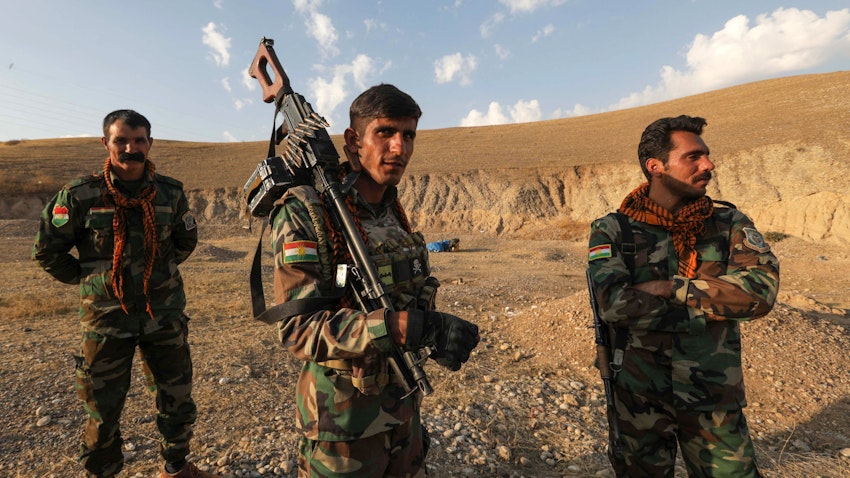
When Syrian forces moved into Kurdish-held territories in northeastern Syria in January, Turkish officials let out a sigh of relief.
The “Kurdish question” seemed to be nearing resolution. For Turkey, armed Kurdish movements seeking cultural and political autonomy across Turkey, Syria, Iraq and Iran pose a threat to the Turkish state. The fractures in the Syrian state created by a decade and a half of civil war had emboldened the Kurdish contingent in the country, in Ankara’s eyes.
But the fall of former Syrian President Bashar al-Assad in December 2024 opened the door for Turkey to advance its Kurdish containment plans. And over the course of a year and a half of negotiations and careful diplomatic moves, Ankara had buoyed the position of its ally, interim Syrian President Ahmed al-Sharaa, and convinced the United States to distance itself from the Kurdish-led Syrian Defense Forces, its former principle ally in the fight against the Islamic State in the Levant.
In the course of a few days in January, a Kurdish autonomous zone right on Turkey’s border rapidly collapsed and Kurdish forces settled on a deal to be folded into the Syrian central government.
However, as much as the Syrian government and Turkey looked at the development as a win, there was also trepidation in that moment, for part of the deal was to have members of the Kurdistan Workers' Party (PKK) withdraw from Syria to northern Iraq and then to Iran, according to a senior Syrian official with knowledge of the agreement who spoke to Mada Masr at the time.
“This solution certainly does not meet the aspirations of [the Syrian government or the Kurds], but it is a temporary necessity that serves the interests of the Syrian state at the present stage,” the Syrian official said at the time. In the same breath, the source said that regional reality may very well change if a war with Iran occurs.
Fast forward one month and that reality is undergoing a massive overhaul.
The US and Israel launched a series of airstrikes on Iran on Saturday, killing Supreme Leader Ali Khamenei and scores of Iranian military and government officials. Iran has responded with a series of attacks on Israel and unprecedented strikes on Gulf states, closing the vital Strait of Harmuz through which 20 percent of the world’s oil and gas is shipped and bombing Western military infrastructure in the Gulf. Images of Gulf hotels, airports and luxury strips ablaze have circulated online, puncturing the long-imagined safety of Riyadh, Dubai and Doha, and for Kuwait, dredging up memories of the Gulf wars.
In these first days, the war was largely a calculation of Iranian rocket launchers destroyed by Israel and the US, and missile interceptors spent in defense of Israeli and Gulf cities. Each side knows the other has a finite amount of launchers, interceptors and rockets. On Monday, the war expanded to Lebanon, with Lebanese officials preparing for a potential invasion of the south as far as the town of Saida.
But on Wednesday night, reporting from multiple outlets that the US and Israel are considering backing a Kurdish force in Iran to lead a ground attack on the government and to “foment a popular uprising” transformed the dynamics of an already transformative war.
Iranian, Turkish and Kurdish sources who spoke to Mada Masr said that, while no decision has been made among Kurdish troops yet, the development may expand an already widening war to include Turkey, which has so far maintained its distance from the conflict.
Iranian forces, who have moved with a brazenness that has largely caught US allies off guard, wasted no time wondering what Kurdish forces would do.
Iran said Thursday it targeted the headquarters of Kurdish forces in Iraqi Kurdistan, according to Iranian state media, following strikes on Kurdish regions in both Iran and Iraq.
Ali Larijani, the head of Iran’s National Security Council and who “currently holds the key to decision-making,” an Iranian diplomat told Mada Masr, warned "separatist groups” from trying to take advantage of the chaos.
They “should not think that a breeze has blown and try to take action. We will not tolerate them in any way. The armed forces are also fully in control of this issue,” Larijani said on Thursday, in comments that were picked up by state television.
Despite the Western reports that the Kurds were preparing to attack Iranian forces, Kurdish media outlet Rudaw quoted several Iranian Kurdish opposition groups who denied the reports.
“None of our forces have entered the territory of Eastern Kurdistan [in Iran],” an official from the Democratic Party of Iranian Kurdistan (PDKI) said.
This is not surprising, given the mounting skepticism among several Kurdish factions regarding US promises.
“The Kurds' trust in Washington is no longer as complete or firm as before, because of the bloody events that occurred with the Kurds in the Syrian city of Aleppo, and before that in Raqqa and the Hol camp,” a senior Kurdish official in the Syrian Democratic Forces told Mada Masr. “The US did not participate as a member of the coalition in striking Islamist terrorists during their escape from prisons; rather, it facilitated their escape. [US Ambassador to Turkey] Thomas Barrack and his immature actions toward the Kurds have led to a decrease in trust in Washington.”
Before the outbreak of the war, a group of Kurdish political parties in Iran came together to express their opposition to the Iranian government and found a new coalition: the Coalition of Political Forces of Iranian Kurdistan. The coalition includes the PDKI, the Kurdistan Free Life Party, the Organization of Iranian Kurdistan Struggle, the Kurdistan Freedom Party , the Komala of the Toilers of Kurdistan. On February 22, coinciding with its founding, the coalition stated that its goals consist of “the struggle to topple the Iranian Islamic Republic, achieving the right to self-determination for the Kurdish people, and building a democratic national institution based on the political will of the Kurdish nation in Eastern Kurdistan.”
In a gesture toward reports of Kurdish collaboration with foreign parties, the group’s statement announced the coalition’s “readiness to cooperate with all parties and political forces outside the framework of this alliance, and we call upon the people of Kurdistan to join the coalition and restore their standing in it.”
But even if Kurds are divided on whether to align themselves yet again with a fickle US partner, Iranian and Turkish officials told Mada Masr that they expect to collaborate closely to counter any contingent of Kurdish forces that joins the fighting in Iran.
“I believe that some countries concerned about the Kurdish issue may intervene to support us,” a former Iranian diplomat told Mada Masr. “Tampering with the Kurdish issue in Iran will negatively impact neighboring countries with Kurdish populations and pose a threat to them. I believe that Washington and Israel are pushing the Kurds into a losing war, just as they did with the Gulf states, and now they stand idly by.”
A Turkish official told Mada Masr that, in light of the news, “Turkey is preparing for a possible scenario that the escalation of the situation by Kurds or separatists in Iran could lead to Turkish-Iranian intelligence cooperation to prevent or obstruct such actions.”
How Turkey would navigate such a reality remains a potential evolving fault line, given its membership in the North Atlantic Treaty Organization, which falls under US military patronage, a fact that the Kurdish source pointed to as a constraint on any Turkish action.
“We are confident that if Turkey intervenes to support Iran against Kurdish movements within its borders, US President Donald Trump will not remain silent, and we will inevitably be drawn into an international war. But at the same time, we are certain that Turkey will work behind the scenes to undermine the Kurds in Iran and may find any indirect means to do so,” the Kurdish source said.
However, the Turkish official defended the potential collaboration with Iran by saying that it would come to “prevent the spread of the separatist contagion to Turkey, Syria, and other areas in the region” and be mostly focused on “information exchange about Kurdish separatist gatherings, the types of weapons they possess, and their strategies.”
“This is something that Turkey has a right to, because the West wants to inflame the situation in the region, along with Israel, of course,” the source added.
But a Turkish-Iranian alliance would not be without its challenges, as evidenced by the ballistic missile fired toward the Turkish border earlier this week.
In a statement released on Wednesday, the Turkish military announced the downing of the missile and cautioned that Turkey “reserves the right to respond to any hostile action taken toward our country,” stating that it will continue to “consult with NATO” over the spread of conflict in the region.
It is this proximity to Western militaries, which Iran sees as the primary aggressors in the war, that has driven Tehran to release a torrent of missiles and drones on Gulf countries hosting Western military bases.
US, French and British bases in the region have all come under attack since the war began.
Turkey has seen its influence in the region grow exponentially in recent years, most notably by cementing its influence in Syria, where its proxy forces pushed out the Iran-backed Assad regime. However, Turkey has adopted a pragmatic and flexible foreign policy in recent years, aligning with erstwhile foes like Egypt and the Libyan National Army to further its immediate interests in East Africa.
أخبار ذات صلة
‘Typical negotiating lines’: Assessing the 1st round of US-Iran talks
Regional diplomats and officials in US foreign policy quarters say talks will likely resume.

Iran’s insistence on Lebanon ceasefire a test for regional sway
After authorizing the deadliest strikes on Lebanon in years on Wednesday, Israeli Prime Minister Benjamin Netanyahu took to the podium in a national address to assure his audience that Tel…

Iran and US claim victory in a war that hasn’t ended. The biggest loser? The GCC
Day 40 of the war between Iran and the United States and Israel was going to be decisive, one way or another. That is because it was the day US…

‘It felt like time stopped:’ Israel launches 100-strike attack across Lebanon despite ceasefire announcement
Israel launched a sweeping wave of at least 100 airstrikes across Beirut and the rest of Lebanon on Wednesday afternoon, shattering hopes…
Your support is the only way to ensure independent, progressive journalism survives.
You have a right to access accurate information, be stimulated by innovative and nuanced reporting, and be moved by compelling storytelling. Subscribe now to become part of the growing community of members who help us maintain our editorial independence.
Join us