
Older staff excluded from compensation deal for 6,200 workers as state industrial giant winds down
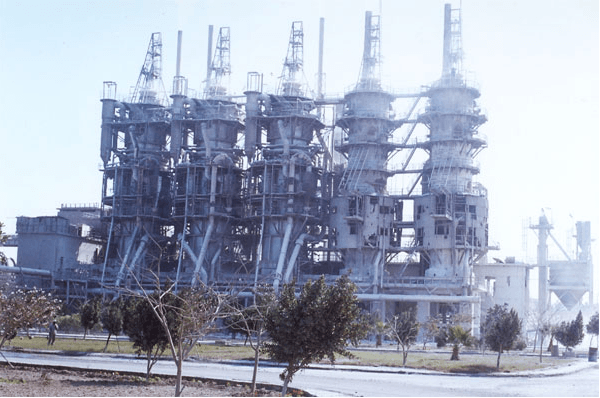
By excluding workers who will soon reach retirement age, the Public Enterprise Ministry is saving some LE350 million in compensation payouts as it lays off a workforce of around 6,200 in the process of liquidating one of its oldest subsidiaries, Egyptian Iron and Steel Company.
Around nine months after huge labor protests were sparked by the decision to close the company — once the star of a flourishing state industrial sector after Egypt won its independence and the site of seminal labor action in 1989 — and after months of negotiations about the settlement, the industry-wide union announced that a settlement to compensate 6,200 laborers had been signed on Thursday.
According to a member of Egyptian Iron and Steel’s trade union committee who spoke to Mada Masr on condition of anonymity on Sunday, the agreement will keep around 775 employees aged 58 and 59 at work for the company during the liquidation process until they reach retirement age at 60.
For the rest of the 6,200 who are covered by the compensation settlement, with payouts starting at LE225,000 and capped at LE450,000 (around US$14,322 to 28,646), at a rate of LE14,000 per year of service.
Given that the vast majority of the company's workers were hired straight out of graduate industrial schools, if the senior staff aged 58 and 59 were to be included in the compensation agreement they would merit the highest rate of severance pay for their years in service.
By keeping the senior staff employed until retirement and circumventing the need to give them severance pay, the Public Enterprise Ministry is ultimately saving LE350 million.
The member of the trade union said that this stipulation is intended to ensure that these older workers will not qualify for compensation payouts. Most of the workers in this age group are on the production side, said the trade union member, and the company won’t need much from production workers during the liquidation. “Liquidation only really requires administrative workers and accountants,” said the trade union member.
Salah al-Tayeb, one of the workers excluded from the deal said, “If the company was staying in business I would at least receive my dues from the company’s fellowship fund.” The fund, which comprises contributions from employees and a share of the company’s revenues, and provides liquidity for the payment of end-of-service benefits upon retirement worth four months’ worth of the baseline wage for each service year up to a maximum of 70 months.” Tayeb told Mada Masr that, after the liquidation, he now expects “only receive the value of my contributions to the fund after it is dissolved.”
According to the trade union member, compensation for these senior workers was among the biggest compromises that the company’s trade union had to make in settlement negotiations with the Public Enterprise Ministry and Manpower Ministry. The appointed liquidator, Mostafa Hassan, and the industry-wide General Union of Engineering, Metal and Electrical Workers were also involved in the talks.
According to the trade union member, compensation for these senior workers was among the biggest compromises that the company’s trade union had to make in settlement negotiations with the Public Enterprise Ministry and Manpower Ministry. The appointed liquidator, Mostafa Hassan, and the industry-wide General Union of Engineering, Metal and Electrical Workers were also involved in the talks.
At an earlier stage of the negotiations in May, trade union members also told Mada Masr that they were demanding compensation packages with a lower limit of LE400,000 and an upper limit of LE700,000, rather than the LE225,000 –450,000 range they ultimately accepted — the same figure that the Public Enterprise Ministry floated in its initial offer.
The union committee member said that, in general, the agreement, in general, offers less compensation than that made when the state-owned National Cement Company was liquidated nearly two years ago, even though the Egyptian Iron and Steel trade union committee used the National Cement deal as a model and argued that it should be worth more due to inflation, the source added.
Under the deal for the remaining 6,200 laborers concluded on Thursday, a separate payment for end-of-service benefits will be distributed at the rate of half a month’s wage for each year of service up to a maximum of LE50,000, and cash compensations for any due paid time off. The senior workers will get the same set of benefits when they retire.
The 6,200 will also receive a lump sum to compensate for early retirement, which the settlement sets at a rate of LE900 per month for each remaining year of service, in accordance with the 2019 law on social insurance and pensions.
An extraordinary general assembly of Egyptian Iron and Steel decided in January to liquidate the company due to the accumulation of its losses. Public Enterprise Minister Hisham Tawfiq had announced for the first time in May 2019 the formation of a committee to study and determine the fate of the company, headed by presidential advisor and former Prime Minister Sherif Ismail.
During his term in office, Tawfiq has revived the Mubarak-era privatization and overhaul of the public sector, having presided over the liquidation of the National Cement Company and the Egyptian Navigation Company amid a major overhaul of a sector that was reported to be burdened with LE40 billion in debt.
Amendments to the public sector law ratified in September 2020 alter bonus schemes to tie workers’ payments more closely to company profits, bring management structures closer in line with the private sector, allow for company management to be contracted out to private sector consultants, and reduce worker representation on company boards.
أخبار ذات صلة
Former employees sue to block sale of Eastern Company workers’ shares to Fidelity
Two hundred former workers at Eastern Company have filed a lawsuit to halt the payout of proceeds from the sale of the…
Egypt’s 1st hourly minimum wage: An ‘announcement to global markets that our labor is cheap’
Sources express fear that the decision will formalize and entrench an already precarious situation

New labor law, same pro-business bias
A decade after initiating the process to draft a new labor law, the government announced on November 6 that the bill had finally been completed after incorporating several amendments. The…

Following strike, Samanoud Textiles Company seeks to fire union leader
Samanoud Textiles Company launched a new lawsuit aiming to fire union leader Hesham al-Banna from the company, his lawyer Haitham Mohamedien told…
Your support is the only way to ensure independent, progressive journalism survives.
You have a right to access accurate information, be stimulated by innovative and nuanced reporting, and be moved by compelling storytelling. Subscribe now to become part of the growing community of members who help us maintain our editorial independence.
Join us