
Egypt’s 1st hourly minimum wage: An ‘announcement to global markets that our labor is cheap’
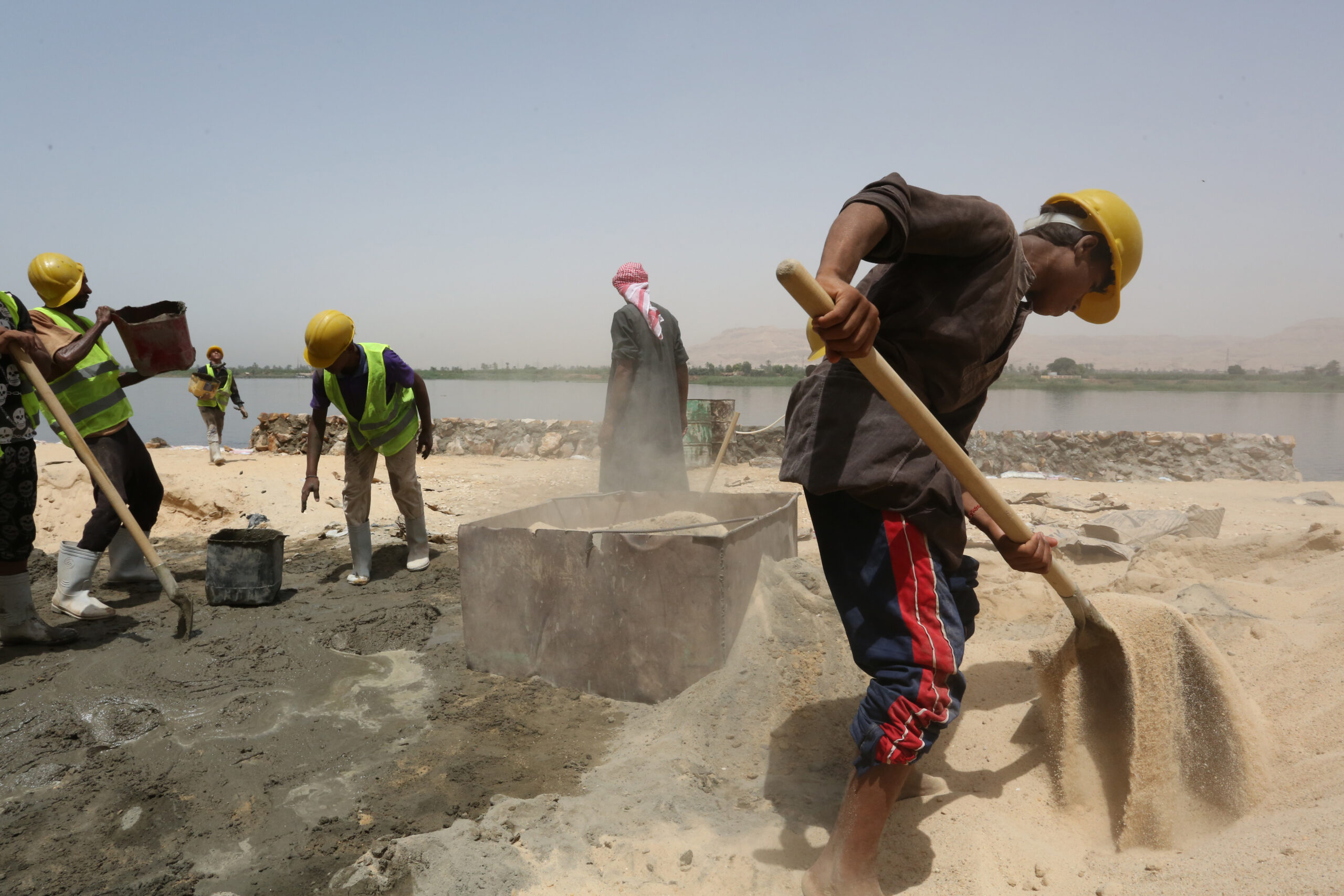
When the National Wages Council (NWC) announced a minimum wage increase for private sector workers effective March 1, it included a new component for the first time: a minimum hourly wage for “temporary” workers.
Their net hourly wage must not fall below LE28 — just over US$0.50 at the time of writing. The Labor Ministry later confirmed the move in a circular outlining the decision’s executive procedures.
While interpretations vary as to which of Egypt’s many temporary laborers the decision applies to, seven sources — including union organizers and hourly workers — told Mada Masr that the low value of the hourly minimum and the absence of enforcement mechanisms are major concerns.
These concerns reflect broader systemic issues in Egypt’s labor environment: a lack of oversight and legal protections for both permanent and non-permanent workers. With no clear mechanism for identifying and registering temporary laborers, and in the absence of strong, independent unions, most will remain outside the reach of any protections or wage standards, even when such standards are codified in law or dictated by government decisions.
Some sources even express fear that the decision will only formalize and entrench an already precarious and insecure situation for informal and irregular workers, particularly as foreign companies gain a growing foothold in the market.
***
‘This LE28-per-hour minimum is laughable’
In February, Magdy al-Badawy, deputy president of the Egyptian Trade Union Federation, described the hourly minimum wage for temporary work as “an important step toward regulating the labor market.”
But union organizers and hourly workers who spoke to Mada Masr criticized the proposed rate as too low, especially when compared to the monthly minimum wage set for public and private sector employees.
“Temporary employment is known to be predominantly found in the construction sector. With a typical seven-hour workday, this translates to LE196 per day, or LE5,069 per month, before tax deductions, which is well below the LE7,000 monthly minimum wage set for the private sector,” says Mohamed Abdel Qader, once secretary-general of the now dissolved independent union for irregular labor.
Mariam, a freelance translator, points to the same issue. Her work falls under the “flexible labor” category defined as temporary work in the new labor law, and she also believes the minimum wage is far too low — particularly since temporary workers typically lack contractual benefits like social and health insurance.
“LE28 per hour? Even if I worked eight hours every day, that’s around LE5,000 a month — still less than the monthly minimum wage for someone who is covered by insurance,” she says.
Ganna, another freelance translator and editor, noted that the value is even lower when taking into account the irregular nature of “flexible” work. “The real problem with freelance work is that it’s intermittent,” she says. “You take on a project or task, deliver it, and then wait with no income until the next one comes along. There’s nothing to cover your living costs in between. No social insurance if you get sick or can’t work,” she adds.
“So this LE28-per-hour minimum is laughable — it turns a blind eye to all of that.”
Who is eligible? Answers vary
Another major concern shared by most sources is the ambiguity over who exactly qualifies for the new minimum hourly wage.
The new labor law, passed by Parliament in April, preserves the old law’s definition of “temporary work:” labor that is part of an employer’s business but lasts less than a year; work tied to a specific task that ends upon completion; occasional work unrelated to the employer’s core business and lasting no more than six months; and seasonal work performed during well-known recurring periods, such as in the agricultural sector, which employs millions under this model.
Two new classifications were also introduced under the new law. The first is irregular workers, defined as those engaged in inherently non-permanent work paid in any form, or those working in occupations not governed by specific regulations, such as street vendors or newspaper sellers. The second is informal sector workers, referring to those employed within or outside establishments under unofficial or covert arrangements, in which workers are hired for one task but end up doing another.
But government and official union representatives interviewed for this piece offer differing interpretations of which worker categories the new hourly minimum wage actually covers.
Ehab Abdel Atty, legal advisor to the labor minister, says the decision applies to all forms of non-permanent and temporary work across all sectors — including irregular and seasonal labor. “Some people don’t even work a full month, others are paid daily, or work part-time or split their time between multiple jobs,” he says.
“Since their pay unit isn’t based on a monthly salary, the idea was to ensure they’re not excluded from receiving the minimum wage. According to international standards, an hourly minimum wage must be set, and that’s what this decision does.”
MP Solafa Darwish, head of the House Labor Committee and NWC member, who describes the wage as “a major achievement for workers’ rights,” also adopts a broad interpretation. She told Mada Masr the decision includes “informal labor, and individuals employed on a daily basis in some factories — those working partial daily shifts.”
But Badawy, head of the official union federation that works closely with the government, believes the decision mainly targets “flexible labor, meaning half-time or part-time workers,” and does not apply to other forms of non-permanent work such as seasonal, irregular, or informal employment.
The ambiguity around who is covered by the decision only compounds an already widespread issue for Egypt’s irregular workforce: the Labor Ministry’s longstanding failure to enforce existing laws and decisions on workers’ rights and entitlements.
Even those with permanent contracts struggle to secure the legal minimum wage, with the ministry unable to compel many employers to comply with the current LE,7,000 monthly rate. Both Kamal Abbas, general coordinator for the Center for Trade Union and Workers Services (CTUWS), and Abdel Qader observe. They point to waves of strikes in recent months demanding enforcement of the private sector minimum wage, noting that many business owners continue to dodge compliance on wages and social insurance contributions — tactics that thrive in the absence of effective oversight, as union and labor sources previously told Mada Masr.
Under these conditions, Abbas and Abdel Qader say, even the modest hourly wage introduced by the new law will be difficult to enforce.
Who is visible?
One of the main barriers to enforcement, according to Abbas, is the Labor Ministry’s failure to register and collect data on irregular workers. Without proper registration, these workers remain excluded from state grants intended to support them — and the same lack of documentation will likely disrupt the implementation of the new hourly minimum wage, according to Abbas.
There is no accurate official count of Egypt’s irregular workforce. In 2022, former Social Solidarity Minister Nivine al-Qabbag estimated the number to fall between 8 and 12 million. But Abbas tells Mada Masr that even the most conservative estimates place the figure at 13 million — and that’s after excluding several categories.
The true size of the irregular labor force could be significantly higher when accounting for Egypt’s informal economy, which represents between 50 and 60 percent of the national economy, according to a 2023 parliamentary study.
By contrast, the Labor Ministry’s database includes just 1.2 million registered irregular workers, according to recent comments from Labor Minister Mohamed Gobran.
The registration gap means that only about one in every 500 workers receives the five annual LE1,500 grants distributed on national holidays, according to Abdel Fattah Abdel Aziz, head of the General Union for Farmers.
“There’s still no real database for this workforce,” Abdel Aziz says. “And it remains extremely difficult to access and register workers, even though the Labor Ministry and its local directorates have departments dedicated to irregular labor and the management of the financial assistance fund.”
Although the new labor law dedicates, for the first time, a section to irregular labor — aiming to “regulate, support, and employ irregular workers and those in the informal sector”— as well as a section addressing new forms of employment such as remote, flexible, and part-time work, it fails to outline a clear mechanism to close the registration gap. Instead, the law leaves the responsibility in the hands of the Labor Ministry, according to a recent report by the CTUWS.
Even in cases where workers are registered, problems persist. Abdel Qader notes that some have been denied their state grants on the grounds that their registering employers failed to “update their records” — a pretext he calls a clear violation, as the responsibility for maintaining up-to-date information lies with the ministry itself.
Agricultural laborers, particularly those directly engaged in planting and harvesting, are a clear example of a workforce in dire need of proper registration and protection. These workers regularly face workplace and health hazards, such as the recent deadly road collisions in Monufiya, yet “there’s no legal method to register them with the ministry or for insurance,” Abdel Aziz says.
Hanaa Abdel Hakim — head of a small-scale farmers union in Samalut, Minya Governorate, who has organized training sessions to encourage health insurance registration among farmers — explains to Mada Masr that the way state social support programs are structured means it is often disadvantageous for agricultural laborers to be officially registered as irregular workers, considering the nature and precarity of their work.
One of the few forms of support open to irregular agricultural workers is inclusion in the Universal Health Insurance Law 2/2018, a crucial safety net for such dangerous lines of work.
“Anyone listed as a farmer or agricultural worker on their ID has the right to self-enroll in the system and access all benefits, including a health card and compensation in case of injury or death," Abdel Hakim explains.
But she notes that the monthly insurance subscription costs LE160, and membership is terminated if payments are not made for five consecutive months. Given the seasonal and unstable nature of agricultural work, many laborers simply opt out.
Additionally, amid worsening economic conditions, a significant portion of agricultural workers rely on Takaful and Karama, the state’s income supplementation pension programs, which pay around LE500 per month. These programs bar recipients from enrolling in any form of insurance, including health, prompting many to choose the steady cash support over monthly insurance payments.
Who will defend the new hourly wage?
For Abdel Qader, the deeper issue behind the vague terms and lack of an enforcement mechanism for the hourly wage decision is the structural weakness of Egypt’s labor organizing. “It comes down to the absence of strong trade unions to represent workers, the dominance of the state-controlled Egyptian Trade Union Federation, and the inexperience of newly formed unions,” says the former head of the independent union for irregular workers.
Both Abbas and Abdel Qader agree that robust unions are essential to monitor and support worker registration — a practice that has helped secure labor rights in many other countries.
But in Egypt’s current environment, where unions are disempowered and legal protections are limited, most irregular workers lack the means to make demands of their employers.
At a marble and ceramics company in Cairo, for example, a former middle manager tells Mada Masr that workshop staff, all irregular laborers paid weekly, once gathered outside the top management office to demand a higher weekly wage. But management quickly shut down the protest, the source says, halting any prospect of negotiation and making it clear that workers could either accept the current pay or leave.
Such diminished bargaining power gives employers the upper hand. A construction worker — part of a sector long known for its reliance on irregular labor — tells Mada Masr, on condition of anonymity, that construction companies often exploit downturns, like during the COVID-19 pandemic, to hire more irregular workers at lower daily rates.
In these conditions, protections boil down to luck, or employer goodwill. “I worked with Hassan Allam through a subcontractor,” the construction worker recounts.
“Everyone on the project signed contracts with no fixed term — they were essentially meaningless and non-binding,” the worker says. “You had no rights to claim. I injured my hand, was off work for three months, and had two surgeries. The company covered the first, and I appreciate that, but for the second, I got no response.”
“In most Egyptian companies, if you have an accident, the best you can hope for is a ride home,” they add.
A similar lack of bargaining power, or worse, also dominates fields like freelance translation, editing, and content production, where many “flexible workers” are employed. These sectors are increasingly dominated by outsourcing firms abroad, particularly in the United Arab Emirates and Saudi Arabia, which hire Egyptian workers at rates far below regional and international standards, operating on the assumption that workers can be easily replaced, both Ganna and Maryam note.
“The dynamic is clear,” says Ganna, who previously worked for an Emirati firm. “You’re cheap labor and they want the job done at the lowest cost. It’s like their model assumes high turnover. What they offer might seem decent in Egypt, but it’s far from fair compensation.”
With little recourse through domestic unions, international efforts to improve worker conditions have achieved limited results, if any.
In one example, UK Aid Direct made a developmental intervention at a strawberry farm in 2024. Program manager Hanan Shaheen tells Mada Masr that UK Aid met with workers who made three basic demands: safer transport to the fields — buses or microbuses instead of the dangerous trucks workers usually ride — permission to bring their children to work, and the construction of toilets in the fields.
While the farm owner agreed to the first two, UK Aid pledged to provide the toilets only if the company completed the program. But communication with the company broke off in December, and the toilets were never built, Shaheen says.
***
So what does the new hourly wage portend for Egypt’s labor market? For Badawy, head of the union federation, the new hourly wage is a step toward adapting to emerging employment models. He sees it as laying the groundwork for future demands to secure rights for workers under non-traditional contracts.
But with so many barriers to implementation, Abdel Qader — of the dissolved irregular workers union — warns that the move risks doing more harm than good. Rather than expanding protections, the new wage and labor law’s formal recognition of irregular work may normalize and allow for the proliferation of precarious labor conditions. It could “open the doors wide for employers to expand temporary, hourly employment in industrial establishments, leading to increased job insecurity and evasion of insurance obligations,” he says.
Ganna shares similar fears, particularly in the context of freelance translation, where middlemen and foreign outsourcing firms already dominate.
“A rate like [LE28 an hour] feels like an official announcement by the Egyptian government to the global market: ‘Yes, Egyptian freelancers are cheap. Not just cheap, almost free,’” she says. “That kind of benchmark drives down our ability to negotiate with clients even further.”
تقارير ذات صلة
Judges of tomorrow to be picked, trained by Military Academy, judicial sources say
Anchor Isaad Younis interviewed on Sunday a crew of newly hired government employees — judges, a diplomatic attaché, a school principal, a legal researcher at the Customs Authority, and an…
The cost of delivery: How the safety and welfare of essential delivery workers is discounted during lockdown
"If a delivery worker gets infected, they will easily replace him with another one"

Corona on set: A nonstop horror show
"I quickly realized that effective sterilization is practically impossible.”
Your support is the only way to ensure independent, progressive journalism survives.
You have a right to access accurate information, be stimulated by innovative and nuanced reporting, and be moved by compelling storytelling. Subscribe now to become part of the growing community of members who help us maintain our editorial independence.
Join us