
Lawmakers approve inclusion of economic agencies in state budget, accommodating IMF criteria
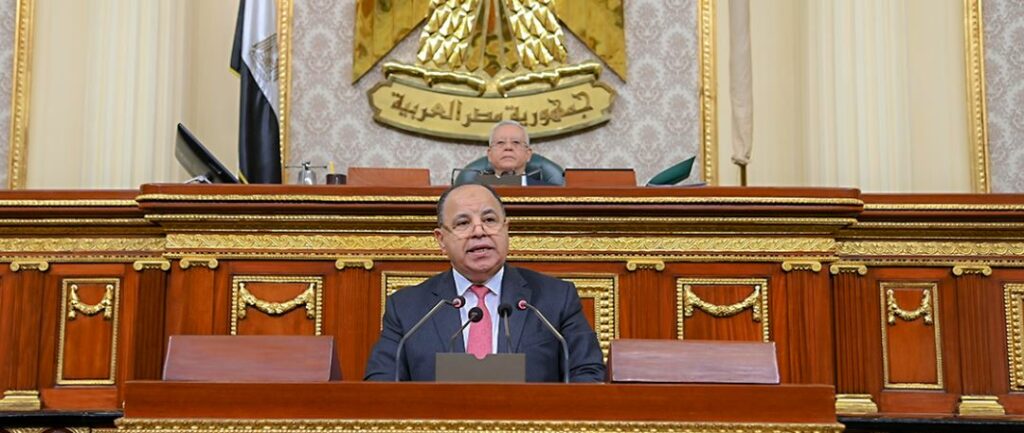
A new law approved by Parliament on Sunday is intended, in name at least, to incorporate Egypt’s economic agencies — bodies which are currently able to operate with partial financial autonomy — into the state general budget.
The legislation, submitted to Parliament at the end of February, entails a restructuring of budgetary practice and will see state finances edge closer to criteria determined by the International Monetary Fund.
The government has made a number of policy adjustments over recent weeks, described by some as directed to meet policy recommendations which came with the fund’s 2022 loan and which the government has stalled on implementing.
“IMF experts reviewed the draft bill after its formulation and endorsed its directions,” said a prominent government official directly involved in drafting the bill, speaking to Mada Masr on condition of anonymity.
The new directions, however, do not affect the budgetary autonomy of special funds, another type of entity which by some estimates hit at least US$9.4 billion worth in state finances.
According to MP Mohamed Badrawy, a member of the Planning and Budget Committee, economic entities fall into three categories: non-profit service entities that provide public support, public non-profit entities that are expected to be self-funded and for-profit economic entities.
The economic entities affected by the law have been historically able to set and seek lawmakers’ approval for their budgets independently of the general budget.
They are able to receive subsidies or financial allocations designated in the general budget. For example, an economic entity handling agricultural affairs may be able to claim state-subsidized fertilizers.
Any budget surplus accrued by an economic entity is also paid back into the public treasury.
But the entities leave the treasury in the red. In the budget for the current fiscal year, the net relationship between the general budget and economic agencies was more than negative LE182 billion (nearly US$5.9 billion), with the economic entities claiming a far greater amount in allocations from the budget than what the entities pay back in.
Gains to the general budget came from just a few of the over 50 agencies, primarily the Suez Canal Authority, the Egyptian General Petroleum Corporation and the New Urban Communities Authority.
Under the new version of the Unified Public Finance Law, some of the budgetary features of economic entities will be presented in the state general budget, increasing the degree of compatibility between the two. Their individual budgets will not be fully integrated into the general budget, however.
The bill, of which Mada Masr obtained a copy, stipulates that over the coming five years, economic entities' resources and expenditures should be gradually included in the overall picture of how public finances are presented.
It also requires that the government set an annual maximum ceiling on acceptable debt levels, including the debt of the state general budget and of economic public entities. The value is to be determined as a percentage of the expected GDP per fiscal year. The legal amendments allow, however, for exceptions to the debt parameters to be determined on a case-by-base basis.
“Exceeding the maximum limit of the government's debt” is prohibited, the law says, “except in cases of necessity and national emergencies, after being presented to the president and approved by the Cabinet, based on the Finance Minister's presentation and Parliament’s approval of amending the state’s general budget law.” The text does not define what circumstances would justify waiving the debt obligation on the basis of emergency or necessity.
The planned gradual integration is set to see “all indicators of public finance” ultimately calculated “based on the resources and expenditures of the state general budget.”
According to the law’s amendment, this should include a five-year record of the “total resources and expenditures of economic entities after excluding the mutual budgetary relationship as per the state general budget law.”
“The exclusion of the mutual budgetary relationship” is a principle intended to unify accounting and prevent duplications, explained Badrawy. For example, expenditure in the current general budget is allocated to the General Authority for Supply Commodities to allow it to procure goods to be provided at subsidized rates to the public.
The quantity allocated to GASC would appear as a resource in its individual budget, while it would appear as an expense in the general budget.
“When applying the concept of the state general budget, including the subsidies twice would be an accounting error," said Badrway, explaining how the amalgamation of economic entities with the state general budget will work.
The goal is to enhance how public finance indicators are presented, explained Badrway, clarifying that the amendment does nothing to alter actual state spending or revenue.
The government official involved in drafting the approved bill likewise said that the amendments are intended to enhance the visual representation of public finance indicators, which will positively impact how many international institutions assess the state's general budget.
“For this reason, the law stipulates a phased inclusion of these entities into the state general budget, as their immediate integration would have an overall negative impact given the losses that many of them incur,” they said.
The source justified the separation which the law preserves for economic entities’ budgets by saying that the entities follow different accounting principles than those used for the general budget, since “the essence of economic entities is based on economic principles fundamentally aimed at generating profits.”
Badrawy was positive about the incorporation of economic entities into the state general budget. Under the amendments, economic entities will be presented to Parliament more clearly than the current statistical report on their performance, he said.
“This step will carry a positive impact on the range of data being presented from economic entities,” Salma Hussein, research director at Friedrich Ebert Stiftung Middle East and North Africa, told Mada Masr.
Hussain added that “amending the law to enhance the presentation of data from economic entities through their integration into the state general budget is part of the agreement between the government and the International Monetary Fund (IMF).”
“The agreement stipulates the government's commitment to applying the Government Finance Statistics Manual standards issued by the IMF, serving as a benchmark for presenting general budget data,” she said.
أخبار ذات صلة

Govt’s ‘national economic narrative’ lays bare constitutional breaches in spending, signals continued limits to survey data
The Planning Ministry released on Sunday the National Narrative for Economic Development, a document first announced last week as the government’s program…

Domestic natural gas declines further as govt increases imports from Israel
Natural gas produced at Egypt’s largest field, Zohr, continued to decline over the course of 2023, according to reporting by the Middle…

Sources: US, Egypt and Israel agree to reduce the Israeli input in QIZ agreement products
Egypt, Israel and the United States have agreed to lower the required Israeli component in duty-exempt Egyptian exports to the US from…

Unsweetened days: How the sugar crisis was stirred by government policy missteps
Another sugar crisis spells out longer queues and shortages as government rushes to address problem.
Your support is the only way to ensure independent, progressive journalism survives.
You have a right to access accurate information, be stimulated by innovative and nuanced reporting, and be moved by compelling storytelling. Subscribe now to become part of the growing community of members who help us maintain our editorial independence.
Join us