
Unsweetened days: How the sugar crisis was stirred by government policy missteps
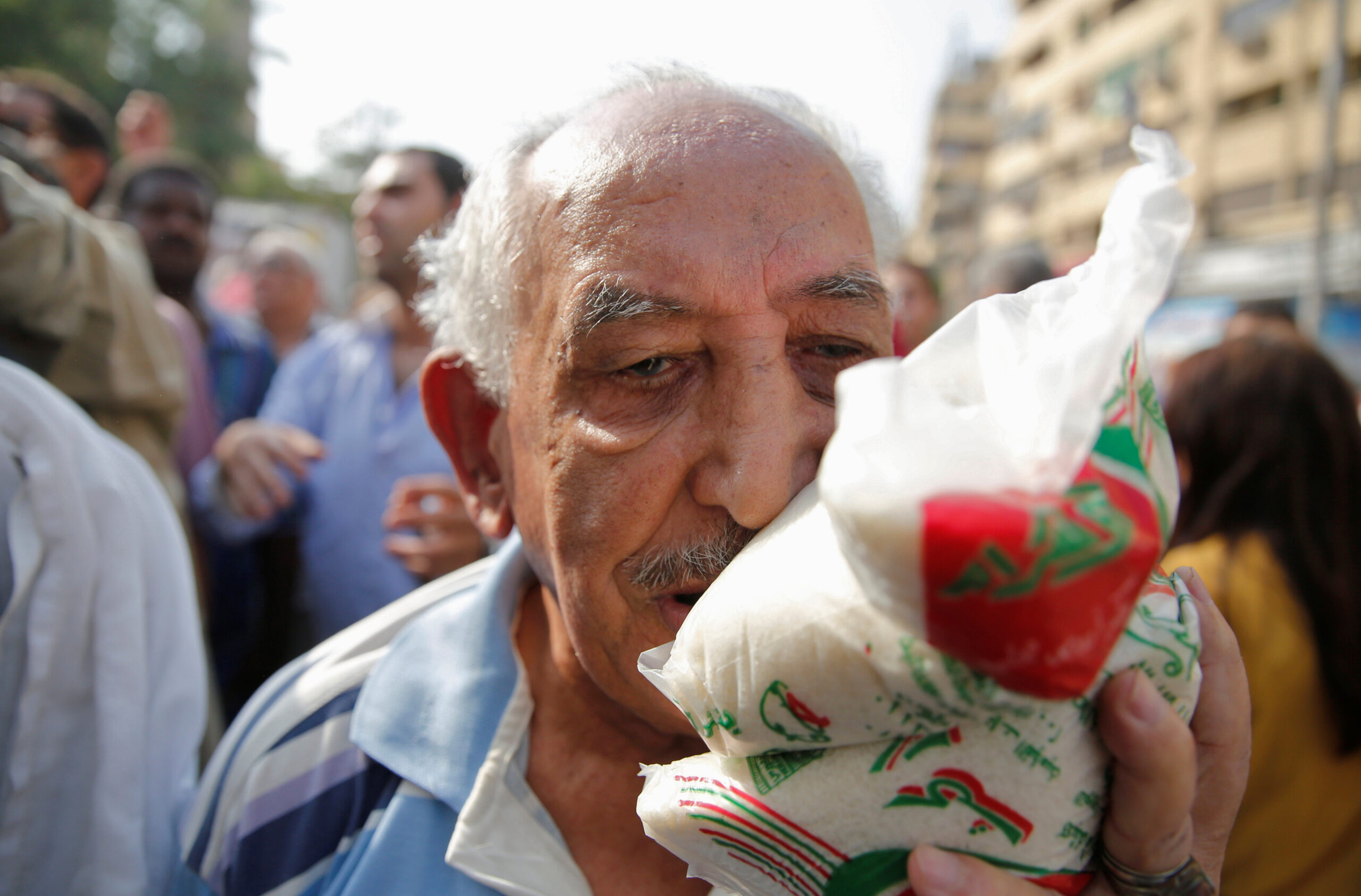
In a televised interview last week, Supply Minister Ali al-Moselhi apologized to citizens for the months long sugar crisis that has been marked by shortages and a 275 percent price increase compared to last year. During the interview, the minister called on citizens to “calm down a bit” and endure, advising them not to purchase sugar until the "crisis" is resolved, a resolution he promised would come by December 15.
The extent of the crisis can be seen in queues outside food outlets. Those standing in lines tell Mada Masr they wait for hours only to receive 2 kilograms of sugar each. In some areas, it is only 1 kilogram. Despite the minister's assurances, the long queues remain unchanged.
Sugar shortages and consequent staggering price increases are nothing new, with markets beset by repeated cycles of crisis. The most comparable crisis to what consumers are facing now happened in 2016. Similarly, back then the government blamed “greedy traders” without acknowledging that its own decisions had been a significant contributing factor to the crisis.
***
Egypt's annual sugar production amounts to approximately 2.8 million tons. This includes 835,000 tons from sugarcane and 1.7 million tons from beetroot produced by both government and private sector companies, in addition to 250,000 tons of sweeteners extracted from corn, according to a report by the Council for Sugar Crops for the year 2022 obtained by Mada Masr.
On the other hand, Egyptians consume over 3 million tons of sugar, of which about 1 million tons are allocated for ration card holders, according to Moselhi's statements. Thus, there is a gap of up to 600,000 tons between domestic production and consumption. Most of this gap is filled by the private sector through imports. The Supply Ministry has also made exceptions to import quantities for local markets through tenders, as stated by Moselhi.
The first signs of the crisis emerged several months ago, after the end of the sugar beet planting and harvesting season, which takes place over three cycles during the year.
With the beginning of the first cycle, unusually high temperatures forced many farmers to refrain from planting beetroot, resulting in a decrease in crop volumes. In the following two cycles, farmers expanded the areas of beetroot cultivation to compensate for the shortage in the first cycle. However, this led to an oversupply of crops that went beyond the capacity of factories.
This oversupply and subsequent delay in manufacturing operations yielded faulty beetroot crops with lower sweetness than usual and ultimately led to a decrease in sugar production.
At the same time, sugarcane cultivation areas decreased by about 21,000 acres compared to the previous season, as acknowledged by Moselhi during his televised interview.
Nevertheless, the shortage in total sugar production was not more than 100,000 tons, which represents only 3.5 percent of the annual production and does not exceed 3 percent of Egypt's official estimates for sugar consumption.
As is usually the case, the Supply Ministry began procuring its needs from factories to meet the demands of ration card holders. Likewise, packaging companies, which used to import and refine raw sugar before re-exporting or supplying markets with it, adopted the same approach.
However, due to constraints on imports and challenges in obtaining necessary hard currency, these companies have resorted to purchasing sugar from the domestic market and exporting it to capitalize on higher prices abroad, while saving on scarce hard currency, according to the supply minister’s televised comments.
After weeks of harvesting, the Supply Ministry noticed the increase in sugar export rates, prompting a decision to ban them in March, with some exceptions granted in cases of surplus.
Sugar exports came in at US$394 million in the first nine months of 2023, with just shy of $51 million recorded in January and February alone (just a few days before the export ban was issued on March 20). This means that the value of exports after the ban stands at approximately $343 million, owing to those exceptions.
Exceptions continued to be granted, which led to the increase in exports. Meanwhile, sugar import rates declined rather than increasing to fill the gap, according to Moselhi’s comments and industry sources who spoke to Mada Masr.
To address the shortage, the Supply Ministry imposed on May 9 distribution limits on subsidized sugar, restricting ration cards covering four individuals or more to 6 kilograms. Additionally, the price of sugar was raised from LE10.25 per kilogram to LE12.6. The ministry justified this increase by the rise in global commodity prices, increased shipping costs, and the government's wish to narrow the gap between subsidized and free-market prices, a Supply Ministry source tells Mada Masr. These new restrictions succeeded in reducing the monthly demand for sugar from approximately 80,000 tons to around 65,000 tons, according to sources in the sector.
However, the sugar shortage worsened, particularly as food manufacturers increased their purchases from the limited supply without sufficient replenishment from imports, according to sector sources.
The crisis began to take shape as prices soared to record levels before supplies completely vanished from store shelves. Traders began hoarding their valuable sugar supplies due to increased demand and limited availability, an importer and trader tells Mada Masr.
In an attempt to alleviate the pressure, the Supply Ministry decided to intervene by importing raw sugar for the Holding Company for Food Industries in July, which would then be refined and released to the private sector. However, the quantities contracted by the Supply Ministry did not arrive until September, leaving the crisis unchecked over July and September.
While awaiting the shipments, the government opted for a more decisive intervention by offering sugar through commodities exchange outlets in mid-August, in an attempt to flood the market and lower prices. However, the situation did not improve. As a result, the government changed its plan in the beginning of October.
The new plan implemented by the Supply Ministry can be described as their tried and tested approach, having been previously employed during a similar crisis in 2016. The plan of action mostly consists of "holding the purse strings and cracking the whip to keep [everyone] in line," as described by an importer and trader to Mada Masr.
To break the monopoly of sugar traders, the government assumed control of the market. With the arrival of imported shipments, it amassed a large stockpile. The first procedure in the new plan was a verbal decision issued in October, prohibiting government-owned sugar factories, about 80 percent of all 15 facilities, from supplying sugar to any trader, company, or outlet, except through the commodity exchange market, three sources in the sector tell Mada Masr.
The decision did not take into account that hundreds of companies and thousands of distributors nationwide cannot register in the exchange market to purchase sugar for various reasons, including high insurance costs, lack of official registration of the company, or the absence of a company altogether, according to the sources. The Supply Minister acknowledged this oversight in his televised statements, where he said they realized the mistake later and worked to rectify it without specifying how.
This measure has confined buyers to 15 tenders listed on the commodities exchange between August and the end of last week to sell 177,000 tons of sugar to major traders and companies. The measure facilitates monopolization, making it difficult for wholesalers, retailers, consumers and traders across governorates to purchase sugar from the few large companies that obtain it through the commodities exchange.
Furthermore, some food manufacturers have started selling excess sugar, after meeting their needs, to packaging companies that are not registered in the exchange at LE37,000 per ton. That is a 23 percent markup compared to sugar prices in the commodities exchange, which don't exceed LE30,000 per ton, packaging factory owners told Mada Masr.
The government rectified this supply leakage and, days ago, decided to suspend all dealings with 10 companies for failing to comply with the exchange’s regulations regarding the selling and trading of sugar, in relation to quoted prices and quantities.
The second procedure in the government's plan involved conducting extensive raids on traders and factories to confiscate any stockpiles of sugar. The campaigns have already succeeded in confiscating several tons of sugar in various governorates. However, these types of raids have prompted traders to become more secretive in their storage practices, rather than selling their stock, according to various sources in the sector.
Furthermore, 75 percent of packaging factories have temporarily ceased operations due to law enforcement raids and inspections targeting companies, as reported by a packaging company source to Mada Masr.
Small shop owners, some supermarket chains, and small-scale distributors have also decided to distance themselves from these developments. "I have five tons of sugar that I distribute in my area in Giza. If they catch me, they will take it from me and accuse me of hoarding. Even if I have an invoice, the best-case scenario is that they’ll take it without filing a case. That's why I’ve stopped buying sugar until things calm down," says a wholesale trader to Mada Masr.
Small grocery store owners are doing much of the same in order to “avoid the hassle,” as one source puts it.
The temporary halt of most packaging factories and the refusal of small shops, retailers, and wholesalers to sell sugar has further exacerbated the crisis.
The government pressed on with its plan by implementing stricter measures. Moselhi announced a deadline for traders who had hoarded sugar and raised its price to LE50, giving them ten days to reduce prices. Failure to comply would result in the government imposing mandatory pricing on sugar. However, the threat did not succeed, and a few days later, the price of a bag of sugar rose to LE60.
The Supply Ministry followed the same steps in the sugar crisis of 2016, reaching the same outcome. In both instances, the crisis worsened, leading to longer queues, until the ministry was compelled — after realizing these mistakes, as Moselhi said — to reverse its initial decisions.
In his statements, Moselhi says that the ministry worked to rectify the mistakes, allowing the market to return to normal, without providing further details. Industry sources tell Mada Masr that the Supply Ministry canceled its October plan and reinstated sugar trading to its traditional channels — through traders and food companies.
Moselhi also announced that the responsibility for sugar imports would now rest with the ministry instead of the private sector. Without specifying the agreement's details, he stated that the government's future sugar imports would be agreed upon with traders, with the condition that the price per kilo does not exceed LE24 after the crisis.
Despite the government's reversal of its decision last week, the sugar crisis remains unchanged. Sugar is still scarce, and available quantities are priced at up to LE60. On Friday, Moselhi issued a directive to increase the availability of sugar allotted to ration cards covering four persons or more to 2 kilograms, priced at LE27 per unit.
A trader explained to Mada Masr that the process of providing sugar through its customary channels may take days to return to normal. Even then, he adds, the changes in prices and the availability of sugar will not be significant because most traders have decided to store sugar until after the anticipated exchange rate liberalization following the presidential election. "Most traders are currently storing sugar in homes rather than warehouses because entering homes requires a warrant, unlike warehouses,” he says. “Hundreds of apartments are now filled with sugar, and it won't come out until after the flotation.”

تقارير ذات صلة
Have the IMF’s promises to Egyptians come true?
The IMF did not only promise growth, it also promised inclusive, job-rich growth.
Sources: Officials delayed survey results showing Egyptians face highest poverty rate since 2000
The survey results show 32.5% of Egyptians live below the poverty line, the highest rate in decades
Some people prefer working in the shadows
The state approaches the issue as a strictly binary one leading to a simplified view of the economy
Your support is the only way to ensure independent, progressive journalism survives.
You have a right to access accurate information, be stimulated by innovative and nuanced reporting, and be moved by compelling storytelling. Subscribe now to become part of the growing community of members who help us maintain our editorial independence.
Join us