
UPDATE: Senior Hezbollah commander assassinated in Beirut airstrike was meeting with Radwan forces leadership
Hezbollah senior commander Ibrahim Aqil was assassinated in an Israeli airstrike on the southern Beirut neighborhood of Dahiyeh on Friday afternoon, Agence France-Presse (AFP) and Reuters independently reported.
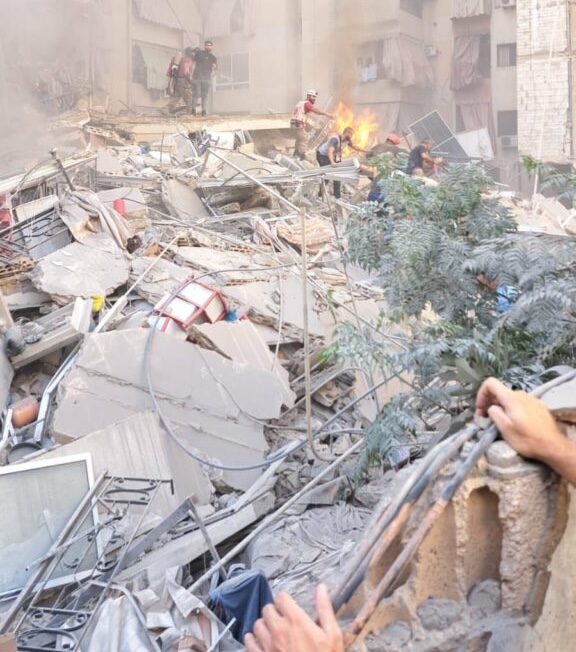
The airstrike took down two residential buildings in Beirut’s Jamous Street, according to the Lebanese Civil Defense. Search and rescue is ongoing but the Lebanese Health Ministry has given a casualty count of 12 killed and 66 injured.
According to a Hezbollah source who was in the area at the time of the airstrike and who spoke to Mada Masr on condition of anonymity, Aqil was in a meeting with Radwan forces leadership at the time of the airstrike.
The source said that people at the scene were still working to retrieve those who were inside the buildings from under the rubble, making it impossible to be able to say who was killed and who survived the strike.
A Lebanese security source told Reuters on Friday night that Aqil had been killed “alongside members of Hezbollah's elite Radwan unit as they were holding a meeting.”
Following the strike, the Israeli military acknowledged that it had carried out the strike and claimed that Aqil and “the top leadership of the operations apparatus and the chain of command of the Radwan Unit were eliminated in the strike."
The Radwan Force is an elite unit within Hezbollah’s military wing reported to consist of a few thousand specially trained forces. The unit operates in the south of Lebanon and was created to conduct offensive operations into Israeli-held territory.
Preliminary images showed pillars of smoke rising from the site of the explosion in Dahiyeh visible from across Beirut. In Dahiyeh, the scene was chaotic as residents and passers-by rushed to leave the area or to retrieve belongings from among the rubble and glass strewn across the street. First responders at the scene worked to extinguish the flames and remove those trapped under the rubble.
Aqil, whom Israeli media initially reported was the main target of the attack conducted during a meeting of Hezbollah leaders, was a member of Hezbollah’s Jihad Council, the body responsible for military and security decisions within the party. He also headed the elite Radwan Force and was coordinating military operations in the southern front.
Aqil had long been wanted by both the United States — for his alleged role in the 1983 bombing of a barracks in Beirut housing American and French service members of the Multinational Force in Lebanon, a peacekeeping force deployed during the Lebanese civil war — and Israel.
The Lebanese judiciary accused Aqil of attempting to assassinate former Prime Minister Shafik al-Wazzan in 1983.
Following the strike, the Israeli military acknowledged it had conducted a "targeted strike" in Beirut, without giving further details.
"The IDF [Israel Defence Forces] conducted a targeted strike in Beirut. At this moment, there are no changes in the Home Front Command’s defensive guidelines," Israeli military spokesperson Avichay Adraee tweeted on Friday.
The assassination of Aqil marks the second time in two months that Israel has killed a senior figure in the military wing of Hezbollah. In July, Israel assassinated Fouad Shukr, the party’s top military commander.
Friday’s assassination follows a week of escalation pushed by Israel, after it detonated thousands of pagers and wireless mobile devices that had been rigged with explosives before being imported into Lebanon and distributed to Hezbollah members. The devices exploded simultaneously across the country, while those holding them were in public space.
The attacks, which played out over the course of Tuesday and Wednesday, left 37 dead and 2931 injured and panic running through Lebanon.
Speaking on Thursday, Hezbollah leader Hassan Nasrallah acknowledged that Wednesday and Thursday’s attacks were a major blow, saying that investigations were ongoing into how the pagers and wireless devices were tampered with. The group remains steadfast, however, in its intention to continue launching strikes against Israel until there is a ceasefire deal in Gaza, and to prevent Israeli citizens from returning to the areas they have left in the north, Nasrallah added.
On the heels of the week’s events, Israel conducted some of its fiercest bombings yet on Thursday night and into the early hours of Friday morning in the south of Lebanon, where it has launched low-grade but continuous airstrikes since late last year. The Israeli military stated on Friday morning that it had conducted strikes on 100 targets in southern Lebanon last night.
Israeli Prime Minister Benjamin Netanyahu, who has faced growing internal criticism for continuing Israel’s war on Gaza and sabotaging ceasefire negotiations, stated last week that he was working to return Israeli nationals who have left their homes in the north, adding that this would require “a change” in the deployment of Israeli military forces to the north. Around 100,000 Israeli residents of the north are reported to have left the area due to Hezbollah’s strikes since October 8.
Successive US envoys have attempted to defuse tensions to no avail, as Israel continues to escalate.
In the wake of the attack, an Israeli official said that the political and military leadership in Tel Aviv has reached the conclusion that it won’t be able to get a diplomatic solution to the tension on the northern border without going through military escalation. “This is why we have been gradually taking our gloves off and increasing our attacks against Hezbollah,” the official added.
Before Friday’s attack, Israeli airstrikes had killed 627 people in Lebanon, including at least 141 civilians, according to an AFP tally.
This text was edited after publication to reflect updated information.

أخبار ذات صلة
Israel launches ground incursion into south Lebanon, Lebanese govt reviews scenarios as military withdraws
Israeli forces began an incursion into south Lebanon on Tuesday under cover of airstrikes, its military announced. While the Israeli military downplayed…

The ‘open battle’ comes to Lebanon
In the Lebanese border village of Ainata, Batoul Ismail was awoken by her mother shortly after midnight with the news: rockets had…
Shutdowns at Gulf industrial facilities as scope of US-Israel war on Iran widens
Iranian strikes over the last 24 hours began to hit Gulf industrial and logistical hotspots, leading to shutdowns at key facilities —…
As Israel ramps up strikes on Lebanon, Egypt’s intelligence chief joins international push to de-escalate by kickstarting talks
“Calming the situation in Gaza should reflect positively on the region,” Egypt’s ambassador to Lebanon, Alaa Moussa, told reporters at a press…
Your support is the only way to ensure independent, progressive journalism survives.
You have a right to access accurate information, be stimulated by innovative and nuanced reporting, and be moved by compelling storytelling. Subscribe now to become part of the growing community of members who help us maintain our editorial independence.
Join us