
Shutdowns at Gulf industrial facilities as scope of US-Israel war on Iran widens
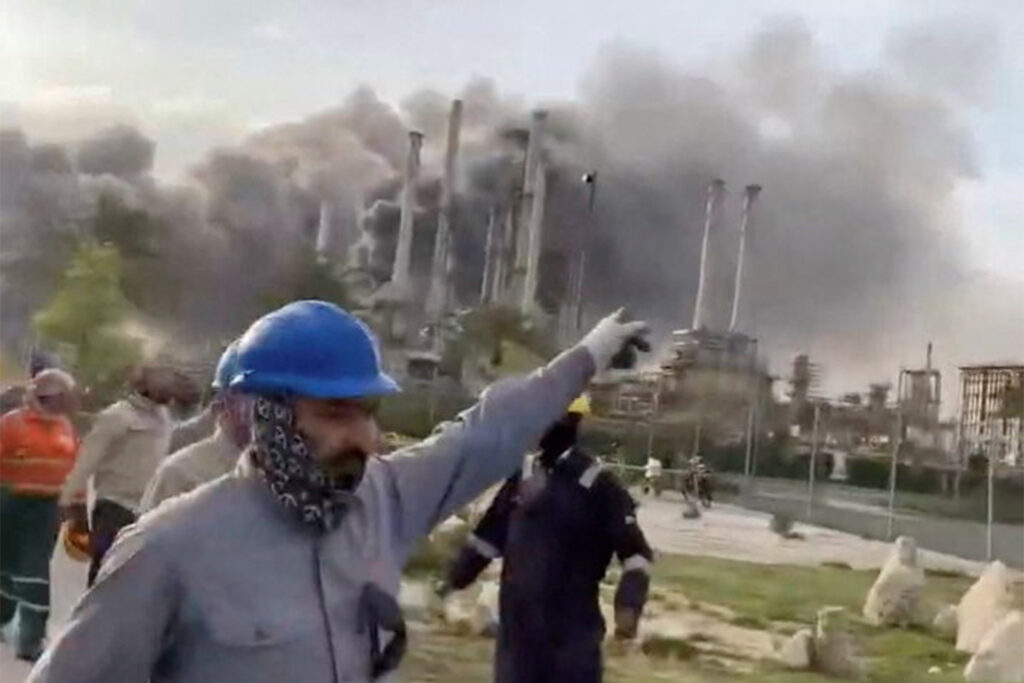
Iranian strikes over the last 24 hours began to hit Gulf industrial and logistical hotspots, leading to shutdowns at key facilities — including Saudi Arabia’s biggest oil refinery and Amazon’s facilities in the United Arab Emirates — as the shock of the war that Israel and the United States began on Saturday continues to shudder through the region.
The stakes of the conflict continue to escalate on the third day of the war that has spilled across the region, with Hezbollah launching strikes at Israel and the Houthis threatening to do the same and Iran openly rejecting a return to negotiations.
Western powers, meanwhile, have started to volunteer their readiness to back the US and its allies in the Gulf, as both US President Donald Trump and Israeli Prime Minister Benjamin Netanyahu increasingly speak of an extended aggression.
US-Israeli strikes have simultaneously continued to rain down throughout Iran, with state media reporting over 500 people killed.
The Iranian Red Crescent said that 131 cities have been affected and 555 people killed, while state media agency, Fars, reported military attacks hitting eastern, western and southern Tehran once again at dawn on Monday. The agency said that key military and police facilities in the city had been targeted the previous day and an unspecified number of people killed.
In Saudi Arabia, a drone attack sent billows of thick smoke soaring over the country’s largest oil refinery, Ras Tanura, on the coast of the Persian Gulf, in the first strike to hit the energy facilities that underpin the economy of the Gulf’s richest nation.
State oil company Aramco said the facility has been shut down, with a spokesperson for the Saudi Defense Ministry explaining on Al Arabiya TV that two drones targeting the facility were intercepted, with debris causing a limited fire. He added that there were no injuries.
In Bahrain, falling debris from the interception of an Iranian missile caused a fire to break out on a ship in Salman Industrial City, killing a foreign national working at the facility and causing serious injuries to two other people, according to the country’s Interior Ministry. An Iranian missile also hit a maritime facility near the Salman Port causing a fire to break out, the ministry said.
Iranian fire has already extended from port facilities in Oman to energy facilities in Haifa.
The missile and drone strikes at key logistical and trade facilities in the region expand the scope of the spiraling conflict, extending from the US military facilities in the Gulf that predominated Tehran’s first round of retaliatory attacks to key elements of civilian infrastructure.
In Kuwait, several US warplanes were filmed toppling out of the sky Monday morning, with the Kuwaiti military announcing that they “fell” and their crews were evacuated safely, without stating the number of jets or those affected.
In south Kuwait City, eyewitnesses reported flames rising in the morning from the US Embassy compound following another Iranian attack. Earlier, the US had issued an urgent warning to its citizens in Kuwait to remain indoors, “not come to the Embassy.”
US air bases in all of Erbil, Bahrain and Qatar were also hit by Israeli strikes.
One person was killed in Kuwait and over 30 injured, according to the Kuwaiti Health Ministry, while the Emirati Defense Ministry reported three killed and the Qatari Interior Ministry said 16 people were injured.
The US Central Command reported Sunday that three of its personnel had been killed in Iran’s response.
Israeli authorities have reported a total of eight people killed in Iranian strikes across the country.
The scope of the Iranian response also extended on Monday to Cyprus, where a UK airbase was hit by a drone attack, the first attack on the facility since 1986. No one was killed.
The attack came a day after United Kingdom Prime Minister Keir Starmer announced that he had given the US permission to use British airbases for “defensive strikes” against Iranian missiles.
Meanwhile, Cypriot President Nikos Christodoulides stressed that his country is not involved in any military operations.
Breaking its abstention from participating in the first 48 hours of the war, Hezbollah launched rockets over the southern border of Lebanon into Israeli territory shortly after midnight on Monday. The group said it struck Israeli military positions in Haifa in response to the killing of Iran’s Supreme Leader Ali Khamenei.
The Israeli military retaliated immediately with heavy strikes on Beirut’s southern district and southern Lebanon, killing 31 and injuring 149, according to an initial count issued by the Lebanese Health Ministry.
This is the group’s first return to active fighting since a ceasefire was reached in November 2024, although Israel has continued to attack Lebanon almost daily since then, killing hundreds in strikes on the country’s southern and eastern villages.
The front’s ignition raises the prospects of another extended Israeli aggression against Lebanon, with Israeli military Chief-of-Staff Eyal Zamir saying Monday morning that he expects the fight with Hezbollah to extend for many days. The Israeli military said it is prepared for an “all-fronts scenario.”
Despite the US floating the prospect of “off-ramps” for a negotiated end to the war it launched with Israel on Saturday, the immediate horizon of a diplomatic solution has receded as per official comments in recent hours.
Iranian security chief Ali Larijani denied on Monday morning a report that he had privately sought a diplomatic off-ramp through Omani mediators, stressing in a post on X that Tehran “will not negotiate with the United States.”
In another X thread, he stressed that “the armed forces of Iran did not initiate the aggression” but is only defending Iran against an aggression launched by the US.
“Trump plunged the region into chaos with his ‘false hopes’ and now fears more American troop casualties. With his delusional actions, he turned his self-made ‘America First’ slogan into ‘Israel First’ and sacrificed American soldiers for Israel's power-hungry ambitions,” Larijani said.
The Iranian security chief also directed a message to “the countries of the region,” saying that they are not the intended target of the attacks, but the US military bases they host which are used to attack Iran. He argued that Iran can target those bases because they “are not on the territory of those countries; they are American territory.”
Trump does not seem to have a plan for ending the conflict soon either. In a telephone interview with The New York Times, the US president said the US and Israel intend the attacks to continue for “four to five weeks,” assuring the reporters that the US has enough ammunition reserves to sustain such an attack. The NYT, however, echoed concerns from the Pentagon that the conflict could deplete those reserves if it goes further than a few days.
France also announced on Monday its readiness to join the conflict on behalf of the Gulf states. “We stand ready to contribute to their defense, based on their request,” French Foreign Minister Jean-Noel Barrot said. He referred to the US and Israel’s initial assault as “unilateral strikes” that should have been discussed by the UN Security Council, and called on Iran to cease attacks and offer major concessions in return for peace.
On the other hand, German Foreign Minister Johann Wadephul denied on Monday Israeli reports that Berlin is “seriously considering” joining the conflict, stressing that Germany “has no intention of participating.”
أخبار ذات صلة
Kurdish forces taking up arms in Iran could drag Turkey into the war
When Syrian forces moved into Kurdish-held territories in northeastern Syria in January, Turkish officials let out a sigh of relief. The “Kurdish…

Tehran hit with fresh attacks, Iran sends missiles toward Israel, Gulf states vowing renewed force after supreme leader’s assassination
Further blasts shook the Iranian capital, Tehran, on Sunday morning, part of a renewed wave of attacks in the offensive that Israel…
How Iran may have found a new deterrence mechanism in its war with Israel
Over the course of two years of regional war, Al Jazeera’s Doha studio has been the epicenter of television coverage on the turbulent events that have touched nearly every country.…

‘It felt like time stopped:’ Israel launches 100-strike attack across Lebanon despite ceasefire announcement
Israel launched a sweeping wave of at least 100 airstrikes across Beirut and the rest of Lebanon on Wednesday afternoon, shattering hopes…
Your support is the only way to ensure independent, progressive journalism survives.
You have a right to access accurate information, be stimulated by innovative and nuanced reporting, and be moved by compelling storytelling. Subscribe now to become part of the growing community of members who help us maintain our editorial independence.
Join us