
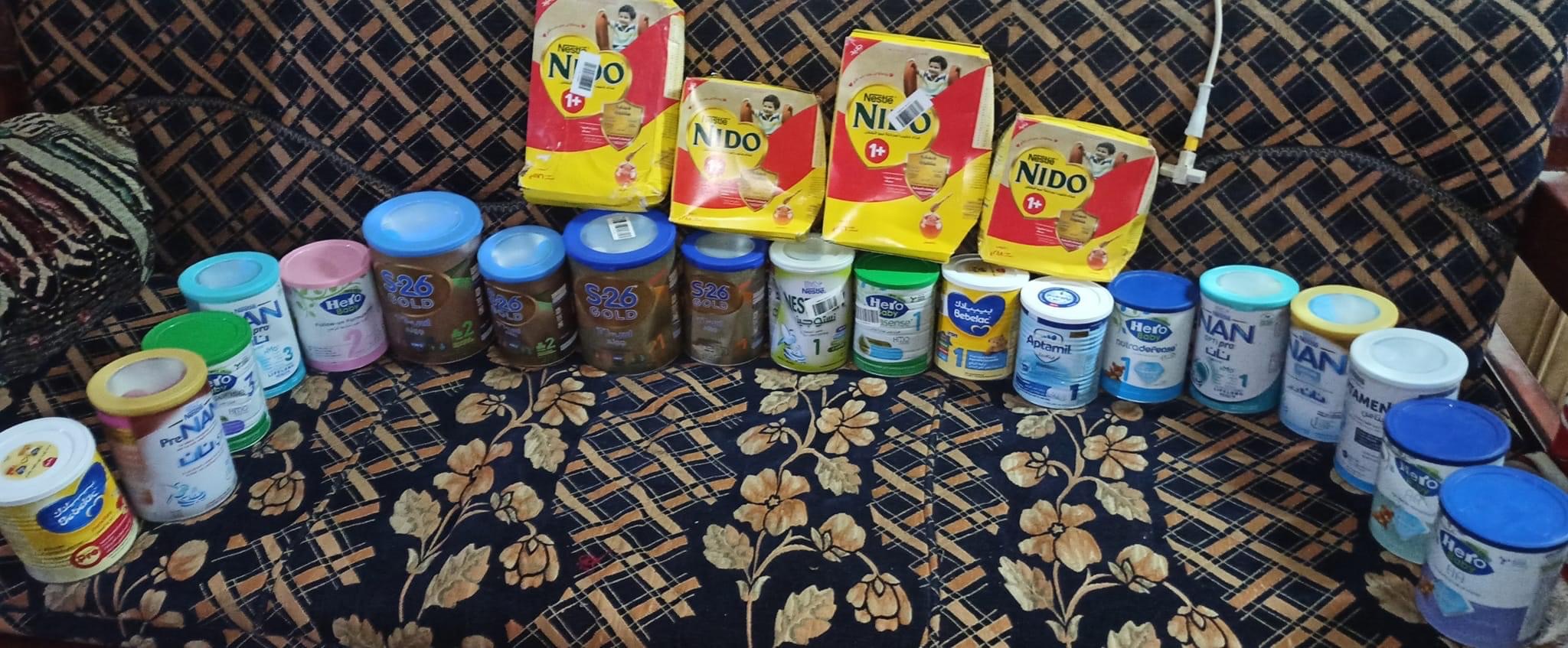
What to do when what a baby needs is nowhere to be found?
Manar, a mother of a seven-month-old infant with a cow milk allergy, requires a specific type of therapeutic milk (Neocate), which contains hydrolyzed proteins that are easier to digest for infants with this condition.
Manar says that she went to the healthcare center in Heliopolis, Cairo, where she lives. There, she was instructed to go to Helwan to collect her allotted subsidized formula milk. However, after only receiving four cans in Helwan in January, she did not receive her share in the following three months. “I searched everywhere and eventually they referred me to a village in the Monufiya governorate. I went, and they told me, ‘You will take whatever is left,’ which could be one or two cans. In the end, they told me nothing was left,” Manar tells Mada Masr.
Forced to turn to the open market, Manar was faced with another supply shortage of Neocate, and a surge in its price, from LE450 in January to around LE700. The only relatively available alternative was Hero, priced at LE720.
Manar’s infant consumes around ten cans monthly. Ultimately, she ended up on a Facebook group, like many others, to acquire formula. However, the prices offered on the group mirrored those in pharmacies.
Manar is just one of many mothers looking for formula amid a widespread shortage in supply that has most prominently affected “shaabi brands” of cheaper, lower-quality formula, according to families, distribution company agents and pharmacists speaking to Mada Masr.
Myriad factors are contributing to the formula milk crisis, whether subsidized or commercial, and have led to exorbitant prices and the emergence of the formula milk black market. This has placed a heavy burden on the majority of families, amid an economic crisis, heightening the risk of malnutrition among young children, as indicated by several studies.
There are two sources to obtain formula milk in Egypt: the open market at pharmacies, and the subsidized distribution network operated by the public maternal and child care centers at more than 1,100 outlets across the country.
Subsidized milk is allocated based on specific criteria, such as a mother’s death, infant allergies, or if a mother has twins. The maximum allowance is six cans per month, and prices vary depending on the brand, ranging from LE5 to LE26. The market accounts for 22 million cans annually, according to two informed sources speaking to Mada Masr.
Previously, subsidized formula milk was imported. This practice shifted eight years ago, when formula milk began being manufactured locally at the Lacto Misr factory, according to several sources and the factory’s owning company’s board of directors head Ibrahim Ezzat.
“We manufacture enough to cover the demand for subsidized milk,” says Ezzat. However, he notes that there has been a recent hike in production costs, given that 60 percent of production inputs at the factory are imported. Consequently, production costs for subsidized milk were impacted by the pound’s devaluation and the rise in shipping expenses, among other contributing factors.
***
This has led the subsidized formula milk distribution crisis to worsen in recent months, according to families speaking to Mada Masr. Formerly allocated four to six cans, a mother may now receive fewer cans, or sometimes none at all.
According to all the mothers who spoke to Mada Masr, an infant typically needs between seven to ten cans per month. Without any formal supply, mothers have turned to the open market (pharmacies) to meet their children's needs.
The formula milk import market is subject to monopolies, according to the Egyptian Center for the Right to Medicine head Mohamed Fouad and two sources in the Pharmaceutical Division and the Medical Supplies Division at the Federation of Egyptian Chambers of Commerce, who spoke to Mada Masr on condition of anonymity.
The United Company of Pharmacists, the commercial agent for Bebelac, one of the formula milk brands, monopolized 40-45 percent of the open market for formula milk, according to the Pharmaceutical Division source. However, following the company’s bankruptcy last year, a supply gap emerged.
This sudden gap in the market was compounded by the dollar crisis and the volatility of bank exchange rates. Thus, importers turned to the black market to secure dollars, according to Ezzat and the Medical Supplies Division source. Customs clearance delays heightened the risks for importers, especially since formula has a limited shelf life and requires special storage conditions to prevent spoilage. Importers began to refrain from importing it, worsening the shortage in the open market.
A sales agent from the United Company of Pharmacists who spoke to Mada Masr on condition of anonymity says that there is a severe shortage in their inventory, resulting in very limited supplies currently being distributed. “Two years ago, I could supply pharmacies with crates of cans. Now, it's a struggle even to provide a single can,” the agent says.
Families now wait for days to obtain a single can of formula milk, with prices starting at no less than LE280, a sharp increase from the LE30-LE50 range of two years ago, according to a pharmacy owner in Monufiya.
Ahmed, who works as an agent for PharmaOverseas, a pharmaceutical distribution company, confirms a severe supply shortage, especially of the cheaper varieties like Nestogen.
Ahmed tells Mada Masr that he has a seven-month-old infant who needs formula. He is forced to wait until quantities of Nestogen are commercially available. Only then can he purchase it, from the pharmacies he supplies himself, at a price of LE250. Ahmed adds that each pharmacy is limited to receiving only one can.
The open market consumes approximately 15 million cans annually, according to distribution agents and pharmacists who spoke to Mada Masr, making the total consumption in Egypt range between 35-40 million cans annually, including both subsidized and commercial products.
Typically, the open market is catered to financially affluent consumers, as well as families receiving insufficient allocations of subsidized milk, who then purchase the remainder from private pharmacies.
These crises have thrown the subsidized and commercial formula milk markets into disarray, giving rise to a parallel third market.
When mothers like Manar cannot obtain the necessary quantity of cans — or any at all — or are denied subsidized formula based on eligibility criteria, they turn to this third market.
Om Hassan was able to purchase the same brand of subsidized formula milk, Egy1, from this market at prices ranging from LE100 to LE150, whereas before she paid only LE5 for it.
Om Hassan, from Assiut, is a mother of two infants: one is a year and three months old, and the other is two and a half months old. She tells Mada Masr that she developed breast hematoma a week after giving birth, rendering breastfeeding impossible. Although her condition was diagnosed at a government hospital, the public health insurance office denied her access to subsidized formula milk, citing that her condition was treatable and not chronic.
Struggling to find affordable formula milk at pharmacies, Om Hassan was left with the limited options available in some pharmacies, such as Bebelac, Nan and Hero. “These are very expensive: LE300, LE400. I couldn't afford them,” she says. She resorted to feeding buffalo milk to her older infant, a solution that is not viable for the younger one.
Eventually, Om Hassan found Egy1 formula through a Facebook group that sells formula milk. The brand of formula, however, which is subsidized through public health insurance offices and maternal and child care centers for LE5, was being sold in the group for prices ranging from LE100 to LE150 per can, which she was forced to pay to feed her youngest child.
“I found someone from Marg in Cairo, who has ten cans for LE100 each. I will see if someone is traveling to Assiut from Cairo to deliver them to me, and I will pay their transportation fee, because it is a bit cheaper than the Egy1 sold here in Assiut for LE140 or LE150.”
***
Hoda, a pharmacist in the Tukh markaz in Qalyubiya, describes how women gather around outlets providing the subsidized milk, negotiating with recipients who managed to obtain their allocation, agreeing to purchase the formula at increasingly higher prices, reaching between LE200-LE300 per can. They have become intermediaries between those receiving subsidized formula and those seeking affordable options.
The subsidized formula is sold on the black market by those who obtained it through corrupt supply circles or by families whose infants did not tolerate the taste of the subsidized milk, or whose infants did not respond well to therapeutic formulas, prompting the families to seek alternatives. These families opt to sell the subsidized formula in order to purchase the commercial alternatives, according to Hoda and others.
The overall supply shortage, stemming from private sector importers refraining from importing and the subsidized sector only meeting about 60 percent of the demand, has led to further price hikes in the formula open market.
Yasser, a pharmacy owner in Nasr City, Cairo, tells Mada Masr that prices have tripled over the past two years, with official prices now ranging between LE250-LE1000 per can in some cases. Ezzat, head of Lacto Misr, described these prices as “terrifying.”
The scarcity has also affected the prices of formula milk that leaks out of the subsidized market, a phenomenon that has been on the rise as people exploit the acute shortage in pharmacies. A mother said that when she objected to the inflated prices of leaked formula, which have become comparable to commercial cans in pharmacies, the seller responded, "Go buy it from the pharmacy if you can find it."
“As a pediatrician, I can say that, for the first time in Egypt, cases of malnutrition-related illnesses among infants are reemerging after having been almost eradicated or significantly reduced,” Ezzat says. He notes the coping mechanisms adopted by financially strained families to deal with the high prices and scarcity of formula milk, such as diluting and reheating it with rice water.
This sentiment was echoed by mothers speaking to Mada Masr, including Manar, who adds two or three spoonfuls of Cerelac, the infant cereal, to each feeding for her milk protein-sensitive child, in order to save up on formula, which now incurs monthly costs of up to LE5000.
The mortality rate for infants below the age of one has surged by more than 20 percent from 2020 to 2022, contrary to the relative stability in the preceding five years. Currently, there are 18.9 infant deaths per 1,000 live births, according to data from the Central Agency for Public Mobilization and Statistics, despite a 5 percent drop in the birth rate during the same period.
Additionally, anemia rates among women of childbearing age (15-45 years) have risen from 25 percent to 38 percent between 2014-2021, according to the Egyptian Family Health Survey, necessitating the provision of formula milk for their children to ensure proper nutrition.
The same survey indicated a rise in anemia and acute malnutrition rates among children under five years old from 27 percent to 43 percent during the same period.
Acute malnutrition increases the risk of fatality from other illnesses. A study released in August examined the impact of malnutrition on the deterioration of pneumonia cases among children below five in Egypt. The study found that 25 percent of pneumonia patients with malnutrition had died, compared to a nearly nonexistent fatality rate among pneumonia patients without malnutrition.
تقارير ذات صلة
Abwab al-Kheir: Charity for a season
The initiative has appeared as state expenditure on social protection has decline over recent years
How is the Egyptian government dealing with the global wheat crisis?
The response could mark a departure from a policy direction toward drawing back bread subsidies
Bread politics
An eight-part series that takes an in-depth look at bread subsidies in Egypt
Your support is the only way to ensure independent, progressive journalism survives.
You have a right to access accurate information, be stimulated by innovative and nuanced reporting, and be moved by compelling storytelling. Subscribe now to become part of the growing community of members who help us maintain our editorial independence.
Join us