
What happened in the first coordinating session of the National Dialogue?
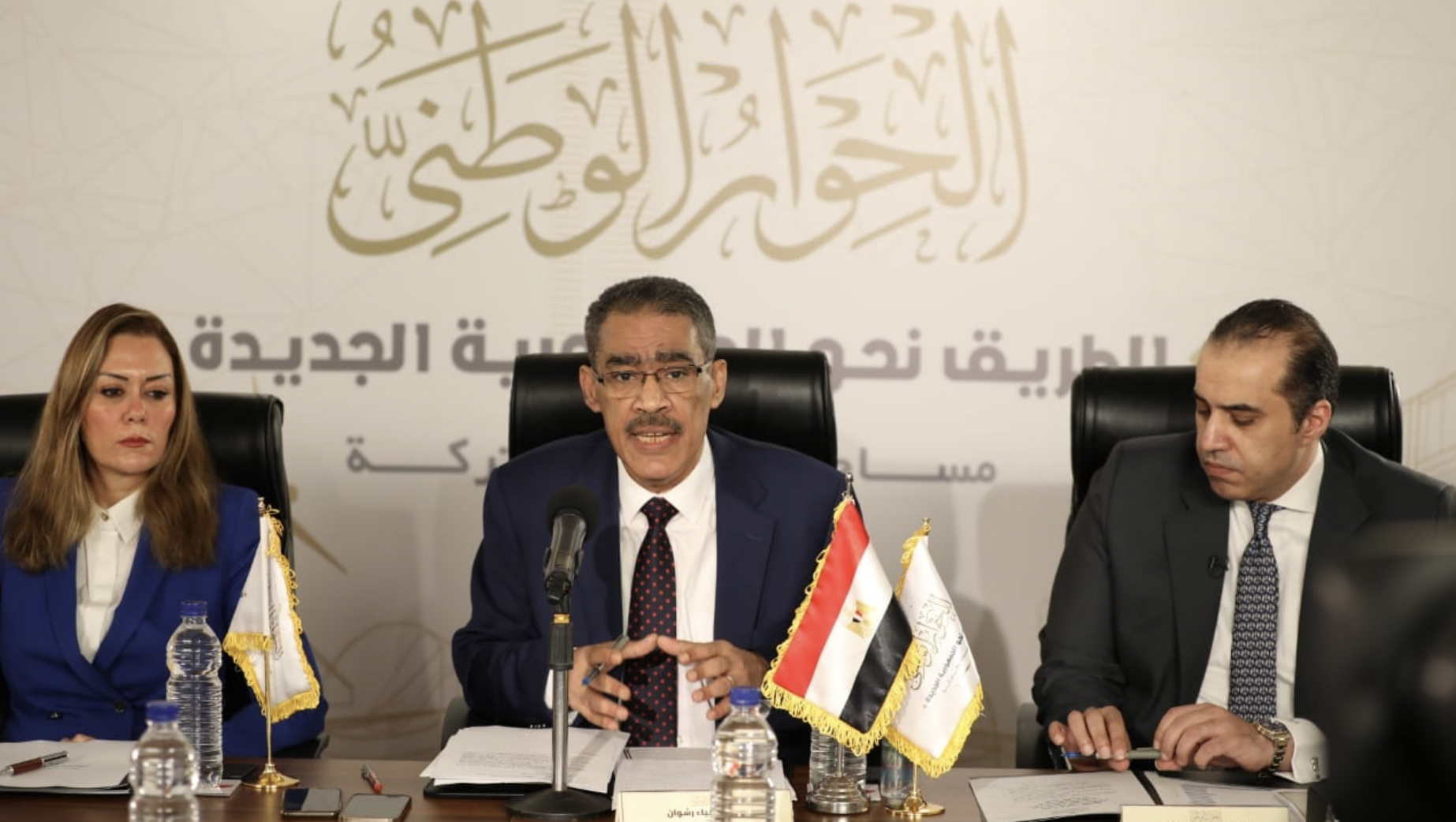
“Anyone who practices, participates in, incites or threatens violence, will be excluded,” Diaa Rashwan told journalists assembled at a Tuesday evening presser that ended the first public coordinating session of the dialogue.
“Most prominent among them," Rashwan, the dialogue's general coordinator, added, "are the Muslim Brotherhood."
“Anyone who does not accept the 2014 Constitution as the basis of governance in the country” will also be excluded, Rashwan continued, defining such people as "putschists who wish to overturn the state."
Describing the National Dialogue’s board of trustees as “a major part of the June 30 coalition,” Rashwan linked the state’s legitimacy to participation in the June 2013 protests against the Muslim Brotherhood government.
Rashwan was speaking to conclude the first meeting of the National Dialogue board of trustees, a public consultation process on political life in Egypt called for by the president and heralded as a forum for inclusivity and participation. While the initial dialogue coordinating session produced apparent consensus around the two exclusion criteria for dialogue participants, board members disputed aspects of how the dialogue has been put together thus far, and how topics for discussion will be curated.
On Tuesday afternoon, the 19 board members convened at the National Training Academy for five hours of talks to establish the committees associated with the board of trustees, the rules that will determine how the board works and the code of conduct and ethics to determine how the dialogue sessions are run going forward.
An initial session lasting one hour was broadcast to the public, which saw board members comment on some of the foundational principles of the dialogue.
In his opening remarks, Rashwan, who also heads the State Information Service and the Journalists Syndicate, said that the National Dialogue, as proposed by President Abdel Fattah al-Sisi, is meant to be a step toward the declaration of “the new republic,” which will be “a modern civil democratic state,” based on the 2014 Constitution. He also reiterated Sisi’s declaration that “the dialogue is open to everyone” and that differences in opinion are welcome.
The head of the dialogue’s technical secretariat, Mahmoud Fawzy, also presented a slideshow to the board of trustees, comprising a breakdown of around 96,000 topics for discussion that he said were suggested by the public as suitable for the National Dialogue to address, including political topics (37 percent of the suggestions), social topics (33 percent) and economic topics (29 percent).
Other speakers in the initial hour of the dialogue coordination session raised issues regarding the role of the training academy in hosting sessions and the selection process for participants and topics for discussion.
Independent MP Ahmed al-Sharqawy expressed opposition to the presence at the podium of Rasha Ragheb, executive director of the National Training Academy, a body that falls under the supervision of the presidency.
Sharqawy’s proposals — for regulations to set out the powers of the board of trustees and to relegate the academy to an “assisting” role — were ultimately passed during Tuesday’s session.
Criticizing the role of the dialogue’s technical secretariat, Sharqawy said that it transgresses upon the competencies of the board of trustees. The technical secretariat, headed by State Council Vice President Mohamed Fawzy, should not have received in advance all the proposals for subjects to be tackled in the dialogue, Sharqawy continued, and it should not have been tasked with determining who should and shouldn’t be invited. The MP expressed doubt that the public’s concerns center exclusively around education and health, rather than political or economic issues.
Likewise calling for the dialogue to address more overtly political issues, defense lawyer and civil society veteran Negad al-Borai said, “We are not going through all this effort to examine traffic policies for tuk tuks.” “With all respect to the significance of social and cultural problems, this dialogue should be political first and foremost,” Borai added, demanding Rashwan take a firm position against any attempt to “divert” the dialogue into a non-political space.
With a specific demand for the agenda to include remand detention, a contentious and widely abused practice that has kept political opponents in prison for long periods of time without trial, Al-Ahram Center for Political and Strategic Studies Deputy Director Amr Rabei stepped in: “The issue of remand detention affects much wider groups. Great numbers of people have already exceeded legal duration for detention. They should have priority.”
Rashwan responded to the points by saying: “We will not hide anything. There were no preliminary preparations to determine the types of issues [to be discussed] nor to develop solutions, and you, as members of the board of trustees, will do that.”
The public session was immediately followed by a closed four-hour-long meeting, during which Mada Masr witnessed press and TV correspondents left outside the meeting hall.
A heated argument ensued on several fronts, regarding the formation of the board and continuing dispute around the subjects of discussion, according to sources who attended the meeting and spoke to Mada Masr on condition of anonymity.
Some board members, including Sharqawy and former three-time cabinet member Gouda Abdel Khaleq, argued that there should be more clarity around which body took the decision to form the 19-member board. The official decision to form the board is signed only by Rashwan, while sources said that Sharqawy and Abdel Khaleq argued that this makes it look as though the board established itself, instead of making it clear who was really responsible for selecting its members.
The formation of the board of trustees was announced at the end of June, in a press release that stated the selection process had taken 20 days and had involved talks between Rashwan and “all the political groups, labor groups and participants” in the dialogue.
Aside from those mentioned above, the board of trustees includes figures from the ranks of the press: Editor in Chief of Al-Ahram Al-Arabi magazine Gamal al-Kishky, Senator and Editor in Chief of Al-Shorouk Emad Eddin Hussein and journalists Mohamed Salmawy and Fatma al-Sayed Ahmed.
MP Amira Saber, MP and head of the General Federation of NGOs Talaat Abdel Qawy and researcher and writer Samir Morcos are also on the board, as are businessman Kamal Zayed, Arab States Civil Society Organizations and Feminists Network coordinator Fatma Khafagy, National Council for Women head Maya Morsi and Al-Ahram Center for Political and Strategic Studies head Mohamed Fayez Farhat.
Three Cairo University staff are also on the board of trustees: commercial and maritime law professor Hany Sarie Eddin, international relations professor Reham Bahy and journalism professor Mahmoud Alam Eddin.
Sessions in the National Dialogue proper are set to begin after Eid al-Adha.

تقارير ذات صلة
Q&A with Civil Democratic Movement co-founder Mostafa Kamel al-Sayed on the latest in the national political dialogue
"The academy issued its statement without consulting the civil movement"
With 59 political detainees ordered released since April, do steps toward ‘national dialogue’ represent a breakthrough for political freedoms?
So far, releases have been determined on a case-by-case basis
Q&A | Director Khaled Youssef on the national political dialogue: We must take full advantage of this opportunity, even if our chances are slim
After falling out of favor with the state post-2013, Youssef has appeared to return to the scene
Your support is the only way to ensure independent, progressive journalism survives.
You have a right to access accurate information, be stimulated by innovative and nuanced reporting, and be moved by compelling storytelling. Subscribe now to become part of the growing community of members who help us maintain our editorial independence.
Join us