
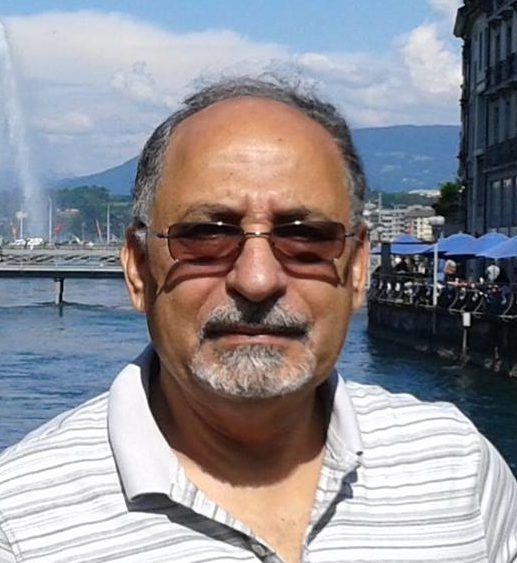
Q&A with Civil Democratic Movement co-founder Mostafa Kamel al-Sayed on the latest in the national political dialogue
As a format begins to take shape for the national political dialogue, which President Abdel Fattah al-Sisi called for at the end of Ramadan, recent steps by those managing the dialogue have sparked negative reactions from some of the opposition groups that were invited to participate.
The National Training Academy — an institution directly supervised by the president tasked with hosting the dialogue — announced on Wednesday that Diaa Rashwan, the head of the foreign press regulator, the State Information Service, and of the Journalists Syndicate, has been appointed as the general coordinator for the dialogue.
In response, the Civil Democratic Movement, an opposition coalition comprising seven political parties, released a statement on Friday rejecting the unilateral manner in which Rashwan’s appointment was made, but accepted the appointment itself in a subsequent statement on the understanding that “consultations with the party calling for the dialogue” over their preferred choice to assume the position of secretary-general are still ongoing.
Mada Masr spoke with Civil Democratic Movement co-founder and political science professor at Cairo University Moustafa Kamel al-Sayed about the group’s issues with the academy’s announcement and about what cards are in the opposition’s hand. The interview has been lightly edited for clarity.
Mada Masr: Why did you reject the training academy’s statement regarding the selection of Diaa Rashwan as general coordinator of the national dialogue?
Mostafa Kamel al-Sayed: There were communications between former presidential candidate Hamdeen Sabbahi and the body calling for the dialogue. Many ideas were put forward on how to organize the national dialogue, among them choosing a secretary-general and a board of trustees that would consist of an equal number of representatives from opposition and from dominant parties, in addition to a number of experts and a general coordinator.
But in a rather sudden fashion, Rashwan was appointed general coordinator, and Mahmoud Fawzy, the secretary-general of the Supreme Media Regulatory Council, was tapped to lead a technical secretariat. Nor did the statement have any reference to negotiations and agreements regarding the appointment of a secretary-general for the board of trustees.
So the academy's statement doesn't reflect reality. Plus, Rashwan was not agreed upon by the civil movement.
MM: Did the civil movement put forward a name for a general coordinator in its discussions with authorities?
MKS: No. The movement suggested that [doctor and activist] Mohamed Ghoneim should be secretary-general, to be assisted by the board of trustees, but we left it up to the authorities to name the general coordinator. The technical secretariat’s role is purely technical, not related to setting the agenda, choosing the participants in the dialogue, nor setting the rules for organizing the dialogue.
MM: Does this mean that the Civil Democratic Movement’s negotiations with the training academy will return to square one?
MKS: The academy issued its statement without consulting the civil movement, conveying a unilateral will and selectivity with the facts. This unilateral approach aborts the idea of dialogue as well as the chance that the guarantees the movement called for will be fulfilled, foremost of which is the release of not only well-known political activists, but any political prisoners who have not committed acts of violence.
The movement adheres to its May 8 statement, which said that its participation in the dialogue with the authorities depends on a number of procedural and objective parameters that would make the dialogue a chance to save the nation and solve its problems, rather than just cosmetic.
The consultations are still ongoing. The important thing now is to agree on a secretary-general and on the rules for selecting the board of trustees from representatives of the opposition parties and the parties in power.
MM: What do you know about what the “new republic” entails?
MKS: The statement of the civil movement did not refer at all to the term "new republic" — it appeared only in the training academy’s statement. But so far, we do not know the features of this new republic and what the authorities mean by the term.
In political science, a new republic means amending the Constitution and changing the system of government. But in reality, there is definitely no intention to amend the Constitution anytime soon, especially since some figures close to the authorities repeated rumors earlier about amending the Constitution for the purpose of announcing the new administrative capital as the official capital of the country, but it is clear that that idea has been abandoned.
But there are still possibilities, as the dialogue has not yet started. We do not know if the results of the dialogue will include a radical amendment of the Constitution or not.
MM: What cards does the opposition have in its hand at the moment?
MKS: The Civil Democratic Movement is the only opposition movement in Egypt. There is no other party or political force that claims to be an opposition movement. What we can do is not participate in the dialogue.
MM: Why do the authorities need dialogue at the present time?
MKS: All we have at the moment is an analysis of what the authorities might want, not information on what they actually want. It can be said that Sisi would like to mark his move to the new administrative capital with a kind of breakthrough.
On the other hand, Egypt is facing a deep economic crisis, and we’ve read what was published recently about Egypt repaying US$24 billion during the last five months, which is a huge amount. My personal estimate was that Egypt would be required to pay $20 billion throughout the year. We did not know how much the Egyptian government had to repay as principal debt or interest, but it is clear that the internal and external debt is a deep one. Additionally, the economic situation is exacerbated by the Russia-Ukraine war, and the consequent rise in the price of grain, oil and natural gas.
At the same time, there are discussions between the United States, the European Union and the Egyptian government on improving the human rights situation. US President Joe Biden intends to visit the region in late July and there are supposedly plans for a summit that will be attended by the heads of the Gulf states, Jordan, Iraq and Egypt, with a high probability that Biden will meet with Sisi. The EU envoy to Egypt also visited Cairo recently and spent days talking with Egyptian officials.
Perhaps Sisi wants a breakthrough that would ease the US administration's rhetoric on Egypt before his meeting with Biden. But for now, this is all speculation as to the reasons for the government's desire to call for dialogue at the present time.
MM: What do you think of the rumors about the authorities preparing a figure from the opposition to run against Sisi in the 2024 presidential elections?
MKS: It is too early to prepare for the presidential elections at the moment, but the strongest factor now is the economic crisis, and the foreign press reports coming out to remind us that a number of countries will face severe food crises, which may lead to social unrest. Egypt was referred to constantly as a potential place for such crises to occur. Certainly, these reports reached the president’s office, intelligence and national security bodies, and were conveyed as concerns to the president.

تقارير ذات صلة
Presidential elections: Seasonal oppositional division
9 of 12 political groups associated with the Civil Democratic Movement urged the public to abstain.
Presidential elections: An opportunity for the opposition to come out of the margins?
Now, there are three members of the Civil Democratic Movement who have stated their intention to run
Exposition, character, scene: Staging the upcoming presidential elections
Sisi recently told officials he's searching for a new framework to manage Egypt's affairs
Your support is the only way to ensure independent, progressive journalism survives.
You have a right to access accurate information, be stimulated by innovative and nuanced reporting, and be moved by compelling storytelling. Subscribe now to become part of the growing community of members who help us maintain our editorial independence.
Join us