
‘Unable to erase the sight of the dead from our minds’: Scenes from Fasher’s fall
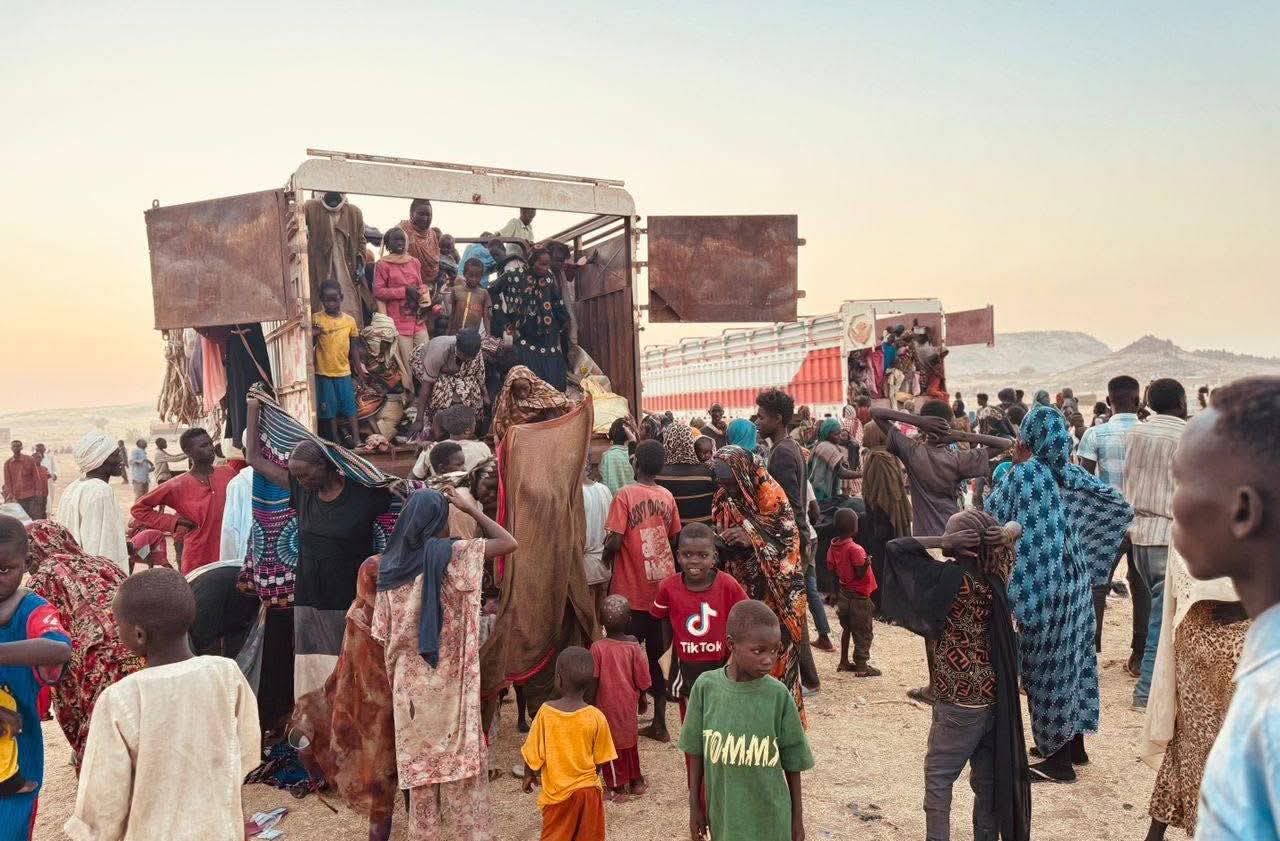
Even in relative safety, Malaz says the images won’t leave her — the massacres, the burning homes, the city of Fasher consumed.
She was among those who escaped the Rapid Support Forces’ offensive that culminated on Sunday with the group declaring that Fasher — the last major city outside their control in Darfur — had fallen. But the truth is, Maalaz says, there is no place safe from the RSF’s brutal reach, even in displacement.
For nearly two and a half years, the city of Fasher — the historic capital of western Sudan’s Darfur region — stood on the path of ethnic cleansing and the shadow of genocide.
This week, the city met the same fate as West Darfur’s Geneina, where, between April and June 2023, RSF fighters and allied militias killed an estimated 10,000-15,000 people.
In the early hours of Sunday, RSF units led by the group’s deputy commander, Abdel Rahim Dagalo, stormed Fasher after a deadly military campaign that began with a siege in May 2024. The city, known as the Sultan’s Fasher, was soon the scene of massacres still ongoing. While access to Fasher remains impossible, satellites captured images of blood soaked streets.
Over the course of the 18-month siege, the RSF employed brutal tactics. They sealed off the city with sand berms and trenches to cut off movement and launched near-daily artillery barrages. The systematic campaign managed to empty much of the city. Once home to over 1 million people, Fasher’s population dwindled to a quarter of its former size.
By the end of the first day of the city’s fall, there was hardly anyone in Sudan unaware of the slaughter in Fasher and along the routes leading out of it. RSF fighters proudly circulated footage of their assaults on homes and the killing of unarmed civilians, young and old.
One fighter, known as Abu Lulu, filmed himself executing civilians, boasting on Tik Tok that he had killed 2,000 people and would “do it again” because he “might have miscounted.” Attempts by RSF supporters to dismiss him as an isolated case have been contradicted by dozens of other videos showing similar scenes — proof that there are thousands like him, killing for the sake of killing.
The fall of Fasher is not merely a military event — it marks a turning point, unleashing an unprecedented wave of violence against civilians. According to sources within military-aligned armed groups, thousands of people were killed so far and around 30,000 fled in the first days.
Mada Masr spoke with 11 sources from Fasher — civilians who fled the carnage, medical workers and members of the military-allied joint force — to understand the catastrophic humanitarian situation that unfolded in Fasher as tens of thousands fled earlier this week. It remains, inevitably, an incomplete account. Many of those who could have told the story have been killed, or remain unreachable amid the telecommunications blackout.
***
Even before Fasher’s fall on Sunday, civilians were already fleeing the days-long assault. Malaz, a medical student from Fasher, says residents began fleeing early Saturday morning, when the RSF launched its first incursion, pushing deep into the city and reaching as far as the governor’s residence and the military’s Sixth Infantry Division’s headquarters.
That morning, she left her home in southern Fasher’s Higra, heading west toward the Abu Shouk neighborhood — her family’s third displacement since the start of the siege. They had already moved from east to north to south, then west, before setting out on the road to Kutum, northwest of the city, where they are staying now.
The journey across the city on Saturday, she says, felt like a “trip back to the Dark Ages.”
“The streets were boiling with fire and smoke. Running between the ruins of destroyed houses was the only way to stay alive, as artillery shells and stray bullets rained down from every direction,” she recalls.
RSF armored vehicles moved through the streets “without mercy,” while gunfire erupted all around. Homes were burnt and markets looted. “Along the roads lay bodies — men, women and children — who had fallen before the eyes of those who survived,” Malaz says.
The western neighborhoods were overcrowded and saw what she describes as “massacres on a large scale.” Some civilians were killed instantly after being stopped by RSF fighters, while others were ordered to run without stopping.
“Every step was fraught with danger,” she says. “Snipers targeted anyone who tried to flee. The air was filled with the screams and cries of women and children. Blood covered the side streets. Every moment of delay meant a direct threat to one’s life.”
The road toward the outskirts, she says, was “a continuous nightmare.” RSF units stormed homes, killing anyone who resisted and looting everything.
Bodies lay scattered all along the road out of Fasher, Malaz recalls. In safer areas on the road, survivors briefly took shelter beneath the trees before pressing on, desperate to cover as much ground as possible.
She still can’t bring herself to believe any place can truly be safe. “Any village could become a target for the RSF,” Malaz says. Though she has reached a place considered safe, she says the images of terror and destruction that consumed Fasher remain with her in memory.
From the Tawila locality, west of Fasher, Shala tells Mada Masr he left the city a day after its capture.
On Saturday, he had been sheltering with some of his neighbors in a charity kitchen they thought would be safe. But soon, the blasts of gunfire and shelling surrounded them from every side.
“There was no safe place left in the city,” he recalls, “so we headed for the Abu Shouk camp, thinking it might be spared since the RSF had already entered it before.”
But the RSF reached it too.
At the camp on the city’s outskirts the following day, Shala says they tried to hide behind crumbling walls and small huts, but the bombardment intensified. They took cover in a trench reinforced with sandbags.
“When the battle ended and the RSF seized full control of the city, their fighters entered the nearby parts of the camp, looting everything before our eyes and killing anyone who tried to resist — young and old,” he says.
Some RSF fighters gathered them in an open area. “After two hours of pleading — and under threats of execution and beatings — a field commander finally ordered our release,” Shala says. “He told us to leave the camp at once, saying he couldn’t protect us from what the fighters might do.”
Realizing that staying “meant certain death,” Shala and his group fled. “It was just after dawn on Monday,” he recalls. “The camp was shrouded in smoke and flames. The streets were littered with bodies — some half burnt, others lying in blood. We didn’t see any soldiers among them — all were civilians, mostly frail men in their fifties and sixties.”
They carried one another across valleys, “unable to erase the sight of the dead from our minds,” he says. Most of the young men collapsed from exhaustion and hunger along the way. “I broke down completely when we finally reached the displaced persons’ gathering areas in Tawila. They registered our names — but I still had to find my family, whom I’ve known nothing about for days.”
In the days following the city’s fall, another wave of displacement began. Darfur Governor Minni Arko Minnawi’s office told Mada Masr that around 30,000 people fled Fasher within 48 hours, heading toward the areas of Tandfai and Ashoush in western North Darfur, and toward the Tawila locality, crossing barren valleys without food or water.
A survivor who reached Malit after Monday says she saw RSF fighters execute hundreds of people in trenches dug around the city and firing at the bodies of the dead and wounded — mostly men in civilian clothing — along the road to Malit. "The fighters searched the victims’ belongings carefully, she says, and ordered some survivors to abandon all personal possessions before leaving.
Some families remained trapped in the city, unable to leave amid the ongoing clashes, Adlan, who fled with his family to Tawila, says.
UN Humanitarian Coordinator in Sudan Denise Brown also warned that the number of people making the 50 km journey to Tawila had dropped sharply by Wednesday — a sign, she warned, that the RSF had tightened its grip on the city and was effectively preventing people from escaping.
Three sources within the military-allied joint force estimate the civilian death toll in Fasher at more than 2,000, while the fate of thousands more remains unknown amid a total telecommunications blackout. A source from the Justice and Equality Movement, however, says their field sources inside the city believe the death toll has exceeded 3,000, with more than 10,000 people missing so far.
Human rights organizations and international actors are calling for the immediate establishment of safe corridors to evacuate civilians and the wounded. However, local sources tell Mada Masr that no such corridors have been opened yet.
The situation is expected to get worse, with the government lashing out at humanitarian agencies in the wake of Fasher’s capture. On Wednesday, Khartoum announced it was expelling the World Food Programme’s top leaders “at a pivotal time,” the agency said in a press release. The Foreign Ministry informed the relief organization that its country director and emergency coordinator have been designated as personas non grata “without any explanation.”
***
In the days leading up to its fall, the city was already enduring dire conditions under a suffocating siege imposed by the RSF since mid-2024. Supply routes had been almost entirely cut off; food and medicine stocks were nearly exhausted; and hospitals were operating at less than 20 percent of their capacity.
A medical source who fled the city says that the RSF repeatedly bombed makeshift field clinics set up by relief teams throughout the siege.
In the final week, as hospitals came under heavier strikes, it became impossible for civilians to receive treatment there, the source said. On Sunday, when the wounded began pouring in, there were no medical supplies left — the blood bank was empty, and nothing could be sterilized.
As the city’s defensive lines collapsed and military troops withdrew, medical personnel were forced to abandon around 200 wounded people — civilians and soldiers — in a facility at the Daraga Oula neighborhood after RSF strikes hit the building.
Yale’s Humanitarian Research Lab corroborated the reports, with satellite imagery showing evidence of mass killings in hospitals and surrounding areas.
From inside the Abu Shouk displacement camp, resident Babiker describes the situation in Fasher as “hopeless.” Even if the RSF now holds the city, “they control nothing but ruins,” he said. There’s no infrastructure left, medical staff have been displaced, no market to loot or rebuild. In his view, it’s almost impossible for people to return. “We are now trying to mobilize the few remaining resources to save whatever can still be saved,” he said.
“The horrors in Darfur’s Fasher were no accident,” United States Senate Foreign Relations Committee Chair Jim Risch said on Tuesday. “They were the RSF’s plan all along. The RSF has waged terror and committed unspeakable atrocities, genocide among them, against the Sudanese people.”
تقارير ذات صلة

The return to Sudan: Redrawing politics from square one
After more than a year and a half in Cairo, Um Mohamed is back to her home in Khartoum. But like many of the hundreds of thousands who have heeded…

The Quad War
After the fall of Fasher, Egypt turned to Turkey to find a way to deter the growing Emirati threat
Video | Out of Sudan, into precarity
Two women who fled the Sudan war share their survival, escape and refuge stories
Your support is the only way to ensure independent, progressive journalism survives.
You have a right to access accurate information, be stimulated by innovative and nuanced reporting, and be moved by compelling storytelling. Subscribe now to become part of the growing community of members who help us maintain our editorial independence.
Join us