

The Quad War
From one angle, the four trucks burning in the desert of western Sudan are barely noticeable. Black smoke from the smoldering munitions tucked inside their canvas-covered rear beds billows upward to block out the sky.
But if there was any doubt about what is causing the apocalyptic scene, another shot confirms it is the trucks. The camera holder, who can only be assumed to be a nonpartisan who has chanced upon this scene of war, has moved in closer to give the viewer certainty.
“Today is Wednesday, November 5, 2025,” he says, making sure the viewer knows this isn’t a deepfake.
But his attempt at establishing truth is interrupted. The munitions in the truck he is filming explode. The frame of vision swings right. All we see is sand and debris.
***
The convoy that was hit is one of hundreds, if not thousands, that have carried Emirati-supplied weapons along a complex and shifting transport route from eastern Libya, sometimes passing through Chad, and onward to Darfur to the Rapid Support Forces, the paramilitary force led by the Dagalo family.
It was these routes that supplied the RSF with the munitions to take the city of Fasher, where the paramilitary unleashed a staggering killing campaign last month against tribal rivals and the people that had been sheltering in the military’s last major stronghold in Darfur.
And it is now these routes that are the site of an escalating military struggle that is quickly internationalizing Sudan’s war to unprecedented levels, as foreign parties have rushed in to prevent the RSF and its main backer in the United Arab Emirates from riding the wave of Fasher’s fall to take all of Sudan.
Since the fall of Fasher, Egyptian officials, as well as Sudanese and Libyan sources, have spoken to Mada Masr about Cairo’s growing concern over the military supply line extending from Libya to Sudan, which has occasionally crossed over into Egyptian territory. With the fall of the Sudanese military’s last major stronghold in Darfur, Egypt has taken a more proactive stance to support the Sudanese military, balancing its relations with the UAE and its coordination of military support with Turkey, yesterday’s foe.
In the words of one Egyptian official, the military intervention follows the same strategy Turkey used in Libya in 2020 against the Libyan National Army forces led by Khalifa Haftar — one that relies on cutting off supplies as a means of creating a balance of power to pave the way for diplomatic talks.
Mada Masr has spoken to sources in Sudan, Libya and Egypt to understand the dynamics of the RSF’s supply route and the political calculus in Cairo that has opened the door to a potentially new chapter in Sudan’s war.
***
The weapons supply route that was bombed earlier in the month dates back to the war’s beginnings, when Mohamed Hamdan “Hemedti” Dagalo visited Libya to sit down with Saddam Haftar, the son of Libyan General Khalifa Haftar, at the LNA headquarters in Rajma Heights, southeast of Benghazi. Over two days at the close of April 2023, a mere 15 days after the outbreak of the Sudan war, Hemedti, Saddam, an Emirati intelligence officer, several senior LNA commanders and field commanders close to the Haftar family from southern Libya hashed out how to ensure the delivery of military supplies from the Russian mercenary Wagner Group and the UAE to Sudan, and to determine which groups would facilitate and oversee transport operations through the Kufra military region, a source close to Saddam told Mada Masr at the time.
The plan, worked out in those early days of the war, was to see weapons transport operations managed by LNA-affiliated companies from the Subul al-Salam Brigade, led by Salafist field commander Abdel Rahman Hashim al-Zawy; and the 128th Reinforced Brigade, led by Hassan Maatouq al-Zadma, along with elements from the RSF and the Wagner Group.
And with the inflow of advanced weaponry, the RSF has made huge gains in central, southern and western Sudan, leaving a trail of atrocities in their wake. They took Gezira and large swaths of the Sennar and Blue Nile states.
A January 2024 United National Security Council Panel of Experts report makes the impact clear.
“From July onwards, the RSF deployed several types of heavy and/or sophisticated weapons, including unmanned combat aerial vehicles, howitzers, multiple-rocket launchers and anti-aircraft weapons such as man-portable air defence systems,” the report reads. “This new RSF firepower had a massive impact on the balance of forces, both in Darfur and other regions of the Sudan. New heavy artillery enabled the RSF to swiftly take over Nyala and Geneina, while its new anti-aircraft devices helped to counter the main asset of SAF, namely, its air force. Meanwhile, [the Sudanese Armed Forces] could not replenish its Darfur garrisons with any meaningful military supplies, given that RSF had taken control of most portions of the road between Kosti and Fasher, the [military’s] main supply route from Khartoum and Port Sudan.”
With the increased scrutiny on the RSF’s supply lines, the LNA began to make changes in the parties responsible and the route of the weapons transfer.
According to a military source in southeastern Libya, the logistics support line, used mainly for provisions, continues to operate through Kufra.
But in order to avoid “angering the Egyptians,” the source says, weapons now pass through Chad instead of the border triangle between Chad, Libya and Egypt, after a previous and clear Egyptian stance warning eastern Libyan leaders not to use that area as a supply route for the RSF.
A tribal source informed of dynamics in southeastern Libya adds that the LNA General Command has established a new border crossing with Chad — the 17 crossing — which it uses to transport weapons destined for the RSF. Saddam visited this crossing last week, with the trip being framed as a “tour of the south.”

Why was Egypt “angry?” The UAE’s general support for the RSF flew in the face of Egypt’s key parameters in formulating its Sudan policy, according to a political source involved in formulating that policy.
For Egypt, the source says, stability in Sudan is crucial for Egypt’s national security, and therefore state institutions should be respected and the integrity of the military must be safeguarded in order to prevent any further division of the country.
“As such, we look at [Transitional Sovereignty Council Chair and Sudanese Armed Forces Commander-in-Chief Abdel Fattah al-]Burhan as the legitimate president of Sudan irrespective of the mechanism that got him into office. We know that Burhan might not be very strong, but he is strong enough to be in charge of the military,” the source says.
President Abdel Fattah al-Sisi has tried to dissuade Haftar and his son from interfering in Sudan’s war and to stop the support provided to the RSF from southeastern Libya, most recently at a meeting between the two in Alamein in June, an Egyptian government official told Mada Masr at the time. Egypt tried to mediate between the Haftars and Burhan, who confronted Haftar in the unannounced meeting with evidence of arms supplies to the RSF, but the Haftars denied any involvement.
Egypt was equally angered that the supply routes were, at times, running through Egyptian territory.
A former Egyptian diplomat says that at the beginning of the war, the RSF repeatedly entered the Egyptian side of the border. “It happened once at a big scale, but after that, RSF militias entered the Egyptian borders at a more limited scale, and they immediately had to go out after being hit by the Egyptian Air Force,” they say.
Aware of this sensitivity, “the eastern Libyan command is making every effort not to provoke Egypt through its direct support to the RSF,” the Libyan military source says.
But the flow of weapons continued.
***
In the final weeks before the fall of Fasher, the city had been trapped in the tightening grip of the RSF, which had reorganized its military and logistical lines across Darfur.
Sources told Mada Masr the city was receiving increasing quantities of weapons and ammunition through secondary roads and informal supply networks coming from the western borders, including combat vehicles and field artillery. This paved the way for intensified shelling of Fasher’s eastern and northern neighborhoods throughout May and June.
The RSF had gathered around 3,000 four-wheel drive vehicles for the Fasher offensive — many of which were brought in across the Chadian border, with no registration records in Sudan, whether military or civilian.
Some of these vehicles can be directly linked to the LNA, with the Libyan military source saying the LNA-affiliated officer in charge of weapons transfers to the RSF entered Chad last month with 140 vehicles and returned with only 35. It is believed that the vehicles disguised as military escorts were part of UAE military supplies delivered to the RSF through Chad, the source adds.
Alongside the vehicles came shipments of new weapons, light and heavy, also brought in across the border, all in preparation for storming the city.
Around Fasher, the land lay scorched. The RSF burned down around 12 villages in the Tawila and Malit localities, forcing nearly 50,000 civilians to flee into the city. Their forces also struck water storage dams, plunging Fasher into thirst.
The military, on the other hand, faced mounting difficulties in maintaining its supply lines after the RSF cut off the road linking Fasher to Obeid and seized several depots and logistical points along the road to the city. The RSF created a closed “security zone” around Fasher, combining scorched-earth and “isolated islands” tactics. Small dirt airstrips and alternative runways were used to transport light ammunition and drones to the frontlines.
Despite the sizable buildup, supporters of the military and some in Cairo did not believe that the fall of the city was imminent. Speaking to Mada Masr days before the city’s capture, an Egyptian state official said the battle for Fasher was “not easy” but one that the military side was winning.
A Sudanese political source based in Cairo insisted that “as far as Burhan and Egypt are concerned, the Sudanese military needs six to eight months to make a breakthrough.”
But then the city fell, and Abdel Rahim Dagalo — Hemedti’s brother who one Egyptian source working on Cairo’s Sudan policy described as the strongman of the RSF in charge of “gold trafficking, human trafficking, drug trafficking, and arms trafficking” — led a merciless assault on civilians in the city.
In the immediate aftermath of Fasher’s fall, early estimates put the death toll between 2,000 and 3,000, with around 30,000 fleeing the city. But recent estimates from two Sudanese Health Ministry sources speaking to Mada Masr suggest that the figure may now be closer to 5,000, though they say the actual figure is likely impossible to know.
Thousands remain missing, while the RSF continues to burn and bury bodies under the cover of a communications blackout, the sources say. Satellite images by Yale’s Humanitarian Research Lab in early November show evidence of at least two mass graves inside Fasher.
Communication with Fasher remains extremely difficult amid a telecommunications blackout and fear of RSF reprisals. One could get detained in inhumane conditions for claims like communicating with the military.
The International Organization for Migration estimates that almost 90,000 of Fasher’s 260,000 residents were displaced between the city’s fall and November 9. But leaving Fasher offers little relief. Roads leading out of the city are under RSF control, where they kill, detain or return fleeing civilians. Those who manage to reach their destinations — whether nearby localities or hundreds of kilometers away — find dire conditions as already overwhelmed cities struggle to cope with the sudden influx.
Inside Fasher, essential services have collapsed. The tens of thousands left trapped can hardly leave their homes, even to fetch water or look for medicine, for fear of arrest or worse. Since the city’s fall, the Sudanese Doctors Network has documented several cases of physical assaults and rape against women committed by RSF fighters.

In Cairo, the fall of the city sent a shockwave through decision-making quarters and opened the door on a number of Egyptian concerns.
The first response was a political one. Egyptian officials convened with United States Senior Advisor for African and Arab Affairs Massad Boulos and held indirect talks with representatives from the RSF and Sudanese military about a three-month humanitarian ceasefire, during which negotiations would be held to reach a comprehensive halt to the war and launch a political dialogue between the Transitional Sovereignty Council, the RSF and representatives of all Sudanese factions. "The goal, two Egyptian government sources previously told Mada Masr, was to form a joint executive authority to resume the political process over a three-year transitional period."
However, as deliberations about the deal played out, all sides realized that the war was still very much ongoing.
For Cairo, this meant that the fall of Fasher could lead to the complete collapse of the Sudanese state, with the RSF riding the wave of the victory, backed by ever-increasing UAE arms shipments, into the capital and on to the east of Sudan, according to another Egyptian state official.
And more immediately, Cairo was concerned about its southern borders.
“Egypt now has to keep a very close watch on the border triangle space, the borders with Libya and the communication line between the UAE, Haftar and Hemedti,” a second source involved in Egypt’s decision making on Sudan says.
Another Egyptian source working on Cairo’s Sudan policy describes urgency among decision makers in the days immediately following Fasher’s capture. “There were a lot of meetings in the past few days to assess the situation and to decide what would happen,” they say.
According to the source, two views dominated decision-making circles that handle Cairo’s Sudan policy.
The first was pro-intervention, the source says. This camp wants to “go all the way to support the military and consolidate power around Burhan, not just against Hemedti, but against Islamist elements” in his own camp.
The second camp, the source says, was much more pessimistic, viewing the situation in Sudan as “a lost battle that Burhan isn’t up for.” According to the source, proponents of this view believe Egypt should pressure Burhan to talk to Hemedti to accept a deal.
For many involved in these discussions that spoke to Mada Masr in favor of a strong Egyptian response, there were manifold problems.
“We might have to intervene,” one Egyptian state official directly involved in Sudan policy said in the immediate aftermath of the city’s fall, explaining that Cairo viewed the Sudanese military as split over how to manage the battle. “One of the big problems is that Burhan doesn’t have the full respect as a military man of the top brass.”
However, for several other sources, there were two bigger issues.
First, two former Egyptian diplomats and two of the sources working on Cairo’s Sudan policy argued that it is already too late for any decisive Egyptian military intervention in Sudan.
“The Egyptian intervention should not have been reactive but should have been one of proactive deterrence,” says the former diplomat, speaking about RSF incursions into Egyptian territory. “But what Egypt did is like giving a weak antibiotic to someone who is sick: the symptoms would recede for a while but the illness is still there.”
A third Egyptian source working on Cairo’s Sudan policy says there is a perception that the level of military intervention required to bring meaningful change on the ground in Sudan is far too high.
The source argues that bringing the dispute over the Halayeb and Shalateen triangle into the talks between the two sides was a “mistake.”
An Egyptian official and a Sudanese official confirmed that the two sides have held talks about the contested border area in recent months.
Egypt has been involved in providing support to the Sudanese military over the course of the war and has even become directly involved at some points, a fact that two sources acknowledge, pointing to the limited unannounced airstrikes Egypt conducted in October 2024 that helped the Sudanese military retake key sites in Sennar State, which an Egyptian official confirmed to Mada Masr at the time.
But the second Egyptian source working on Sudan says that they advocated for “direct and announced” Egyptian Air Force intervention to support the Sudanese military at multiple points, including after Haftar and Hemedti violated the Egyptian border.
“I pleaded with them at the time to be aggressive, but there was a lot of hesitation,” the source says. “Now, the kind of military intervention required is far too big, and, given the weapons that the UAE has provided Hemedti with, there could be Egyptian casualties, and this is not something we could go for. Egypt will not carry out airstrikes. It is too late. It should have done so much much earlier.”
Speaking on this moment, the first source involved in shaping Egypt’s Sudan policy explains that after Egypt, Turkey, and Iran helped Burhan and the national army regain ground in October 2024, the UAE countered by offering extensive support to Hemedti — pouring money into recruiting mercenaries from Chad and Central Africa in an effort to strengthen his position and steer the conflict toward a political settlement.
This leads to the second problem for Egypt and the source of its hesitation in Sudan.
“From the outset of the war, Egypt was careful to limit its involvement in the Sudanese conflict, avoiding any potential backlash from the UAE, the primary financial backer of the Egyptian government over the past decade,” another Egyptian official told Mada Masr earlier in the war.
This was an important deliberation factor for officials in Cairo as they considered how to respond to the crisis brought on by Fasher.
Since early 2024, Egypt has been involved in a four-party political track concerning the war in Sudan with the US, the UAE and Saudi Arabia.
The first forum for the coordination between the four surfaced when Manama hosted secret talks between military and RSF delegations in January — a meeting that, according to a source in the TSC who spoke to Mada Masr at the time, was attended by officials from US and Egyptian intelligence alongside Emirati and Saudi delegations.
The back-channel contacts turned public the following year, after Trump appointed Boulos to lead Washington’s engagement on Sudan. In June 2025, Boulos and US Deputy Secretary of State Christopher Landau gathered the ambassadors of Saudi Arabia, Egypt and the UAE in Washington, where Landau urged them to push the warring parties toward a ceasefire and negotiated settlement — a session that effectively launched what is now known as the Quad.
By September, the group’s foreign ministers unveiled a roadmap to end the war, outlining a sequenced process: a three-month humanitarian truce, followed by an “inclusive and transparent” political process within nine months that will move Sudan toward “an independent, civilian-led government with broad-based legitimacy and accountability.”
However, the Quad has been a fraught venture since its inception.

“The UAE tried to block Egypt from joining the Quad,” says one former diplomat.
Over time, the group’s cohesion began to turn on itself.
“I think the Quad turned into a joint Emirati-American space to pressure Egypt,” a second former diplomat says. “When Egypt joined the Quad, the idea was that it would influence the thinking of the group toward a reconciliatory approach that would integrate second-tier RSF elements — but not RSF leadership itself — and to spare leadership figures from legal prosecution. But this idea wasn’t backed by the Saudis.”
The other diplomat agrees. “When all is said and done, it is the UAE that the US sides with in the Quad, not Saudi Arabia, and certainly not Egypt,” they say.
And yet, Egypt has not given up on the Quad.
According to the first source close to Egypt’s Sudan policy, Egypt has been able to use the RSF’s mass killings in Sudan to make the US pressure the UAE.
Nonetheless, says the first former diplomat, in calculating the scale of intervention, “there is a limit to how far Egypt could go in Sudan without upsetting the Americans” and, consequently, the UAE.
Even with this constraint, however, Egypt saw an opening for intervention, and it existed outside the framework of the Quad.
“The rivalry between Egypt's main allies in Saudi and Abu Dhabi has led to a striking paradox: the convergence of Egyptian interests in the region with those of Qatar and Turkey, former adversaries of Sisi's government due to their support for the Muslim Brotherhood,” said the Egyptian official who spoke to Mada Masr late last year in the lead up to the first meeting of the Egyptian-Turkish High-Level Strategic Cooperation Council.

“Egypt began its military alliance with Turkey, which is becoming increasingly evident in the Horn of Africa. This alliance appears to have gained the approval of Iran, which also supports the Sudanese army, alongside Cairo and Ankara. This is one reason for the Sudanese military’s growing strength in the war against the RSF,” the source said at the time.
After the fall of Fasher, it was this alliance that Egypt turned to in order to find a way to deter the growing Emirati threat.
“We told the Americans that if the UAE continues to send arms and mercenaries to Hemedti, Egypt will intervene directly and that’s when the Egyptian chief of staff visited Port Sudan. After this visit, the head of the northern Sudanese military zone visited Egypt,” one of the sources involved in Egypt’s Sudan policy said in the days after Fasher’s capture. “We know that the Americans put pressure on the UAE to stop to an extent. But we also know that we cannot expect the Emiratis to stick to this. So there is a whole plan ready for any possible escalation.”
***
The Emiratis did not stop and that plan was put into action, according to four Egyptian officials, as well as several Sudanese military sources serving on the front lines.
According to the four Egyptian officials, Turkey and Egypt are engaging in operational coordination and assisting not only in surveillance and information gathering, but also in battlefield cooperation in western and southwestern Sudan in North Darfur and Kordofan.
“Turkish military officers will supervise field operations employing advanced Turkish-made machine guns, while at the same intensifying strategic offensives on RSF gathering points using drones,” says one of the officials.
Turkish drones are also conducting strikes on RSF supply lines with logistical support from Egyptian and Sudanese airbases.
Speaking of these strikes, a second Egyptian official says that the initial phase of Egyptian-Turkish coordination is focused on cutting off routes and blocking military shipments headed to the RSF from southeastern Libya. He adds that at least three convoys were struck inside Sudan in the first week of November.
Truck carrying military weapons into Sudan from Libya explodes after being targeted, November 5.
Several Sudanese military sources in the advance command described the Egyptian support as "assistance according to the joint cooperation protocol," referring to pre-existing agreements they say were signed when Sudan allowed the Egyptian Air Force to operate out of Wadi Seidna military base during the 1967 war.
A Sudanese military source in the 22nd Division tells Mada Masr that Turkish drones were present in battles that took place on Saturday and Sunday around the besieged city of Babanusa in Kordofan. The source also confirms that strategic RSF positions and supply depots in the West Kordofan cities of Fula and Abu Zabad, which the RSF controls, were targeted by drones.
The same sources acknowledge Turkish assistance in the form of military and logistical support, which they say is “subject to ongoing evaluation and could cease if supply lines were cut.”
The second Egyptian official explains, however, that “the Turkish military is operating in Sudan under the same strategy it applied in Libya in 2020 against the LNA forces led by Khalifa Haftar.”
This strategy helped end the 2019 war in the Libyan capital of Tripoli, but it also cemented Turkish influence in the capital that was furthered by the selection of Abdul Hamid al-Dbaiba, a prominent Misratan Qadhafi-era businessman with strong ties to Turkey, as head of the Government of National Unity. Despite the GNU’s mandate having expired, it has neither left office nor laid the groundwork for elections, and Libya remains divided into distinct spheres of influence.
As for Egypt’s strategic aims, there is no expectation that the Sudanese military could achieve a complete victory.
“There is a de facto division of Sudan and we have to work with that,” one of the sources involved in Egypt’s Sudan policy says. “Egypt is not trying to pursue a confrontation with the Saudis or Emiratis or anyone. What Egypt wants to do is contain the situation on the ground. This is our direct border. This is a top national security issue. The military situation on the ground is very volatile.”
An Egyptian state official agrees. “In the short term, the goal [of the military intervention] is to make it impossible for Hemedti to gain more territories and eventually have the military gain the upper hand. We cannot be sitting down or pretending to look the other way when the RSF is receiving all this military aid from the Emiratis and making advances on the ground at the expense of the Sudanese military. We have to regain the balance in favor of the military. We will not allow Hemedti to move forward and take over the capital, and this could have happened if we did not intervene promptly,” they said.
The state official says Sudan requires an agreement between the two parties on sharing power. This view, they note, is not limited to the UAE but is echoed by Germany and the United Kingdom, who are both penholders in the UN Security Council. The source adds that power-sharing, now the prevailing framework for conflict management internationally, is the approach they are currently pursuing in Sudan.
The RSF seems to be aware of this eventuality, which has long been the group’s aim — to chip away at the Sudanese military’s sole claim to legitimacy — even if Egypt intervenes against their forces.
“Egypt’s stance toward the RSF is extremely tense,” an RSF official tells Mada Masr. “We see that it will intervene heavily if it feels we are close to achieving full control of key states such as the Northern State. It will intervene. So we try to avoid provoking their military ire, but in the end, we will sit down with them, especially if we succeed in taking South and West Kordofan, which are now entering an important phase of military operations.”
Accepting a ceasefire and talks has been a difficult pill to swallow for the military, especially given that a de facto partition of Sudan is now the widely understood reality.
But Egypt has been able to gain some headway in its push for a ceasefire in Sudan since the fall of Fasher.
On November 11, Foreign Minister Badr Abdel Atty met with Burhan in Port Sudan. According to a source briefed on the meeting, discussions centered on reaching a humanitarian ceasefire. "I think we are getting closer to a deal. [Though] Burhan had initially demanded that the RSF withdraw from Fasher, he now agrees that they will not advance, that they will hold positions. It will be the UN who manages the humanitarian aid,” they say.
Abdel Atty followed up on this visit with one to Istanbul on November 12, where he met with his Turkish counterpart. According to one of the Egyptian state officials, the pair discussed “the military support we are working on together because this is essential to stop the RSF and to give a chance for a humanitarian ceasefire.”
So far, the Turkish-Egyptian diplomatic-military push has not provoked the ire of the Americans.
When asked about the situation in Sudan on November 12, US Secretary of State Marco Rubio called for international action to halt the supply of weapons to the RSF.

“We discussed it multiple times with multiple countries today, and I think something needs to be done to cut off the weapons and the support that the RSF is getting as they continue with their advances,” Rubio said. “I think it’s telling — the humanitarian groups are telling us that some of the levels of malnutrition and suffering that they’re seeing from some of these people who have been able to flee is unprecedented, they’ve said. They’ve recorded things they’ve never recorded before, and I think even more troubling is that they didn’t have the number of refugees they expected to receive because they assume many of them are either dead or so sick and malnourished they can’t move anymore. So what’s happening there is horrifying.”
Saudi Arabia, which is also a member of the Quad, is supporting the Egyptian-Turkish intervention in “other ways” beyond the military push, one of the Egyptian state officials says.
According to a New York-based diplomat, Saudi Crown Prince Mohamed bin Salman was set to petition the US to apply pressure on the UAE to halt the supply of weapons to the RSF during his visit to DC this week.
With Trump coming out to assert his intent to intervene in Sudan to bring an end to the war per bin Salman’s request, the Egyptian state official says that Egypt and Saudi Arabia will coordinate in the wake of the visit on the next steps toward a humanitarian ceasefire
The UAE, however, is showing no signs of backing down.
UAE-supplied weapons have been photographed in the military buildup around Babanusa.
RSF with heavy armored vehicles on the outskirts of the Kordofan city of Babanusa. Published on November 16 by Umut Çağrı Sarı/X.
According to Chadian and Libyan sources, the UAE is working with the two sides to fortify the supply line running through southeastern Libya and Chad.
On November 13, the LNA announced the formation of a joint force with the Chadian military to secure the border between the two countries.

A security source close to the Chadian force participating in the joint effort says the LNA will be responsible for delivering military supplies to the RSF across the border with Chad. The formation of the joint forces, they say, "is an attempt to provide cover for these military operations between the Libyan, Chadian and Sudanese borders." The purpose of Chadian President Mahamat Déby's recent visit to Abu Dhabi was "clearly to arrange this matter with him personally," the source adds.
Déby’s visit saw Abu Dhabi and N'Djamena announce the signing of 18 projects in Chad worth over US$6 billion in investment.
Déby is concerned about resentment among the Zaghawa people in Chad over the use of Chadian territory to supply the RSF, the source says. The Zaghawa tribes span the border between Chad and Darfur and many fought alongside the Sudanese military in the siege of Fasher. The president wants to maintain internal cohesion while simultaneously allowing the UAE to supply the RSF with weapons.
A Libyan source close to one of the leaders formerly tasked with securing the RSF supply route says that the tensions caused by the route have pushed the Haftar family to coordinate with the Tebu people, whom the LNA has long marginalized.
“The current joint force arrangement looks less like a partnership between two states and more like a practical structure that depends on the Tebu to stabilize a space that formal armies cannot fully control. It is a mix of geography, tribe and necessity, not a clean military framework,” the source says.
Saddam was photographed last week during his tour of southern Libya standing beside a representative of the Tebu tribe as well as the Salafist leader of the Subul al-Salam Brigade, which is part of the new Chadian-Libyan joint force.

***
Since the fall of Fasher, the threat of further divisions to Sudan has loomed over all political and military moves.
Although the international community views the de facto division of Sudan as a reality that will force both sides to negotiate power sharing, the hardline stances on each side could pose an obstacle to a deal to end the war.
What would happen then remains unclear. Could Darfur secede from Sudan, as South Sudan did? Or will there be a managed, informal zone of influence as political talks play out indefinitely?
What is certain is that, today, the RSF is trying to remake the demographics of Darfur, weakening local communities and reshaping the balance of power through violence. Attacks on villages and the forced displacement of residents depopulate areas and alter land control, the most important element in determining power and influence in Darfur. Once the land is emptied of its people, vital resources such as farms, wells and grazing routes can be seized, granting armed forces greater control and depriving communities of their traditional influence.
This disintegration affects not only the population but also historical social structures such as the traditional administration, which served as a safety valve and an important negotiating institution between the state and society. These same conditions allow for increased polarization and recruitment among young people, by force or enticement, because instability creates a vacuum that armed groups exploit to consolidate their power.
Despite these pressures, political sources from Darfur have said to Mada Masr in recent days that the social ties between the rest of Sudan and Darfur, and the collective memory of the people of Darfur, will not make the RSF’s imposition of a new social order easy, or even likely, especially as the RSF is not offering a viable alternative beyond mere force.
“Darfur is not following the path of South Sudan because the people of Darfur have absolutely no separatist tendencies. The Darfurian orientation is nationalist, meaning there is not even a whisper of [separatist] discussion among the various social groups in Darfur. The citizens of Darfur, regardless of their intellectual, political, social or ethnic backgrounds, have no talk or inclination toward secession,” former Agricultural Minister in Darfur Anwar Ishaq tells Mada Masr.
“Separation requires a popular decision. The people of Darfur are committed to unity and have made immense contributions to Sudan, whether economically, politically or through their participation in all of Sudan's various revolutions — including their presence in the Sudanese Defense Force and later the Sudanese Armed Forces. Consequently, the people of Darfur have a significant and substantial share in the country's national institutions,” Ishaq says.

Human rights and international humanitarian law lawyer Abdel Baset al-Hajj, who works on land disputes in Darfur, echoed Ishaq’s comments. “Unlike South Sudan, Darfur was not a closed region, and the Sudanese Defense Forces actively participated in Sudan's independence, fighting alongside the Allied powers in World War II on the condition that Sudan be granted independence. A significant portion of these forces were from Darfur and contributed to the liberation of Ethiopia, the recapture of Kassala and the occupation of Keren. Therefore, Darfur cannot be separated from modern Sudan in any way,” he says.
Hajj argues that as much as the RSF has tried to position itself as representing the people of Darfur in the imagination of a separatist reality, the paramilitary force occupies “an anomalous position in Darfur, which has historically had a local governance system distinct from the rest of Sudan.”
“Traditional tribal administrations and landowners play a key role in determining the region's fate. Consequently, the RSF cannot determine the region's future, given the absence of most of the original inhabitants from their lands. Some are refugees in neighboring countries, while others are internally displaced. Although the RSF attempts to represent population groups, the reality is that they do not represent the communities currently on the ground,” he adds.
For Hajj, while the RSF has installed a parallel government with the Sudanese People’s Liberation Movement-North and other rebel groups, the group fundamentally does not have a state-building project and it cannot have one.
“They are designed as a militia with a tribal and clan-based foundation, and their only reputation is for mass killings, attacks on civilians, ethnically motivated killings, forced displacement and other practices that have plagued them for the past twenty years,” he says. “The RSF lacks the necessary personnel to build a state and doesn't have sufficient control over its own forces to provide a model of good governance. Throughout the war, the RSF has destroyed the already limited infrastructure in Darfur's major cities, looting and destroying all institutions, and failing to rebuild them after seizing control.”
But if the RSF does succeed, despite the unlikelihood of such an eventuality, Ishaq says, a formal division of Sudan would set a dangerous precedent for the unity of the rest of the country.
“If Darfur were to secede, as South Sudan did, it will lead to the secession of the east of Sudan, because these malicious calls are like invasive weeds, like cancer. Once it takes root, it will spread throughout the entire body,” he says. “We say to the scattered advocates of racism, whether they are in the west, the north or the center, stop harming Sudan and the Sudanese people. This is like setting fire to your neighbor's house, thinking you are safe from it, but the fire will reach you, consuming everything in its path and destroying you.”
***
Correction: An earlier version of this story included a photograph of Khaled Haftar standing beside Tebu representatives and a Sabul al-Salam leader captured on November 11, with a caption that incorrectly described the image as portraying Saddam Haftar. The photograph and description have been amended to accurately reflect the visit that Saddam Haftar paid to Tebu representatives and the same commander on November 6.
تقارير ذات صلة

The return to Sudan: Redrawing politics from square one
After more than a year and a half in Cairo, Um Mohamed is back to her home in Khartoum. But like many of the hundreds of thousands who have heeded…
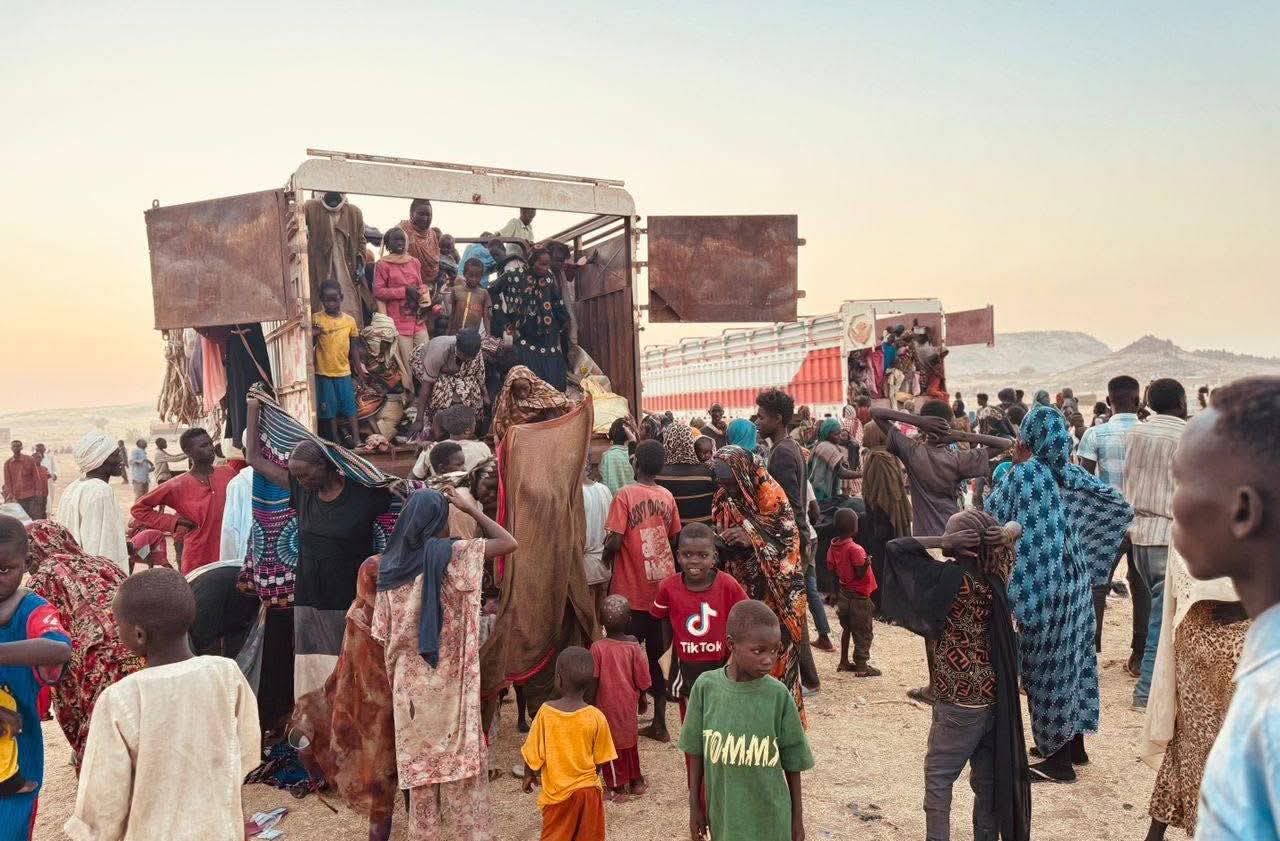
‘Unable to erase the sight of the dead from our minds’: Scenes from Fasher’s fall
Survivors of the RSF's massacres in Fasher recount the harrowing scenes of the city's capture.
Video | Out of Sudan, into precarity
Two women who fled the Sudan war share their survival, escape and refuge stories
Your support is the only way to ensure independent, progressive journalism survives.
You have a right to access accurate information, be stimulated by innovative and nuanced reporting, and be moved by compelling storytelling. Subscribe now to become part of the growing community of members who help us maintain our editorial independence.
Join us