
The global economy is faltering (just a little)
The recent global stock market collapse, which intensified significantly on Tuesday, has many financial analysts pointing the finger at the stringent policies implemented by central banks, particularly the US Federal Reserve. "The Fed rolled the dice one more time on Wednesday and they’ve been proven wrong," Steven Blitz, chief US economist at TS Lombard, told the Financial Times on Saturday.
Blitz is referring to the Federal Reserve's decision to hold interest rates steady, continuing with the aggressive policies it adopted to address soaring inflation rates experienced worldwide in recent years, following the COVID-19 lockdowns and Russian invasion of Ukraine. This was exacerbated by companies and factories exploiting the situation to raise prices and achieve record profits.
The impact of the Fed's latest decision was amplified by various factors, most notably poor earnings reports released over the past few weeks, especially in the tech sector. This was followed by Friday's July jobs report, which showed an increase in the unemployment rate in the US, from 4.1 percent to 4.3 percent —a 0.2 percent rise in just one month. Many analysts see this increase as a sign of an impending economic recession.
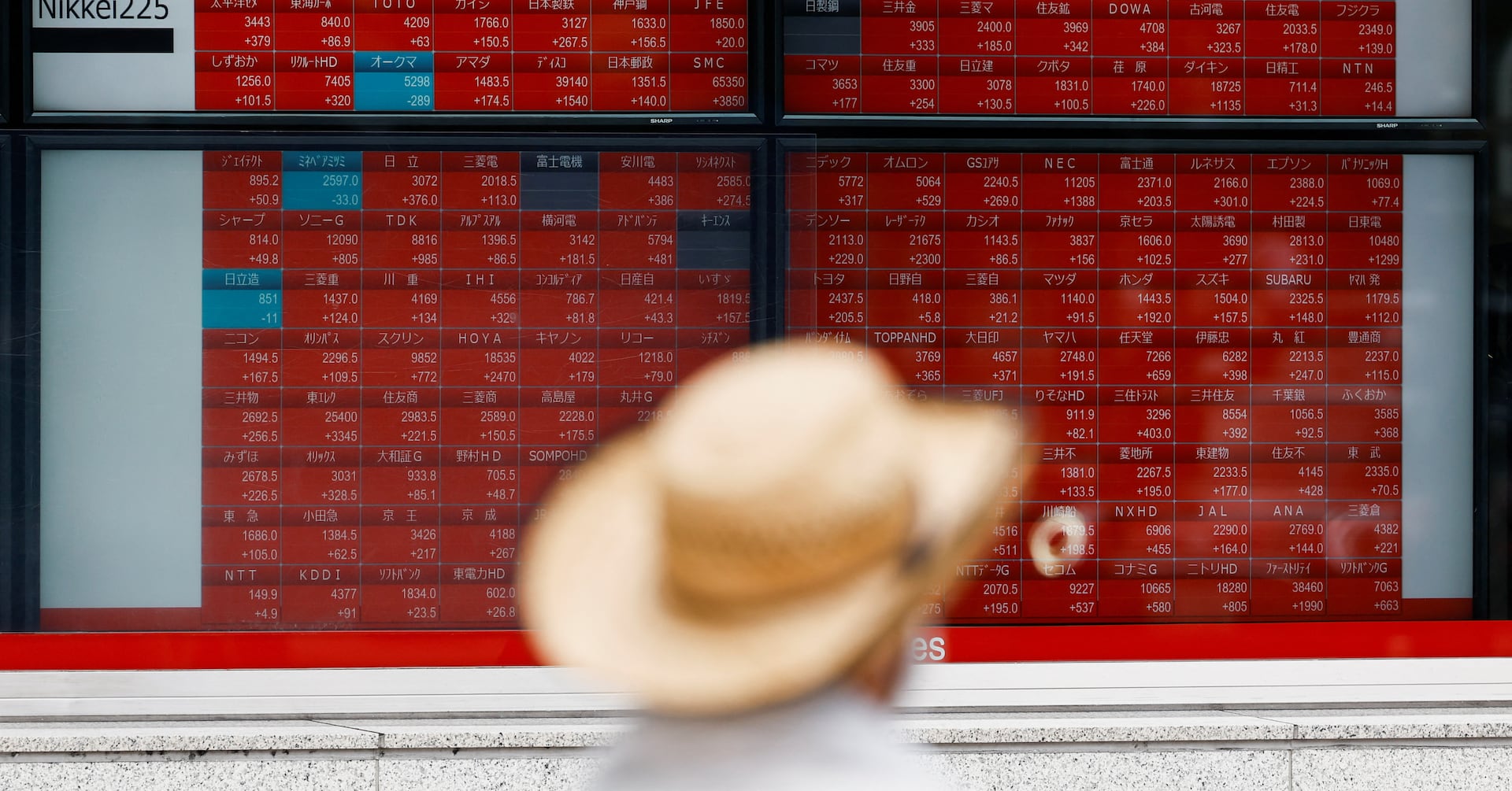
As trading resumed on Monday, panic rippled through global stock markets, starting in Japan and quickly spreading worldwide, with Egypt getting caught up in the snowball.
Despite the panic, a closer look suggests that the world is not currently experiencing an economic recession but rather is faced with deeper circumstances that pose risks to the financial sector. This may force governments and central banks, as has become customary in recent decades, to prioritize the financial sector’s interests at the expense of the middle and lower classes, who are already grappling with a significant cost-of-living crisis.
—
The global investor panic over the past two days has led to significant — and in some cases, historic — losses in stock markets, as a prevailing tone of pessimism and uncertainty about the global economy has taken hold, raising questions about whether or not a recession is looming.
At the start of trading on Monday, Japan saw the steepest decline, with the Nikkei index plummeting 12.4 percent, marking its largest single-day drop since 1987. All major indices in Europe and the US also fell between 2 percent and 4 percent. Cryptocurrencies were not spared, with Bitcoin losing 13 percent of its value over the week and Ethereum dropping 20 percent.
The VIX index, often referred to as the "fear gauge" for its reflection of market pessimism, surged to its highest level since IMthe 2008 financial crisis, rising more than 135 percent in the session following the release of the US employment report.

In recent weeks, investor enthusiasm for the anticipated massive investments in artificial intelligence, projected to reach US$1 trillion in the coming years, has waned. A Goldman Sachs memorandum from late June noted that returns on these investments have yet to materialize.
This skepticism has been compounded by disappointing fourth-quarter reports from major tech companies. Over the past few weeks, through Friday morning, the stocks of the seven largest tech firms — Microsoft, Apple, Amazon, Nvidia, Alphabet (Google), Meta and Tesla — fell by 11.8 percent. Intel, a leading semiconductor manufacturer, saw its steepest decline on Wall Street in 50 years, with its stock plummeting in value by 26 percent.
Additionally, the sharp drop in the Japanese market at the beginning of trading on Monday is partly attributed to its distinctive money market dynamics. For the past two decades, Japan has been known for its low interest rates, often near zero. As central banks worldwide have been raising interest rates to curb inflation, investors have exploited this difference. Economic researcher Mohamed Ramadan, speaking to Mada Masr, explains that over the past three years, investors have borrowed cheaply from the Japanese market and reinvested these loans into high-yield US bonds, a practice known as carry trade. As US interest rates continued to rise, investors significantly profited from the gap between high US yields and low-cost Japanese loans.
However, this has stopped in the past few days. On one hand, the Bank of Japan decided to raise its interest rate to 0.25 percent — a course of action it began four months ago. On the other hand, the US Federal Reserve hinted at a possible interest rate cut in its next meeting, despite maintaining steady rates this month. The shift in these factors has diminished the appeal of such investments, leading to a decline in yen-denominated borrowing and a massive selloff in the Japanese stock market, according to Ramadan.
Does this signal a recession? Typically, a recession involves reduced economic activity, as low demand drives down supply. This results in slower global trade or weak growth, and a drop in prices for essential commodities, like oil, which has fallen 12 percent over the past month to $72 per barrel, despite threats of further conflicts in the Middle East, which usually drive oil prices up.
But this is not the case at present. "The Tokyo market is moving like it did in the global financial crisis, without an actual financial crisis to pin it on," noted a head of trading, as reported by the Financial Times. Economist Adam Tooze, in a brief commentary published on Monday, observed that the economic data "isn't actually that bad" and that it is “consistent” with the notion that the US economy is still recovering from the pandemic and the war's aftermath.
Therefore, Greg Daco, chief economist at the accounting firm EY-Parthenon, believes that the market panic is "disproportionate." In a note to clients cited by The New York Times, he pointed out several healthy indicators and remarked, "This seems like an overreaction."
—
No one knows precisely how this situation will unfold. Whether the massive selloff fueling panic in the stock markets is rational or not will not change the potential consequences it may trigger. Daco points out that this wave brings its own risks. "The primary concern remains the breadth and depth of the market sell-off," he wrote.
This wave undoubtedly indicates a deeper crisis in the financial sector, one that shows no signs of resolution anytime soon. The crisis became evident with the implementation of monetary tightening policies by central banks worldwide to curb the inflation surge caused by the pandemic and the invasion of Ukraine.
Since these policies began, those involved in the financial sector have sought to mitigate the impact of rising interest rates on the markets. Blitz, who accused the US Federal Reserve on Monday of rolling the dice and losing, noted a few months ago that "if there are no rate cuts, this is not necessarily bad news for the markets as it is a signal of sustained growth. The equity market is already relaying that signal," according to his statement in March.
However, this did not stop him from criticizing the Federal Reserve on Monday. To grasp this tension between the financial sector’s fears and central banks’ policies, a deeper understanding of the roots of the issue is essential.
In an article published in late 2022, Cedric Durand, economist and professor of political economy at the University of Geneva, explores these roots. The article is titled with the question "The End of Financial Hegemony?" because, it seems, there is no other viable path for the global economy.
For decades, the financial sector has enjoyed immense benefits and protection from central banks and governments. Although this segment of the economy "ceased to be a dynamic factor in accumulation and has become a deadweight on social reproduction as a whole," according to Durand, it "retained its hegemonic position thanks to uninterrupted monetary infusions from central banks."
But "in the new inflationary context, this monetary guarantee is finally reaching the limits of its effectiveness," says Durand, due to the conflicting interests in this context.
There are structural reasons behind this inflation. The global lockdowns caused by the pandemic revealed a crisis in supply chains, prompting factories and companies to stockpile as much as possible. Moreover, Russia's invasion of Ukraine exacerbated the situation by driving up energy and grain prices.
But this is only part of the picture. What prolonged inflation beyond the pandemic is that companies and factories exploited the situation and raised their prices much higher than what immediate inflationary pressures warranted. This can be seen in corporate earnings reports over the past two years. "Companies are not being forced to raise prices because of the inflation [...] It is actually the other way around. Companies are raising their prices, and as a result, inflation is probably going to keep rising." a Wall Street Journal report noted over two years ago.
This led central banks to employ their standard approach to curb inflation: tightening monetary policy by raising interest rates to reduce market liquidity, thereby lowering demand and slightly easing inflation. This time, however, the crisis transcends economic sectors, transforming into a "general onslaught on labor incomes," as Durand puts it. The working class worldwide finds itself trapped between inflation and falling incomes, while the wealth of the rich accumulates at an unprecedented rate.
The crisis has also impacted the financial sector, which faces grave challenges after decades of relying on government protection. The current inflation is not just a passing wave but is here to stay for some time. Central banks and governments seem to have accepted this, aiming only to keep inflation within manageable limits. Governed by a neoliberal mindset, policymakers cannot conceive of any tool to deal with the situation other than continuing to adhere to monetary tightening policies. This is the conclusion Durand reaches in his article.
Durand uses the chess concept of a "fork" to illustrate the crisis facing the financial sector. In chess, a fork is a tactic where a single piece simultaneously threatens two or more of the opponent's pieces.
This is what is happening in the financial world, as Durand explains. On one hand, monetary tightening deprives financial markets of “the continual [liquidity] support they have received over the years in bailouts and quantitative easing; it could provoke a sudden dry-up of liquidity and the onset of financial panic,” Durand says. “On the other hand, inflation devalues the price of accumulated debt” — which is one of the primary profit sources for the financial sector — when adjusted for the real interest rate after accounting for inflation.
Despite indicators suggesting there is a liquidity crisis not seen since 2008, according to a Reuters report from 2022, this does not necessarily mean a new financial crisis is imminent. Instead, it "means that the central banks will change course," according to Durand. Without serious consideration of other tools to manage inflation, such as implementing pricing mechanisms and price caps, this will mean succumbing to inflation, and a continued cost-of-living crisis faced by the middle and lower classes worldwide.
Monday’s market panic, therefore, signals the financial sector's plea to the US Federal Reserve to hasten interest rate cuts to reassure markets rather than control inflation, says Ramadan. "This will make market reassurance the primary focus for Jerome Powell [chair of the Federal Reserve], pushing inflation targets to a secondary concern," he says.

The impact of the recent panic on emerging markets is yet to materialize, but early signs are already visible. In Egypt, the stock market fell by 2.19 percent during Monday’s session, and the Egyptian pound continued its decline against the dollar, reaching LE49.5 — a drop of about 3 percent in just one month.
Investors attempting to minimize losses are withdrawing from all high-risk assets, including government treasury bills, often referred to as hot money, which saw yields consecutively increase six times over the past quarter, 91 days, reaching 27.65 percent in Monday’s auction.
The exit of hot money has not been offset by new investments, which made a yield curve that had been trending downward begin to rise again.
According to Youm7, around $1.2 billion in hot money exited the market in two days. Since March, around $35 billion in hot money has entered the Egyptian market, according to macroeconomic analyst Mona Bedeir.
In June, hot money recorded an outflow of $4 billion compared to an inflow of only $900 million. Analysts predict that this trend will continue in the coming weeks, while the government faces debts totaling $35 billion this year. Observers believe the Central Bank of Egypt has no choice but to accept higher yields on treasury bills in an attempt to stop investor outflows.
Looking further ahead, if a recession is confirmed and global trade slows, Suez Canal revenues — already reduced by about half annually due to the Red Sea shipping route disturbances caused by the Houthi attacks — are expected to decline further. Suez Canal revenues had exceeded $9 billion in the previous fiscal year, FY 2022/23.
Additionally, there could be impacts on the tourism sector, remittances from Egyptians abroad, and falling oil prices, all of which are vital sources of foreign currency for Egypt.
If the recession materializes in full form, affecting local dollar resources and further devaluing the pound against the dollar, a new wave of inflation could ensue. In such a scenario, and in line with the central bank’s pledge to the IMF to combat inflation, interest rate hikes would likely persist, not only to temper inflation but also as a maneuver to preserve the influx of hot money.
تقارير ذات صلة

Brandishing the military trial stick: The govt’s price control bluff
Another wave of inflation is crashing in. On March 10, and for the third time in the course of a year, the government raised fuel prices again, justifying the decision…

What’s up tomatoes?
During Saturday’s press conference, Prime Minister Mostafa Madbuly addressed the recent surge in tomato prices, following a tour of the Obour Wholesale Fruit and Vegetable Market. “There was a problem…

‘Subsidizing profit?’ – A look into the lifespan of energy subsidies for the industrial sector
The price that industrial actors pay for natural gas remained untouched by the government
Your support is the only way to ensure independent, progressive journalism survives.
You have a right to access accurate information, be stimulated by innovative and nuanced reporting, and be moved by compelling storytelling. Subscribe now to become part of the growing community of members who help us maintain our editorial independence.
Join us