
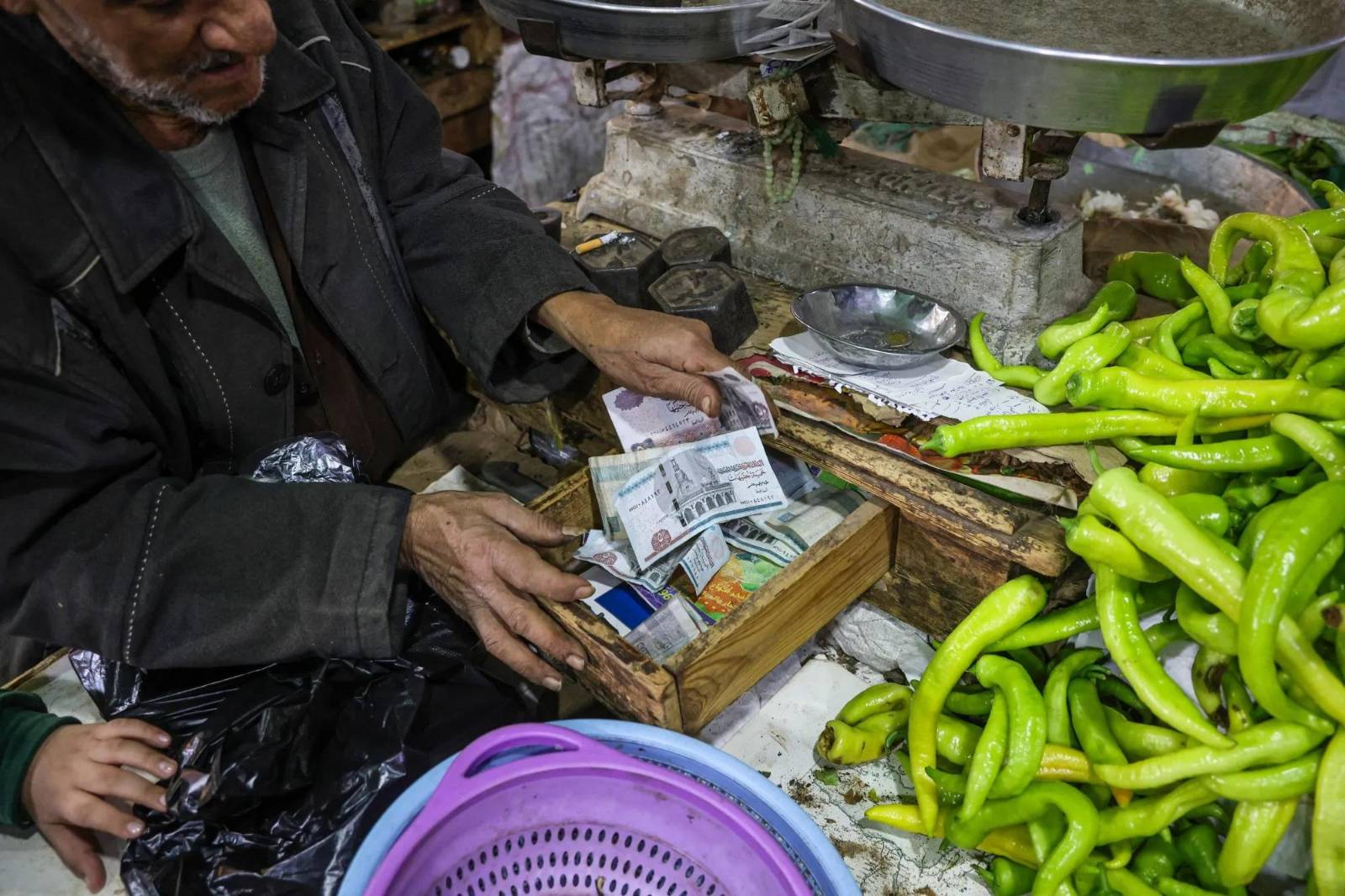
Brandishing the military trial stick: The govt’s price control bluff
Another wave of inflation is crashing in. On March 10, and for the third time in the course of a year, the government raised fuel prices again, justifying the decision as a pre-emptive step to cushion the expected economic fallout from the United States-Israel war on Iran and Tehran’s retaliatory strikes across the Gulf.
The increase — a leap of as much as 30 percent in some fuel categories — was quickly reflected in the cost of a wide range of goods and services. The Egyptian pound has also depreciated rapidly to record an all-time historic low against the dollar, driven by hot money outflows amid regional uncertainty.
Prime Minister Mostafa Madbuly has even apologized to Egyptians for the fuel price increases. But much of the government’s messaging has otherwise leaned on a familiar refrain, one that places the blame squarely on traders and vendors for exploiting the war’s fallout.
This rhetoric peaked when President Abdel Fattah al-Sisi called for the government to explore referral to military courts as a punishment for “anyone who manipulates goods or prices.” The government swiftly echoed the directive, announcing its implementation alongside recourse to civilian courts, an expansion of market inspection campaigns and appeals for citizens to report traders and service providers imposing unjustified price increases.
This forceful line of government commentary invokes measures whose implementation, argues Nasser Amin, the head of the Arab Center for the Independence of the Judiciary and the Legal Profession, would contravene constitutional prohibitions on the military trial of civilians.
Several figures involved in market regulation also tell Mada Masr that the legal basis for prosecuting price manipulation crimes is outdated and harks back to mandatory pricing policies effectively abandoned since the 1980s during Egypt’s integration into the global capitalist market at the time.
The brandishing of military trials as a deterrent therefore raises questions, not only regarding the step’s legality, but also its effectiveness in curbing price hikes in a market where the majority of goods are no longer subject to state price controls.
***
“There is no such crime as ‘price manipulation’ in Egyptian law,” Amin tells Mada Masr.
“What might be construed [as price manipulation] stems from an old provision in the Penal Code tied to violations of mandatory pricing rules, such as withholding goods to drive up prices or altering officially set prices,” the lawyer explains. “This offense is essentially about creating a black market through hoarding,” he says, while noting that “there is currently no legal basis for applying this provision, except in the case of goods [such as fuel, pharmaceuticals, cigarettes and subsidized commodities] whose prices are administratively set.”
Mona al-Garf, former head of the Egyptian Competition Authority, likewise tells Mada Masr that neither the term nor the charge of price manipulation exist in the competition protection law or other Egyptian legislation. She describes the government’s repeated threats against traders over price manipulation as “nothing more than political rhetoric,” adding, “we can easily recall the repeated use of phrases like ‘striking with an iron fist’ against vendor exploitation in similar situations.”
Garf explains that the government’s rhetoric implicitly acknowledges the rapid inflation occurring over a short period. But in effect, she says, there are only a few legally defined offenses that can be prosecuted under the Law on the Protection of Competition and the Prohibition of Monopolistic Practices. “The government may, for example, view a 20 or 30 percent increase in the price of a given commodity over a short period as unjustified,” she explains, “but in reality there is no benchmark for what constitutes an acceptable price increase.”
Competition law in the West likewise moved beyond criminalizing sharp price increases as such decades ago, she adds, even before Egypt introduced its first competition law in 2005.
In her view, the phrasing is just a way of responding to the evident crisis. She says, “the government often resorts to this kind of rhetoric to deflect attention from the root causes, which are tied to higher costs for traders and manufacturers, as is the case now.”
Prices in Egypt are generally allowed to be determined by the forces of supply and demand, says Alaa Ezz, general secretary of the Federation of Egyptian Chambers of Commerce, noting that this is a clear directive under the only market mechanisms in place: those adopted by the Constitution and the laws derived from it.
Vendors are legally required to display the prices of their goods, enabling consumers to compare across producers and choose the cheapest option, he tells Mada Masr.
Ezz argued that, within this framework, the notion of price manipulation applies only to the earliest stages of the supply chain, where large importers or manufacturers can exert control over market prices.
Given the centrality of supply and demand in this view, “[the federation’s] meeting with the prime minister [in mid-March] focused — from our end — solely on emphasizing the availability of goods as the key to stabilizing prices. That is our role: ensuring abundance in a way that creates competition among outlets and brands, while urging the federation members to offset any shortages in a timely manner through imports, or even drawing the state’s attention to intervene with rapid imports if necessary,” Ezz concludes.
A considerable factor of the inflation Egyptian marketplaces are experiencing now is replacement pricing: the practice of setting high prices for goods to prioritize profits at a time when input costs are rising — even if the goods for sale were manufactured earlier at cheaper input costs.
With higher energy prices and a weaker pound already among the immediate economic impacts of the war, many traders have already begun to sell their stock at higher prices in anticipation of further inflation to come.
This is the case in the poultry sector. In the first few days of the war, producer prices for live chickens rose by around 15 percent, on the grounds that feed producers had increased their prices. In reality, the cost of producing feed had not yet changed, as it relied on existing stockpiles of grains. Poultry producers nonetheless passed the higher costs onto the consumer, even though the production cycle lasts around 45 days — meaning that chickens being sold had not been fed the newly priced, more expensive feed.
Ezz argues that replacement pricing, however, cannot be considered as price manipulation. Such behavior, he explains, reflects traders’ efforts to protect profit margins, especially as producers may face declining demand, slowing turnover and threatening cashflow.
A former government official working on competition and anti-monopoly matters tells Mada Masr, on condition of anonymity, that the competition law does not recognize any price-related offense “unless it is fundamentally based on an unlawful agreement among competitors to raise prices simultaneously. In the absence of proof of such an agreement, price increases are considered normal.”
While Ezz agrees that Egyptian law contains no specific offense labeled “price manipulation,” he argues that the term, as used in official rhetoric, serves as “a heading for a range of violations covered by the competition protection and monopoly prevention law.”
According to Ezz, price manipulation can be understood within the framework of the frequently used concept in competition law worldwide: “a deliberate and unlawful interference in the natural forces of supply and demand with the aim of artificially raising or lowering the price of a commodity or financial instrument, or creating a misleading impression of trading activity to induce others to buy or sell.”
Beyond explicit price-fixing, Egypt’s competition law also prohibits a range of agreements that artificially drive prices outside the bounds of supply and demand. These include market-sharing arrangements — whether along geographic lines, distribution centers, customer segments, product types or time periods — as well as coordination in bidding for tenders and other supply offers. The law also bans restrictions on manufacturing, production, distribution or marketing.
Such violations are punishable by fines ranging from no less than two percent to no more than 12 percent of the total revenues generated by the product during the period of infringement. If those revenues cannot be calculated, fines range from LE500,000 up to LE500 million.
The law imposes additional restrictions on entities holding a dominant market position, defined as at least a 25 percent market share. These include prohibitions on selling at below cost prices, halting production or distribution for specified periods, refusing to contract in ways that limit others’ ability to enter or remain in the market and withholding scarce products despite the economic feasibility of supplying them.
Fines in such cases range from one percent to 10 percent of the product’s total revenues during the infringement period, or, where revenues cannot be determined, from LE100,000 to LE300 million.
By way of example, the Egyptian Competition Authority last year filed a criminal case against 162 companies producing broiler chickens, accusing them of colluding to fix sale prices. In a statement, the authority said the agreements “affected the prices of chickens and poultry in Egypt, resulting in exorbitant prices for consumers,” adding that it had confirmed the companies were coordinating “on a daily basis to set selling prices for broiler chickens to poultry farmers and exchanging confidential trade information.”
***
The only exception to the general laxity that allows supply and demand to determine prices is Article 10 of the competition law, which grants the prime minister the authority to “set the selling price of one or more essential goods for a specified period, after consulting the competition authority.” Any agreements concluded by the government for the purpose of enforcing such prices are not considered harmful to competition, as per the law.
The government has invoked this provision several times amid the successive economic shocks of recent years. Following the global inflationary wave triggered by Russia’s war on Ukraine, the prime minister issued a decision in September 2022 capping the price of packaged white rice at LE15 per kilogram, for example.
The rice price cap was repealed in February 2023, after it “failed to bear fruit,” as then-Assistant Supply Minister Ibrahim Ashmawy put it during a TV interview.
The government also relied on the same law during the COVID-19 pandemic in 2020 to fix prices for rubbing alcohol and face masks. That decision included prison sentences tied to violations of the Consumer Protection Law, which regulates the circulation of “strategic goods.”
The Consumer Protection Law prohibits the hoarding of these goods, giving the prime minister the authority to designate particular goods as strategic, setting the rules governing their trade for a specific period and identifying the competent authority for enforcement.
Accordingly, the COVID-19 decision classified the items as strategic goods that could not be withheld from the market. Producers, suppliers, distributors and retailers were required to notify the relevant health directorates nationwide of the types and quantities of these products in their possession, in addition to complying with a set of detailed regulatory controls.
This provision enabled the late Supply Minister Ali Meselhy to roll out a policy to try and control prices for a number of essential food products during the 2023 inflationary surge. He issued a decree setting out implementation rules for an earlier prime ministerial decision that designated seven commodities — blended oil, packaged fava beans, rice, milk, sugar, pasta and white cheese — as strategic goods.
The ministerial decree required companies involved in producing, importing, manufacturing, packaging or supplying these goods to indicate the maximum retail price for consumers. This meant producers had to set retailers’ profit margins, thereby standardizing prices across outlets without the government directly fixing them.
A few years ago, in 2022, a similar maneuver by Meselhy produced a system that supplied flour to commercial bakeries — which sell unsubsidized bread — at a set price, via the private mills that contract with the General Authority for Supply Commodities, Abdallah Ghorab, head of the Bakeries Division at the Chambers of Commerce, tells Mada Masr. In turn, the bread itself was subject to prices set by the ministry. The system was later rolled back.
Meselhy’s decision allowed licensed bakeries to obtain flour at LE10,000 per ton, while fixing the prices of different types and weights of unsubsidized bread, with violations punishable by a fine of LE10,000.
With the system no longer in place, there is currently no legal basis for the Supply Ministry to impose a binding price cap on unsubsidized bread, Ghorab notes. He describes the recent ministerial decision setting maximum prices for bread as merely “indicative,” not mandatory, stressing that such decisions are intended to guide the market and that prices “ultimately remain subject to supply and demand.”
Following the fuel price hikes, which affected diesel and natural gas — the fuels on which bakeries depend — as well as a rise in flour prices of more than LE1,000 per ton since the onset of the war, or around nine percent, the supply minister issued a decision setting maximum prices for unsubsidized bread at LE2 for an 80-gram loaf, LE1.5 for 60 grams and LE1 for 40 grams. Fino bread was similarly capped at LE2 for 50 grams, LE1.5 for 40 grams and LE1 for 30 grams.
On the same day, the bakeries division announced an increase in the maximum price of unsubsidized bread, aligning with the ministerial directive, Ghorab and division member Khaled Sabry previously told Mada Masr.
The minister’s directive adopted a mandatory tone, stating that the ministry would oversee compliance and that “any violation of bread pricing rules shall be punishable under Article 9 of Law 163/1950 and its amendments,” a reference to legislation governing mandatory pricing.
However, a senior source in the bakeries division tells Mada Masr that invoking this law does not create a binding legal obligation and that its penalties cannot be applied to unsubsidized bread pricing, since such products do not fall within its scope.
“It can be said that the decision was framed this way primarily as intimidation,” says the source, speaking on condition of anonymity. They explain that “from a legal standpoint, no violator could be referred to the Public Prosecution on this basis. But the ministry is well aware of the sensitivity of this commodity and the need to ensure its availability and relative price stability, hence why it resorts to this kind of intimidation.”
According to the source, “the pricing of unsubsidized bread is not, legally speaking, subject to any form of government price control. The indicative pricing system instead relies on consultations between the Supply Ministry and the bakeries division to estimate costs.”
In practice, they add, most bakeries comply because they want to maintain good relations with the ministry. They remain subject to ministry oversight under consumer protection and food safety laws, and deviating from the indicative price risks provoking stricter inspections in a sector where violations are widespread. A “very large number” of bakeries operate without licenses, says the source, describing the situation as a reality the ministry turns a blind eye to, given the bakeries’ vital role in ensuring the availability of the food staple.
A senior official at the Supply Ministry with direct ties to oversight affairs, likewise, tells Mada Masr that the scope of the mandatory pricing law is currently limited to subsidized goods, petroleum products, cigarettes and pharmaceuticals, and does not extend to unsubsidized bread. As such, the only penalties currently applied to those who divert from pricing guidance rely solely on violations related to commercial fraud.
***
Amin argues that the prime minister’s remarks about referring cases of price manipulation to military courts are “misleading,” intended to calm public opinion in the face of a poorly regulated market shaped both by supply-and-demand dynamics and by government decisions to raise fuel prices.
The statements amount to “a threat directed at vendors,” he says.
Amin explains that the 1958 Emergency Law allowed cases involving price violations and the hoarding of goods, known as supply offenses, to be referred to military courts at times of national crisis.
But “apart from the fact that the offense itself lapsed with the end of mandatory pricing,” he adds, “the state of emergency was lifted years ago by the president, and the Emergency Law itself was repealed and replaced by the counter-terrorism law,” which does not permit the referral of cases to military courts. Such cases may be brought before state security courts under the counter-terrorism law.
In any event, Amin notes, “these supply-related offenses were tied only to marketing and retail units, not manufacturing, meaning that competition-related offenses have no connection to the types of cases that could previously have been referred to military courts under a state of emergency.”
And as for competition offenses, Egypt has never, at any point in its history, referred a competition law case to a military court, according to both Garf and the former government official.
Amin — who served on the 50-member committee that drafted the current Constitution — also adds that the 2014 Constitution contains a clear prohibition on trying civilians before military courts. The Supreme Council of the Armed Forces, following the January 2011 revolution, abolished Article 6 of the military judiciary law, which had previously allowed the president to refer certain cases, including supply offenses, to military courts — an amendment that came in response to decades of human rights advocacy. However, “after the Emergency Law was repealed, the president issued a decision delegating to the prime minister the authority to refer certain cases to military courts in states of emergency — a decision that is constitutionally invalid and, in any case, cannot be invoked under current conditions because it is contingent on a declared state of emergency.”
In the same vein, a senior member of the board of the Federation of Egyptian Chambers of Commerce, who is close to the government, downplayed the likelihood that such referrals would actually occur.
“The state has determined that the current situation is exceptional and one that requires it to brandish its weapons,” the source tells Mada Masr on condition of anonymity.
“It decided to invoke the military judiciary as if waving a heavy stick — merely as a threat.”
تقارير ذات صلة
Egypt to seek LE1.5 trillion in borrowing as debt servicing consumes 50% of 2022/23 expenditures
An MP blamed the government for not developing an austerity plan.
How is the Egyptian government dealing with the global wheat crisis?
The response could mark a departure from a policy direction toward drawing back bread subsidies

Bread politics
An eight-part series that takes an in-depth look at bread subsidies in Egypt
Your support is the only way to ensure independent, progressive journalism survives.
You have a right to access accurate information, be stimulated by innovative and nuanced reporting, and be moved by compelling storytelling. Subscribe now to become part of the growing community of members who help us maintain our editorial independence.
Join us