
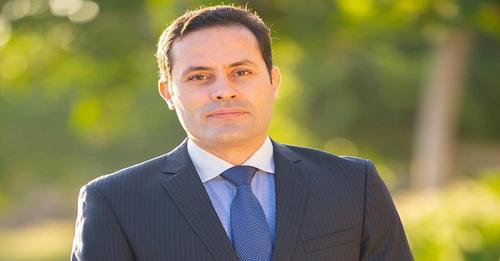
Q&A with Karama Party head Ahmed Tantawi on some opposition groups’ prerequisites for joining national political dialogue with the state
At the close of Ramadan, President Abdel Fattah al-Sisi made a public appearance with a number of opposition figures at his side at the annual Egyptian Family Iftar and issued a call for a national political dialogue.
Two weeks later, the National Training Academy, a body founded and supervised by Sisi, announced that “based on the mandate of the president” it would be responsible for managing the dialogue with “impartiality,” and for facilitating the participation of political, party and youth groups without intervening to affect the content or outcomes.
Invitations to attend the dialogue were sent out by the academy to representatives of a broad swath of social and political groups, besides an open invitation for all those wishing to participate to register on the website of the National Youth Conference.
The academy noted that a joint and impartial committee would be created, including representatives from think tanks and institutions of various positionalities. The outcomes of the dialogue, once agreed upon by the participants, would be gathered in a preliminary document to be submitted to the president.
The response from opposition parties was varied. Some had already come together to lay out principles according to which they believe the dialogue should take place, and suggested that any public consultation held by the national academy would be tantamount to propaganda, or a festival or educational seminar intended to endorse the status quo, rather than a serious dialogue seeking to bring the nation out of crisis.
However, Ehab al-Kharrat, deputy head of the Egyptian Democratic Party for party relations, welcomed the academy's announcement, describing the academy as an appropriate host for the talks. Kharrat told Mada Masr that he anticipates the dialogue will include a full range of political forces and will fulfill the basic conditions for a fruitful and effective dialogue, pointing in particular to those detained in cases relating to freedom of expression.
The newly reformed Presidential Pardon Committee, which is responsible for ensuring the release of select detainees, also announced on Tuesday that it would be joining the National Dialogue sessions and would soon be publishing a list of dozens of detainees who will be freed following requests submitted to the committee after the Egyptian Family Iftar.
Among those skeptical is Karama Party head Ahmed Tantawi, who told Mada Masr on Tuesday that he repudiates the assignment of the national dialogue’s management to the National Training Academy.
After the president announced the dialogue would be launched, the former MP had brought together a broad assortment of politicians from the Civil Democratic Movement in an attempt to establish consensus around a system by which to manage the dialogue sessions with the state, as well as to decide on an agenda.
At the top of this agenda? Tantawi and the Karama party proposed a five-point plan centered on “political reform and democratic transition, economic reform and social justice, legislative and institutional reform, human rights and public freedoms, as well as national security and national interests.”
A meeting held on May 7 to set out the opposition program included representatives from the Socialist Popular Alliance Party, the Conservative Party, the Dostour Party, the National Conciliation Party, the Egyptian Socialist Party and the Bread and Freedom Party, alongside a number of independent activists and politicians.
Points those that gathered secured agreement upon included: that any dialogue sessions should occur under the auspices of the president’s office, should be broadcast through the media, and be attended by equal numbers of representatives from the state and from the opposition.
Mada Masr sat down with Tantawi ahead of the meeting to understand his approach to organizing at the time and his stance toward the state’s push for national dialogue.
Mada Masr: Did you attend the Egyptian Family Iftar?
Ahmed Tantawi: After receiving the invitation on behalf of the Karama Party, we studied our options and decided to participate. I did not attend the event, but party leaders attended, including its founders, deputy Hamdeen Sabbahi, its former president, honorary president Mohamed Samy, director of the party’s board of trustees, former health minister Amr Helmy, and head of the party’s freedoms committee Kamal Abu Eita.
I have not uttered a word on the matter yet since then, but we were keen to develop an integrated vision to address what we believe to be objective and procedural necessities, so that we end up with a truly productive, serious, fruitful political dialogue, with actionable results.
I also believe it is crucial to build a consensus among the broadest spectrum of actors from within the civil movement, including parties and public figures. And so, I called for a meeting with the civil and democratic forces at the party’s headquarters to present them with that vision.
MM: What are the features of that vision?
AT: Procedurally speaking, our vision aims at defining the umbrella under which the dialogue will take place. The dialogue must be conducted with the single party that has proven, in practicality, to be the sole entity capable of implementing what we agree upon. That is to say the presidency of the republic, and not any other party.
The state has only listened to its supporters — we have been ruled for eight years according to a vision that says: “Do not listen to anyone’s words but mine!” It is no mystery to any sane person that we have reached such a low level on all fronts as a result of that vision being the primary ground for public administration and the exercise of power.
We demand a real dialogue on equal footing. If the state actually wants the opposite, if they’re sincerely convinced “that disagreement in opinion does not spoil the nation’s affairs,” then they ought to listen to those who disagree with them, those who expressed their opposition, those who tried to make their voice heard through dialogue, those who committed themselves to the provisions of the Constitution and the law in their opposition to power.
Objectively speaking, we are proposing five domains for the dialogue handled by five different committees: political reform and democratic transition, economic reform and social justice, legislative and institutional reform, human rights and public freedoms, as well as national security and national interests.
We proposed the formation of a technical secretariat for each of those domains in order to decide on the tasks of those responsible for managing the dialogue sessions and its agenda. They should be run equally by state supporters and the opposition. Participation in all sessions and all domains shall also be divided equally between supporters and opposition.
The technical secretariat for each committee will be assigned the responsibility of preparing for the conference, its agenda and its management, as well as following up on its results and briefing the public through monthly releases, for 12 months after the conference, in order to show the extent of progress or procrastination in implementing what is agreed upon during the conference across all five domains.
We suggest that government representatives and heads of parliamentary bodies attend the dialogue, and that government representatives be prepared to provide information and data essential for the interlocutors to make informed opinions. And should we come to practical conclusions, they should be implementable through the state or Parliament. We are now seeking consensus among the opposition forces and the Civil Democratic Movement based on that vision.
MM: And who are the opposition forces now in your view?
AT: Those who identify as opposition are already well-known. For us, the opposition is simply those who were not part of the regime during the past eight years. And we, the Karama Party, were never part of this regime nor its supporters, and we will never be, no matter how long this regime remains in power. That’s why every position we take now is free from any suspicion of any partisan, private, or other interests.
MM: Why do you think the state is reaching out to the opposition after all those years?
AT: The state expectedly wants to stage a certain image, but we are hoping to push it to learn from the lessons of the past years.
On our part, we will not seek to settle accounts at the expense of the nation. We will advocate for the rights and the needs of the people and the nation despite our position vis-a-vis the state. And we are not considering, whatever the outcome of this dialogue, to change this position.
We are doing our best to set a clear, specific agenda for the upcoming dialogue, which should constitute all the terms of a possible agreement. If an agreement is unreachable, then there is no sense for the state to continue to seek collaboration from the opposition, either in resolving the failures of its past or for endorsing or joining its future projects.
We have already noted our opposition to a host of issues: the transfer [to Saudi Arabia] of the Tiran and Sanafir islands; the Nile water agreements; the unprecedented crackdown on human rights. And we have stood in opposition to the manipulation of the electorate’s will.
Within the past three years, many people have been to prison because of me. Some of the closest people in my life — friends, and six colleagues in my Citizens Service Office in my district — were all imprisoned after I called for the Coalition for Hope and then the Third Way Initiative.
Moreover, the will of voters in my constituency was disregarded, and false results were announced, not only according to the testimony of the people of my constituency, but based on the official counting records of 221 electoral subcommittees as well. Although the Constitution mandated that the Court of Cassation decide on electoral appeals within 60 days, no decisions have been taken to this point, now 18 months later.
So, if I am to act out of self-interest, I would disavow the entire scene. However, from a national standpoint in which we sense the danger that the country is facing and feel for the people who are paying the price for it, it remains our duty to try to take onboard this ambiguous invitation and push it in a serious direction.
MM: The activist and the manager of Hamdeen Sabbahi’s presidential campaign, Hossam Moanis, and other Karama Party members were released, while activists belonging to other parties are still being detained. How did that happen?
AT: Hamdeen Sabbahi demanded “the release of all prisoners of conscience” — he repeated this phrase twice in his speech to the president — adding that “among them are ‘my son’ Hossam Moanis.” If the issue is one of personal interest, it would have been a far easier job. I would have asked to be a member of Parliament, and Hamdeen would request the status of “the leader of the national opposition,” which would be an ideal reaffirmation of his historical role as leader of the opposition.
The issue of prisoners can be discussed according to two tracks: on one hand, you have a question of rights and justice, which is governed by a balance of power; and on the other, you have the right to the immediate release of every Egyptian citizen who did not commit or incite violence and was detained under whatever circumstances. Moreover, constitutional and legal guarantees should be used to compensate those who have been wrongly detained, and to hold those who have held them unjustly accountable.
However, our opponent is a state that posits itself as free from any legal or moral constraints. For instance, they were well-informed of all the details regarding the launch of the Coalition for Hope. Yet, as soon as the coalition’s launch meeting ended at midnight, the authorities began promoting the idea that this electoral alliance was an “extremist cell.” Before the sun rose the next morning, they had begun to arrest people, both those who were part of the coalition and others who had nothing to do with it.
MM: Does the fear of 2011 hinder efforts to release prisoners of conscience?
AT: The security administration has pushed people to take to the streets, due to their lack of political wisdom. But in truth, those that want to prevent the state from facing such hardships and upheaval are those who are seeking to turn a new page, those that want to address the mistakes of the past and agree on a new future. Those who are shutting the door on such attempts are the ones who bear the responsibility [for any social upheaval]. People will not remain hostage for the rest of their lives because of some undefined estimation that they pose a danger.
The solution is to protect people’s right to call for change through the ballot box.
MM: Amid optimism about the release of a number of prisoners, authorities have arrested other journalists. Do you have any thoughts on this?
AT: After the arrest of these journalists, they told us, “You didn’t see what they said and whom they insulted.”
I replied to them that whoever attempts public work must open their hearts to what people’s hearts are struggling with. Part of the burden of being a public figure is to be able to bear public insults.
But even if a public figure is sensitive to criticism, they cannot resort to using their authority to accuse the person that has criticized them of terrorism. They cannot throw them in prison for years, with or without a trial. They must abide by legal protocols and hold them accountable for insults or slander rather than terrorism or incitement to overthrow the government.
MM: Will the national dialogue sessions begin before political prisoners are released?
AT: The presidential amnesty committee met on Saturday and on Sunday. We have people who are assigned to look into the situation of prisoners, and we are monitoring how serious the government is about implementing its promises to release political prisoners. The Karama Party formed a committee as soon as the amnesty committee was re-formed, and it put together a list of 700 prisoners within the first 24 hours, which was submitted immediately to the amnesty committee. We do hope that they will be serious in handling this issue.
MM: What are your expectations for the national dialogue sessions?
AT: If we, as a civil movement, agree on the vision prepared by the party for the national dialogue sessions, we will announce it to the people, and we will be ready for dialogue with the state according to a vision that we prepared with the help of experts and specialists in all domains in order for the dialogue to be serious and fruitful.
At that stage, if the dialogue fails, the matter will then be subject to the will of the state and the will of the opposition as a whole. Our role is to express our will, and if the authority is actually serious and sensitive to the magnitude of the crisis, it should respond to our demands. But if it is not, we will also announce that to the people, so that we are not held accountable before the nation and before our own conscience. We do not want to be charged with having retreated and leaving the people to fight for their freedom on their own, because it is the people who pay the price.
MM: Do you think we will see another Hamdeen versus Sisi election? Or could there be an alternative candidate from the opposition to run in the 2024 presidential elections?
AT: The best thing that this regime could ever offer to Egypt, no matter how long it stays, is to leave power to the ballot box. The outcome of past years shows that they have not delivered what they promised the Egyptian people.
At this point, Egyptians could have had a new president. To have a new president every eight years was a gain in the struggle of the January Revolution. Who is responsible for denying them this? Who has overstepped the constitutional articles [on term limits]? Who, after eight years, says the situation is very difficult and that there are no possible alternatives? Change is not an unprecedented concept.

تقارير ذات صلة
Presidential elections: An opportunity for the opposition to come out of the margins?
Now, there are three members of the Civil Democratic Movement who have stated their intention to run
Exposition, character, scene: Staging the upcoming presidential elections
Sisi recently told officials he's searching for a new framework to manage Egypt's affairs
3 acquittals but still behind bars: The trials of Samer al-Desouky
June 18, 2022 In the city of Damietta, straddling the Nile’s eastern distributary, Mohab Mohamed, a 28-year-old National Security Agency officer, writes a report on the results of an investigation…
Your support is the only way to ensure independent, progressive journalism survives.
You have a right to access accurate information, be stimulated by innovative and nuanced reporting, and be moved by compelling storytelling. Subscribe now to become part of the growing community of members who help us maintain our editorial independence.
Join us