
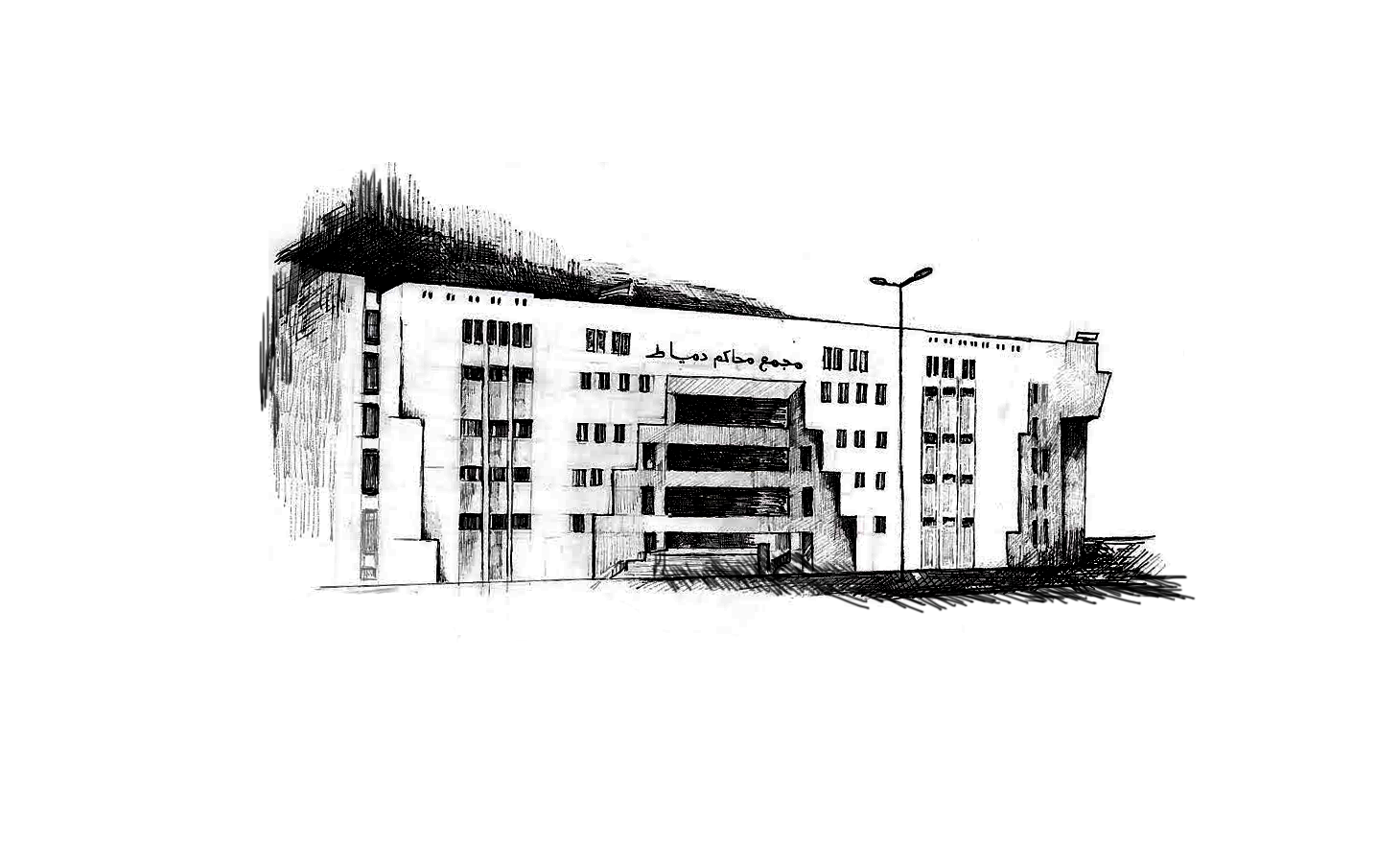
3 acquittals but still behind bars: The trials of Samer al-Desouky
June 18, 2022
In the city of Damietta, straddling the Nile’s eastern distributary, Mohab Mohamed, a 28-year-old National Security Agency officer, writes a report on the results of an investigation he conducted on 32-year-old accountant Samer al-Desouky, who works at a shipping and logistics company at Damietta Port.
The report concludes that the accountant is dangerous, indicating that Desouky had “embraced Takfiri beliefs” based on information corroborated “from secret sources” whose identities he cannot reveal, as he told a prosecutor a week later. That Desouky embraces Takfiri beliefs, Mohamed explains in his report, is a sign that he views Egypt’s current ruler as an infidel and unbeliever and therefore believes in the legitimacy of rebelling and conducting violent operations against him and members of the army, the judiciary and other state security bodies. Desouky believes the same, the report says, about Christians.
Desouky took action by creating a Jihadi cell to plan operations against state institutions and churches, writes Mohamed, calling for jihad inside Egypt and abroad to reestablish an Islamic caliphate. Members of his cell were instructed to monitor state security agency employees, facilities and checkpoints, as well as Christians. He had started to stock weapons, ammunition and dual-use chemicals — over-the-counter chemicals that could be used to make explosives — in his home, Mohamed claims in the report.
***
June 19, 2022
Escorted by a force of plainclothes policemen, Captain Mohamed sets up a number of fixed and mobile checkpoints around Desouky’s house in New Damietta, a tourist town offshoot of the old port city to its east.
One of the checkpoints manages to identify Desouky and Mohamed proceeds to introduce himself, informing Desouky of the reason behind his imminent arrest and apprehending him after presenting him with a warrant.
Upon searching him, Mohamed finds a 15-page photocopied document titled "Commentary on the Book of Oneness" (a text on one of Wahhabi Islamic movement founder Mohamed Ibn Abdel Wahab’s works) and another 11-page photocopied document titled “And the nonbelievers will soon know who will have the ultimate outcome” — part of a Quran verse. Desouky confesses that the papers belong to him and that he intends to use them to recruit others.
***
June 20, 2022
Desouky is transported to the Damietta Court Complex, where the prosecutor’s offices are located, and is questioned about accusations of forming a terrorist cell and planning aggressive acts against the state — accusations cited in Mohamed’s investigative report based on information he provided from his “secret sources,” whose identities were not revealed during questioning.
The prosecutor then orders Desouky’s detention for 14 days pending investigation, and a few weeks later, he is formally referred to trial on misdemeanor charges for possessing documents that incite a variety of anti-state actions.
***
July 6, 2022
A misdemeanor court finds Desouky guilty, sentencing him to three months in prison for possessing promotional print material for the purpose of disrupting constitutional and legal provisions, preventing state institutions from carrying out their duties, overthrowing the state system, jeopardizing national unity and social peace and attacking citizens’ personal freedoms and other liberties and rights protected by the constitution and the law.
***
July 24, 2022
The fifth circuit of the Damietta Appellate Misdemeanor Court, which specializes in terrorism cases, overturns Desouky’s conviction after concluding that the National Security officer’s investigative report is insincere, deeming the information in the report too vague to warrant an investigation. There is no proof, the court says, that the evidence seized from Desouky was intended for the promotion of any ideas deemed to be criminal offenses.
***
August 24, 2022
Officer Mohab Mohamed files another report on Desouky, identical to the version deemed insufficient by the court only a month earlier.
***
August 26, 2022
Mohamed writes an arrest report indicating that he apprehended Desouky and seized a document from him that day comprised of 8 photocopied pages titled Nusus al-Fuqahaa Hawl Ahkam al-Igharah wa-al-Tatarrus, a Jihadi treatise by former Al-Qaeda strategist Fares al-Zahrani.
***
August 27, 2022
Desouky is questioned by prosecutors and ordered detained for 15 days pending investigations into the accusations made against him by Mohamed.
***
September 8, 2022
The prosecution formally charges Desouky with the misdemeanor of possessing promotional print material for the purpose of suspending the provisions of the constitution and the provisions of the law, preventing state institutions from carrying out their duties, overthrowing the state system, attacking the personal freedom of citizens and other liberties and rights protected by the constitution and the law, and harming national unity and social peace.
The prosecution referred Desouky to trial, which was scheduled to begin on September 14.
***
October 5, 2022
The Damietta misdemeanors court acquits Desouky of the charges.
***
November 6, 2022
Mohamed files another arrest report against Desouky with the same accusations, citing similar photocopied documents as evidence.
***
November 20, 2022
The Damietta Appellate Misdemeanor Court upholds Desouky’s second acquittal and rejects the prosecution’s appeal.
***
December 7, 2022
The Damietta Misdemeanor Court acquits Desouky of charges of possessing anti-state promotional print material for the third time.
***
January 15, 2023
The Damietta Appellate Misdemeanor Court upholds Desouky’s third acquittal and rejects the prosecution’s appeal.
*****
This is the story of Samer al-Desouky’s trials, as told from documents made available to Mada Masr by his lawyer — a stark reminder of a practice that has become normalized in Egypt over the past years. If security agencies want to jail someone for any reason, like political activism or suspicion of terrorist activity, among many other reasons, and they don’t have sufficient evidence to present to the court or are uncertain about the outcome of the case’s referral to trial, they subject defendants to a possibly endless loop of imprisonment.
The timeline above conceals another timeline that started before Mohamed’s initial arrest report in June 2022, diverging with it at several junctures. Traces of this other timeline are found in the documents made available by Desouky’s lawyer — but only to the attentive eye, or rather to one who is weary of the authorities’ unofficial practices that they never acknowledge, be they related to law enforcement or investigations. When questioned by prosecutors, Desouky stated that he was in fact first arrested on May 8, 2022, a statement supported by his family and lawyers, who all confirmed that he had disappeared that day.
Desouky said that Mohamed, along with another officer named Mohamed Rady, intercepted him while returning home from work and took him to New Damietta Police Station. They then took his mobile phone, wallet and watch and detained him without informing him of the charges made against him. A few days later, Desouky said, he was transported to a National Security Agency headquarters — a white, fenced-in, five-story building overlooking the Damietta branch of the Nile — where he was held until he was transported to the prosecution in late June.

During questioning, Desouky was surprised at the charges being levied against him, telling the prosecutor that this was the first time he was informed of them, insisting that he had never before seen the photocopied documents presented against him as evidence and that he was not presented with an arrest warrant, and denying all the charges made against him by Mohamed.
Desouky testified that he spent 33 days behind bars with no official charges against him and 32 days past the maximum legal detention period for any Egyptian citizen before being questioned by prosecutors.
Not only did his unlawful detention start immediately after his arrest in May 2022, but it was ongoing between his consecutive charges, meaning that even though the charges made against Desouky were acquitted by the court three times, he was never released after his first arrest in May to be rearrested. Desouky told prosecutors, while being questioned for his second case in August, that the day after his first acquittal, July 24, he was transferred to a Central Security Forces camp, where he was detained until he appeared for questioning that same day. His family and lawyers corroborated his disappearance throughout that period of time.
This parallel timeline, which illustrates the rift usually found between state authorities’ narratives and those of incarcerated Egyptians, can be seen in hundreds, if not thousands, of cases where prisoners of conscience are forced to spend the two-year maximum remand detention period to be released by the prosecution’s orders, but only on paper. What actually ends up happening, according to dozens of witness reports and human rights lawyers following these cases, is that defendants get illegally detained by security forces for some time, often weeks or months, and then reappear at the prosecution only to find themselves facing a new case with similar — if not identical — accusations.

What is it like to be a prosecutor at this point in Egypt’s history, when people are being jailed for as minor an offense as a satirical Facebook status? How much power do prosecutors really have, and how do they wield it? Are they complicit in perpetuating this practice? Can they stop the practice dead in its tracks if they are willing? Can they be a nuisance to the police if they choose? Would they want to?
Isn’t it odd that the prosecutor would see that a suspect is being accused of the exact same accusations that they were previously acquitted of, with virtually identical circumstances and evidence, and still proceed with charging them?
Mada Masr spoke with several judges and a prosecutor, all of whom requested to remain anonymous, in an effort to understand how such a chain of events could be possible in a judicial system that is, in theory, meant to be subject to a post-revolution constitution that should be protecting citizens from Egypt’s infamous legacy of remand detention.
A variety of reasons coalesce to allow for the circumvention of guarantees against arbitrary detention, chief among which is the sway of the executive branch, represented by the security agencies, over the prosecution. The practice of rotating prisoners, as it came to be known around 2019, will persist, supported by some prosecutors’ understanding of the scope of their disciplinary roles and a slew of operational hurdles standing in the way of releasing suspects and investigating forced disappearance cases.
One judge at the Court of Cassation, Egypt’s highest appellate court, told Mada Masr that the explanation is simple. Prosecutors, unlike judges, have bosses, and those who work at local offices are near the bottom of a command chain that leads up to the public prosecutor. When they are ordered to “lock them up” by their superior, according to the judge, they cannot disobey.
The prosecution does not act independently on its decisions, unlike the courts, where the presiding judge has the final say.
This wasn’t always the case. Another judge told Mada Masr that, even as recently as 2013 and 2014 and amid widespread protests, he would merely notify the superior prosecuting attorney of his decision and often release people accused of protesting due to insufficient evidence. This, the senior judge said, is how things operated in better times. “On the rare occasion when a senior prosecutor would try to influence my decision, I would document his communication in the case file; that was the norm.” This is not allowed to happen anymore, he said.
This is an important clarification to keep in mind when looking at Samer al-Desouky’s case. One of the judges told Mada Masr that the prosecutor probably gathered that he would be acquitted based on the evidence and his questioning. So why would the prosecutor go through any hassle when he knows the suspect will be quickly acquitted, even if it is clear that the case is being recycled? “Just leave the decision to the judge,” he said, emulating the prosecutor’s own reasoning.
Those who have been forcibly disappeared will often testify to their experience, but investigations are seldom opened. When asked why, the judge said that this would be hard to do in practice. Where would the judge look out of the many places the defendant could be detained? Even if they went to a suspected place of detention, how would he know the defendant was there? he asked.
The senior judge, on the other hand, pointed out that inspections of police stations, while a legally mandated right for prosecutors, are essentially suspended. “No one inspects police stations these days,” he said.
One prosecutor told Mada Masr that another reason behind such decisions is that, in his opinion, prosecutors in such cases are likely to view a National Security Agency officer as the “quintessential “Egyptian policeman instrumental to “keeping the public peace.” They could assume that the officer likely knows something the prosecutor doesn’t, even if he’s not trying to prove it in the investigative report, so the suspect is kept in prison based on the national security officer’s judgment. Both the prosecutor and one of the judges told Mada Masr that the prosecutor also likely gives the officer the benefit of the doubt, believing that suspects probably continue to do what officers warn them about and that a few weeks in jail could "help" them get their act together.
It is important to note that Samer al-Desouky is an imam and a Salafi Muslim, making him suspicious in the eyes of Egyptian police, who are generally hostile to Salafis. Imams are also always under surveillance by the National Security Agency in Egypt, and Desouky was occasionally called upon to meet with different security officers, according to his lawyer, Samuel Tharwat.
This, the prosecutor who spoke to Mada Masr thinks, makes it likely that one of the officers had a reason to jail him, and a prosecutor wasn’t going to stand in the way of that, especially since, if there’s no concrete evidence, the court would eventually acquit Desouky of the charges, easing the officer’s guilty conscience.
One of the judges speaking to Mada Masr made a distinction between prosecutors’ and judges’ roles, explaining that a judge has less authority to detain someone, whereas, according to the law, detainment charges are at the discretion of the prosecutor, who can order a suspect’s detention, even if it is just on the basis of maintaining public order from their perspective.
Even after explaining such a rationalization, the judge, speaking to Mada Masr, expressed his exasperation over the fact that the judicial system is now involved in the state’s arbitrary imprisonment tactics. But the judge does not condone these arbitrary imprisonment tactics; he tells Mada Masr with a hint of irony, saying that he would rather Egypt re-embrace administrative detention — in that case, at least, the judiciary system would not be involved.
While stories of zealous judges and prosecutors who would eagerly turn a blind eye to the law believing that they were protecting the state from chaos and terrorism do exist, judges speaking to Mada Masr don’t think this is necessarily a widespread attitude. They all expressed strong dissatisfaction with the current state of the institution they represent. There was a sense of muted acrimony and surrender permeating the interviews Mada Masr conducted with them, sending a subliminal message that this is the way things are and there’s no way out.
That feeling of powerlessness reflects the institutional subversion of the prosecution in Egypt, aside from the individual attitudes of the prosecutors staffing it. Far from being an independent institution that investigates crimes and safeguards citizens’ legal rights in the courts, the prosecution has historically always been subject to the government’s will, albeit in different ways, a legal researcher, lawyer and advisor to several human rights organizations, Mohamed al-Ansari, tells Mada Masr.
In a 2017 report written on the public prosecution's role in Egypt for the Project on Middle East Democracy, Ansari illustrated that there was already plenty of evidence at the time, even when the practice of prisoner rotation was still not as apparent, proving the prosecution’s role in locking up dissidents and others who are considered enemies by the state.
One of Ansari’s major criticisms of the Egyptian prosecution is the combination of its vast administrative power to initiate criminal proceedings and conduct investigations against suspects and its lack of independence.
Ansari points to developments in the institution, dating back to as early as the 1950s, that subjugated it more or less to executive state bodies’ will. In 1952, investigative judges’ roles were transferred to those of the public prosecutor’s office, with the option of temporarily appointing investigative judges if necessary, which rarely happens. This change in roles, according to Ansari’s analysis, was meant to grant one institution, the prosecution, over which the state has the most sway, complete power to issue orders for both investigations and criminal proceedings.
Consecutive governments have exercised power over the prosecution in a variety of ways. During the Mubarak era, for instance, the president had the power to appoint the prosecutor general from among the judges appointed in the Court of Cassation, the Appeals Court, or their peers in other judiciary bodies and in the prosecution, but did not have the power to remove him from office.
During the Muslim Brotherhood’s one year in power and before the 2012 Constitution was ratified to replace the 1971 Constitution, former President Mohamed Morsi issued a decree to replace long-serving Prosecutor General Abdel Meguid Mahmoud with Talaat Abdallah. The 2012 Constitution, which came into effect under Morsi’s time in office, granted the judiciary the upper hand, rendering the Supreme Judicial Council, a judicial body composed of Egypt’s most senior judges, the only body with the power to appoint the head of a Public Prosecution office. The president could only appoint the top prosecutor nominated by the council. The 2014 Constitution further entrenched the Supreme Judicial Council's authority, as it saw amendments that sought to maintain the council's power to appoint the Public Prosecution’s head and stressed that the president is required to "formally approve" the nominee.
This was upended in 2019 when constitutional amendments enacted by the current government granted the president unprecedented power to appoint a prosecutor from among three candidates nominated by the Supreme Judicial Council.
Ansari tells Mada Masr that the prosecution doesn’t view itself as on equal footing with other state powers, like the executive and legislature. While the second prosecutor has the right to shelve the case or dismiss it entirely on the basis that there are no grounds for criminal action against the suspect, prosecutors don’t bother, Ansari says, preferring to avoid getting a bad evaluation report or being overlooked for a favorable promotion.
Further to that point, Ansari says that there is no way to hold officers accountable for attempting to jail someone based on a previous identical investigation in which they were already acquitted. This should be the obvious course of action in Desouky’s case if the accusation’s details had undergone any serious scrutiny. However, the prosecution's general guidelines make it imperative that prosecutors take the chief prosecutor’s permission, or, in some cases, that of the district attorney, before deciding to shelve a case like this, again exposing Desouky to the backlash of the prosecutor general’s office, which is closely aligned with the presidency and security agencies.
Aside from the difficulties of dismissing a case that was already prosecuted twice, it is worth questioning why the case against Desouky didn’t go straight to the State Security Prosecution, which handles cases related to national security, and where a terrorism-related felony could have easily jailed him for the two-year maximum remand detention period instead of the series of speedy trials where he was acquitted multiple times — that is, if the officer was indeed intending on having him detained for reasons undisclosed to the judiciary.
The State Security Prosecution is an exceptional office established in 1953 to investigate crimes deemed “threatening to the state’s domestic and international security,” according to the law, and it has been instrumental in jailing regime opponents, often solely relying on reports written by National Security officers to detain and charge suspects.
According to the prosecution’s general guidelines, any case that occurs outside the capital and is related to crimes that fall under the State Security Prosecution’s jurisdiction must be flagged for it to decide on the appropriate course of action. But for some reason, the state security prosecution did not take notice or see intervention as necessary throughout the course of Desouky’s three trials.
Officer Mohamed had to do three rounds of paperwork and interrogations instead. After the third acquittal in January, though, Desouky was not released, and Mohamed didn’t have to go to the Damietta prosecution again.
***
December 2022
Desouky appears at the State Security Prosecution in Cairo, where he is questioned on accusations of joining a terrorist organization and being in possession of pamphlets promoting terrorist ideology.
***
January 15, 2023
Supreme State Security prosecutors renew Desouky’s detention for 15 days.
***
January 29, 2023
State security prosecutors renew Desouky’s detention for 15 days.
***
February 12, 2023
State security prosecutors renew Desouky’s detention for 15 days.
***
February 26, 2023
State security prosecutors renew Desouky’s detention for 15 days.
***
March 12, 2023
State security prosecutors renew Desouky’s detention for 15 days.
***
March 26, 2023
State security prosecutors renew Desouky’s detention for 15 days.
***
April 9, 2023
State security prosecutors renew Desouky’s detention for 15 days.
***
April 18, 2023
State security prosecutors renew El-Desouky’s detention for 15 days.
***
Sometime in the first week of May, 2023
The State Security Prosecution renews detention for El-Desouky without the presence of his lawyers, as they told Mada Masr.
***
May 15, 2023
A criminal court judge renews Desouky’s detention for 45 days.
***
June 25, 2023
A criminal court judge renews Desouky’s detention for 45 days.
***
August 26, 2023
A criminal court judge renews Desouky’s detention for 45 days.

تقارير ذات صلة
What happened in the first coordinating session of the National Dialogue?
Sessions in the National Dialogue proper are set to begin after Eid al-Adha
With 59 political detainees ordered released since April, do steps toward ‘national dialogue’ represent a breakthrough for political freedoms?
So far, releases have been determined on a case-by-case basis
Q&A | Director Khaled Youssef on the national political dialogue: We must take full advantage of this opportunity, even if our chances are slim
After falling out of favor with the state post-2013, Youssef has appeared to return to the scene
Your support is the only way to ensure independent, progressive journalism survives.
You have a right to access accurate information, be stimulated by innovative and nuanced reporting, and be moved by compelling storytelling. Subscribe now to become part of the growing community of members who help us maintain our editorial independence.
Join us