
How proposed 21-day ceasefire would still face significant hurdles to end Lebanon war
The United States, France and regional parties have hastily put together a deal in recent days to bring a 21-day pause to Israel’s assault on Lebanon that has killed over 650 people since Monday and “open a way for dialogue and understanding,” according to a source directly involved in the negotiations and a parliamentarian from the Lebanese Amal party.
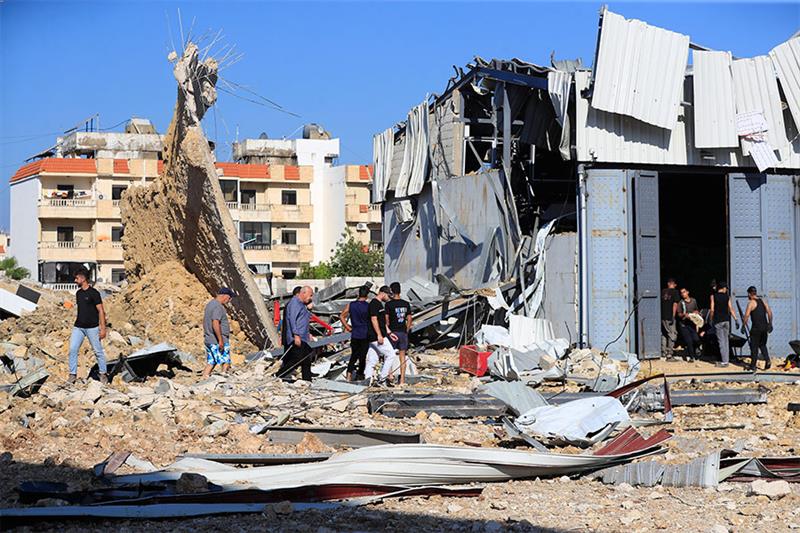
Since Monday, Israel has conducted thousands of airstrikes across Lebanon’s south and east and has continued to conduct strikes on the capital, Beirut, in attempts to assassinate Hezbollah leaders.
At least 650 people have been killed and 7,000 injured, and around 400,000 people have been displaced so far as the rain of bombs continues to fall on Lebanon.
“I can say we can put out a statement for a 21 day-ceasefire along the Lebanese-Israeli border. We were able to generate significant support from Europe as well as the Arab nations. It’s important this war not widen. I will have more to say about it tomorrow,” Joe Biden told a press pool late on Wednesday night in the US.
Biden’s comments came shortly after French Foreign Minister Jean-Noel Barrot addressed the United Nations Security Council, saying that a ceasefire was “possible.”
“In recent days, we’ve worked with our American partners on a temporary ceasefire platform of 21 days to allow for negotiations,” he told the council.
According to the source involved in the negotiations, the pause would allow both parties to discuss substantive issues, but any ceasefire would not include agreements regarding the border. Those would have to be deliberated during the ceasefire period. While there is a lot of pressure on Hezbollah and Israel to accept the ceasefire, the source continues to say that it might not hold.
While the source says that Prime Minister Benjamin Netanyahu was briefed on every detail of the proposed ceasefire, the Israeli statesman struck out against it on Thursday morning.
“The news about the supposed directive to moderate the fighting in the north is also the opposite of the truth. The Prime Minister instructed the IDF to continue the fighting with full force and according to the plans presented to him,” a statement published by the prime minister's office read.
Israeli officials have justified the last two weeks of aggression — which included the detonation of explosive-rigged wireless devices that killed dozens and maimed thousands — as "de-escalation through escalation." The officials, who spoke to Axios, said Israel believes putting more pressure on Hezbollah could push the militia to agree to a diplomatic deal that would return citizens to northern Israel and southern Lebanon, irrespective of the deadlocked negotiations to establish a ceasefire in Gaza.
However, even with a 21-day ceasefire, a larger deal would face significant obstacles, according to sources who have spoken to Mada Masr from various capitals in recent days informed of the talks. As Israel’s military moves attempt to impose a fait accompli on the ground, they leave little room for an increasingly isolated Hezbollah to maneuver diplomatically.
The core of this diplomatic initiative comes from Saudi Arabia, France and the United States, according to an Arab diplomat based in New York who told Mada Masr that three countries are trying to avoid “a big catastrophe in Lebanon that would include high casualties and massive displacement of civilians.”
On Monday, France requested an emergency UN Security Council meeting to discuss the situation in Lebanon, after Israel launched a major attack following nearly a year of low-grade exchange of fire across the border with Hezbollah.
Saudi Arabia is working to get a ministerial meeting of Organization of Islamic Cooperation and Arab League members on the sidelines of the 79th United Nations General Assembly in New York, the diplomatic source added. If the meeting does not convene in New York, then it will be called for in Jeddah — most probably at the ministerial level, the source says.
If the 21-day pause goes into effect, the core of discussions would center on concluding an agreement that would prevent Hezbollah from advancing toward the northern border of Israel to facilitate the return of Israeli residents who were forced to leave their cities after October 8 of last year, an Egyptian diplomat stationed in a Gulf capital and briefed on the Saudi, French and American talks and the source informed of the talks say.
The diplomacy, the diplomat says, is based on trying to create a fait accompli situation on the ground.
"Israel will continue to strike Lebanese territory with the aim of forcing hundreds of thousands of residents of southern Lebanon to leave their cities beyond the Litani River, which is the border that Israel demands be the limit for the deployment of Hezbollah forces. International negotiations will suggest to the party's negotiators that they accept the fait accompli because there is no escape from this matter,” the source added.
The Litani River is a key reference for the UN-imposed Blue Line, which was set out in 2000 by the international body to serve as a “withdrawal line” for Israeli occupying forces that had invaded Lebanon in 1982.
The line remains a point of dispute as Israel continues to occupy the village of Ghajar, Shebaa Farms and the hills around Kfarchouba and call for the full implementation of UN Security Council Resolution 1701, which makes provisions for the disarmament of all armed groups in Lebanon and a restriction on the deployment of troops south of the Litani River to only UNIFIL troops and the Lebanese Armed Forces. Hezbollah has vowed not to cease their operations as long as Israel continues to occupy Lebanon.
Neither the Arab diplomat, a Lebanese diplomat previously stationed in a Western capital nor a Qatari political source expect a larger diplomatic solution to successfully enforce the UN resolution.
“It is not realistic to expect the UN, or even for that matter, the UN Security Council, to get Netanyahu to stop the war or avoid the invasion. I am not sure Biden can do this either,” the Arab diplomat says.
Qatar is keen to play a mediating role, the Qatari political source says, but “it wants to guarantee Lebanon's right to maintain its borders with the Litani River and before it, because it is Lebanese territory and Lebanon has the right to keep it.”
“Mediation is currently difficult because the party will not easily accept Israel's conditions, and it seems that [Israel’s] solution is to weaken Hezbollah so that it disappears little by little,” the source says. But in the short term, the source adds, no negotiations for a broader deal will succeed.
Rather than any diplomatic move, the Lebanese diplomat says that what Israel is doing is "drawing a new map for Lebanon.”
“Our information says that the bombing of sites and even homes will continue until Hezbollah raises its white flag. Thus, Israel will impose its conditions, which is the new map," the diplomat adds. "There is no place for diplomatic negotiations with Netanyahu. Anyone who knows his history fully understands what I am saying. We, in Lebanon, expect the worst because the international response is just talk for the media and public opinion. Just as he rejected the idea of negotiating with Hamas, he will do so with Lebanon.”
“The overall sentiment is that there will be a ground invasion unless Hezbollah were to make a decision to move beyond the Litani River,” the Arab diplomat says.
A UN diplomat in the region who spoke to Mada Masr on Monday said that Lebanese officials and UN diplomatic and security teams also highly expect Israel to conduct a ground invasion.
Faced with Israel’s belligerence, Hezbollah also seems to have increasingly constrained military and diplomatic maneuvers.
Part of the reason might be the surprising Iranian public position. Sitting down with CNN ahead of the UNGA, newly elected Iranian President Masoud Pezeshkian made waves with his response to the question, “Will you counsel Hezbollah to restrain itself? We know that Iran has a lot of influence over Hezbollah.”
“Hezbollah by herself cannot stand against a country that is armed to the teeth and has access to weapons that are far superior to anything else,” Pezeshkian said. “Now, if there is a need, Islamic countries must convene a meeting in order to formulate a reaction to what is occurring. Now, if we are speaking of Hezbollah alone — what can Hezbollah do alone? Regional countries, the Islamic countries, must sit together, and prior to anything more severe taking place, I do believe international organizations — today, we did have a meeting at the United Nations with Mr. [Antonio] Gueterres, and tomorrow we will see such discussion and topics taking place, and we must not allow for Lebanon to become another Gaza at the hands of Israel. Hezbollah cannot do that alone. Hezbollah cannot stand alone against a country that is being defended, supported and supplied by Western countries, European countries and the United States of America.”
In his address before the UNGA, Pezeshkian signaled a willingness to resume talks on a nuclear deal that had faltered in recent years after former US President Donald Trump unilaterally pulled out of a 2015 deal.
"We are ready to engage with participants of the 2015 nuclear deal. If the deal's commitments are implemented fully and in good faith, dialogue on other issues can follow," Pezeshkian said.
Speaking to Mada Masr after the interview, an Iranian diplomat says that the president’s remarks come out of an understanding and realization that Iran does not want to wage war in the absence of complete planning and study, “as this would be useless and would lead to disastrous results — not as some have interpreted it, as abandoning Hezbollah or the war.”
Still, the perception of Iran being hesitant to back Hezbollah in a highly public setting has stirred ire in some quarters.
“Israel is stronger than yesterday and, tomorrow, it will be stronger than today, especially after the Iranian president's speech,” the Lebanese diplomat says, describing the speech as cowardly and saying it was tantamount to telling Hezbollah “you are fighting alone.”
While Iran has seen Hezbollah as the crown jewel of its resistance network, it is also keen to not come out of the year’s long war on Gaza, which has drawn in Iran and its allies, with nothing to show.
“Iran wants to take advantage of the current circumstance to reach an understanding with the Americans about the general framework of the new regional arrangements after the war on Gaza, so as to ensure a reduction in the level of threats against its interests in the Gulf, the Levant and Yemen,” an Egyptian security source who has held meetings with Iranian intelligence officials throughout last year previously told Mada Masr.
And in the end, Iran’s primary goal is to become a nuclear power, which will give it a larger seat at the bargaining table, according to a high-ranking former Iranian diplomat who was posted in the region.
Iran is keen to export its conflict with Israel to other parties in the region in order for them to "bear the brunt of the military, logistical and human" costs rather than having to bear those costs itself, the diplomat says. This outsourcing of its direct conflict with Israel buys Iran more time to advance its drone, ballistic missile and nuclear programs.
Iran “invests in tactical frameworks through international maneuvers and leveraging the global climate to pressure its adversaries to the greatest extent in the stalled negotiations, aiming to realize Iran's aspiration for a nuclear bomb as a true deterrent weapon to prevent any aggression on its territories,” the source adds.
Back in Lebanon on Wednesday morning, Hezbollah fired a single ballistic missile at Tel Aviv aimed at the Mossad headquarters "responsible for the leaders assassinations and blowing up the pagers," the party said in a statement.
The missile, the first of Hezbollah’s advanced weaponry that it has fired since the war started on October 8, was swifty intercepted by Israel’s air defense system.
A source close to the party who spoke to Mada Masr late on Wednesday night says that Hezbollah will continue to fight with whatever weapons they have and will not cease as long as Israel continues to bomb Lebanon, because stopping would be considered a significant defeat and a surrender to the enemy, something Hezbollah will not do.
If Israel seeks negotiations and a truce, Hezbollah is prepared to lay down its arms, as they do not wish to spill more of their people's blood, the source adds. “At least for now, they will not announce a withdrawal from the war, even as they are prepared to negotiate through the Lebanese government. However, we doubt that Israel will listen, especially since there is an almost complete lack of goodwill in the relationship between Israel and the US. The latter currently has no authority over Israel to restrain it from aggression against Lebanon.”
تقارير ذات صلة
Hezbollah vote secures General Joseph Aoun’s election as new Lebanese president, underscoring party’s concessions to new regional reality
When the Lebanese military began to send the first of its soldiers to the south of the country on November 28, hours after a ceasefire was suddenly announced, it marked…
Assad no more: The 10 days that changed everything
What had been long unthinkable is now a reality. And it came to pass in just 10 days. That reality is that, after more than five decades, the Assad family’s…
Hassan Nasrallah: the Sayyed, the disappointment, the Shaheed
Hezbollah announced on Saturday that its Secretary-General Hassan Nasrallah was killed in a series of airstrikes targeting him in Beirut the day before. His death marks the end of more…
Your support is the only way to ensure independent, progressive journalism survives.
You have a right to access accurate information, be stimulated by innovative and nuanced reporting, and be moved by compelling storytelling. Subscribe now to become part of the growing community of members who help us maintain our editorial independence.
Join us