
Palestine on strike | Mada live from Gaza
As tens of thousands of Palestinians went on strike against the Israeli occupation on Tuesday, both in areas that Israel annexed in 1948 and in the occupied West Bank, Mada Masr invited activists and journalists from across historic Palestine to participate in a roundtable discussion as an attempt to document some of what is happening.
The discussion, which focused on several cities across Palestine, took place as over 64,000 Palestinian construction workers went on strike, according to Israeli news sources, which noted that for every day the construction sector is shut down, Israel loses 130 million Israeli shekels (around USD$39.8 million). Rights organizations identified at least 48 West Bank residents who were fired from their jobs for participating in the strike.
The strike was paired with demonstrations across several cities, which were met with violence by Israeli security forces. At least four Palestinians were killed in Ramallah and Khalil, where Israeli security forces opened fire at protesters using live ammunition as well as rubber bullets and tear gas.
Yesterday’s casualties brought the total number of those killed in the West Bank since clashes began two weeks ago up to 26, with at least 5,164 injured, according to the Health Ministry in Ramallah.
In the ‘48 areas, at least 58 Palestinian citizens of Israel were arrested, while at least 23 Palestinians were arrested across Ramallah, Khalil, Bethlehem, Nablus and Tubas.
Before the protests were over on Tuesday, Yasmeen Daher from Febrayer and Lina Attalah, Mada Masr’s editor in chief, spoke to journalists Salem al-Rayyis, the editor-in-chief of Msdar News in Gaza, Mohamed, as well as Carmel al-Abbasi, who arrived in Gaza in recent days passing through the Rafah crossing.
Lina Attalah: I think we can start to talk a little with Salem and Carmel. I am aware that there isn’t enough electricity in Gaza, there isn’t enough internet in Gaza. So I am happy they are here with us, and I don’t know how long they will be able to stay with us because of the situation there and the other needs there. So let’s start with Salem. Let's start with what you're seeing in the rest of Palestine, how you feel that all these things are happening around you even if you can't physically be part of it.
Salem al-Rayyis: Hi everyone, is my voice ok?
LA: Yes, we can hear you.
[wonderplugin_video iframe="https://www.youtube.com/watch?v=l9LaXm_yuMc" lightbox=0 lightboxsize=1 lightboxwidth=960 lightboxheight=540 autoopen=0 autoopendelay=0 autoclose=0 lightboxtitle="" lightboxgroup="" lightboxshownavigation=0 showimage="" lightboxoptions="" videowidth=600 videoheight=400 keepaspectratio=1 autoplay=0 loop=0 videocss="position:relative;display:block;background-color:#000;overflow:hidden;max-width:100%;margin:0 auto;" playbutton="https://www.madamasr.com/wp-content/plugins/wonderplugin-video-embed/engine/playvideo-64-64-0.png"]
SR: First of all, I’m very happy and thankful for this opportunity and for all of us gathering together here from all Palestinian cities. I’m enjoying seeing what’s happening in Haifa, Jaffa, Lydd, areas that, in reality, we cannot communicate with on the ground because of the occupation that we have been talking about for more than 70 years. It’s nice to see all the Palestinians, whether in the occupied interior, West Bank, Jerusalem, Sheikh Jarrah and of course Gaza. We talk of the same cause, and we are rebelling for our cause that we have exhausted ourselves talking about, trying to get the world to see that we have a fair cause that has been going on for years.
I’d like to talk personally about what’s going on in Gaza. We've been getting viciously bombed by Israeli military strikes for days, from the air, land and sea. Friends from abroad ask me how I am, and I’m hesitant over how to describe the situation, whether to say it has been going on for an hour or two, or days nonstop. As a journalist, I almost don’t go home. All the staff and my colleagues at Msdar news network are always in communication to keep up with what’s going on. We go to the square to cover. Sometimes, maybe once every 24 hours, we sleep for half an hour, maybe an hour. This is very exhausting, on top of the fact that we have poor communication with our families, on account of being in the field.
But our minds are heavy, with every rocket, everyone checks their home area. Was it far? Was it near? If it’s far, then we ask: Who do we know there? Relatives? Friends? We try to communicate with everyone, and our friends check in on us. Three or four days ago, as we were on the job, we experienced a severe strike in the building we were in. There was lots of confusion. We had to move to another building because of the internet outage.
All of Gaza suffers from internet and electricity outages. I’ve been talking to you on the generator for five or six hours. We don’t know when it might come back, and if it does, it’s for three or four hours. And then we use generators, which are very expensive, but we need them, so we can do the minimum work.
Everyone here has their concerns, their worries. When we see people in the streets, the hospitals, they’ve suffered severe Israeli strikes. The size of the towers that have been hit, many of which were residential, mean that many families are homeless. Some of the buildings housed more than 70 families, in addition to families hosting others from border areas, be it relatives or friends. These people now are homeless. There are 140 schools. They’ve been opened for these people, which is neither easy nor safe. Some people say stay somewhere safe but not one place is safe in Gaza, whether schools, hospitals, or even our offices as journalists. It could all be targeted, directly or it could be the house next to you or in front of you or the street you live on.
This is not the first time Gaza has suffered from vicious Israeli aggression of this scale, but this is the first time they have targeted streets and alleys directly, which destroys infrastructure. The municipality is working around the clock despite the strikes, despite the risks which affect their physical and mental wellbeing. They’re trying to offer some basic services, such as opening roads, getting water and sanitation to people. It’s not easy to work under these conditions, whether we are journalists, municipality workers, or volunteers. We are living in a time of immense pressure.
In the past three hours, there was a constant firing of artillery in the east of Gaza — nonstop — as if it were a hammer on one’s head. They are firing arbitrarily in border areas. It could land on someone’s house. We worry that some people did not evacuate and stayed in their houses. A large number of martyrs are children, unfortunately, and a large number are also women. This is because of the direct targeting of civilian homes. These are people who were not there to fight. They’re not wearing military outfits. They have no weapons. This was after midnight, which is supposed to be the safest time for someone to lay their head down and rest after a long day of work. But unfortunately, we are living this for the millionth time in Gaza. Eight continuous days, and the problem is we don't know when it will end: Day 10? Day 20? After 1 month? 2 months? There were other conflicts that went on for 20 days or 50 days, or more or less.
We stand before an enemy or an occupation that makes it an art form to perform their brutality on us as a people and I only call for this people’s rights. We only ask for our rights that have been taken away for nearly a century now, our father and grandfather’s rights. Our rights which people around the world enjoy as human rights, the right to movement, the right to services, or at least the right to safety. At least give us safety, so someone can leave their house, or be in their house and know nothing will happen to them. But unfortunately that is not the case.
Of course, we are happy to see the solidarity campaigns whether in the Arab world or the West or in our occupied Palestinian territories, but we really wish to one day reach the feeling of being safe.
LA: We pray for that, Salem. Our hearts are with you and the feeling of helplessness is constant because of what you are going through. Not sure if Carmel can hear me. Are our voices audible?
Carmel al-Abbasi: I’m here with you.
LA: Hello.
CA: Hello. There is a little noise. Sorry there are kids playing on the street. Not sure what to say. You can help me. I'm a little overwhelmed. I just got to Gaza. I haven't slept in three days.
Yasmeen Daher: We won’t keep you long, Carmel, because we know that the internet there is unstable, and also, for Salem, we understand if you need to go because of the internet. I know that you’ve just arrived in Gaza. Talk to us about the crossings? There’s been a change. They’ve allowed the entry of the wounded from Gaza to Egypt. This wasn’t allowed before. Also Salem, if you have something...
SR: Can I ask Carmel a question?
LA: Go ahead, Salem.
SR: Carmel, I’m in Gaza, but tell us about the crossing. How was the road, the circumstances?
CA: Sure, and this is what I can be most useful in because I just arrived in Gaza and can’t talk about the situation much. The crossing was officially supposed to open after Eid, but with the strikes, they decided to open it suddenly on Sunday. What is the date today?
SR: Today is Tuesday.
CA: Tuesday, yes! We are in the stage where we forget the day and the date. So they decided to open the crossing on Sunday for just one hour, on the basis of… They agreed to let ambulances go in and then agreed to let the wounded come back out. Then, yesterday, Monday, they decided to open it officially. The road from Cairo to Rafah was very difficult. At the ferry crossing, we stayed for about four hours, and, at the last checkpoint at Sheikh Zuwayed, they asked us to turn back because the crossing was closed. So we had to spend the night and go the next morning. There weren't many people there, about 75 people coming back. The problem is the Sinai road. As soon as you’re in Sinai, it’s a military barracks effectively: high alert and a lot of checkpoints. And we weren’t sure if we would make it in time or not, but thankfully we made it, and we didn’t spend a lot of time at the crossing.
I haven’t crossed in 12 years, so I don’t know personally what it’s usually like, but most people had told me to prepare myself to spend four to five hours at the border. However, perhaps because there weren’t many people there it didn’t take that long.
At the Palestinian border checkpoint, everything was quite fast. People were prepared to receive us and everything went well.
I’ve been quite lucky so far. I’ve managed to visit three families.
People are saying that it’s the first time they’re living through a period of bombing that's this frightening, with this intense targeting of civilian complexes and buildings.
Mohamed: The electricity has just been cut off, and I assumed the internet had been cut off as well, but we’re still here.
We waited for three hours for the Civil Defense to extract children from beneath the rubble. Sadly, they were dying and took their last breath in the hospital. It was very emotionally draining to witness their deaths. We had all been praying that they would still be alive. It was traumatic to hear their cries beneath the rubble only to find out they had died. This is just one of many scenes I have witnessed.
LA: Is it possible to have hope under these circumstances?
Mohamed: The only hope it’s possible to ask for is the hope that a medic has as they’re trying to resuscitate a dying person’s heart.
Hope can come when one is in a state of rest and ability to form awareness of what one is living through. Not during a state of war. It’s hard to talk about hope during wartime without being in a state of dissociation from what’s happening. We can’t have hope while we are dying.
This goes against logic and religion.
We are only human. Any hope we can develop comes in periods of rest and stability, economic, social, intellectual, spiritual stability.
I can’t ask someone who is dying to talk about hope. It’s a request to dissociate from one’s emotions and thoughts completely.
All that can be asked of us now is for us to hold on and for our emotional trauma to not become pathological. That would affect who we are.
We’ve lived through many difficult periods, and we need a lot of psychological support.
I’m not just talking about my personal feeling, I’m addressing this to humanitarian organizations and NGOs.
It’s so infuriating to give a child who’s just lost all of their family a rose and ask them to smile. I just hope that this nightmare ends.
We are not demanding a war. We do not like war. We want peace. We want the things that will make us happy and make our communities happy. But we can’t be demanded to submit and be quashed just so we can live in peace.
Some people would kill their brothers or relatives for a piece of land or over inheritance, and our cause is infinitely harder than this.
We are aware that maybe tomorrow or the day after or after we will be gone, that Palestine may be liberated, but it’s difficult to understand what we are going through if you’re not here on this land.
I’ve been to many countries. The way I feel about Gaza is different from anywhere else in the entire world.
Everyone needs to go before the power outage so they can manage to get home.
SR: There’s not much else to add after what Mohamed has shared about the family targeted in Wehda Street. It wasn’t just one building that was bombed but an entire building complex. More than 30–35 consecutive missile strikes on the same spot destroyed five buildings completely over the heads of the people who were sleeping peacefully in their beds, children, women, with no prior warning or announcement to evacuate the building before striking. This has martyred many men as well, including doctors and engineers. We have received many calls from people from beneath the rubble calling out for help from the Civil Defense.
It was very hard to locate where exactly people were beneath the rubble. It wasn’t easy at all and took a long time. Doctors and Civil Defense personnel were risking their lives to save those trapped under the rubble. Many of them almost lost their lives trying to rescue others. It’s an extremely dangerous area to be in.
As difficult as it is to describe the situation here, we think it’s important for us as journalists to tell the world what’s happening to us here in Gaza.
Hopefully this war will end soon, but, even after it ends, we will witness extremely terrible events, us here in Palestine and you as well.
We will witness friends, loved ones, relatives whose names we missed in the list of dead, who were martyred here or others in the interior that we missed because of the intensity of what’s happening right now. We will find out that they have lost their lives.
I really do hope things will get better. It’s more of a dream at this point, but hopefully it will come true.
Thank you for the opportunity Lina and Yasmeen to share with you what’s happening in our daily lives, and this wave and our cause, in the interior, West Bank, Jerusalem and Gaza.
I hope the world is listening to us.

تقارير ذات صلة
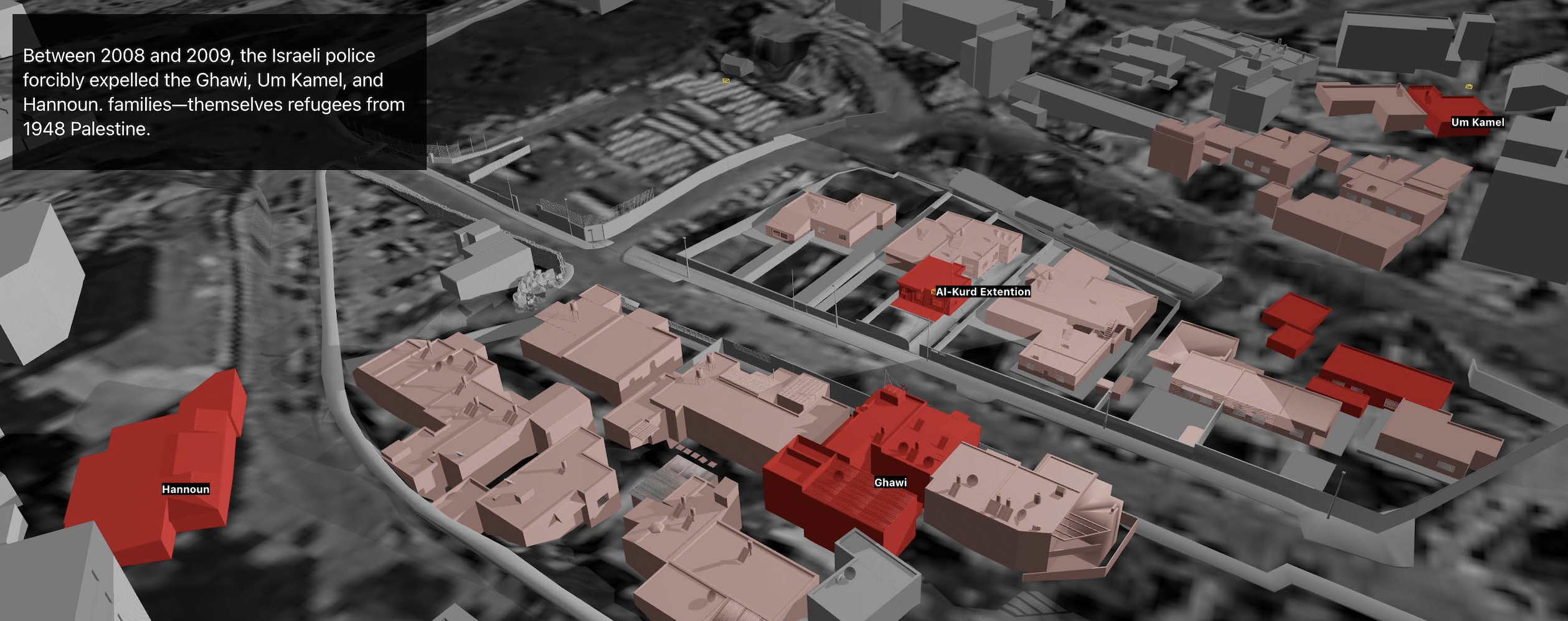
Sheikh Jarrah: Ethnic cleansing in Jerusalem
A single line can be drawn from the Kurd family home in Sheikh Jarrah to every corner of Palestine
Q&A: National Economy Week campaign in Palestine challenges Israeli colonial-economic power
The campaign seeks to challenge monopolistic colonial-economic power
What now? A changed struggle, and motherhood in an uprising
She texted a sort of proverb: “Having kids brings cowardliness.” And it’s true, I have to say.
Your support is the only way to ensure independent, progressive journalism survives.
You have a right to access accurate information, be stimulated by innovative and nuanced reporting, and be moved by compelling storytelling. Subscribe now to become part of the growing community of members who help us maintain our editorial independence.
Join us