
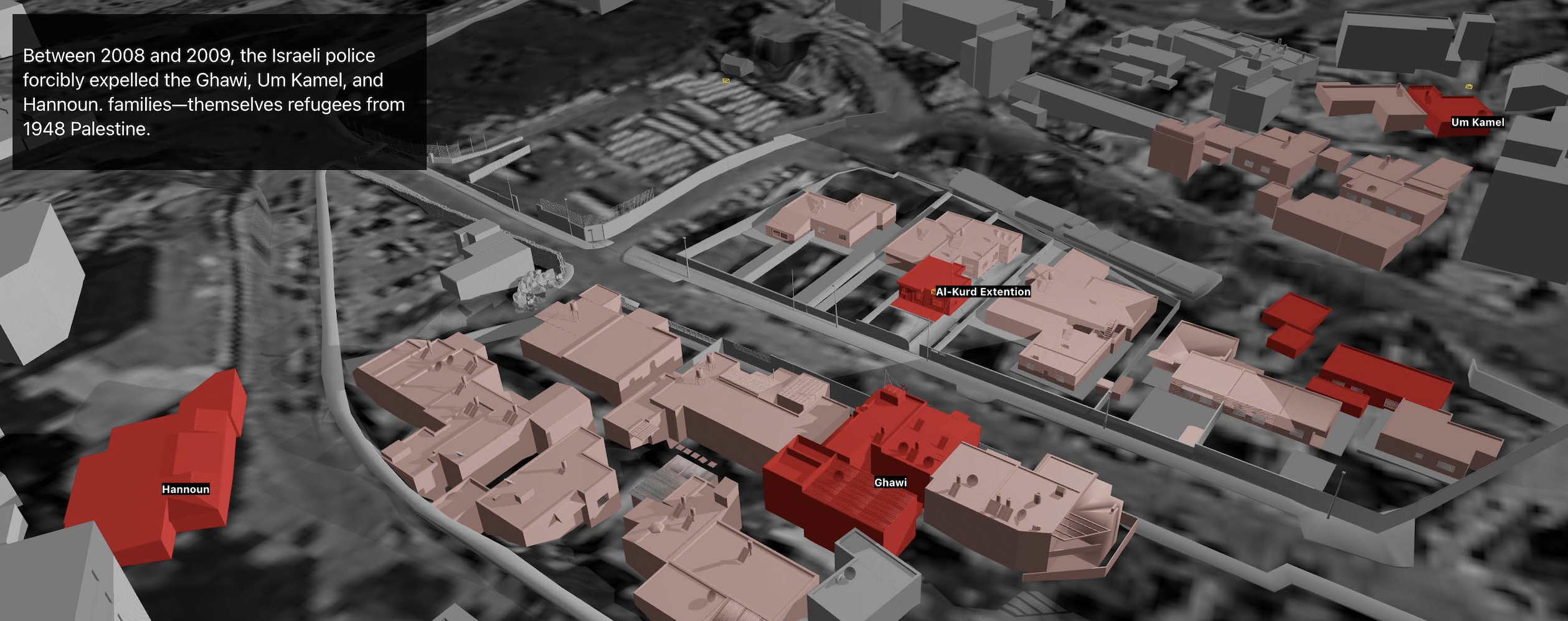
Sheikh Jarrah: Ethnic cleansing in Jerusalem
A single line can be drawn from the Kurd family home in Sheikh Jarrah to every corner of Palestine. A continuum of colonization linking the micro to the macro.
During the Unity Intifada last May, it was repeatedly invoked that Sheikh Jarrah is a microcosm of Palestine. Efforts to expel its residents — themselves refugees from homes that were colonized in 1948 — to make room for Jewish settlements encapsulate the core of the contemporary Palestinian experience. Dispossession, home demolitions, forced removals, mass incarceration, army brutality, legal acrobatics and false narratives constitute today’s Zionist settler-colonial project in Palestine. The threat faced by the residents of Sheikh Jarrah mobilized Palestinians globally because it is a threat we are all familiar with, one lodged into our very being. We feel it viscerally in our bodies. We understand Yacoub, the settler who claimed a portion of the Kurds’ home, to be the individual embodiment of the arrogance, racism, entitlement, and colonial mindset of the Israeli state and its Zionist underpinnings.
Sheikh Jarrah: Ethnic Cleansing in Jerusalem, a project led by Nour Abuzaid, a Palestinian architect and web developer at Forensic Architecture, follows this continuum. It zooms all the way into the very heart of the Kurds’ home, and back out again to encompass the width and breadth of The Land, meaning of course, Palestine, from the river to the sea. The line passes through The Street, Karm al-Jaouni, where the Kurds live in number 13; The Neighborhood, Sheikh Jarrah; and The City, Jerusalem. Through this digital reconstruction, viewers can visually connect with localized apartheid, manifesting in homes, on streets and in checkpoints, with its corollary of Grand Apartheid; the staggering system of Jewish domination that the Zionist movement has built — is building — throughout Palestine.

One of the greatest successes of Zionism is its fragmentation of the Palestinian people, who in their silos, face seemingly disconnected forms of oppression. Palestinians in Gaza are fighting a hermetic blockade while being killed by overwhelming Israeli air power. In the occupied West Bank, Palestinians fight settlement expansions, armed settlers and a vast network of brutalizing checkpoints. Those in 48 fight legalized discrimination, while refugees await return in exile, in camps that are themselves being emptied out in the region. In Jerusalem, the residents of Sheikh Jarrah are fighting against their dispossession. The power of this project is that it shows how these granular challenges are not disparate; they are interconnected facets of a singular regime. It showcases how we can, and should, connect the stories that break into headline news — settlers taking over a home in Hebron, the government refusing to dismantle the “illegal outpost” of Homesh — to constitute the whole.
This is no easy task. There are many microcosms in Palestine and multiple frontlines. These are not just fragmented geographically. They also exist on a temporal continuum — one which depends on how far along Israel’s colonization has unfolded. Before Sheikh Jarrah, historically, there was Haifa, Yaffa and Lydd. The battle line is now Sheikh Jarrah, Masafer Yatta, and the villages in the Naqab. Unless we are victorious in reversing this trajectory, in a few years, other parts of the Palestinian ecosystem will be making headline news. This is what we call our ongoing Nakba. This is a relentless structure of colonization, and these are its front lines. The outcome is well known: the emptying of Palestinian quarters to make room for Jewish settlers.
I have argued elsewhere that Gaza is a microcosm of Palestine — a space that is artificially overpopulated as refugees and residents alike are crammed and locked into a tiny strip of land to allow for the expansion of Jewish settlement in its periphery. Gaza today is surrounded by Ashdod, Ashkelon and Kiryat Gat, and held apart by a militarized blockade. This structure replicates itself to various levels of completion throughout the land. Further north of Gaza, on the coast, Jisr al-Zarqa and Beit Hanania are surrounded by Caesarea, Zikhron Yaakov and Nahsholim Dor, their residents ghettoized by structural inequality, economic deprivation, and racialized legislation. To the West, Nablus and Jenin and the other urban centers, constituting “Areas A” in the West Bank are bustling Palestinian cities encircled by “Areas C”, vast lands set aside for Jewish settlement where armed settlers roam. And Jerusalem, Sheikh Jarrah, where alongside efforts to expel the Kurds and their neighbors, Israeli authorities are Judaizing the city, using apartheid walls, zoning parks, roads and railways undergirded by racist legislative formulations.
Understanding the singularity of this structure of apartheid, even while acknowledging its various microcosmic manifestations, is key to our liberation. And drawing these continuums from the micro to the macro is one way to do that. Just as a line exists between Yaacoub and the Zionist movement, historically and at present, so can a line be drawn between the Kurds and the Palestinian struggle for liberation, both in its historic resistance against Zionism and in its contemporary formulation. Last May, in the Unity Intifada, the Palestinian Manifesto of Dignity and Hope noted: “In these days, we write a new chapter, a chapter of a united Intifada that seeks our one and only goal: reuniting Palestinian society in all of its different parts; reuniting our political will, and our means of struggle to confront Zionism throughout Palestine.”
In our struggle, there is room for all the different elements that constitute our people and the multifaceted resistance we employ to fight Zionist colonialism, all bound together by a singular idea too: freedom.
CLICK HERE TO ACCESS FORENSIC ARCHITECTURE’S SIMULATION Sheikh Jarrah: Ethnic Cleansing in Jerusalem
تقارير ذات صلة
Mai Serhan imagines Palestine and recounts life after for us
"I have never been to the place where I am from, but I can imagine it for us, Baba, for you and me." This opening line of Mai Serhan's I…
Doha summit: Arab unity in image
Sources tell Mada Masr why the Arab Summit failed to galvanize Arab unity
Palestine in the Claws of Colonialism
Selections from Ahmed Sadeq Saad’s “Palestine in the Claws of Colonialism” (1947)
Your support is the only way to ensure independent, progressive journalism survives.
You have a right to access accurate information, be stimulated by innovative and nuanced reporting, and be moved by compelling storytelling. Subscribe now to become part of the growing community of members who help us maintain our editorial independence.
Join us