
Out of scorched earth: The future of the RSF lies in Abdel Rahim Dagalo’s hands
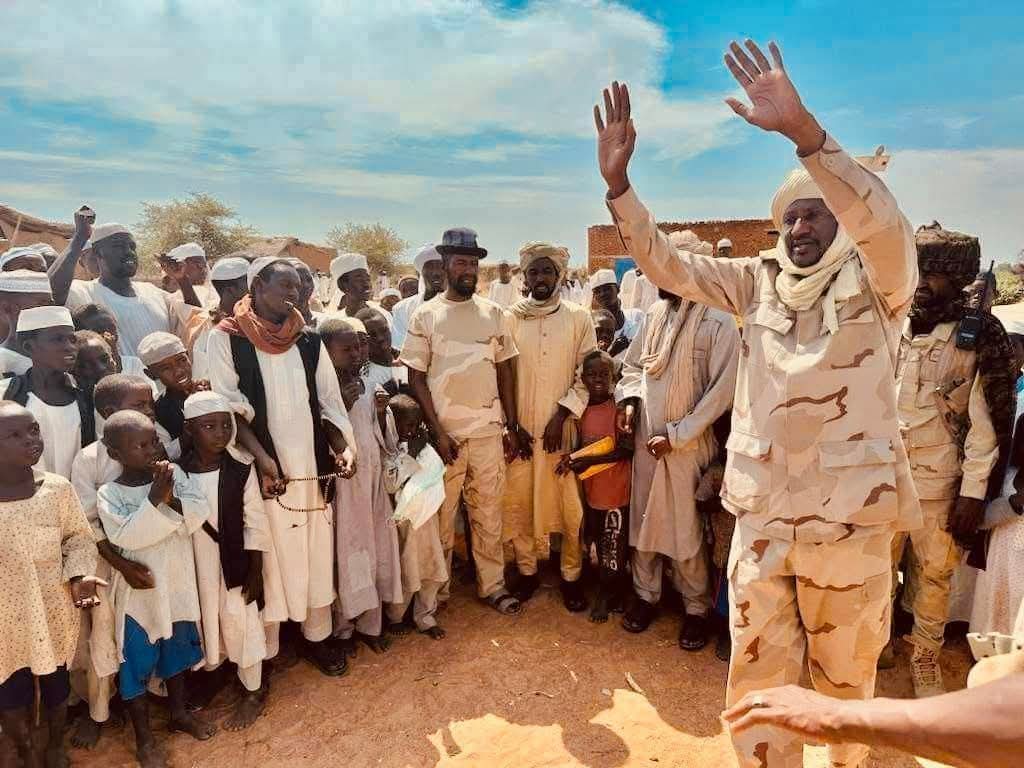
Far from Khartoum, where the two Nile rivers converge and Sudan’s economic and political elite have wielded power for decades, Abdel Rahim Dagalo — deputy commander of the Rapid Support Forces (RSF) and brother of the paramilitary group’s infamous commander, Mohamed Hamdan “Hemedti” Dagalo — stands in the desert that stretches across the borders of Chad, Libya and Sudan, his gaze fixed on the future.
Abdel Rahim’s appearance is shabby. An automatic rifle rests on his shoulder. He speaks to the men surrounding him — the men he is personally leading in an assault on Fasher, the historic capital of Darfur.
By September 2023, nearly five months into the war between the Sudanese Armed Forces and the RSF — a conflict that ended the paramilitary group’s fraught power-sharing time following the October 2021 coup that ousted the civilian transitional government — Abdel Rahim had left Khartoum, possibly never to return.

Here, in Darfur, the luxuries he and his brothers enjoyed during their brief time in power with their military partners are gone. Abdel Rahim has traded the shade of the ancient ficus trees on Khartoum’s Nile Street, access to ministries, upscale hotels, the historic presidential palace and the new one that the Chinese built in 2015, and the luxurious villas he owned in the upscale neighborhoods of Khartoum for the harsh Darfuri sun and the thrill of battle.
And in many ways, he would have it no other way.
Over the course of twenty years, the RSF built a sprawling economic and military empire that was catapulted onto the national and international stages with the ouster of former President Omar al-Bashir in 2019.
While his brothers, Hemedti and Gony Dagalo, the financially minded sibling, sought to break away from the family’s tribal background and ride the opportunity provided by Sudan’s re-entry into the world economy after being a pariah state in the eyes of the West, Abdel Rahim was never as invested in the transnational component of the grand political and economic empire.
For the shadowy Dagalo brother, the RSF’s future was always rooted in the political marketplace of Sudan; the ruthless and deadly force that the family built, with the backing of General Omar al-Bashir and his now rival, Armed Forces General Abdel Fattah al-Burhan, over years of bloodshed in Darfur and Yemen; and their monopoly over the gold trade.
Today, nearly two years into the war, and despite the immense backing the RSF received to take control of Khartoum, what remains of their forces have fled the city, and any ambition the RSF leadership may have had for a transnational project has crumbled. The military has refused to let the Dagalo brothers rewrite Sudan’s political order from the presidential palace, which has historically served as a temporary guesthouse for many rebel leaders.
Hemedti has fled to an undisclosed location and has not appeared in public in months. Meanwhile, Abdel Rahim is charting a divergent path, sources tell Mada Masr, preparing to recast the future of the RSF with the blood of Fasher and a political project that will move Sudan away from the path it had been charting toward global integration, with the RSF trying to drag the whole state itself back into the peripheries where it has always been able to wield influence.
Over the past six months, Mada Masr has spoken to 23 sources, ranging from those close to the Dagalo family and its economic empire to Chadian security sources, RSF officers, Sudanese diplomats, politicians and intelligence officers, to understand how Abdel Rahim, long-overshadowed by Hemedti, has become the Dagalo brother that will decide what comes next for the paramilitary group that nearly seized control of all of Sudan.
***
When protesters took to the streets across Sudan in December 2018 to call for the ouster of longtime ruler Omar al-Bashir, it wasn’t just the political class that they had set their eyes on.
The economy was reeling. Bread prices had skyrocketed. Inflation in the few years prior had risen to about 73 percent and the pound’s value against the dollar was plummeting.
The Bashir government had begun printing money to try to cover the cost of expensive imports, and the Gulf patronage that Sudan had relied on was not forthcoming.
While Bashir’s cronies surely benefited from illicit gains, many of the distortions in the economy were predicated on the fact that Sudan had become a pariah state that was ostracized from the world economy for the war crimes committed in Darfur and its financing and hosting of Islamist groups.
This had led Sudan to increasingly turn to the Gulf, giving out large plots of land for agriculture practice and sending troops to fight alongside Saudi Arabia and the United Arab Emirates in Yemen.
In 2017, the United States announced it would begin lifting sanctions on Sudan. But even with the slow removal, the country was still plagued by decades of isolation.
When Bashir was finally ousted from power by nationwide popular protests and a military-RSF coup, one of the most pressing topics on the agenda for the transitional period was how to re-integrate Sudan into the world economy. For citizens, there was a dire need to tamp down the cost of living. And for the country’s new leaders, it provided a chance to put their hands on new wealth that would enter the country from the West for the first time in decades.
Hemedti, who had built a vast economic empire himself through control over Sudan’s gold mines, positioned himself at the forefront of this new economic bureaucracy when he was appointed to lead the Supreme Committee for Managing the Economic Crisis in Sudan.
And the RSF leader, who was already angling to catapult himself to the presidency, hit on all the right notes.
During a speech at the farewell ceremony for US Chargé d'Affaires in Khartoum Steven Koutsis, Hemedti gave voice to hopes that economic aid would be forthcoming. Sudan greatly needs the cooperation of friends and brothers to achieve economic development, reintegrate into the international community and reconnect its economy to the international economic and financial system, he told the crowd.
As Hemedti hosted foreign diplomats and delegations, engaging in negotiations with revolutionary forces at times and tribal elders at others, his brother Abdel Rahim remained in the shadows. He steered clear of politics and instead limited his role to military operations, overseeing the training and arming of RSF troops.
A former sergeant in a military-aligned militia fighting Darfuri insurgents, Abdel Rahim had little experience navigating Khartoum’s political corridors. His role under Bashir’s Islamist regime had been limited to that of a paid military contractor.
But the crisis that followed the October 2021 coup, which ousted the civilian component of the transitional government, gave him his first chance to step onto the political stage.
In the month between October 25 and the November signing of an agreement to attempt to remedy the crisis created by the coup, there were intense talks between different political parties and the conspirators in the coup, the military and the RSF.
And Abdel Rahim was at the center of it all.
According to a former RSF intelligence source, Abdel Rahim wanted to reshape Sudan’s political landscape on his own terms, rejecting the participation of any political bloc in the transitional period. He was in favor of a purely military-led arrangement with a civilian prime minister, aiming to prevent alliances that would allow Sudanese Military Academy officers to collaborate with political factions. In the source’s estimation, Abdel Rahim was wary of broader alliances because he believed that if military, international and political actors collectively agreed to sideline the old regime, the RSF would ultimately be sacrificed in the process.
But this clashed with Hemedti’s vision, who sought to establish an alternative political base. Hemedti was trying to recalibrate his alliances, moving away from traditional tribal leadership structures in favor of forging a political coalition that could dictate new terms for governance, according to a former political advisor to Hemedti and member of the government delegation for the Juba peace negotiations in 2020. His aim was to establish an alternative political bloc, one independent of the Islamists and Sudan’s traditional elites, including the National Umma and Democratic Unionist parties, the source says
Ultimately, Abdel Rahim deferred to his brother’s aims.
According to a source from former Prime Minister Abdalla Hamdok’s office, Abdel Rahim attempted to persuade the Freedom and Change Coalition’s Central Council – the main faction of the revolutionary bloc which had shared power with the military and the RSF before the coup that ousted them — to back the agreement in the works, promising to reinstate them to power in exchange.
In a last-minute twist, however, the council withdrew from the November signing ceremony at the presidential palace. The catalyst for their decision, according to the source, was Burhan’s move to unfreeze Islamists’ bank accounts, effectively bringing the civilian bloc’s rivals back in from the cold and casting doubt on Abdel Rahim’s ability to deliver on his promises.
The council’s last minute decision reinforced Abdel Rahim’s belief that relying on political coalitions to sustain the transition was a mistake. A second former RSF intelligence source tells Mada Masr that Abdel Rahim saw the coup as the beginning of the end for his brother’s grip over both the RSF and the state, as it allowed their adversaries to regain influence. Chief among them, in Abdel Rahim’s view, were Ali Karti, the secretary general of the Sudanese Islamic Movement, along with remnants of Bashir’s security guards, the source says.
The differences between the Dagalo brothers had always been there, but it was this moment that set in motion a slow drifting apart.
A member of Abdel Rahim and Hemedti’s clan tells Mada Masr that years of financial maneuvering in the shadows had granted Abdel Rahim a degree of independence from his brother. However, he lacked the ambition to establish a transnational financial network, preferring instead to expand his influence locally through tribal alliances and market traders. Leaving the public front to Hemedti, Abdel Rahim kept a low profile, though his approach did not sit well with their younger and more educated sibling, Gony.
Speaking to Mada Masr, a former financial official at Al-Gunade, the gold mining company owned by Hemedti’s family, describes Gony as someone who sought to break away from his tribal environment and immerse himself in global financial markets. This ambition became evident when he took charge of the RSF’s financial network, which the US Treasury Department sanctioned in October 2024 for procuring arms and military equipment both before and after the war.
Hemedti admired Gony’s business mentality, the former executive says, particularly his strategic handling of trade and finance. In contrast, Abdel Rahim found his inspiration in Muammar Qadhafi, another Bedouin who had had everything. Embracing the strongman model, Abdel Rahim surrounded himself with loyal fighters, heavily armed convoys and money, caring little for his public image or the sources of his wealth, the former official says.
But when it came to navigating Sudan’s fractious political scene, it was Abdel Rahim who had the leg up on his brothers, the former official says. He possessed a unique ability to find quick solutions for problems, as he did in the post-October crisis, he adds.
***
It is early 2023 and the RSF’s Hino ZS cargo trucks — with fronts painted yellow like their signature kadmuls — are navigating the rugged routes toward Khartoum. Abdel Rahim is in his luxury residence in the upscale Garden City neighborhood of eastern Khartoum, a property seized from a former diplomat in Bashir’s regime. According to a young leader from Darfur, there, while eating manasees — a Darfuri-style grilled meat — he sat in his kadmul, confiding to young Darfuri commanders that the RSF expected an Egyptian military attack against its positions. But he struck an air of confidence, dismissing concerns over Burhan or the Sudanese military. "The walls of the General Command won’t protect them once the war begins," he told the young commanders.
Of course, reality would not follow on from the Dagalo brother’s braggadocio. But in those days before the war, Abdel Rahim’s enmity for Burhan had reached its tipping point.
Burhan himself accused Abdel Rahim of igniting the war, claiming he had controlled his former deputy, Hemedti, according to a Sudanese diplomatic source who met Burhan during his 2024 visit to Kenya. The source tells Mada Masr that Burhan referred to Abdel Rahim as "the sergeant” that started the war, “and not Hemedti.”
Abdel Rahim and Burhan were not always so distant, however.
A source who accompanied Abdel Rahim between 2007 and 2017 tells Mada Masr that he built influence among military commanders overseeing operations in Darfur. This marked the beginning of Abdel Rahim’s relationship with the military leadership in the region, particularly with Burhan, who was in charge of the Border Guard Forces at the time.
The Dagalo brother’s ties with military recruitment officers were instrumental in mobilizing young men from Arab communities and organizing them into combat units. This contrasted with Musa Hilal, the leader of the Mahamid tribe, who could rally fighters through direct calls to tribal leaders across Darfur. Unlike Hilal, Abdel Rahim had to assemble forces on his own — an aspect he initially saw as a shortcoming but which ultimately allowed him to cultivate an extensive network of relationships and power bases.
Burhan had previously served as commissioner of Nertiti, a locality in Central Darfur, where he acted as the link between the state government and its administrative regions under Sudan’s local governance framework. At the time, the commissioner’s role entailed oversight of all administrative affairs, including matters related to the ruling National Congress Party.
Burhan’s involvement in setting up the Border Guard Forces — an entity integrated into the military’s combat structure under Sudan’s centralized governance model — brought him into close alliance with Bashir’s security strategy. Bashir had fragmented the central authority’s monopoly over violence across multiple security agencies and paramilitary groups, each controlled by select commanders, while ultimate decision-making remained with the Bashir-controlled central powers.
Sway and political survival increasingly hinged on loyalty to Bashir, creating an environment where figures from outside the formal party structure — such as Burhan and Hemedti — emerged as influential players in the former Sudanese president’s orbit.
Before long, Hemedti became Bashir’s favorite. As Bashir himself repeatedly put it: “Hemedti Hemayti,” or Hemedti is my protection.
But it was Abdel Rahim who played a key role in many of the offensives that the military and RSF undertook in Sudan’s border regions.
His military expertise was on full display during the 2015 Battle of Goz Dango, where his forces dealt a crushing blow to the Justice and Equality Movement (JEM), led by current Finance Minister Gibril Ibrahim. While his brother Hemedti issued orders from a nearby position, Abdel Rahim himself was on the ground, directing the battle, a JEM fighter who was captured during the fighting tells Mada Masr.
The alliance between Burhan and Abdel Rahim also played a pivotal role in securing Bashir’s ties with the UAE through RSF-led recruitment efforts for the war in Yemen.
As Bashir’s regime teetered on the brink of collapse, he set about bringing in a new inner circle to replace his old guard, but a lot had already changed beneath the surface. As Hemedti strode through the palace, he no longer seemed in need of Bashir, neither as an ally nor as a protector. Bashir had nothing left to lose, but Hemedti was unwilling to go down with him as he desperately clung to power.
Thousands of miles away, a different alliance was taking shape in the shadows, bringing Abdel Rahim closer to Burhan, who had been appointed Inspector General of the Armed Forces in early 2019.
So, what went wrong?
A member of Abdel Rahim’s advisory team explains that the Dagalo brothers saw the transitional period as a chance to reshape Sudan’s landscape. Hemedti would ascend to the presidency through elections at the end of the transition, and command of the RSF would fall to Abdel Rahim.
Abdel Rahim had envisioned himself rising within the military hierarchy, sitting across from Burhan as an equal, as the source puts it.
"We are certainly not talking about personal whims or reckless ambition," the source says. "Abdel Rahim is fully aware of what it means to lead the RSF. He would have been at the table, facing the military chief: Burhan."
However, this entire project collapsed, which Abdel Rahim and Hemedti attribute to the Islamists, the source says. They recognize the Islamists’ capabilities and how deep they are lodged within the state, especially having witnessed their security influence and maneuvering.
But beyond the Islamists, there is also a clear animosity between the Dagalo brothers and Burhan’s tribal background.
Much of Hemedti’s discourse harkens back to Sudan’s Mahdist state, which briefly ruled Sudan from 1885-1898 and came to power when the religious movement of Mohamedd Ahmad bin Abdullah – who claimed he was the Mahdi – ousted the Egyptian-Ottoman administration in Khartoum. But Abdullah died shortly after seizing the capital, and control eventually fell to his follower, Abdallahi ibn Mohamed, who launched a vicious campaign to consolidate power that included killing Abdullah’s family, genocidal attacks against rival tribes and mass demographic changes that saw his Taaisha tribe settle in Khartoum.
With Sudan gripped by famine and the khalifa increasingly facing domestic challenges, an Anglo-Egyptian force advanced toward Khartoum to reoccupy Sudan. In the 1898 battle of Kerreri, on the northern outskirts of Omdruman, the Mahdist military was largely massacred.
For Hemedti and others that hold onto the Mahdi narrative, the defeat in Kerreri was a return to colonial rule that delayed the true blossoming of the Sudanese state. What is needed, they might argue, is a return to the messianic politics of Abdullah and punishment for those that sided with the Anglo-Egyptian forces against the Mahdis, whom they largely see as Sudan’s riverine tribes.
And, indeed, 2019 felt like the return of the Mahdi for RSF loyalists and those that subscribe to this narrative.
In the wake of Bashir’s downfall and the RSF’s entrance into a powersharing transitional government with the military and the Freedom and Change Coalition, Hemedti, his family and legions of his relatives relocated from the middle-class district of Gabra to some of Khartoum’s most affluent neighborhoods. His troops patrolled the city in four-wheel-drive vehicles, guarded the Nile bridges and the presidential palace and hung their clothes to dry on its walls — a striking Bedouin symbol of how Khartoum City turned into a village within the capital.

In March 2021, during Sudan’s transitional period, while addressing a large Darfuri crowd in Khartoum, Abdel Rahim angrily blurted: "Whose father does Khartoum belong to?”
The advisor to Abdel Rahim explains the enmity between him and Burhan in these atavist terms. It is an enmity, the source says, that dates back 130 years, to when the Rizeigat backed the Taaisha and led disciplinary campaigns against the Jaaliya and Shaigiya tribes, who had opposed the Taaishi.
“We are also talking here about a military representing Sudan’s Nile elite — the Jaaliya and Shaigiya — as Burhan himself is of Shaigiya descent and was raised in Jaaliya villages,” the source says. This has fueled the Dagalo brothers’ enmity toward him, particularly Abdel Rahim, who knows that Burhan has been pulling these threads.
In January 2024 meetings with tribal elders in Babanusa, Abdel Rahim made his particular animosity toward Burhan known. According to a local source who met Abdel Rahim in West Kordofan, as he prepared to seize the 22nd Infantry Division in Babanusa, the Dagalo brother justified his military campaign to the Messeria tribal elders in a lengthy conversation. He appeared convinced that no military agreement could be reached unless “his weapon is locked and loaded,” the source says. “Burhan only understands the language of blood,” the source says, quoting Abdel Rahim. “He has thrown us all into the fire, and he will have to pay the price.”
“Dagalo was deeply disheartened when the Messeriya tribal leaders refused to relinquish Babanusa,” the local source says. The elders attempted to negotiate an exception for the military division, sending their pleas to Hemedti, but no response ever came.
***
By September 2023, after nearly five months of war, Abdel Rahim left Khartoum — possibly never to return. He traveled to Chad to meet leaders of armed movements in a negotiation brokered by Chadian President Mahamat Deby, a military source in N’Djamena tells Mada Masr. The talks sought to secure a deal in which armed groups would withdraw from Fasher, the source says, allowing the RSF to capture the military’s Sixth Infantry Division. However, the leaders rejected Dagalo’s proposition, particularly after he refused to meet with JEM leader Gibril Ibrahim, the source adds.
In a lengthy interview broadcast from the 16th Division in Nyala in November 2023, Dagalo declared that Fasher would not be spared and that the armed movements stationed there were merely being given time to surrender.
In his final public appearance in Khartoum on November 3, Hemedti reiterated a plan long in the works by Abdel Rahim, demanding the joint force to withdraw from Fasher and vacate the eastern sector to clear the way for his troops to advance on the division and overthrow it.
A former Sudanese intelligence officer tells Mada Masr that Hemedti’s insistence on holding central Sudan despite the heavy attrition suffered by his forces, while Dagalo withdrew to Fasher and continued fighting there, reflects a strategic divergence in the RSF. Abdel Rahim’s decision to focus on capturing Fasher rather than defending Khartoum’s buildings, now left to “the cats,” marks a significant rift in the paramilitary group’s vision of its future existence, the source says.
A source within the RSF’s western sector command tells Mada Masr that seizing Fasher was never the original plan. “But after capturing Nyala and facing the intransigence of armed movements as they aligned with the military, Dagalo became convinced that capturing Fasher was necessary to impose new military equations — creating conditions for a possible settlement with the military within the new military framework,” the source says.
Abdel Rahim’s failure to capture Fasher, at least so far, can be attributed to the mass mobilization of Zaghawa fighters, along with reinforcements from armed groups in Libya and Chad sent to defend the city. The Sudanese military also deployed substantial military equipment to Fasher, drawing from units that had withdrawn from other Darfur states.
A source within the joint force tells Mada Masr that Abdel Rahim remains determined to advance on Fasher, viewing it as a life-or-death battle — one that will allow him to assert his agenda on both the military and political landscapes.
Under Abdel Rahim’s command, the RSF continues their assault on the outskirts of Fasher, deploying drones and armored vehicles specially brought in for this offensive. Senior commanders have been called from Khartoum to prepare for what is expected to be the largest assault ever on the city.
By October 2024, the RSF had begun regrouping around Fasher. A Sudanese intelligence source says that, at the time, Abdel Rahim was working to secure military supplies through South Sudan and held meetings with South Sudanese leaders. While Juba denied Abdel Rahim had met with President Salva Kiir, it did not refute reports that he had been present in the capital. Sudanese intelligence attributed this to Abdel Rahim’s broader regional push to secure support for his campaign to overrun Darfur, the source said.
His efforts did bear fruit, as large-scale military shipments were funneled from Um Jaras to Nyala. On December 2, the joint force intercepted an RSF-bound shipment that included drones capable of carrying short-range and guided missiles, as well as reconnaissance drones and munitions, a source in the military-allied armed movements’ joint force told Mada Masr.
Meanwhile, Fasher remains in a state of crisis, waking each morning to the stench of blood and death. Its sands whip through the dreams of men seeking to carve their names in history through blood and tears, heedless of the innocent lives buried daily along the city’s streets.
Cities may reshape the course of history and alter events, but in the end, they etch their memories with foreign bullets slipping through the valleys of Darfur, spreading terror through relentless shelling and sniper fire.
***
Today, the RSF, once embraced as a legitimate representative of the people before the international community, is folding in on itself.
A former advisor in the RSF’s political office tells Mada Masr that Hemedti’s sharp-tongued criticism of the international community in a recorded statement published last October is a sign of his inability to contain the war’s costs.
“Hemedti never expected things to spiral this far,” the source says. “He has always gone back on critical decisions. He prefers to execute decisions rather than make them. That’s who he is politically. It was Bashir who bore the consequences of every order he issued to Hemedti.”
In his last recorded statement on March 15, 2025, Hemedti vowed not to leave Khartoum, Mogran or the presidential palace. Yet, between March 21 and 28, the military drove him out — not only from the palace, but from all of Khartoum and central Sudan, ending his dream of holding onto the capital.
Meanwhile, it is increasingly clear to many in the RSF’s circles that Abdel Rahim is the one in control of the paramilitary.
Abdel Rahim’s position as the RSF’s military commander became undeniable after the capture of Gezira State in December 2023, when newly formed combat units emerged within the paramilitary’s ranks.
During a meeting in Addis Ababa with the Civil Front for Democracy, Hemedti himself admitted he couldn’t control these fighters, a source present at the meeting tells Mada Masr. "These forces are not fighting for the RSF, but for their own interests," Hemedti said. It was the same strategy Abdel Rahim had pioneered in the battle for Nayala’s 16th Division — assembling hybrid mercenary units driven by financial and armament incentives.
And the loss of Gezira 13 months later was just as indicative.
“When the RSF began suffering defeats, a senior RSF figure contacted me,” a development economics expert who was part of the RSF’s advisory team says. “I had been monitoring crimes and violations taking place at the external level. We repeatedly warned Hemedti about the dangers of leaving the RSF at the mercy of his brothers and cousins, particularly in the investment sector.”
The expert says that it is Abdel Rahim who pushed for the recent formation of a parallel government in the Kenyan capital of Nairobi. For the expert, this is a nail in the coffin for any chance the RSF had to win international legitimacy.
“You can see what he did in Nairobi. I received a call from stakeholders who had been working toward announcing a government since the fall of Wad Madani. We rejected the idea, and I told them clearly that Libya’s model is not available to Sudan — without the resources or infrastructure, it is not possible to establish a government,” the expert says. “But with Abdel Rahim in charge of military decision-making, he pushed for this option to impose a new reality, particularly in Darfur. Sooner or later, Abdel Rahim will declare his government, disregarding international implications. He wants to reap the benefits of what he has been doing for years within the RSF.”
For the RSF expert, “Abdel Rahim is like an invasive weed — he reduces everything to something simple and inconsequential.” But in the scorched earth that the RSF has made of large swaths of Sudan, it is weeds more than anything else that will take root.
تقارير ذات صلة

The return to Sudan: Redrawing politics from square one
After more than a year and a half in Cairo, Um Mohamed is back to her home in Khartoum. But like many of the hundreds of thousands who have heeded…

The Quad War
After the fall of Fasher, Egypt turned to Turkey to find a way to deter the growing Emirati threat
‘Unable to erase the sight of the dead from our minds’: Scenes from Fasher’s fall
Survivors of the RSF's massacres in Fasher recount the harrowing scenes of the city's capture.
Your support is the only way to ensure independent, progressive journalism survives.
You have a right to access accurate information, be stimulated by innovative and nuanced reporting, and be moved by compelling storytelling. Subscribe now to become part of the growing community of members who help us maintain our editorial independence.
Join us