
On leaving heaven: Ibrahim Ahmed’s show at Virginia Commonwealth University
“It Will Always Come Back to You” is a befitting title for the first retrospective exhibition of Ibrahim Ahmed’s work. What connect the assemblages, paintings, photo collage and installation pieces, currently showing at the Institute for Contemporary Art at Virginia Commonwealth University, are the ways they translate the 37-year-old artist’s experience living between Egypt, Kuwait, Bahrain and the US.
A major piece occupies the institute’s outdoor pool. It comprises 30 life-sized sails of linen towels used for domestic chores, sewn together and adorned with geometric designs. This is the first time that “Only Dreamers Leave” (2016) has been exhibited in water. Its first iteration was during the 2018 Dakar Biennale for contemporary African art, where the masts were drilled into a concrete tiled floor. Fluttering, yet stuck. The new set-up at VCU, reflects on the water surface, and like most of Ahmed’s work is aesthetically pleasing. It, however, only hints at the frustrations and helplessness many emigrants from the global south experience upon moving, in favor of emphasizing the allure of developed countries as a destination — the 30 sails are meant to symbolise the 28 EU member states, as well as the US and Canada.

Ahmed’s father first moved from his hometown in Monufiya, Egypt to the US in the 1960s under a state-sponsored exchange program. Upon returning to Egypt, he started a family and relocated to Kuwait where Ahmed was born, then moved to Bahrain. In 1997, he found an opportunity to move with his family to Freehold, New Jersey where he still resides. Ahmed was 13 years old at the time. After finishing high school, he enrolled in an undergraduate program in English literature in Newark, as he wanted to become a writer. He also started working with children at a local foundation, where a staff member saw his sketchbook and encouraged him to teach art there. For the first time, he began thinking of art as more than a hobby. It’s a different language from writing — more accessible, universal in a sense, he tells me as I visit him in his current studio in Cairo. In 2005, the foundation hosted his first solo exhibition at their floor-wide gallery, and he sold his first piece. Art became his focus. He took on an art handling job, and became involved with the then-budding Newark School, known for their unconventional use of materials and assemblage sculptures.
“Newark has a very specific place in my heart,” he says. It’s “truly the beginning of understanding visual language, understanding what it means to be an artist, selling work, engaging with galleries, curators … studio visits. [Understanding] what a studio practice looks like, and what that dedication feels like.” Outside the art community, however, life in the US was rough for Ahmed. With distinctively Arab features and a Muslim name, he was often feared by others and repeatedly harassed, he explains.

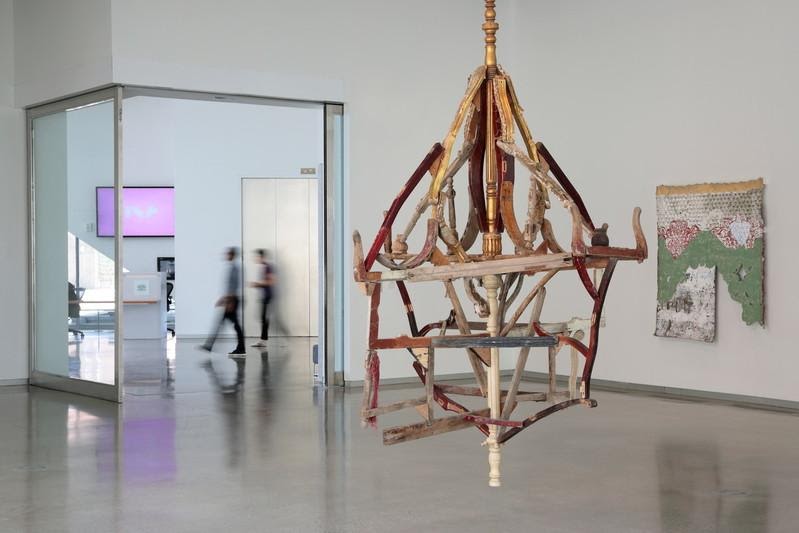
In 2014, during one of Ahmed’s visits to Cairo, a friend introduced him to the artist Hamdy Reda, director of the now-closed gallery and project space Artellewa. Situated in Ard al-Lewa, a working-class neighborhood on the fringes of Greater Cairo, Artellewa had attracted a range of local and international artists since its founding in 2007. Projects shown or realized there often sought to involve the local community or reflect on the neighborhood’s history and living conditions. Reda offered Ahmed a three-month residency at the space. By the end of that period, Ahmed produced his first chandelier assembled of found objects — with the latest iteration produced in 2021 now exhibited at VCU — then moved out of the residency space into an apartment of his own.
Ahmed has been living and working in Ard al-Lewa, which features heavily in his work, for the past seven years. Besides offering him an affordable living and workspace, and a community of craftsmen to collaborate with in realizing his projects, Ard al-Lewa presents him with a more “honest” representation of life in Cairo than the upper middle-class Nasr City where his family home is located, he tells me. The neighborhood is slowly gentrifying with more cultural projects popping up. Its demographics are also changing as it becomes home to a growing community of emigrants and refugees from the global south.
Upon settling in the area, he produced a series of map-like fabric collages inspired by historic trade links of the Silk Road, and titled them “Ard El Lewa” (2015-16). While a more captivating and humorous take was shown in 2016 at the “Iconic City: Cairo Now! City Incomplete exhibition at Dubai Design Week. Titled “South x South,” the project is a collection of 50 bricks made from fabric scraps that friends and neighbors often give Ibrahim as gifts, and which he imagines people excavating in the future instead of the signature red bricks characterizing the neighborhood.

Some experiences yielded less interesting results, however. Choosing to leave the US and settle in Ard al-Lewa, Ahmed was often asked “Does anybody leave heaven?” — a question that inspired a piece bearing the same title in 2019. He collected garments with distinctively American symbols and patriotic slogans worn by locals in Ard al-Lewa, and sewed them to create a four-by-ten-meter long drape. He wanted to exhibit it at the Havana Biennial the same year, but was asked by organizers on site to flip the drape to make the symbols more subtle. The biennial did not want to be perceived as a political tool of the Cuban state given the piece’s criticism of the US. Ahmed turned down their request and incorporated this censorship incident into “Does Anybody Leave Heaven?” He currently exhibits the drape with excerpts from an audio recording of his discussion with the biennial organizers, two glass vitrines displaying American-themed T-shirts and baseball hats, and 40 photographs that he shot of Cubans wearing such garments. Although much celebrated, the message behind “Does Anybody Leave Heaven?” is too overt, as US cultural hegemony is not news.

“Burn What Needs to Be Burned [The Things I Hope to Bury]” (2018) and “I Never Revealed Myself to Them” (2016-2021), on the other hand, use a personal lens to critique mainstream perceptions of masculinity. The first is a face mask assembled from old car parts. Hanging off a central concrete plinth, Ahmed has scrapped off the paint, revealing its metallic shine and embossed Mercedes Benz logos. He leaves empty screw holes unpatched although they are too small to see through and only one is aligned with where a human eye would be. A piece resembling a worn-out elephant trunk, or perhaps a battered phallus dangles across the mask’s center. Lining the walls of the same gallery is a selection from the photo collage series “I Never Revealed Myself to Them.”

In it, Ahmed poses shirtless in heart patterned briefs inside a thread bear studio. He occasionally fiddles with a massive concrete block, and at times sports his mask. The sharp lighting in the black and white prints aggravates his physical contours — his shadow might seem like a plump female figure in one image or a huge phallus in another. His figure morphs and shapeshifts, at times resembling a Pharaonic or Greco-Roman statue, at others a cubist sculpture. He draws on the photographs, superimposes cutouts of limbs and manipulates shadows, perspective and background details. The results are unsettling, at times sexually charged, and occasionally darkly humorous.
Ahmed began working on the series in 2016. The decreased mobility since the start of the pandemic inspired him to push it further, reflecting more on his personal history and interactions at the various places where he’s lived. He analysed the postures, body language and backdrops of photographs in his family’s archive, and reconstructed them to highlight patterns and identity markers, while responding in his own photoshoot to the image of the practical, composed and virile modern male. When combined, his father’s presence in the family photos first seems like a counterweight, before the two men blend in the colllages, producing figures that are highly macho, sometimes mythical and occasionally androgynous. The photo collages come off like performances that challenge how male bodies are expected to behave in familial, amicable, formal and professional relationships. They are perhaps Ahmed’s strongest work to date.
Much of Ahmed’s practice is strongly tied to how his experiences as a member of an emigrant family have shaped him. One might fear that such readings of his work would inevitably pigeonhole him, relying too much on his background. But he successfully complicates our understanding of identity through works like “South x South” and “I Never Revealed Myself to Them” that playfully expose inherent contradictions while also experimenting with materials and form.
“It Will Always Come Back to You” is on view at Virginia Commonwealth University until November 7, 2021.
تقارير ذات صلة
Tuk tuks: Tottering through regulations
When you stop a taxi and ask the driver to take you to Ard al-Lewa, the answer will almost always be “I’ll drop you off outside.” The heavily populated area…
Lara Baladi’s Cosmovision
In Cosmovision, Lara Baladi breaks down photography’s cadre into a discursive unfurling of her becoming from 1996 to 2011, autobiographically performing the logic of the white cube. Shown at Tintera,…
How to make friends, by Jeffrey Epstein
power begets power, even if just by association
Your support is the only way to ensure independent, progressive journalism survives.
You have a right to access accurate information, be stimulated by innovative and nuanced reporting, and be moved by compelling storytelling. Subscribe now to become part of the growing community of members who help us maintain our editorial independence.
Join us