
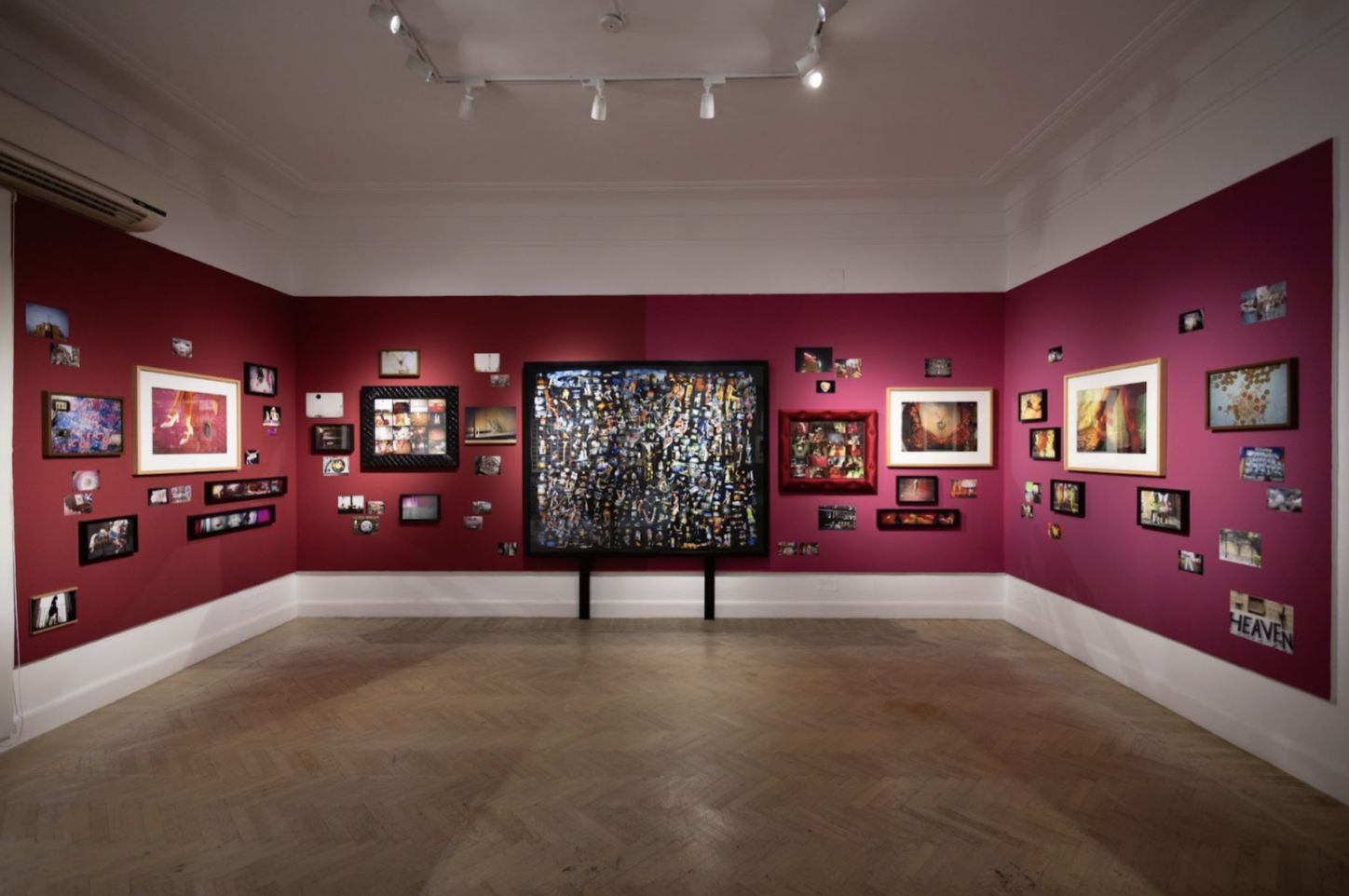
Lara Baladi’s Cosmovision
In Cosmovision, Lara Baladi breaks down photography’s cadre into a discursive unfurling of her becoming from 1996 to 2011, autobiographically performing the logic of the white cube. Shown at Tintera, the exhibition ran until 11 January, and comprised over one hundred works, more than half of which were on view for the first time.
Cosmovision staged photography as an installation of practice, rather than a privileged medium, transforming Baladi’s archive into an autobiographical, epistemic apparatus.
Baladi describes the period of her life as one during which she was on a quest: social, political and spiritual. In a 2016 essay for AGNI, a writing journal publication by Boston University, titled Vodka–Chamomile: cocktail for a revolution, Baladi writes: “Writing used to petrify me. Making images allowed me to speak the things I did not dare to express in words. I always thought (wrongly) that words were too specific: they could reveal too much, although they showed nothing, while images showed everything, sometimes crudely, yet stayed mute. As time goes on, what I most desperately seek is the silence between thoughts, where I can root and grow.”
Baladi’s Cosmovision, while seemingly an open book, remains opaque. The exhibition unfolds to me, truly, in the silence (space) between the thoughts (images). In this manner, Cosmovision speaks to me as an artwork, a spatial memoir, and I will be addressing it as such. Specific works referenced are to be considered as spatial joints that constitute the whole. Meaning-making in Cosmovision thus emerges from the embodied navigation of its fragments rather than from individual works, following a Warburgian and Benjaminian method of thinking through the visual archive. Cosmovision operates as an atlas and generates tension with linear narration, inviting the construction of meaning through juxtaposition and affect.
The making of Cosmovision officially began during a residency at the Civitella Ranieri Foundation. In what she describes as a tiny studio space, Baladi printed a roll of photographs on a contact sheet and started cutting. She then pinned what she describes as the strongest images on her studio wall. Following this selection, Baladi grouped the remaining photographs aesthetically through tonality and feeling, a strategy she describes as something new to the way she engages with her work. She describes the collage-like aspect of compiling Cosmovision as rhythmic and story-like.
Following her return to Cairo, Baladi worked with the gallery to select the final works for display. She describes the framed works as anchor images, while the unframed works as punctuation. All displayed in affectively-inspired constellations. Only framed works were offered for sale.

Having visited the show multiple times during its run, I have been continually fascinated by a wallpaper created in 2025 to complement her panel Digital Alienation (2003) from the series Shish Kebab. Digital Alienation was created following six months in Japan, a time the artist describes as overwhelming due to the sheer amount of digital images she consumed. Being in Japan at that period also coincided with the United States invasion of Iraq, which augmented Baladi’s engagement with digital imagery as she sought access to information on the region she considers home. The wallpaper placed behind the panel at Tintera comprises a collage of self-portraits from Baladi’s Japan archive. Made more than 20 years after her time in Japan, the wallpaper embodies Cosmovision distilled down into a spatial joint. The wallpaper operates discursively as a meaning-making entity of her experience in Japan. Acutely so, considering her image choice in which she, herself, was the sitter. The wallpaper communicates to me the unfolding of time. Time, in Cosmovision, swims through a suspended autobiographical present. In a 2018 interview for Hromadske, Baladi describes that what interests her is how many things take on new meaning over time. How meaning-making is about “reading and understanding this moment, but in the present tense, and about transforming the present into a dynamic dialogue with a specific moment in the past.”


While positioned as anchors, Baladi’s two monumental works, Oum El Dounia (2000) and Sondouk El Dounya (2001), do not operate as generative nodes, but somewhat stabilizing gestures within the exhibition’s commercial frame.
Cosmovision marks its conclusion with Pop Corn & Revolution (2011) and an exit sign. Baladi describes 2011 as the onset of a climactic peak. She had just finished working on her series, Diary of the Future, about the death of her father, which was set to be exhibited in Qatar in December 2010, and aiming to leave for a two-month residency in Mexico in March. Then came the revolution, which took place a month before the ceiling of her old Zamalek apartment fell. Baladi recounts that it fell right where she was seated organizing documents. It fell five minutes after she stepped outside the room. She describes how it took her days to address the fallen ceiling. Perhaps the shock engendered silence. And a need to exit.
In her most recent work, Baladi executes what she terms “performing the archive.” Anatomy of Revolution (2019–) reactivates her long-term digital archive, Vox Populi, which assembles material from the 2011 Egyptian revolution alongside other global social movements. In a 2012 interview with Sam Bardaouil and Till Fellrath, Baladi states that while she identifies as Arab and a woman, she rejects any definition of herself as a female Arab artist, claiming that “it does no more than state the obvious in a way that reveals little or nothing.”
Cosmovision thus relocates Baladi’s photographic practice from image-making to exhibition logic, montage and spatial thought, transcending clarity of medium. Its opacity resists geopolitical simplification, insisting on photography as being an archival and epistemic structure. In doing so, the exhibition offers a demanding form of legibility that unfolds through sustained attention.
One may ponder the name Cosmovision. Derived from cosmos, meaning universe, the name alludes to universal vision. Perhaps some sort of universality of being. In keeping with its title, Cosmovision does not manifest through a linear reading, and the connections it engenders are spatial, conceptual and relational. Baladi’s exploration of self, in other words, appears as a constellation. Cosmovision thus carries out an epistemically and esoterically informed unmaking of the medium of photography, acting as a punctuation in an artistic and cultural landscape that has distilled fine art photography down to a framed artifact in a canonized white cube.
Through the white cube, Baladi turns the medium inward, mobilizing it as an epistemic structure. In the interview with Bardaouil and Fellrath, she emphasized the importance of making her work accessible “so that people without formal art backgrounds can understand and engage with it.” While photographers such as Wolfgang Tillmans similarly dismantle hierarchies of display through informal installation, Tillmans directs this visual democracy outward, toward the social world. Baladi, by contrast, turns it inward, mobilizing photography as an autobiographical and esoteric structure of becoming.
Cosmovision speaks to me with a visceral intensity comparable to Mona Hatoum’s Hair Necklace (2013). In Hair Necklace, a sculpture comprising strands of her own hair formed into beads, threaded together and placed on a wooden display bust, Hatoum condenses displacement into an object worn against the body. In Cosmovision, Baladi unfolds displacement spatially, across an exhibition that functions as an autobiographical atlas. In both cases, meaning-making is pressurized rather than explained. There is something grotesque about the deeply personal, a repulsive yet wholly captivating realm.
تقارير ذات صلة
Doria Shafik: A life recovered
Shafik’s life resists simple categorization
In pursuit of filling art-historical cracks: Chafik Charobim and missed opportunities
Hana Elhaddad considers the effectiveness of the retrospective's curatorial framing
On living, dreaming and dying in peace: Huda Lutfi and Bernard Guillot
Quiet Dwellings was first and foremost an invitation to meditate on death and dreaming
Your support is the only way to ensure independent, progressive journalism survives.
You have a right to access accurate information, be stimulated by innovative and nuanced reporting, and be moved by compelling storytelling. Subscribe now to become part of the growing community of members who help us maintain our editorial independence.
Join us