
Innocuous Colonialism: I, Pet Lion
كتابة: Sarah A. Rifky
5 دقيقة قراءة


While I was studying for a teach-in I co-organized for students in the US on Palestine and Israel last year, I asked my friends how I might approach it, and I was told: if there’s one book to read that can guide that discussion, it’s Eyal Weizman’s The Least of All Possible Evils: Humanitarian a Violence from Arendt to Gaza (2012).
One scene that the author describes in that book has stuck with me since: judges, lawyers, plaintiffs and activists in a courtroom all huddled over an architectural model of a landscape representing a wall — a segregating wall the enemy insists on building, cutting through the agricultural land of the villagers of Beit Surik, in the northern West Bank. As part of the proceedings, the court requested a physical model be made, asking the Palestinians to provide it. In doing so, they effectively modeled the wall as a proposition for the first time.
Weizman describes the impact of the model on disrupting the etiquette of court proceedings but also the effect of miniaturization — the bringing of reality closer to toy scale. “People like models,” he explains. “Models are like toys — reduced worlds under control.” Weizman recalls Ludwig Wittgenstein in the trenches of First World War, coming across a magazine illustration of a legal case — a truck hitting a pram in Paris — and noting how apt the image was, yet how utterly devoid it was of the pain it should hold.
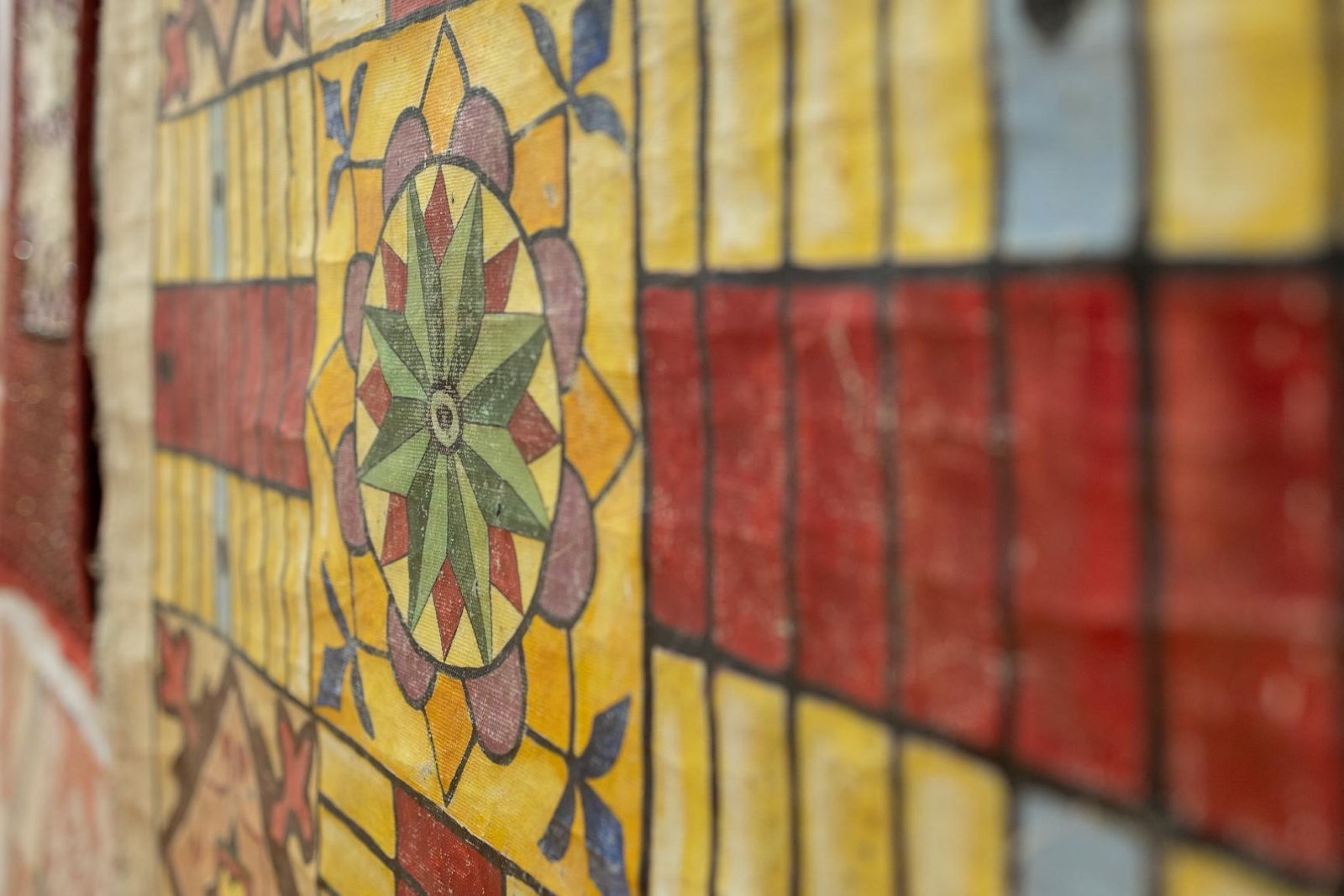
The specter of British colonialism permeates Mohamed Monaiseer’s exhibition at Gypsum Gallery (on until January 15). It is visually delightful, playful and alluring: the iconography of war, colonization, dispossession, power and genocide. The works are unambiguous references to British domination — flags, war-related strategy board games, insignia, crown jewels. They include drawings of little tin toy soldiers, rendered as cute playthings of imperialism — a common motif in the artist’s work.
I spent the most time with two large drawings that made me feel small. Composed of thousands of identical toy planes — miniatures of the British Sopwith Camel propeller aircraft, the most important and successful among the Allied fighters. War is precise and absurd. In one drawing, the planes are arranged in rhythmic disarray, pointing in all directions. In the other, they are neatly aligned in rows. At first glance, the patterns feel repetitive, almost compulsive, clichéd (in a way that consciously evokes the etymology of the word, of block prints reproducing images ad infinitum). Closer inspection of the drawings reveals glitches: the planes, though appearing identical, are slightly different, their arrangement subtly broken, hinting at the fragility of systemic order. Looking at the drawings for an extended time feels like child’s play.
The iconography and references are straightforward and precisely opposite to the complexity of Monaiseer’s craft, both materially and spiritually — it is also somewhat esoteric. The work is a culmination of the artist’s research during a residency at the Delfina Foundation in London in 2019. Monaiseer’s work draws on a range of colonial artifacts and histories: the Cullinan Diamond, discovered in South Africa in 1905 and now part of the British Crown Jewels; medieval paving tiles housed in the Parker-Hore Archive at the Ashmolean Museum in Oxford; artifacts from a 13th-century medieval monastery in Somerset, England, kept at the Victoria and Albert Museum; and the Imperial War Museum in London, which features exhibitions on the Holocaust. He transforms the material histories of extraction, domination and violence through the intricate use of sequins, beads and textiles.
Monaiseer’s work is composed of drawings, paintings and textile works, reflecting a meditative compulsion. Repetition is key to understanding his practice. The embellishments and meticulous stitching are often designed as precise grids, checkerboard formations, or lattice frameworks — the geometric precision reminiscent of Islamic art. Monaiseer is known for his mesmerizing craftsmanship.
Still, there are undercurrents of the unusual. He confides in me that the water used in the making of the work is his dirty bathwater that he collects. (It behooves me to say that there is a long tradition of well-known contemporary artists, like Mona Hatoum and Marina Abramović, who use traces of their body in their work: piss, hair, sweat, saliva.) The process of making is one of purging oneself of the libidinal traces of the colonial. The work is not merely representational; it is weird and corporeal. This is what instinctively draws me in, I think — not the icons themselves, but the hidden, lurking things that are unstated but felt.
Monaiseer’s works evoke the long shadow of British colonialism, from the First World War and the Sykes-Picot Agreement to the Balfour Declaration. These events form a sequence of betrayals that entrenched British involvement in the Eastern Mediterranean, laying the groundwork for the dispossession and ongoing struggle of the Palestinian people. The work becomes a séance of these histories, conjuring their specters while reframing them in glittering, disorienting forms.
It strikes me as an odd coincidence that British colonization keeps popping up in the work of contemporary Egyptian artists this season. Wael Shawky’s Drama 1882 (2024) is also looking at such a moment. The is a palpability to the concurrence of these works with the menacing zeitgeist: the war in Palestine and genocide in Gaza.
Still, the first reflection on models and toys and their relationship to the legal realm was activated upon my first encounter with the exhibition by Monaiseer.
A truck hits a pram, a wall divides the land, but in Monaiseer’s work, all I can see are shimmering crystals, sequins, patterns and a love for ornament. It is eerie to come face-to-face with the unsettling beauty of control, capture and colonialism.
عن الكاتب

Sarah A. Rifky
Sarah Rifky is a curator and writer based in Cairo, Egypt. She is the co-founder of the Beirut art initiative.
تقارير ذات صلة
#exhibition reviews
Lara Baladi’s Cosmovision
In Cosmovision, Lara Baladi breaks down photography’s cadre into a discursive unfurling of her becoming from 1996 to 2011, autobiographically performing the logic of the white cube. Shown at Tintera,…
Hana Elhaddad
7 دقيقة قراءة
#feminism
Doria Shafik: A life recovered
Shafik’s life resists simple categorization
Nadia Salem
15 دقيقة قراءة
#exhibition reviews
In pursuit of filling art-historical cracks: Chafik Charobim and missed opportunities
Hana Elhaddad considers the effectiveness of the retrospective's curatorial framing
Hana Elhaddad
10 دقيقة قراءة
Your support is the only way to ensure independent, progressive journalism survives.
You have a right to access accurate information, be stimulated by innovative and nuanced reporting, and be moved by compelling storytelling. Subscribe now to become part of the growing community of members who help us maintain our editorial independence.
Join us