
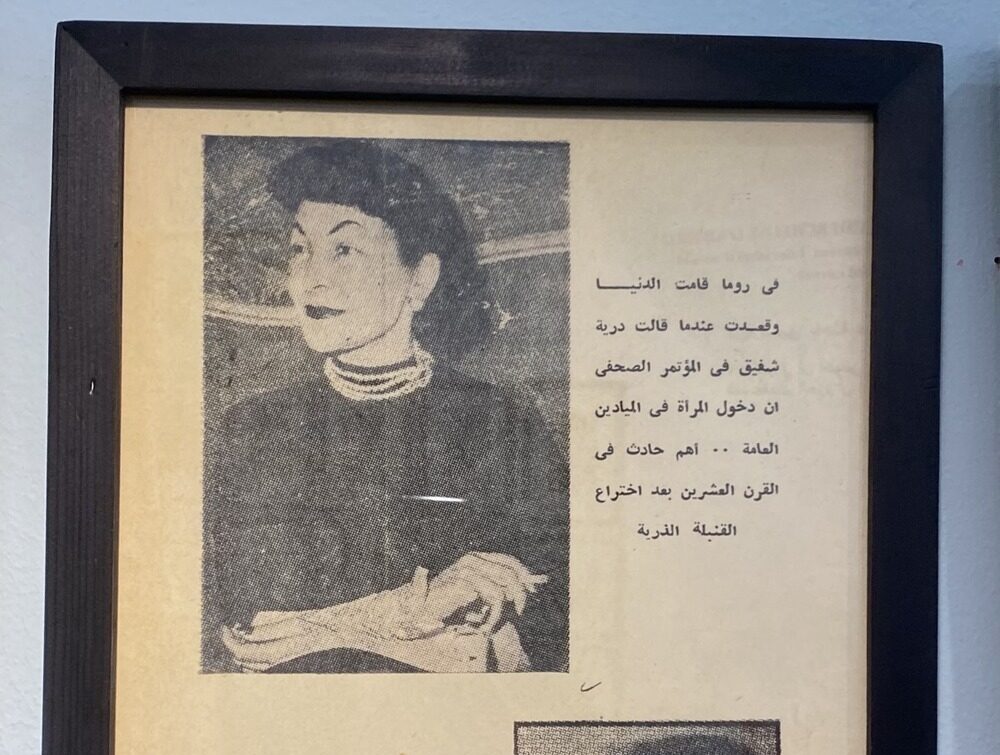
Doria Shafik: A life recovered
Walking through the halls of the Doria Shafik exhibition, curated by art historian Nadine Nour el-Din on the 50th anniversary of Shafik’s death, I couldn’t help but notice the tensions of a life story. Some clearly exhibited, others as subtexts — inviting us to dig further into Shafik’s life. They were captured somewhere between her radiating portraits and dark poetry.
The intimate exhibition, which was showing at the Institut Français d’Egypte from November 19 until January 15, approaches Shafik not as a fixed icon of feminism but as a trailblazer reconstructed through fragments; handwritten letters and poetry, editorials, photographs, wardrobe recreations and her personal art and jewelry. Her life appears here not as a linear success story but in parts of intense peaks and withdrawal. As Shafik herself wrote, her life was not merely a record of events but “the trajectory of a life” — a trajectory inseparable from Egypt’s 20th-century struggle between liberation and authoritarianism.
“To catch the imponderable thread connecting my very own existence to my own past, as well as to my own country's history and civilization. The Egypt I knew in my early years was an Egypt awakening from a thousand years' sleep, becoming conscious of its long sufferings — that it had rights! And I learned in my early childhood that the Will of woman can supersede the law.” — Doria Shafik, Memoirs (1975)
Shafik’s life resists simple categorization. Once a journalist, political organizer, philosopher, poet and public intellectual, her story is one of ongoing wrestling through learning, writing, organizing, instituting and staging public acts.

Born in Tanta in 1908 into a middle-class family, the second among her siblings, Shafik experienced early contradictions between tradition and ambition. She grew up at the intersection of provincial life and aspirational mobility. Her childhood, as she later reflected, coincided with an Egypt “awakening from a thousand years’ sleep,” becoming conscious of its suffering and its rights.
Class shaped her early consciousness sharply: she lacked inherited wealth or political pedigree, but benefitted from enough educational access to imagine another life. Her introduction to French came when she attended the French school Notre Dame des Apôtres in Tanta, a decision biographer Cynthia Nelson, author of Doria Shafik, Egyptian Feminist: A Woman Apart, described as a strategic move by her family to enable her social advancement.
In the 1930s, a scholarship from the Egyptian Education Ministry, brokered by Hoda Shaarawi, the pioneering founder of the Egyptian Feminist Union, sent Shafik to Paris to study at the Sorbonne, where she completed two doctorates.
Paris was formative not just intellectually but as a place for construction of the self. Studying philosophy, psychology and aesthetics, Shafik encountered debates about subjectivity and freedom while also confronting her own solitude. She discovered poetry as a mode of survival and expression, often writing in French, a language she associated with introspection and abstraction.
French was sometimes closer to Shafik than Arabic for certain forms of expression, Nour el-Din explains, showing a relationship to language that is read in a matter more complex than through simply a class lens. “While much of her political and editorial writing, particularly in Bint al-Nil, was in Arabic, the deeply personal, diaristic poetry she wrote in her later years was handwritten almost entirely in French. In that sense, the language was not a symbol of diplomatic alignment, but an intimate intellectual and emotional tool.” French was a language she inhabited from childhood and used for her most private, vulnerable forms of writing, Nour el-Din adds.
In other aspects of Shafik’s rich life, Nour el-Din doesn’t try to resolve the associations of class complexities. Although we see Shafik’s affinities to certain classed and colonial aesthetics, especially in her fashion statements, we also see active political moves toward inclusion, especially in her Arabic editorials and organizing work. We are left with these tensions, rather than any resolve about Shafik’s character.
Feminism propelled Shafik into politics. If it weren’t for Shaarawi, Shafik’s path could have drastically differed, and it is possible we would not be where we are today as Egyptian women. Shaarawi’s authority offered both a model and, later, a constraint; she represented an earlier generation of elite feminism rooted in philanthropy and gradual reform. Shafik would inherit this legacy and try to radicalize it.
Handwritten letters of correspondence between the two were displayed in the exhibition, highlighting the growth of their relationship from one of mentorship to that of a real and affectionate friendship.

While living in France, Shafik developed her concept of the “New Woman.” For her, modern womanhood meant the unity of intellect and beauty, mind and form. Life itself, she believed, was to be a work of art.
When Shafik returned to Egypt after four years abroad, she confronted a rapidly transforming society, grappling with economic depression, nationalism and the sting of colonial politics. Labor unrest, student demonstrations and intensifying anti-colonial struggle marked the early 1940s. While she conversed with elites, she was acutely aware that real political energy was erupting elsewhere — in strikes, protests and mass mobilization.
At this point in her life, she also began to see gender oppression as a symptom of a broader social illness, produced by both colonial domination and an ossified social order. This realization deepened her resolve but also sharpened her sense of estrangement from Egyptian society. Despite her doctorate, she was denied a teaching post at Cairo University on the pretext that her modern style was “unsuitable.”
Undeterred, she turned to journalism. As editor-in-chief of La Femme Nouvelle, a cultural francophone magazine founded by Princess Chevikar Ibrahim, King Fouad’s first wife, and later as the founder of the Arabic-language magazine, Bint al-Nil, Shafik used writing to articulate feminist politics and women’s right to political participation to women.
Rejecting both revolutionary extremism and conservative retrenchment of the time, she positioned herself as a reformer with urgency. In La Femme Nouvelle, she articulated her first sustained feminist philosophy since her doctoral work. Writing in French, she addressed the educated elite, who she believed must act as the vanguard of social change. She challenged Western orientalist fantasies of Egyptian women and insisted instead on their rapid transformation, ambition and political potential.
Yet this choice of language and milieu made her vulnerable. In the heightened nationalism of the postwar years, her Frenchness — real and imagined — became a liability.
By the mid-1940s, Shafik found herself accused of being insufficiently Egyptian: too elegant, too francophone, too close to foreigners. Rumors circulated that she collaborated with colonial interests. These attacks cut deeply, widening what she described as an “abyss” between herself and her country.
Her response was both strategic and emotional. She threw herself fully into journalism, founding Bint al-Nil, an Arabic-language magazine that marked a decisive turn toward mass engagement. Journalism offered her what her Egyptian social life could not — dynamism, immediacy and daily struggle. Through Bint al-Nil, she articulated a vision of Egyptian society that combined liberal-humanist principles, moral values derived from a progressive reading of Islam and a modernist feminist consciousness.
Although Bint al-Nil was an attempt at channeling a more mass-oriented approach, primarily through language and the range of topics discussed, it also remained somewhat elitist, Nour el-Din says. “Paris and London fashions, for instance, would not have been accessible to all women” at the time. “This tension is precisely what makes the magazine interesting, reflecting aspiration as much as reality.”
Nour el-Din did not end up displaying issues of La Femme Nouvelle, for spatial constraints. Instead, she chose to focus on Bint al-Nil. In the exhibition, the pages appear as artifacts of a politics of representation.


The show doesn’t stop at exhibits of Shafik’s different endeavors. Close attention highlights the tensions, which cause ruptures at times and enable continuations at others.
In 1947, following Shaarawi’s death, Shafik stepped decisively into leadership. Her eulogy was a pivotal moment. She transformed mourning into mandate, insisting that true remembrance lay in action: education, labor and political participation.
Within months, she founded the Bint al-Nil Union, an extension of her vision to connect women across Egypt through activism and political involvement, launching the group with press conferences that provoked outrage across the political spectrum. Critics attacked her association to elite circles, her audacity, her interpretation of Islam, and her presence in politics. Yet she succeeded in assembling an unprecedented coalition of professional and middle-class women, as well as students drawn to her charisma and urgency.
By the late 1940s, her editorials shifted from discussions of women’s lifestyles to explicit demands for women’s rights, legal reform and economic equality.
"The freedom granted so far remained on the surface of our social structure, leaving intact the manacles which bound the hands of the Egyptian woman. No one will deliver freedom to the woman except the woman herself…I decided to fight to the last drop of blood to break the chains shackling the women of my country in the invisible prison in which they continued to live; a prison, which being invisible, was all the more oppressive.” — Doria Shafik
In 1945, she famously stormed the Egyptian Parliament with 1,500 women, demanding political rights and suffrage. The spectacular moment, captured in the news, was presented as a video installation in the exhibition through a television screen looping the live broadcast of the moment at the time.

Her tactic was confrontation: sit-ins against colonial symbols, public denunciations of sexist practices, and community organizing that blurred lines between cultural production and political action. In this context, feminism was not a vocabulary of rights alone, but a practice of resistance. Shafik reflects this in her editorials, printed and framed for the exhibition.
Nonetheless, her actions garnered diverse reactions: praise among urban educated youth, critique from different political traditions, disdain in conservative circles, and suspicion from a state consolidating power post-1952 revolution.
The mid-1950s marked both triumph and rupture. In 1954, Shafik and colleagues staged a hunger strike at the Journalists Syndicate to protest the exclusion of women from the constitutional committee drafting Egypt’s new political order — a protest that drew national and international attention and contributed to women gaining the right to vote in 1956.
“I have taken my decision to begin at noon today, March 12, 1954 in the Press Syndicate, a hunger strike until death, in protest against the coming formation of a founding committee to create the new constitution in which no woman has been included. I refuse to be governed according to a constitution in whose drafting I have not participated. I make my strike at the Press Syndicate because the latter, by its very essence, is intimately connected with every movement of liberation. Signed, Doria Shafik.”
What began as a single protest became a national media sensation, accompanied by vicious rumor campaigns accusing the participating women of immorality. Shafik understood these attacks clearly: in a Muslim society, reputational damage was the most dangerous weapon.
Yet the strike forced women’s political rights into constitutional debate and linked feminist struggle directly to democracy itself.

Initially hopeful after the 1952 revolution, Shafik soon recognized the danger of Gamal Abdel Nasser’s centralized populism. While women gained suffrage, independent organizations were dismantled, including Bint al-Nil, feminism was absorbed, and like all other aspects of politics, neutralized and silenced.
Her final act of public defiance came in 1957. As a friend of the wife of the Indian ambassador to Cairo, she entered the Indian Embassy on February 6 and declared a hunger strike “unto death,” demanding both Israeli withdrawal from Egyptian territory and an end to Nasser’s dictatorship at home. She had informed foreign news agencies in advance, understanding that censorship might stifle her protest. The authorities were furious. Egyptian police could not enter the embassy, and international media broadcast her defiance to the world. Another spectacular moment highlighted in the exhibition.

Shafik’s protest was widely reported abroad. Radio Monte Carlo called her “the only man in Egypt,” as a way to highlight her courage in a society dominated by patriarchal, authoritarian power. At home, the press was silent. She was fighting the currents alone this time. She continued her fast under medical supervision, protected by diplomatic arrangements secured by the prime minister of India. Over the course of 11 days, Shafik persisted, despite the government’s efforts to portray her as mentally unstable, while her husband and close allies negotiated her safety and well-being.
Some prominent women voices, including Inji Efflatoun and Ceza Nabrawy, circulated a petition denouncing her actions as poorly timed and self-serving, reflecting broader political tensions, especially a classical one between Marxist feminist traditions and suffragist ones.
This protest sealed her fate as the state responded decisively. She was placed under house arrest, her archives were destroyed, her magazines banned and her publishing house closed. Her name was officially erased from the press.
This marked the abrupt end of her public career, spanning nearly 30 years since 1928, and the beginning of an 18-year period of near-total seclusion, a disappearance enforced by the state, during which she was largely cut off from public life and political activism.
Solitude became a repository of reflection, a space where protest took the form of introspection. Shafik turned inward, writing thousands of pages of memoirs. Writing became survival, a means of preserving freedom when public life was no longer possible. Her belief that her own destiny was inseparable from humanity’s remained intact — even as her community disintegrated.
In the exhibition, we see furniture and personal belongings, a recreation of her desk and bookshelf, the corner of her home where she wrote in her final years of solitude, and a blown up version of her final poem. Playing in the background is Non, je ne regrette rien by Édith Piaf, a favorite of Shafik’s.

In the final stage of her life, Shafik adopted a minimalist lifestyle, limited her material possessions, and devoted herself to writing. Her daughters describe her to Nelson, her biographer, as living in quiet discipline: vegetarian, deeply spiritual and devoted to the Quran, and learning several languages while continuing to produce over 16 books, including poetry, essays, translations and memoirs.
Shafik reflected on this seclusion with a profound sense of moral victory.
“From this isolated ambiance, where my enemies believe that they have driven me back to a slow death, I nevertheless have discovered the most beautiful windfall: my own existence as a free being.” — Doria Shafik
Her death in 1975, the result of a fall from the balcony of her sixth-floor Zamalek apartment, reintroduced her to the collective national consciousness. Media outlets both in Egypt and internationally paid tribute to her courage, recognizing her as a pioneering figure whose audacity and vision had challenged both societal norms and authoritarian power.
“It was really important to me not to omit difficult aspects of her life, including the fact that she took her own life, a detail many people are unaware of due to social taboos around suicide. I excavated her own writing, books, handwritten pages, magazines, and combined this material with family-held objects, photographs, clippings, portraits and elements from my own archive to construct a coherent visual narrative,” Nour el-Din says.
Decades later, the work of Nour el-Din, in collaboration with Shafik’s family, seeks to reassemble what the state once disassembled, to reanimate, visualize, and extract truth and narrative from what censorship attempted to bury.
While Shafik’s story has been rescued and put to different uses, this time being hosted by a French institution priding itself for France’s influence on Shafik’s trajectory, the exhibition enlarged the scope of her achievement beyond political co-optation.
Nour el-Din resists reading Shafik as a success story validated by foreign education or external values, and is instead invested in how feminist histories are retrospectively sanitized. “Her life was marked by political failure, silencing and isolation, and it is precisely this unresolved tension that gives her relevance today.”
This expansive approach is manifest in the assembly and montage of Shafik’s life fragments; archival material, reproductions and multisensory elements. Nour el-Din wanted audiences to connect with Shafik “by presenting her multiple facets” intimately, through the inclusion of details such as “her perfume, her handwriting and her music…”
“I wanted the exhibition to be open enough to accommodate both critical, informed audiences and those encountering Shafik for the first time, without reducing her to a single narrative or ideological frame.”
In the exhibition’s act of retrieval and witness, we see the enduring struggle of women who seek to enact transformative change across different tensions; the personal and the social, the conviction in change and the steadfastness of tradition, activism and poetry, resilience and submission.
This exhibition does not try to resolve Shafik’s contradictions; instead, it puts them on display. Mother and militant activist, poet and journalist, nationalist and cosmopolitan, charismatic and isolated — she resists easy canonization.
Remembering her today is not an act of nostalgia but of reckoning: with erased histories, compromised revolutions and feminist struggles that were never allowed to fully unfold.
تقارير ذات صلة
Iranian protester: Young generation does not have our fears, tomorrow will be shaped by their courage
"We must be unpredictable and conquer public spaces"
Sexual health and social change: A conversation with Nour Emam of Mother Being
"I have to push myself and leave my comfort zone to reach the people who need this information"
Midnight in Cairo: A Conversation with Raphael Cormack
Ifdal Elsaket discusses "Midnight in Cairo" with author, Raphael Cormack
Your support is the only way to ensure independent, progressive journalism survives.
You have a right to access accurate information, be stimulated by innovative and nuanced reporting, and be moved by compelling storytelling. Subscribe now to become part of the growing community of members who help us maintain our editorial independence.
Join us