
In Other Words | The Official History of the Gods of Egypt by Mohamed Rabie
Introduction
What would compel a god like us to perform a lowly task like writing?
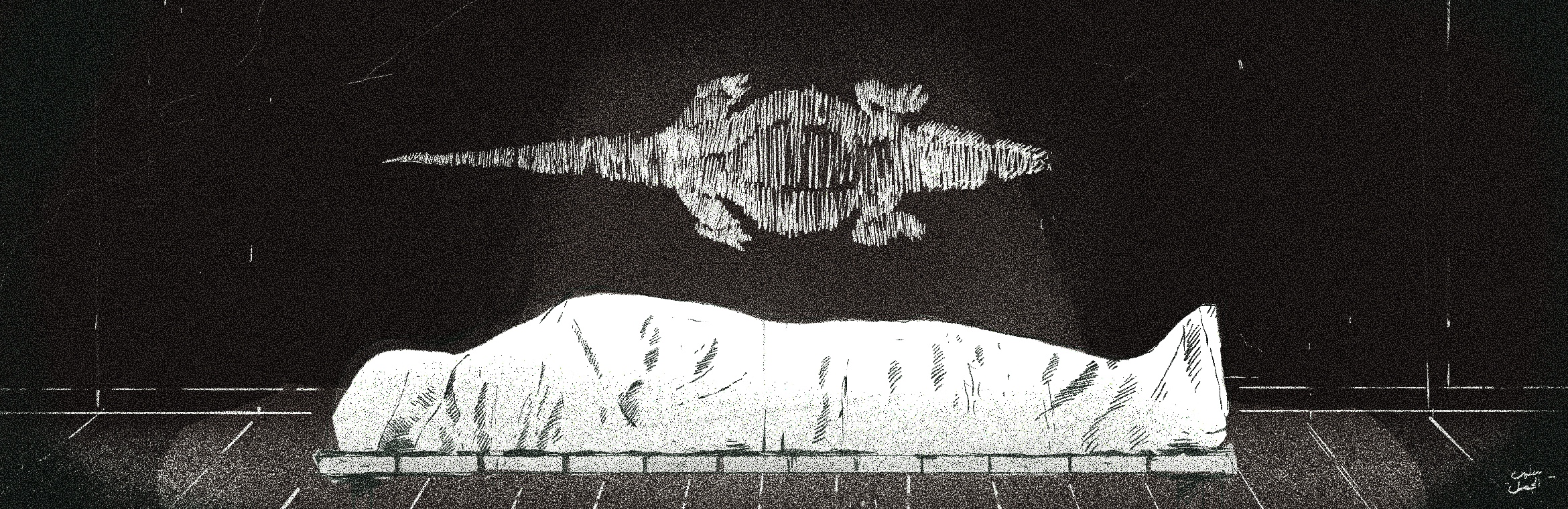
There is an event from our childhood we remember vividly. We lived at the time with our parents and siblings, in a small house nestled in one of the capital’s ancient neighborhoods. Our father was in the habit of decorating the walls with little mummified crocodiles. He spread them around the house, placing one in each room as if to signify that it was safe to abide therein. Most of these were small crocodiles, save for a big one hung up in the living room that measured more than two meters in length. With a wider belly than the rest, it appeared to be the dominant one. Perhaps this was an ancient custom our father had acquired in the distant days of his childhood, back in his ancient village in the south. And yet, our happy home was not immune to the winds of change. One day, there spread throughout the house a foul odor of unknown origin. We remember our father, mother, and brothers roaming around the apartment, sniffing around corners, behind the chairs, under the beds, in every nook and cranny. Eventually, our father happened to pass by the big crocodile hung up in the living room, and thus discovered it to be the source of the odor.
Ever since then, the idea of rot and its inevitability has continued to fascinate us. We were amazed at humanity’s desire to immortalize any living thing. We could not grasp the reason behind hanging crocodile carcasses on the walls, nor could we fathom the necessity of all that trouble involved in hunting a crocodile, then killing it, then mummifying it. This last step was surely a tiresome, complicated task. Did our forefathers worship the crocodiles? Did hanging them up on the wall like this mean they embraced the divinity of an enormous flying reptile? Or were the crocodiles earthbound deities at some point? As we write this today, we recall our father’s anger and sadness when he realized his crocodile had succumbed to rot. This was not the anger of an antiquities collector whose treasures had suffered damage, but rather, we think, it was the anger of a worshiper whose object of veneration had suddenly been defiled.
Of course, our father would never have admitted to worshipping a mummified, hollowed-out crocodile. The Age of Darkness had long since passed into oblivion, never to return. Still, there remained those weak souls — our father and mother, for example — who clung to the remnants of that distant past. Even though they had not actually lived way back then, in the Age of Darkness, they nonetheless had inherited some of its deplorable relics, whose original meanings had been lost with time. It would appear our father did not fully realize that he had been worshiping the crocodile on the wall, nor that his anger was the result of seeing the image of his god smashed right in front of him.
Our father never did explain to us the reason for his intense anger, as he died just a few days after the aforementioned incident. Our mother believed his death to be connected in some way to the rotting of the crocodile. This sort of linkage between two unrelated incidents would seem strange to us today, as indeed it seemed to us at the time of our father’s death all those years ago. Yet it seems our family still retained some of those ancient beliefs, those types of linkages that, in ages long passed, used to be called “superstitions.” These were things that people could not perceive or understand, and for whose existence they could find no evidence, but which they still believed in as having real effects on their lives. My mother didn’t talk with us much. She treated us as though we were a child, even though, at the time of our father’s death, we were fifteen years old. She didn’t explain why she believed in a connection between the rotting of the crocodile and the death of our father. Soon we would grow up, enter the College of Arts and Letters, and gain a considerable amount of independence. And so we turned the page.
This is not, however, a work of literature, wherein we recount memories of our family and our life before the period of our divinity. This is a work of history.
The idea for this book came to us one day long ago, when we was still a historian of the gods in God Palace. We were making our way through the throngs of people along Khizou I Street, in the center of New Capital 9, when suddenly the statue of Khaero the Farmer came crashing down, burying a small number of pedestrians underneath. We thought all of them had been killed instantly, until we heard the screams of one that was still alive. We rushed over to the scene, and found a man whose lower half was trapped under the rubble. He was ranting and raving, cursing the gods with the most brazen insults — words which would be inappropriate to reproduce here, utter and complete blasphemy. When he spotted us, he began to quiet down. As we approached, we noticed his eyes were fixed on the golden god-pin we had fastened to the button-hole of our jacket — the special mark of those who work in God Palace. The man went silent, then started again in a cracked voice that gradually smoothed out as he spoke. He said that Egyptians never believed in these gods at all, that they mocked them all the time, and that they still kept their faith in their old gods in spite of everything that had happened. A day would come, he said, when Egyptians would conquer their fear, and smash all these statues with their bare hands. He added that every single Egyptian has nothing but contempt for these gods, and then was quiet again. We thought he had expired, but after a short while, he spoke again in a weak voice, declaring that he was saying all these things because he knew that we could not punish him, and that death is the only possible liberation from the group of lunatics who think they’re gods. Then, with a quivering finger, he pointed at us and said, “You people.”
When he said that we “could not punish him,” he probably meant that we would not inform on him, call for him to be imprisoned, and testify against him in court for having said these things. That we would not see him tied up in ropes, weighed down with a stone, and tossed from a boat in the middle of the Nile. His reason for saying all this was his total lack of faith in the gods of Egypt. No doubt, he was one of the few Egyptians of his time to still believe in the gods of the Age of Darkness — gods that the majority of Egyptians had exerted great effort to rid themselves of and forget. Surely, his words were nothing more than the rantings of man who never experienced the bliss of faith in the true gods of Egypt — a sad man who knew he would die within seconds.
At that very moment, as the man lay stretched out before me on that long-ago day, we remembered our father and his crocodiles.
We went on our way, leaving the man’s corpse far behind and thinking about what could be done. The statues of the gods were lined up evenly on either side of the street, each in the proper godly pose: figure upright with legs in line and arms at the sides, head raised towards the horizon, broad shoulders and clenched fists. We stood gazing at these numerous statues — hundreds of statues of the four gods — when suddenly, way back on the long-ago day, the idea for this book popped into our head.
The Egyptians lack true faith. Some might still believe in what they called, back in the Age of Darkness, “religions.” In their adherence to these “religions,” humanity wasted enormous amounts of time, money, and effort, before wasting even more to get rid of them. Unfortunately, some of the old doctrines and rituals seem to have percolated down to Egyptians today through their fathers and grandfathers. You might think, dear reader, that Egyptians are a poisonous plant of infidelity. But the thought has never crossed our mind: after everything the Gods of Egypt have accomplished, there remains not a single poisonous plant in all of Egypt.
We write this book to remind Egyptians of everything that was accomplished in the Age of Light, as well as to inform the rest of humanity of the auspicious events that passed. We write in order to teach them the true faith, and to push them to follow rationalistic modes of thought — modes that have nothing whatsoever to do with the old myths and superstitions — which will lead them inevitability to faith in the Gods of Egypt. We write so that all of humanity may exit the Darkness and enter the Light. We record here the history of the Gods of Egypt so that humanity might realize how mightily they erred, how long they wandered in the Darkness they called Light. Our hope is for them to recognize the ridiculous nature of the beliefs they once held, and to remember how they worshipped gods of their own making, which they fashioned with names, attributes, and various shapes and sizes. We write also to affirm that all Egyptians emerged from that dark age after having sustained great losses, for what they lost as a result of believing in false gods is incalculable. We write to affirm that all Egyptians duly accepted the first Egyptian god to declare his divinity in their midst, without messengers or prophets or intermediaries. From that moment, they have been fighting on a daily basis to dispense with the pitiful remnants of the execrable Age of Darkness. Those who embrace the religions of the Age of Darkness could not possibly fathom the suffering of the Egyptians before Khizou I declared his divinity.
On that long-ago day, our mind wandered far. Leaving behind the throngs of people and the statues of the gods, we found ourself alone outside New Capital 9, and our mind was suddenly crowded with thousands of thoughts from the hundreds of books that we had read: history as written by Egyptian historians. But these historians were human beings, no different from those ordinary pedestrians whose only concern is with the Gods of Egypt: Egyptians like any others, who perceive only a small fraction of the things happening around them. As we recalled all those books that we had read, we recalled how marvelous they were, how impressive! And yet, the ordinary reader would surely find them disorienting, and difficult to comprehend in their entirety. These books were completely lacking in organization and structure — fitting testaments to the chaotic minds of the Egyptians who wrote them. Even we found them confusing — that is, back when we were only a historian of gods, before we were a god ourself.
On our way home, our mind wrote everything it had in mind: history as it had happened exactly, organized and arranged according to chronological order. No more scattered, disordered thoughts such as those that assailed us a few hours ago. Everything was ordered, ordered by our mind alone.
The ordinary reader may be astonished to find in this book details of which he was previously unaware, or perhaps he was aware of them but did not comprehend them completely. Yet he is to be assured that this book is the only path to True Faith.
Kherebtou the Absolute
In Other Words is a series of translated excerpts from contemporary Arabic literary works, by emerging or established authors, published in English for the first time. For a long time, the process of selecting works written in Arabic for translation, which gives them the opportunity to reach a wider audience and to potentially join the ever-expanding canon of “world literature” (as problematic as that term is), has been largely confined to a designated community of “gatekeepers” — mostly made up of Western publishers and translators — who decide which narratives they deem most “representative” of the region and are therefore worthy of traversing cultural borders and crossing over to other parts of the world.
By offering translated glimpses of works that we believe are significant — in their language, format, or thematic resonance — we are attempting, at least in part, to perhaps effect that selection process by bringing more attention to stories that we think deserve to travel far and wide. We hope to create more space for diverse voices from the region to be heard elsewhere, not for what they “represent,” but for the unique, singular vision each of them provides.
تقارير ذات صلة
In Other Words | The Musk of the Hill by Sahar El Mougy
I took a breath, and a second, and a third, as if I were shoving away the heaviness on my heart
In Other Words | A Very Social Distance by Amr Ezzat
“What brought you here, you bastard? Are they arresting people who write down their dreams now, too?
In Other Words | Sorrow in My Heart by Hilal Chouman
“There is no pleasure for me without sorrow,” I once told Adrian, my psychotherapist.
Your support is the only way to ensure independent, progressive journalism survives.
You have a right to access accurate information, be stimulated by innovative and nuanced reporting, and be moved by compelling storytelling. Subscribe now to become part of the growing community of members who help us maintain our editorial independence.
Join us