
In Other Words | The Musk of the Hill by Sahar El Mougy
Translator’s note:
This excerpt appears in Sahar El Mougy’s latest novel, The Musk of the Hill (Dar El Sherouk, 2017). In these two chapters, we see the main characters coming together: Mariam, Amina, Cathy and Virginia. The whole novel, and consequently this situation, involves three categories of characters: fictional characters, protagonists derived from other novels and a historical character — in a narrative of ingenious intertextuality. Mariam and Nagy are Sahar El Mougy’s invented characters; Amina and her son Kamal are two characters derived from Naguib Mahfouz’s novel (and film) Palace Walk (1956); Cathy is brought here from Emily Bronte’s Wuthering Heights (1847); while Virginia Woolf (1882–1941), the most real of the women, has perhaps — ironically — the most metaphysical presence in Mougy’s narrative. All these historical and literary figures live in the Sirens’ house and meet Mariam in contemporary Egypt (2010) to help her out of her sorrow. The characters of Amina and Cathy are deconstructed, rewritten and represented in a new feminist light, where they are all empowered by their femininity, mutual support, solidarity and the power of the Sirens.
In Chapter 29, we see them on one of their journeys, guided by Virginia and roaming freely in a natural landscape, while Mariam, the depressed middle-aged woman, is remembering her loss of husband and unborn child. Chapter 30 marks a narrative shift to a journal entry by Amina, where she addresses her son following a dream she had of him during her stay with Mariam in the hospital. We witness the characters’ transformation through this monologue, as well as through their shared lives in the Sirens’ house, which lies on top of the Hill surrounded by the fragrance of Musk.
These two chapters reflect Sahar El Mougy’s masterful power of imagination and expression, offering a glimpse into her art and style. Although narrated in the third person, the novel gives the characters space to express themselves, revealing their thoughts and feelings through dialogue as well as narrative shifts to first person accounts, and sometimes through the stream of consciousness technique.
Chapter 29
Mariam went out of the door and walked slowly in the garden, then looked around.
The house appeared like a medieval castle, rough and grim with the gray stone blocks forming its haughty body, and those strange spear-pointed towers. Were they once hermits’ caves? Or perhaps towers protecting a military fort? Who would be crazy enough to attack a castle at the edge of a mountain overlooking a void? Who is the craziest of them all, who built this fortress at the tip of the world, then went on, leaving it behind?
She wandered through the garden with her eyes; it was drenched in the deep color of cranberries, red poppies, and white calla lilies. From the far right side of the house, she heard the rattle of kitchenware. In spite of the sunshine, the air was robust with a slight chill. Mariam took a breath and felt her chest opening up to receive even more air. The air had a taste of its own.
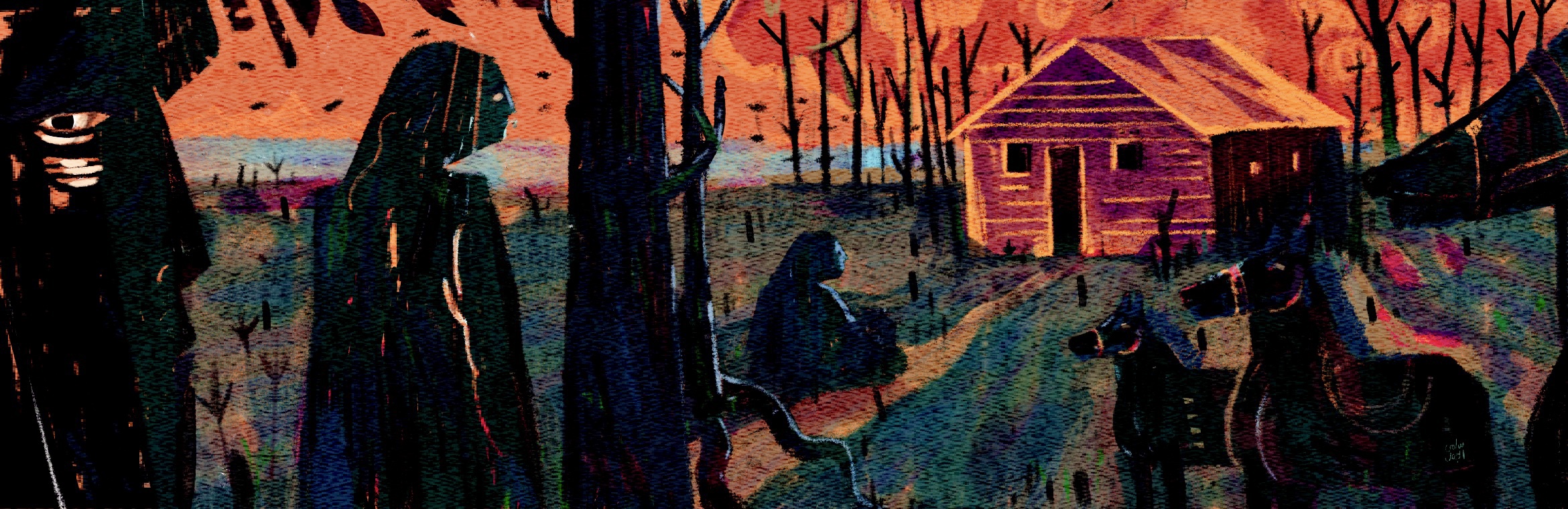
She heard the rustling of the leaves, and footsteps coming close, and saw a slim, tall woman sliding through the trees followed by three horses. It was Virginia Woolf, with her silver hair tied up in a bun at the back of her head and her little eyes lying deep in her face. Catherine met her at the fountain at the same instant when Amina came out the door of the house heading to the black horse, patting it on its face, while it shook its head gently as it looked at her.
Catherine mounted the saddle, and on horseback approached Mariam, to whom she stretched out her arm invitingly. Mariam’s eyes widened. You must be joking, Catherine! Of course I’m not going to mount this horse; I’ve never done it before! And this poor animal, why should it bear it all?
After a few attempts, Mariam settled behind Catherine.
The journey down the hill started, and Mariam’s heart pounded. She firmly embraced Catherine’s body, which in turn sat upright and settled on the saddle. Mariam was scared of falling face first, squashing both Catherine and the horse. Yet after a while of trotting on, she felt her heartbeat calm down and settle into a slightly nervous pulse. The place fell into a tranquility only touched by the soft swish of the tree leaves and the muffled thumps of the horses’ hooves. It was a peaceful, solemn silence, only focused on itself. Mariam turned her head toward Amina, only to find her looking back, before glancing ahead again with a smile.
The caravan ended its journey down the hill and entered into a tree-canopied road like an enormous orange tunnel, the autumn leaves having covered the trees in yellow and orange, while extending on the ground a crisp, colorful natural mat.
Virginia was in front of her now, holding the reins and leading the horse with gentle motions of her hands. Her horse took a turn to the left, while the caravan continued its flow from the tree tunnel into the woods. Mariam had never seen such tall trees in her life! She looked upward to see the sunlight coming through the leaves in slender threads. The road kept ascending and descending until Mariam could perceive the lake below and realize that the woods stretched across the hills, descending toward the water. The fragrant air carried the scent of moist grass and bluebells gathered in thick purple flower patches. The air had a taste of its own.
They dismounted by the shore, where Catherine hitched the horses to a tree near a small wooden shed. She looked at the distant lakeside and walked away. Virginia sat on the ground, took out her papers, and started reading. Amina sat cross-legged, leaning her back against the willow tree-trunk, and took out a book to read. Mariam stood there for a moment, unsure of what to do with herself. Why aren’t any of the women saying anything? Silence makes her nervous and confused. Hesitantly, she sat down, and felt her body sink into the thick grass. She rested her hand on it, feeling its soft movement below her palm. She startled. The lake stretched in front of her eyes, with the reflection of the sky, clouds, and the tips of the hills on the surface of its water. What are these colors that spread across this place? They are clear and sharp in a way Mariam has never known before — the blue, white, and degrees of green! She glanced at Virginia who had started rolling a cigarette with straying eyes.
At this moment, Mariam remembered that Mrs. Dalloway* was the only novel of Virginia’s that she had read. She was taken aback by how the details flowed through her mind, as though she had just finished reading it. The protagonist, Clarissa, had opted for security, deserting the man she loved, and instead created a comfortable cocoon for herself inside the elegant walls of a marriage that secured her a privileged position on the social map of London in 1923. That way she’d be able to hold parties. Clarissa’s greatest passion and joy was to offer her guests a sense of perfection, even if for just one night; the women are more beautiful and radiant than ever while the men brim with satisfaction. The whole universe is then compressed into the space of this little party, with its music and ringing laughs. Clarissa is capable of creating a single night of pure magic. On such nights, she’d experience her own Self away from all the fuss embedded in her bubble, reassuring herself that she owned something to care for and protect — her secret mysterious Self, unshared even with her husband, or with anyone else.
What did Clarissa know about her “secret mysterious Self”?
What do you know, Mariam, about your Self?
Mariam had had her share of wild journeys in that arena since the secret cave and the world of fiction. But something happened after Nagy’s death, so that the life-loving young woman vanished, with her belief in the human ability for self-regeneration. She suddenly vanished as though she had never existed at all. Now she didn’t even remember her features, as though that woman had been a person she met en passant, someone she never got the chance to really know.
Mariam looked at the lake water that was a few steps away. She saw a raft of ducks swimming and getting close, while other long-beaked birds landed by the shore and started walking toward Amina, shaking their full backsides. Amina took a handful of grains out of her bag and threw them a step away, so the birds crowded around her. She smiled at them, then went back to turning the pages of her book. Mariam observed her, thinking: Amina, how comfortable you look! Mariam does not know if comfort is the proper word or the accurate description of the feeling that accompanies Amina wherever she goes. She retrieved an image of Amina sitting cross-legged on the sofa in the Rawda house, with the coffee-making set in front of her, just two days after arriving there.
Mariam closed her eyes and took a breath, then looked at the clouds floating over the lake. She tried to remember the features of the old Mariam, and failed. In her mind she could only see this rigid face and the two glassy eyes that have been with her since Nagy’s death. These years seemed to her like a vast space of ice: extended, featureless time. For a quarter century, Mariam has moved only between her home, the hospital and her clinic. Her body can neither feel nor react. Her Self wanders aimlessly across a ruined land, the location of which Mariam does not know. She tried to remember anything worthwhile, an experience, or even a moment in her life, but did not find even a single picture worth placing in an album of memories. She felt like a void entity or a hollow paper doll; if anyone tried to stretch their hand inside it, they’d find nothing but air.
When Nagy died, Mariam held herself up during the funeral, dealing with the required procedures, and stayed as such even after she lost the baby. On that day, Zaza tried to hold her tears back but she could not. Yet Mariam received the news calmly, after the effect of the anesthesia was gone, as though it were another woman’s matter.
She raised her face up to the sky, where clear white clouds floated. Catherine had not appeared yet, while Amina was deeply engaged in reading the book in her hands, and Virginia was scribbling words on paper. Mariam’s body was tired, like that of someone who had just come back from a tough battle. Yet at the same time she could feel the touch of the chilly autumn air on her skin, and the tree leaves that gently landed on her forehead. She could hear the sound of water gurgling near her, almost able to feel the movement of the fish swimming at the bottom of the lake.
Mariam, have you died and gone to heaven?
If this is heaven, then why isn’t Mariam feeling the happiness everybody speaks of?
She curled her lips mockingly.
Yesterday, she told Amina that she only remembered Nagy from his days of illness. She tried in vain to go back in her memories to any other moment of them together. Ten years had separated their college days and marriage; how was it that she could not remember anything? Nothing came to Mariam except her sense of triumph over her mother. Her marriage to Nagy was against Nahed’s will, and was hence Mariam’s victory. Her new life was a victory. Even her decision to delay pregnancy could be considered part of the undeclared war with Nahed, who — once she had finished with her repertoire of the “mismarriage” — started nagging at Mariam about getting pregnant: “You’re over 30 now, and it is high time you had children. It might turn out that he has a problem. And what if there is something wrong with you?”
Mariam saw Virginia leave the papers under a small rock and walk to the lake, standing a step away from the water. Mariam looked at her, and felt nervousness tapping into her, like a colony of ants filling her up and rising to her head. There were questions she held without knowing what they were. Thoughts were drifting in her head like tiny mercury droplets slipping through one’s fingers: the black box ... Nagy ... victory ... heaven.
Come on, Mariam. You can call Virginia, she will turn to you, then you can ask her what you wish.
What should I ask her about?
Ask her, for instance, about the meaning of looking life in the face — to know it as it is, to love it as it is, and then put it aside.
Mariam does not remember where Virginia said these words, and does not really know what it means to love life and then “put it aside.” Or is that what Virginia did when she filled the pockets of her coat with stones and walked into the cold water of the lake?
Then ask her why you are here, ask her what this place is, and how Virginia herself — a writer — has come to the Sirens’ house when all its inhabitants are women protagonists.
“Mariam …!”
Her attention was drawn to Amina calling her, standing next to her, and stretching her arm to her with a loaf of bread, round and fluffy, filled with cranberry jam. Mariam took a bite looking into Amina’s eyes, but the food stuck in her throat. How she wished to tell her right now about a thing of great importance. She would utter one short, simple sentence — in three words — saying it as though it were a normal thing that did not require all that drama: “I am miserable.”
She got up, leaving Amina behind, and walked away. To her right, the trees rose up in the shape of enormous question marks, while on the other side the lake stretched out, colored by the sun’s orange threads. She looked at the shallow water where the little stones and pebbles glimmered, and where the schools of little fish swam among the shore grass. She raised her eyes toward the hills and then lowered them back to the water, where on its surface she saw Nagy’s face. He was having a nap on a beach chair in Maamoura with a book lying on his belly. The image grew very clear, with his skin tanned by the summer sun, his cheekbones similar to those of the ancient Egyptians on temple walls, his chest going up and down with every breath he takes, and his skin shining with drops of sweat and sand. Where was Mariam then? She moved the camera lens to reveal the other chair, filled with Mariam’s body, slightly flowing over the sides of the seat. But she could not discern her face. Perhaps this was the summer of 1981 or 1982. But that is not important. She can see Nagy now!
Her chest quivered with tears.
Chapter 30
November 13, 2010
Qasr al-Aini Hospital garden
3 am
My heart has sunk and my body is as cold as ice. I wrapped the woolen scarf around my shoulders and left Mariam’s room, with the notebook in my hand. I need to write and to breathe in some of God’s air rather than that artificial hospital air. I sat on the little grass patch outside the building.
Am I supposed to worry about you now or about Mariam? Isn’t it such a bad time for you to come to me in my dream and make me worry about you?
Today, around one o’clock at night, the nurse bathed Mariam, inserted the medication into the cannula, and left the room. I sat next to her bed, laid out the sheets of paper, and started translating Ms. Virginia. I want to finish the part I’m working on because tomorrow I have a meeting with the publishing house that agreed to have a look at the translation. It seems I worked a lot without feeling the passage of time, without even realizing that my head fell on the papers. I had a nap and saw Kamal in a dream, but it was a long and very heavy dream.
I saw him walking in the Gamaleya alleys after the shops were closed and the place turned eerily silent. But the silence was a bit too much, as if we were in the days of war. He was wearing his English wool coat, and his golden eyeglasses, foggy with the late night mist, unable to hide the look of worry and concern in his eyes. He was walking absent-mindedly, seeing neither the coppersmiths’ houses nor the lights behind the mashrabiyas, the elaborate wooden lattice windows. I wanted to say to him: Why are you so late? Come on, walk a bit faster and go home before you come face to face with the English officers on the road. That’s all they’re capable of doing — blocking people’s ways! Why don’t they go fight the Germans and leave us alone? But, Amina, these words fall on deaf ears! Kamal could neither see me nor even know that I was around.
Taking one step after the other, he was lost in thought, as if there was a very serious matter on his mind.
What are you thinking about, Kamal? What’s wrong, my darling son? Why couldn’t you inherit your father’s ability to unwind, his peace of mind? He who was scared of aging because growing old would deprive him of all the late-night delights he enjoyed! While you, my dear son, carry the burdens of the world on your head. Why so?
Kamaaal!
I noticed then that he wasn’t walking; the road was rather moving under his feet. I was alarmed, and wanted to tell him: My son, this way you’ll never get home! Take care... Kamal...!
I tired from calling till my voice grew hoarse, and when I stopped I could hear the sound of his mind: “There are many people who believe that it is wise to consider death a reason to think about death, but in fact we should make death a reason to think about life.”
Do you know, Kamal, that I didn’t understand these words the first time I read them in Palace Walk? But now I can tell you this: Yes, death must be a reason for us to think about life. How to live? That is the hardest question, my son. How to tolerate heartache and desperation, and continue thinking that we have something to give to life?
A long time ago I used to worry about you, seeing you approaching your forties without a woman or a child in your life. Your father used to tell me: Some people, Amina, are not made for marriage; like that boy, Kamal. I used to respond: By God! Why are you saying this, Master Sayed? And he would answer: Amina, your son roams inside his own head because he’s scared of living his life. Even if he marries, he’ll stay lost in his thoughts. Marriage won’t make him live his life!
I’ll never tell you to leave your books behind and live your life, especially after I have entered that world and tasted it to the fullest. But I read to understand more and to know how to live properly. What use are thoughts, my son, if they won’t help us live well? Aren’t you the one who says: “How can we create for ourselves a faith that is worth living for?”
I’ve thought a lot about this sentence of yours since I read it the first time, and with everything that has happened to me since I left you and your sisters and brothers, I started seeing that, faith in life needs courage, needs a brave heart that keeps us going. How can we continue walking straight despite the burdens that life keeps throwing onto our backs all the time? Your sister Aisha couldn’t take it anymore; I could see her withering in front of my eyes, from one day to the other, like a dry plant that doesn’t get a drop of water; until she turned into a human shadow, and I couldn’t do anything for her. But you, Kamal, with all the books that you’ve read, have you been able to find faith?
I also remember you, sitting in your room, reading. I used to come in with a cup of tea, and you wouldn’t notice me; it was as if you were in another world, just like you are now.
Kamal, can you hear me?
I looked around to find that we were no longer in Gamaleya. We were in a place that looked as though it were next to the Sirens’ house. You are walking in a pathway between the hills, going up and down; and it’s no longer the dark night but sunset time. You still couldn’t see that it was the hills moving under your feet. And then the wind blew strong, roaring in my ears, so I couldn’t hear your mind anymore. Just fragments of speech. What is right and what is false? Is doubt a kind of escape? Revolution... betrayal... the bubble of selfishness.
It started raining. A stream of water, pouring from the sky onto my head. The wind grew stronger and kept pushing my body backwards. I was soaking wet, feeling chilly, and my bones hurt. I remembered the day of the storm after which Cathy and I came here, and it tore my heart out thinking of Kamal, thinking that if it started snowing now he could freeze to death while walking, unaware of what was going on. My steps slowed down and the distance between us grew, as he got farther and farther away. I started calling him again: Kamal, it’s Mommy! But the air swallowed my voice and I fell down crying.
I woke up from this dream with a sunken heart. Now I feel tired. This is perhaps the first time I’ve said it to myself: Yes, you are tired, Amina, and you need to cry without bottling up your tears, without even having to know the reason you’re crying. You need to sleep in someone’s arms, someone who would pat you and tell you what you keep telling others: Sleep, Amina. Tomorrow is another day. Tomorrow God will make things better.
It was four-thirty in the morning, and dawn was breaking in the palace garden. I took a breath, and a second, and a third, as if I were shoving away the heaviness on my heart. Two birds landed in front of me, pecking at the lawn. I raised my face from the sheets of paper, looked at them, and smiled. God Almighty is able to push the distress away. All your life, Kamal, my heart has been aching for you. May God forgive you. I have enough worries about Mariam! It’s taking too long, and one week follows the other while she remains out of contact with the world.
I keep telling myself: Patience, Amina. Patience.
It’s true that I’m exhausted, but I’m also patient, and certain that she’ll come back. It can’t just end this way. When I sit looking at her as she lies there sick, I can see in her face that her mind is working; perhaps it’s elsewhere, but working. Sometimes I look at her forehead, and I feel as if she’s crying or fighting with someone. My heart tells me it’s all just a warning.
Rania, the nurse, has just passed by. By now they’re all used to seeing me sitting like this; they’re no longer surprised. She said good morning and asked me: Aren’t you cold, Madame Amina? I shook my head to reassure her, while laughing to myself, thinking what Rania would do if she saw how cold it was in the Sirens’ house. None of us could step out of the house because of the snow surrounding us on all sides. The Egyptian winter is but spring, my dear girl. It’s spring, I swear by Sayidna Hussain.
In Other Words is a series of translated excerpts from contemporary Arabic literary works, by emerging or established authors, published in English for the first time. For a long time, the process of selecting works written in Arabic for translation, which gives them the opportunity to reach a wider audience and to potentially join the ever-expanding canon of “world literature” (as problematic as that term is), has been largely confined to a designated community of “gatekeepers” — mostly made up of Western publishers and translators — who decide which narratives they deem most “representative” of the region and are therefore worthy of traversing cultural borders and crossing over to other parts of the world.
By offering translated glimpses of works that we believe are significant — in their language, format, or thematic resonance — we are attempting, at least in part, to perhaps effect that selection process by bringing more attention to stories that we think deserve to travel far and wide. We hope to create more space for diverse voices from the region to be heard elsewhere, not for what they “represent,” but for the unique, singular vision each of them provides.
تقارير ذات صلة

In Other Words | A Very Social Distance by Amr Ezzat
“What brought you here, you bastard? Are they arresting people who write down their dreams now, too?
In Other Words | Sorrow in My Heart by Hilal Chouman
“There is no pleasure for me without sorrow,” I once told Adrian, my psychotherapist.
In Other Words | Mr. Fahmi Rides the Metro by Haytham El Wardany
“Where are your papers? Where have you come from?"
Your support is the only way to ensure independent, progressive journalism survives.
You have a right to access accurate information, be stimulated by innovative and nuanced reporting, and be moved by compelling storytelling. Subscribe now to become part of the growing community of members who help us maintain our editorial independence.
Join us