
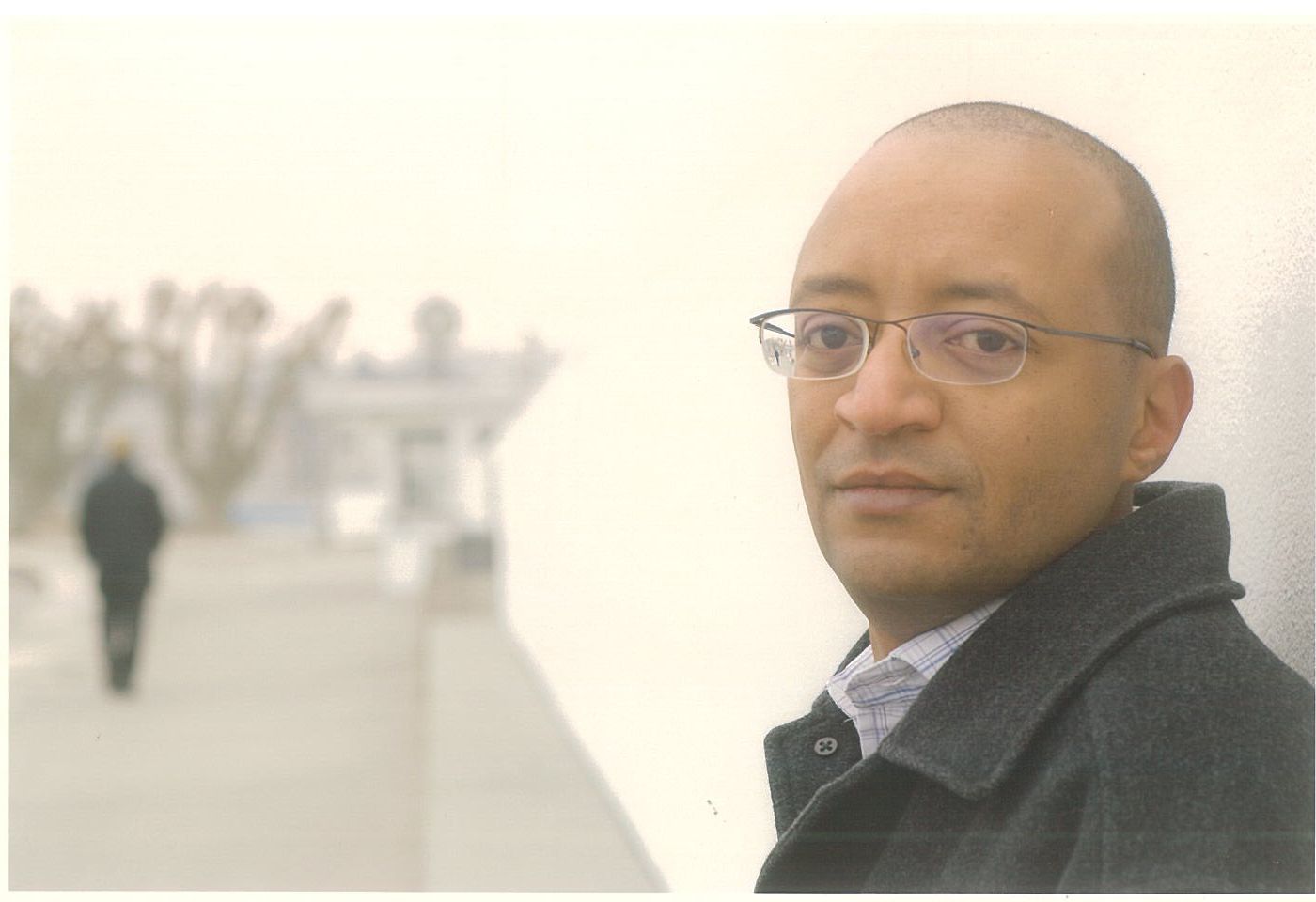
Games well played: Yasser Abdel Latif’s On Settling and Traveling
We all vividly recall the books we have devoured from beginning to end (almost) without interruption. For me, reading Fi al-Iqama wal tirhal: qisas wa hikayat (On Settling and Traveling: Stories and Fables, Kotobkhan, 2014) by Yasser Abdel Latif, is one such book.
Here, I engage with the elements that make this autobiographical anthology of 29 short stories an enjoyable read and an example of writing that draws its quality from well-played textual games. Below, Karim El-Sahafi has translated one of the stories, titled A Ghost’s Birth Certificate.
What are the specifics of producing good writing? Is there a formula to that end? George Orwell, with his five rules of good writing, ties it to the ability to “think wordlessly,” avoiding abstraction and focusing on concrete objects. In the Arabic context, the battle between the old tradition that appreciates wordiness and linguistic indulgence and newer schools that skewer these sacred cows of old for the sake of content remains unresolved. In the prized introduction to his Malim al-Akbar (Malim the Great, 1942), Adel Kamel takes the latter side of valuing ideas.
This is the secret of the craft of writing. It is an impenetrable secret. It is difficult to comprehend how an ordinary utterance can be likened to a precious gem when used by a masterful writer. Perhaps Tawfiq al-Hakim was the most aware of this secret among Arab writers. You feel you want to swallow his words when you read his prose. A beautiful ecstasy inspires you to devour it page after another, until after you’ve finished the book you find yourself regretting it wasn’t longer.
This is precisely how I felt reading Abdel Latif’s On Settling and Traveling.
One of the best studies on textual games in autobiographical writing is Sabry Hafez’s insightful Raqsh al-dhat la kitabatiha, tahwulat al-istirajiyyat al-nassiya fi al-sira al-Dhatiyya (Variegating the Self: Transformations of Textual Strategies in Autobiography). Hafez reminds us that instead of autobiographical writing being a mirror that we face, dressed up, done up and presentable, there is an unspoken “autobiographical pact.” This pact asserts that what is written is about a real person and events, but it also transforms writing about the self into a game that has its own set of imprecise rules that inspire strategies for narration. This, along with other difficulties, makes autobiography a textual game that prompts us to understand the “textual strategies” of the self, according to Hafez.
Abdel Latif’s first strategy was deciding not to write a book-length memoir with an overarching theme or cause. Through short stories he is able to talk about the self in a more realistic, concrete, and even intimate fashion. After all, our lives are full of complexities and contradictions that are personally important but not poetic, nor disposed to become a literary or creative writing project.
Since one cannot write about oneself without embellishment and maneuvering, blending or transforming such stories into fictional plotting adds depth to them and makes them transcend mundane reality. We are left uncertain about what really happened in each of Abdel Latif’s stories — we are unsure which elements are true and which are fictitious. The plotting and narration are simultaneously playful and rock solid enough that the real story does not really matter anymore. This frees us — reader and author — from having to encounter narcissism and self-obsession (it helps also that Abdel Latif’s book is interspersed with self-depreciation). Selective memory and self-deception can open the door for creative imagination and, as a result, mischievously follow the rules of good short story writing, structuring and plotting.
Each short and well-plotted story in On Settling and Traveling is a complete, highly condensed scene with a clear message. The first captivating escape-based short story is about the intimacy of reading a collection of poems by a fellow African immigrant (Abdel Latif has moved to Canada). Another (my favorite) is a story of self-discovery and maturation about his father’s preference for the Apollonian poetry of Salah Abdel Sabour over the Dionysian poems of Amal Dunqul that he himself cherishes. One concerns his poetry reading and cultural discovery in Colombia and the secret of making third-world poets more appealing to a Latin American audience than other poets. There’s also a deep engagement with the domestic and the universal in culture through a reading of the British children’s show The Night Garden, an examination of change in a Pink Floyd-filled adolescence in suburban Maadi, and an account of getting even with the school principal, Egyptian style. At the end, we reach a series of three humorous stories of foolhardy characters falling from grace, and then a letter written to a friend on Facebook about the rumored death of another friend.
Having studied philosophy and undergone a conversion toward literature as better able to provide illumination and truth, I’ve found I have an affinity for literary figures with a philosophy background. There’s something about philosophical ideas when interwoven with fiction that is lost when the same ideas are expressed in a philosophical treatise or confession. And there’s something peculiar about such writers. Abdel Latif is a philosophy graduate, along with Naguib Mahfouz and Ibrahim Abdel Meguid, while international authors who started out studying philosophy include Simone de Beauvoir, Umberto Eco and T.S. Eliot. Ideas about identity, life and death, and our relationship with authority snake their way out of the short story translated below.
With its self-referential nature, and its understanding of itself as fictional, literature does not take itself too seriously the way philosophy does, and its simple genius lies in an understanding of truth that does not require it to move beyond itself. This is particularly moving when the subject of writing is the self, and in such a condensed format as short stories.
Robin Moger, a skillful translator of many contemporary Arabic writings into English, has already translated and published two stories from this collection, Osama Al-Danasouri and Country Train, on his valuable blog Kisasukhra. To give a further taste of the collection, Karim El-Sahafi has translated another short story to share with Mada readers here.
A Ghost’s Birth Certificate
By Yasser Abdel Latif
Not very long ago, before the instatement of the Egyptian National Archives’ electronic database, I needed to get a copy of my birth certificate issued, and another for my father, for official purposes. I decided to begin with the most difficult task. I’d get a birth certificate issued for my father, who passed away years ago — then one for myself.
I headed for the Egyptian National Archives, one of the oldest civil records storehouses in world, established by Mohamed Ali Pasha in the nineteenth century. Situated on the far side of the Citadel, it goes by its Ottoman epithet: the Daftar Khana. My father was born in 1938, and hence his birth certificate — dating back to the pre-WWII period — must be stored there, I reckoned.
At the Daftar Khana, they told me I had to check with the health office closest to my father’s birthplace, in this case the Abdeen Health Bureau, which incidentally — as described to me by the good Samaritans at the Daftar Khana — is not located in Abdeen, but near Ramses Square. No big deal. I wasn’t about to be disheartened by these all-too-common absurdities.
I set course for the Abdeen Health Bureau on a busy morning. The trip from the Citadel to Ramses Square, which usually takes ten minutes, was trekked in about an hour and a half of congested traffic.
The clerk produced a timeworn logbook. The label on the cover read: “Births — November 1938.” He ran his finger down the page to the designated date, and after inquiring about the names of the parents (i.e. my grandparents), he moved it across, screening the lines for the correct name.
He stopped at an entry and said: “I found him: Ibrahim Abdel Latif Hussein, born 11 November, 1938.”
I said: “No, my father’s name was Mohamed, not Ibrahim.”
He replied: “The birth listed under the names of the parents you dictated to me is Ibrahim.”
He went silent for a moment, then redressed: “Got him. Just below Ibrahim: Mohamed Abdel Latif Hussein.”
Suddenly the name Ibrahim flashed through my memory like a searchlight. My father had had a twin brother who died in infancy, whose name was indeed Ibrahim. Hitherto I had no recollection of this forgotten fact. They were identical twins sharing the most intricate features and often their mother had difficulty telling them apart. During the lethal cholera outbreak of the mid-1940s, my grandfather dispatched the entire family to Upper Egypt in fear of the epidemic. He kept one of twins with him, however. This family anecdote continues to cause unending contention until this day, for no one really remembers exactly which of the two brothers traveled to the Sayeed and which stayed back in Cairo with my grandfather. Whatever the case may be, Ibrahim did not die from this epidemic but of natural causes, just as countless other children died unceremoniously during those times.
Apparently Ibrahim’s death left a deep and long-lasting scar on my father that dragged on for years. A friend of my father’s, a man from Port Said named Abdel Qadir Khidr, who knew my father from the time they were engineering undergrads at Ain Shams University up until he turned 60, once told me that my father used to sense a space around him occupied by his deceased twin’s doppelgänger. He even reserved a vacant seat next to him in the auditorium for “Chief Engineer” Ibrahim! My father married at 30, and by the time we came into the world these effects had subsided with the efflux of time and eventually entirely faded away, and thus we had no insight to the story. And thus children forfeit some of their fathers’ most defining traits because they only catch up with them after they’ve traversed an essential part of their journey.
Cometh the time to get my own birth certificate issued! First I had to go to Al-Waily Health Bureau, in the locality where I was born, and the Civil Registry thereof. Once again, the unwieldly volume was produced, and this time the label read: “Births — October 1969.”
The clerk’s finger glided over the lines until it stopped at a blank cell. “Did you say October 5?”
I said: “Yes.”
He said: “God forgive her… Madam Samia!”
I asked what he meant by that and he said that the pages in question were missing from the log. They had been torn out and he blamed the negligence on his colleague Madam Samia.
“So where do we go from here?” I demanded.
He proclaimed that my name did not exist in government records.
I protested: “But I’m a civil servant, I have an original birth certificate appended to my employment dossier at the Radio and Television Union, along with my school and university credentials, my status from military duty, and my social security number.”
“But your original birth is unregistered in the birth logs… You, in the eyes of the government, were never born, and you must be relisted,” he declared.
“And how can I do that, pray tell?”
He said: “All those papers you just mentioned? Pull them all out of your employment file and resubmit them to be reregistered in our records. Then you can get a new copy of your birth certificate issued.”
Ultimately my premise had transpired as false: begetting a copy of my father’s birth certificate proved far easier than getting one for myself, notwithstanding the temporal gap between them, nor the fact that I still walk this earth.
Young Ibrahim, my uncle who died as a child during the 1940s and his doppelgänger who sat for engineering classes in the Ain Shams University auditorium in the 1960s, successfully maintained a verified, official mention in government records. I, on the other hand, a married writer and member of the government apparatus, languished — until completing relisting procedures — in limbo, an identity drifting on the surface of life, a ghost of flesh and blood.

Tarek Ghanem
Tarek Ghanem is a researcher and the founder of MetalingualTranslations.com, an Arabic-English translation company that specializes in cultural and academic translations. He received his bachelor's degree from and is a master's…
تقارير ذات صلة
Noor Naga, metafiction and the limits of self-knowledge
Sometimes a story needs three acts
‘Nothing moved but the mirage’: Movement and its absence in Adania Shibli’s Minor Detail
The novel is a contender for the 2020 National Book Awards
What I didn’t tell the officer: a review of Randa Shaath’s The Sand Mountain
"The Sand Mountain? Hmmm … Is this a political novel, Mr. Shady?”
Your support is the only way to ensure independent, progressive journalism survives.
You have a right to access accurate information, be stimulated by innovative and nuanced reporting, and be moved by compelling storytelling. Subscribe now to become part of the growing community of members who help us maintain our editorial independence.
Join us