
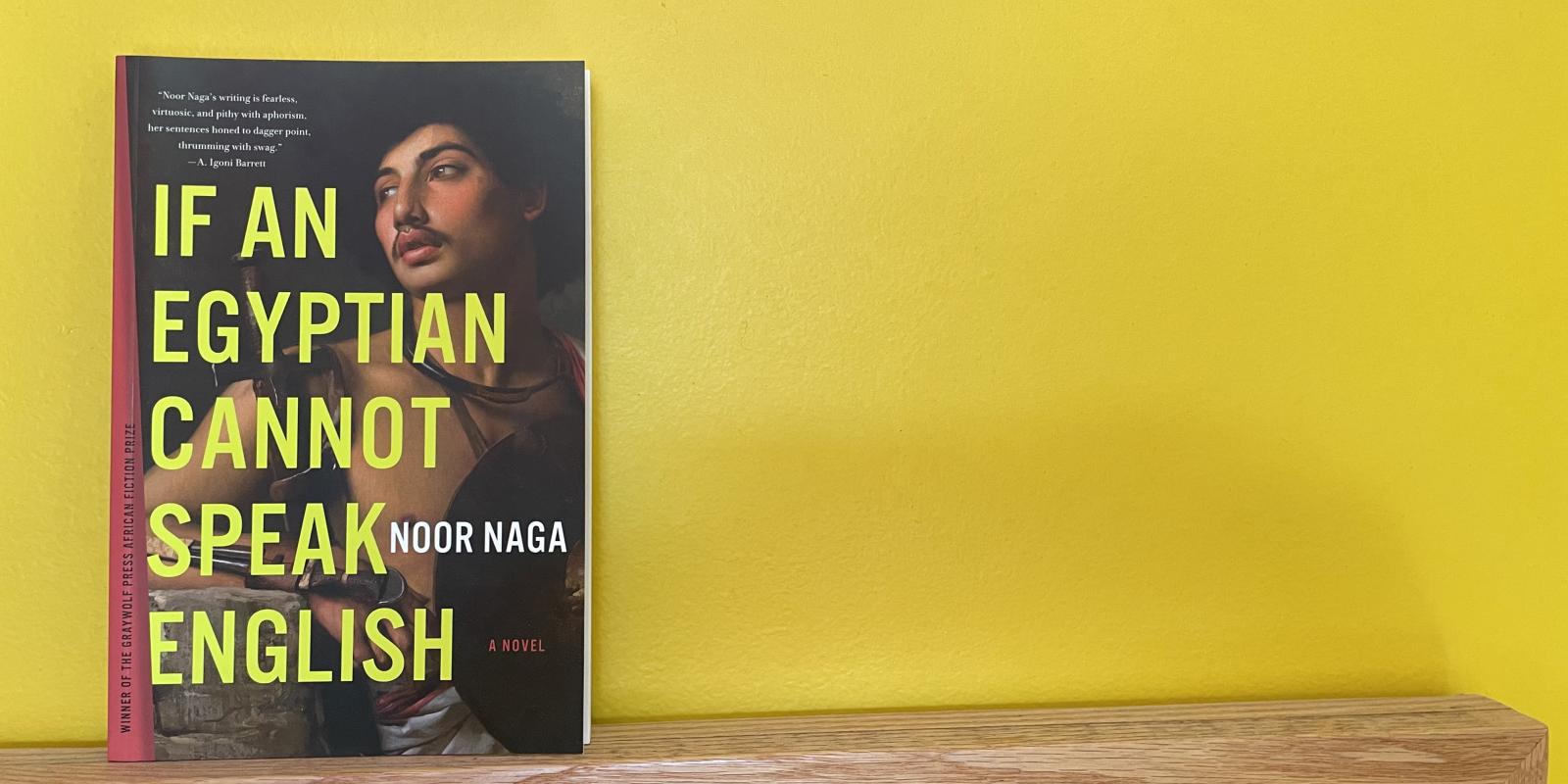
Noor Naga, metafiction and the limits of self-knowledge
Sometimes a story needs three acts
When I first picked up Noor Naga’s If An Egyptian Cannot Speak English, I had to put it down after the first scene. After rebelling at her own daughter’s miserliness, the narrator’s beloved grandmother climbs into an oven in the Nile Delta village of Shubrakheit to find her death. The book’s opening is dense with the violence of a country’s margins, the crushing lack of prospects that drives the narrator to leave for Cairo. It poked at a wariness of poetic deaths in poor villages, told in forms of art that are for people like me: people reading in English, in a major city.
The book took my wariness into its hands, and as it turned out, it was part of the story. As hinted in its title, Naga’s novel is a work of metafiction that critiques its own form. In the first part of the book, a strange question frames each passage or vignette, introducing a suspicion about authorial presence. This unease is the beginning of a structural game through which the novel asks astute questions about story-telling and knowledge production. What happens when a story from Cairo is written in English and published for an American reader? How is it changed — by the writer, by her editors, by the process of commodification itself — in anticipation of such a reader?
When I spoke with Naga at her apartment in Maadi earlier this summer, our conversation also revolved around another question: What happens when the story comes back to Egypt?
Driving the plot is a doomed romance between two narrators: the boy from Shubrakheit and a wealthy Egyptian girl who grew up in America and has come to Cairo to “find her roots” as her mother mockingly puts it. The first two parts of the novel alternate between their voices as they each tell us about their arrival to Cairo and take us through a love affair with distinct points of tension: their class and cultural differences, his drug addiction, and their feeling of rejection by society, which they experience from vastly different subject positions but which is also the feeling that draws them to one another. She is constantly harassed and lectured about her shaved head. When she takes him to an expensive café in Zamalek, all the other tables fall silent. He wouldn’t be allowed in, with his threadbare clothes and unkempt hair, were it not for her. Eventually, the exclusion from which they seek solace in one another is replicated within their relationship, and the ways in which they shut each other out reflect the very forces they are trying to escape.
The theme of estrangement is huge for Naga, who grew up in Canada and Dubai and has been teaching in the rhetoric department at the American University in Cairo for the last few years. She started writing the book a few months after moving from the US to Cairo in 2017, and describes the genesis of the project as driven by anger and vulnerability, which found their first expression in the boy’s voice.
Nour Naga: It started with the very first vignette, and I had no idea who was speaking or what was going on. This is usually how it is, my prose is very voice-driven, and I don’t always know who is speaking or what is going on at first. So I wrote one or two sections and then, as an exercise to understand what I'm getting at, I tried to translate what each piece was getting at into a question. The questions were never intended to be published. There wasn’t a clear inspiration for the piece as much as there was a particular voice that I followed to see where it goes.
I was living in downtown Cairo when I first started writing this, and I really didn’t like living there. I don’t understand the romanticism about downtown. But part of what’s interesting to me about it is that you can have clashes of people from different classes and cultures … it has a bit of a third space thing. The person next to you at the ahwa could be an academic or a bus driver in a way you don’t get in other parts of the city.
I have a complex about not feeling welcome, or imagining that I’m on the outside and looking in and that I don’t belong, because I’ve lived in so many places and I feel this way about all of them. I’m always looking and trying to get in, trying to find a way in.
Yasmin El-Rifae: Do you feel that that’s a generative posture to be trying to create from?
NN: Definitely. It’s easier to see certain aspects of a culture when you have so many other reference points and you can constantly compare them: thinking about what it means to date in Toronto versus Cairo, what it means to eat in Alexandria versus eat in Cairo. Where do you go and where does the produce come from, and who is cooking it?
***
Naga’s poetics focus on the sensorium, which gives the novel a certain grace in dealing with the place where it is set. The city is always brought in through the protagonists’ senses: it is not a place being described from any narrative distance, because it is a place being lived. From the boy, in his moment of arrival: “When I arrived at Ramses Station, the air was people.” From the girl, traveling alone from New York with a shaved head; as her plane lands in Cairo, her fellow passengers have transformed as they “muscled past in the aisle, suspicious all of a sudden.” They seem to have forgotten, she thinks, where they have all just come from.
She speaks broken Arabic and is immediately identifiable as not really being from here because she grew up elsewhere and because having the option of being elsewhere seems to also keep a person from feeling, or from being perceived as being, really Cairene. She looks to him to explain and show her the city. He resents her privilege and access but feels she is different to other foreign women he’s dealt with, although he never trusts her fully. It’s never made clear (and perhaps doesn’t matter) how much of this is class, how much is a racialized and sexed mistrust toward her as a culturally white woman, and how much is his own trauma from a revolution that he saw as betrayed. She too maintains an element of control. He stays in her apartment with its tastefully eccentric furniture, which he describes as perverse just as he notes that she is perfectly comfortable there while he is left to slink around like a thief. She never gives him a key.
Naga’s use of language is musical and incisive, and this makes the tensions she’s writing about feel deeply intimate. Sometimes, the boy thinks, “she looks at me with an appetite that is romantic but wrong. Curious, consumptive … anthropological? As though she were peering at a moth pinned to a corkboard, shivering, still very much alive. As though she were laying it on her warm tongue, letting it dissolve there. Then I get so wicked I make up things just for her.” One of the ways he tries to wield power over her is to give her false information about Cairo, about Shubrakheit or about the culture; he sabotages her fieldwork with fantastical stories, strange poetic text messages and references to German and Japanese art.
YR: Did you decide to make his language so much more beautiful than hers — even though he is the one who does not speak English? Or did that happen naturally as you wrote?
NN: I think it was his character. When I moved to Cairo, I was shocked by how romantic and sentimental men here can be. They’re about these giant gestures of affection, right away, and they want to take you to the pyramids to ride horses, and they want to meet your dad and it’s all very fast. Whereas in New York or Toronto it’s the opposite: everyone is a commitment-phobe and no one makes any effort. So it was shocking. And I spent a lot of time thinking about this mixture of definitely some misogyny but also romantic and sentimental energy. Certain things that in other cultures might be stalking, here … there’s this understanding about playing hard to get, and imagining offenses, and a bit of dala’ [a feminized coyness that invites pampering]. His character was definitely inspired by men I have dated.
***
Quickly, the dynamic between them toxifies. She comes home from work to find him fuming from boredom and trying not to do drugs, imagining what he thinks must be her desire for men she works with. She starts to navigate his anger with expectation. One day he snaps, and throws furniture around the apartment. In the morning, he is gone. Here we come to Part II of the novel, and we find that the framing questions are gone, replaced by footnotes about Egyptian people’s sexual signaling, eating habits, popular culture and Mamluk history delivered with an authority that quickly becomes suspect, because much of the information is false. Is this a joke or an error? Here the question is not whether the romance is one of anthropology, but whether the novel is.
NN: I got to the end of writing Part I and felt the questions had gotten tiresome. I couldn’t drop them altogether, because that would create an imbalance. So the footnotes were an answer to a structural problem, but they were also a way of privileging the Egyptian reader because you would immediately begin to feel that something’s wrong: you can’t be getting the references to El Lemby (a 2002 blockbuster comedy film) that wrong. My fear was that the Egyptian reader would get to that part and think, “this writer doesn’t know what she’s talking about,” and just stop reading. So I thought if I made them just that bit over, just a bit too crazy to be an honest mistake, then the reader would cotton on that something is not right, that there is something suspicious about the text and about the voices. It was a way of creating two reading experiences depending on how much information you have, and whether you’re the girl or the boy from Shubrakheit.
***
The following section reveals major plot points.
In the making of literature in the West about Cairo, or Lagos or Mumbai, editors, and perhaps the writer herself, might ask: Can these characters be made more relatable? Can we explain more, give the reader more of a sense of place? The main point about the story might become that it happened there. When does having to explain the context around a love affair or revolution bracket them off as being particular to a place, rather than part of the human experience that an array of readers could imagine into?
Publishers and readers can get stuck in a loop. The industry puts out books that create certain habits and postures from which to read about foreign countries, and readers then expect all books about other places to take a similar form, which then makes publishers think nothing else will sell. A doomed love affair that is, for the American protagonist, about a search for her roots, though, would be marketable. The book winks at us as it packages itself as a familiar love story, and then uses the characters’ self-awareness to ask its most uncomfortable questions. The boy from Shubrakheit and the girl from New York know exactly what they bring to one another. In fact, it seems to be their obsession with how they are seen through the other’s eyes that sets their romance in a certain trap: constantly looking for parts of themselves they believe the other might unlock — parts of themselves they believe they are owed by the world — they are unable to truly recognize one another.
The boy’s tragic path culminates in his death at the end of Part II. They are no longer romantically involved but meet for food and conversation. She slips cash into his pocket, which he finds each time they part: a silent penance. He is homeless now, and back on drugs. “One shot and I am like a god: headless, high as a cloud.”
She is having an affair with an unpleasant British man from work, a direct stand-in for her running back to English “as if to the arms of a lover, and I feel instantly safe and indigenous there.”
In less deft, and yes, perhaps less knowing hands, this might seem to play along predictable lines: Arabic as the space of abuse and poverty, which her character flees by sleeping with a white man whom we quickly learn to be racist. But because the girl is so self-aware as she observes him being terribly cheap and imperious, and because she sort of hates herself for it, this second affair seems a search for comfort for which I wanted to forgive her.
When the boy comes bursting into her apartment while her new British lover is on her balcony, he charges at him, and ends up falling to his death. We do not know whether he was acting out of jealousy or protectiveness, or both, because we do not get his voice anywhere around this act. From her, we read: “It happened as it was always going to happen, and it happened quickly.” But then, more tellingly: “No, please, not this. It was excessive, imaginative and punishing in a way that only fiction could or should be. This is the shape of narrative climax, but what is it doing in my life?” Selfish, yes, and perhaps resonant with immediate, self-protective feelings we might have when crisis arrives.
In Part III, the book radically changes to bring us to a creative writing workshop in the US, where the students are discussing the story we have just read, except in the form of a memoir by one of them about her time in Cairo, the romance with the boy and his death. The name of the writer — and therefore of the previously unnamed character in the pages we have just read — is Noor.
Here the book looks at how current political and literary sensibilities in certain spaces of knowledge production might engage with a story like this. The writing students see Noor solely as the survivor of the boy’s abuse; absent is the realization that hers is the only life to have survived between the two. They ask Noor if she is ok and tell her she was wrong to grieve him at all. They are able to speak about power — and to see it — only as it plays out between individuals. Through their discussion, we learn that there are some pages that we have not read, in which the police did not even question Noor after the boy fell to his death from her balcony, because of the class dynamics at play. One more astute reader remarks to Noor: Maybe you needed to be questioned. Maybe it would have somehow made coping with this easier. He immediately gets shut down by another woman: “Men … I can’t even.”
Noor is encouraged to put in more about her mother, to describe the city more — to bring in the “quirks that make Cairo Cairo.” Because of what’s known as the gag rule in writing workshops, she remains quiet.
It’s Part III that Naga is least sure about.
NN: If I encountered this book in the wild, I might be put off by the third part. I know that this metafictionality will be understood by readers in America, questions about writing as anthropology and so on; there is a mechanism in place for this book. For Egyptian readers, I don’t know, and if it’s translated … how much of it will translate to Arabic? Like, this third part … I don’t even know how to translate some of these terms. It’s such an American discourse. And also, are people going to get to the end and think it was all real?
YR: Have you ever been to Shubrakheit?
NN: No. I had a very good friend from Shubrakheit, and he would tell me all kinds of things and I would write them down. I’ve never been, and I think that’s part of the reason that it ends up being one voice in the end. Because at some point I felt that I can’t actually write this, I can’t truly represent what this place is about or what this boy is about. It can’t really be his voice, because I don’t know, and I don’t have the ability or the desire to find out. I can’t actually go to Shubrakheit and so it was a way of getting around that.
***
One gets the sense that Naga is working her trap: she has a novel about Egypt that she can only write in English. Not only that, she knows that she — a poet — will write it beautifully. So she has made it her work to unsettle those of us who are “inside” enough to read it, to push us to interrogate where our ability to do so comes from, and at whose expense. The boy does not survive the story, but it’s his voice that keeps speaking once we have finished the novel. “My father is a mother-cunt, too, but he is not a lucky mother-cunt in America, he is not even a lucky mother-cunt in Cairo. He’s on his knees day and night, patching rubber in Shubrakheit because Egyptians like your father are in America. Because. It’s because, you understand? Who do you think is funding this regime? Why do you think we’re still in this shit?”
Sticking to her characters’ interiorities, Naga is able to give us a sense of their intelligence as they take in each other and the city. We are part of their consciousness, part of a deep self-awareness they possess as they start to manipulate and use one another. Importantly, because the book problematizes power between lovers as a stand-in for so many other social forces, the self-awareness Naga has so carefully given to her characters does not save them from their sad endings. He is dead, and she, the Noor in the novel, the Noor who wrote the memoir, is in a lonely place; she has this story, but none of the people she is able to tell it to can understand it. But for the novel as a work of art, self-awareness allows it to ask about its own form, and how it came to be.
NN: “I think I wrote it with a certain amount of hatred toward her. And I was definitely working out some complexes about my own sense of belonging there, and insecurities and questions about my relationship to the English language and the American publishing industry. Why am I writing this? What am I trying to say and who am I talking to? Publishing in the States … what is that doing? The only way I was able to publish with Graywolf, which is my dream press, was to apply to the African Fiction Prize, and I’m born in the US and have lived all over, and I’m only really living here now, so I didn’t even know if I had the right to apply to this prize. So I was working out my own suspicions about myself. Which is partly why I named her Noor at the end. This is not abstract to me. I wanted the metafiction to be clear.

Yasmin El-Rifae
Yasmin El-Rifae joined Mada Masr’s editorial team in 2019, where she focuses on gender, among other areas. Her first book, Radius, a narrative history of the militant feminist group Operation…
تقارير ذات صلة
‘Nothing moved but the mirage’: Movement and its absence in Adania Shibli’s Minor Detail
The novel is a contender for the 2020 National Book Awards
What I didn’t tell the officer: a review of Randa Shaath’s The Sand Mountain
"The Sand Mountain? Hmmm … Is this a political novel, Mr. Shady?”

Detox: Issue 02
Our weekly guide to help you unwind during the weekend.
Your support is the only way to ensure independent, progressive journalism survives.
You have a right to access accurate information, be stimulated by innovative and nuanced reporting, and be moved by compelling storytelling. Subscribe now to become part of the growing community of members who help us maintain our editorial independence.
Join us