
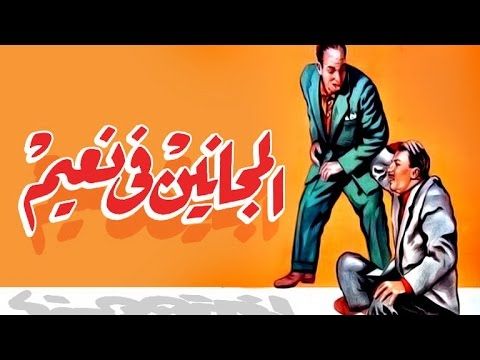
Egypt’s cinematic gems: The Mad Are in Heaven
Weird!
Recently I started feeling my relationship with reality getting a bit distorted. Maybe it's politics, maybe it's Egypt, maybe it's reading too much about the possibility that we're in a virtual reality. So I remembered that in one of the many movies where Ismail Yassin plays a mad person, there’s one where his name is Andeel, like me. I decided to watch it, because that's what you do when you worry you might be going insane — you look for a movie with a mad person in it who has the same name as you, and in Egypt you find it, even if your name is as rare as Andeel is.
Al-Maganeen fi Naaeem (The Mad Are in Heaven, 1962) was directed by Hassan al-Saify and written by Abu al-Souod al-Ibiary, the prolific script/songwriter who wrote almost all Ismail Yassin movies, contributing to the creation of one of Egyptian comedy’s most famous legends. This trio (Yassin, Ibiary and Saify) worked together on some of Yassin’s most interesting films, like Afreetit Ismail Yassin (Ismail Yassin’s Ghost, 1952) and Al-Millionaire al-Faer (The Poor Millionaire, 1959). These gave Yassin’s career and personality a classic philosophical depth as his ability to play the peculiar eccentric character was co-opted into social critique, seeking a role like the Charlie Chaplin tramp-versus-society trope, or Yassin’s local pioneer predecessor Naguib al-Reehany.
The Mad Are in Heaven is built around a basic, slightly clichéd paradox: A madman exposes humanity's insanity. Andeel — the movie character, not me — leaves a mental hospital after 10 years of treatment are over to face the world again. Whenever he reveals — with a lot of unpragmatic honesty — that he used to be a mental patient, he is faced with aggressive suspicion, cruelty and rejection. When a shop owner refuses to hire him, he yells that he is the only one with an official certificate that proves he is actually sane. We follow his miserable search for a job and watch situations in which, over and over again, he gets very close to a decent life just before his unrestrained tongue reveals a side of his madness that freaks people out. Andeel is an honest, kind person who's good at what he does, but people’s uncontrollable fear of madness makes them want to get rid of him and the uncomfortable state he puts them in, probably because of how normal he seems, just like them, yet how crazy he is, like they fear they might be.
Ibiary's script seems quite liberated and doesn’t have the usual strict Ismail Yassin formula, in which he is poor, in debt and in love, then goes on a trip (to the army, the zoo, whatever) which culminates in a happy marriage that’s supported or encouraged by the state, and music plays and everybody's happy. Instead, in this film, Yassin is a total outsider, completely disconnected from everyone else — no family, no lover, no house, no career, just a constant fear of society and total dissolution. He sleeps in the back seats of cars, jumps from one job to another, one outfit to another. It’s a state that to me feels very honest and realistic and reflects a deep sense of loneliness only few artworks dare convey. At certain points The Mad Are in Heaven pays close attention to a specific subplot or dynamic but then completely loses interest and starts a new thing. It’s a rhythm seen in a lot of badly written, low-budget contemporary comedies, but with this film a quintessential respect is paid to beginnings and endings, and even this free floating between stories is performed with grace and smoothness.

On his journey, Andeel meets many opposites of himself. Sherif for example — played by famous heartthrob Roshdy Abaza — is superficially, in the story and in reality, the opposite of Ismail Yassin. He’s a good-looking serious rich dude who is treated with a lot of respect and admiration by society, the same society he — at least in the story, I don’t know about real life — parasitically feeds off, exploits and despises, yet always evades punishment or blame. Sherif’s manipulative reverse psychology hypnotizes everyone, including Andeel, who thinks his job as Sherif’s rent collector will rescue him from poverty but ends up paying off Sherif’s debt and going through a painful experience that leaves him literally naked.
The fact that Ismail Yassin’s character is mad allows him to play some very unpredictable tricks and say strange lines that silver-line the otherwise disciplined, straight-laced script. Yassin’s usual intense exploitation of noise and hysteria is applied to the drama carefully and effectively. It’s true that you do miss those Yassin signature scenes in which the actual drama ends and he just talks gibberish for 20 seconds or sings out of the blue, the way he does in movies like Ibn Hamedo (1957), but when he fails to suppress moments of total madness in a movie where he’s struggling to convince everybody that he's not crazy, it’s a lot more powerful and funny.

The Mad Are in Heaven shows Cairo in the 1960s in a weirdly non-retro or exotic way, unlike other black-and-white movies where everything seems almost as though it’s happening in a parallel universe. It has a very uncanny familiar vibe to it. Maybe the fact that the main character's name is Andeel made me engage too much and ignore the exoticism, but I managed to forget during most of the movie that it was made many years ago. When this normality collides with a scene as weird as the one in which Ismail Yassin gets a job interview at a space travel agency in downtown Cairo, your senses are stimulated and the location strikes you even more strongly with its silly toys and tiny light bulbs pretending to be super futuristic technologies. I think the last time I had that feeling with a black-and-white film was in Chaplin’s The Great Dictator (1940) — another reason to make me feel that The Mad Are in Heaven has something to it.
Saify and Ibiary seemed to be really interested in the relationship between what’s normal and what isn’t, and they used social constructs and language as a platform for this conflict — marriages, love, economy, poverty and the way people talk and joke are the main areas in which the movie experiments. Unfortunately it’s still imprisoned in its function as a mainstream comedy targeting a huge cross-section of film consumers, so it has to mask these interesting findings in rather boringly relatable structures like plot, characters, scenes and so on.
Watching The Mad Are in Heaven made me wonder what would have become of an actor like Ismail Yassin if he had existed in a different time or reality where there was more openness for experimentation and freedom in a country like Egypt. I wonder what it would have been like if Yassin had been given ultimate freedom to provoke and make fun of Egyptian reality while being liberated from the social obligation to have a moral purpose for his work — or a straight-up direct speech that literally interprets what the film is trying to imply or symbolize every few minutes.
Comedy is indeed a magical loophole in reality, a green card to an inverted world that everyone seems to desperately long for yet be really scared of. A world where nothing has to make any sense or feed into any benefit, where you don’t have to compromise and do the right thing then regret it for the rest of your life. Where the good and the bad and the ugly and the beautiful are all merged into the tackiest ever juggling act that still gets people’s attention like it’s being done for the first time. A world we’re all definitely heading towards, especially after Trump. A world of complete madness.

Andeel
Andeel was born in Kafr al-Sheikh in 1986. His uncle told him that his paternal grandfather was a filmmaker who made a feature film called “Horses,” which he took to…
تقارير ذات صلة

Avant-titre | Our bread, our dignity: Bread in Egyptian cinema
This episode of Avant-titre is part of Mada Masr's Bread politics, an eight-part series that takes an in-depth look at bread subsidies in Egypt in the context of recent talk…

Video | Privilege and responsibility: A letter from Carol Mansour
Carol explains why allowing the voices of others to be heard helps to make the world a better place

Video | The archivist
Over decades of collecting, Makram Salama has turned his home into a cinema archive.
Your support is the only way to ensure independent, progressive journalism survives.
You have a right to access accurate information, be stimulated by innovative and nuanced reporting, and be moved by compelling storytelling. Subscribe now to become part of the growing community of members who help us maintain our editorial independence.
Join us