
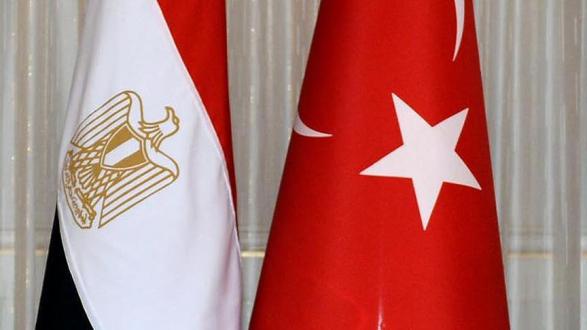
Egypt, Turkey move toward reconciliation, but obstacles remain
Despite the slow pace and difficulty of progress on the Egyptian-Turkish reconciliation front, the ongoing developments suggest that the two parties are in agreement that some form of reconciliation must occur, even if the process takes time.
The difficulties came a few weeks ago when the Egyptian Foreign Ministry issued a statement to condemn Ankara’s decision to partially reopen the abandoned resort of Varosha, whose citizens fled during the 1974 Turkish invasion of the island of Cyprus that followed on the back of a Greece-led coup. Even though Varosha is practically a ghost town, Egypt was quick to issue a statement saying that Turkey’s move violates UN Security Council resolutions. The UN considers the self-declared Turkish Republic of Northern Cyprus an occupation force.
According to an Egyptian government source, the statement was a reminder to Ankara that “problems between the two parties will not be resolved by shutting down a few anti-Egypt television programs,” as he put it.
It was also a message of reassurance to Greece and the Republic of Cyprus. “A communication channel between Egypt and Turkey does not mean that Egypt is retreating from its steadfast positions vis-a-vis relations with Greece and Cyprus, as long as both countries continue to carry through their roles and respect the terms of relations with Egypt,” the source says.
The decision to shut down television programs mentioned by the source came in late June after a security delegation from Egypt went on an unannounced three-day visit to Turkey to meet its counterpart and resume negotiations. In light of that visit, Turkish authorities discontinued the broadcast of three television programs run by anti-government Egyptian presenters in Turkey, who had been a thorn in Egypt’s side. Beyond the media, Turkish authorities also went further, issuing directives to some figures to stop blogging about Egypt on social media networks.
An informed source close to Muslim Brotherhood leaders and who lives in Turkey told Mada Masr that the Turkish side is trying to fulfill some of Egypt’s demands before each visit that both parties organize to resume negotiations. Even though Cairo considers Turkey’s efforts to heed the former’s demands to be slow, according to official government sources, the Brotherhood source believes that “the Turks will agree to anything that the Egyptians want” for the sake of reaching an agreement over the maritime borders in the Eastern Mediterranean.
In August 2020, Egypt’s Parliament approved an Exclusive Economic Zone (EEZ) agreement for the “partial demarcation of the sea boundaries between” Greece and Egypt, noting that “the remaining demarcation would be achieved through consultations.”
Under the United Nations Convention on the Law of the Sea, a state’s exclusive economic zone extends 200 nautical miles (370 km) out from its coastal baseline. The exception to this rule occurs when EEZs overlap: that is, when state coastal baselines are less than 400 nautical miles apart. When an overlap occurs, it is up to the states to delineate the actual boundary.
Turkey, however, is not a party to the UN convention, and it has contested that the Greek islands of Rhodes and Crete are not entitled to EEZs. It also argues that the EEZ granted to the island of Kastellorizo, positioned close to Turkey’s coastline, should be limited, as granting it an EEZ would greatly reduce Turkey’s maritime territorial reach into the Mediterranean.
Based on a map obtained by Reuters at the time, the Greek-Egyptian maritime agreement only applies to Crete and Rhodes, leaving the question of what will be decided with Kastellorizo up in the air.
Even though trade relations between Turkey and Egypt remained solid over the past few years, the effort to resolve the political conflict and restore diplomatic relations completely is advancing albeit slowly and with a great deal of anticipation. According to different sources who spoke to Mada Masr over the past weeks, there is a desire to move forward to resolve a number of urgent and vital issues.
Moataz Mattar, one of the Egyptian TV presenters in Turkey who was taken off the air, issued a statement in late June saying that there have been developments in the relations between Turkey and the Egyptian regime.
“I told you, the main demand was for our tone to change toward Sisi and his associates. This is something I will not accept. I said ‘we won’t be a burden on Turkey,’” he said. “So we’ve decided to go on an open-ended vacation and continue on YouTube. Our show perturbs the stability of Egypt. Today, and out of the principle of transparency, I am announcing that, for the first time, we were officially asked to stop broadcasting the show on TV or online.
In May, Cairo passed along a set of clear demands to a high-level Turkish delegation, headed by the Turkish deputy foreign minister. The demands included shutting down the channels broadcasting from Turkey, not just the television shows. At the time, informed Egyptian officials described this visit as one of “frankness,” “where the two parties could listen to the demands and decide how to formulate the terms agreed upon.”
According to the Egyptian official, the Egyptian side “unambiguously” told the Turkish delegation at the time that there were several demands that Cairo will not negotiate if Turkey is truly serious about restoring full bilateral relations and diplomatic representation, which were reduced to the level of charge d’affaires in 2013.
At the time, the source saw the decision to discontinue the TV shows as a “serious step that must be followed by other serious steps,” adding that Egypt will not move toward appointing an ambassador in Ankara or heeding any of Turkey’s demands, whether regarding official economic cooperation or maritime borders, if the Turkish authorities do not take the measures judged to be “essential” by Cairo.
Apart from discontinuing anti-government Egyptian media figures in Turkey, those essential measures include halting the political, legal, and financial activities of the Egyptian Muslim Brotherhood on Turkish soil or any other organizational efforts, such as the Egyptian Revolutionary Council, an opposition group formed in 2014 in Istanbul that is seen as having strong ties to the Brotherhood.
The official adds that Cairo is expecting Turkey to take action toward expelling specific figures convicted of violent crimes against persons and officials in Egypt. “This matter cannot be resolved except in two ways: either extradition back to Egypt or expulsion from Turkey, and in the case of the latter, Egypt will follow up with the authorities in the countries that those figures go to,” the source says.
Nonetheless, such demands come up against the fact that many members and allies of the Muslim Brotherhood living in Turkey have Turkish citizenship, which means that extradition and expulsion are thorny issues. A young man close to the Muslim Brotherhood who lives in Turkey tells Mada Masr that he does not believe the issue warrants any worry because the large wave of Turkish naturalization rules out the possibility of extradition.
But not everyone feels that safe. Another young Muslim Brotherhood member in Turkey, who spoke to Mada Masr on condition of anonymity, is not overly optimistic. “Yes, there is naturalization. But it doesn’t happen for everyone. At the same time, people are having to deal with expired Egyptian passports and the situation is difficult with the Egyptian consulate here, so it can be hard to obtain a long-term visa,” he says.
He adds that the only available alternative, if one’s passport has expired, is to apply for a humanitarian residency given that the security situation in Egypt prevents people from returning. But even that type of residency will not be granted to everyone, in addition to the fact that it’s impossible to leave Turkey after the passports expire, he says.
However, the Brotherhood member is doubtful that the Turkish authorities will hand over figures wanted by Egypt, adding that one of the people convicted in several cases, including the assassination of Hisham Barakat in 2015, and sentenced to life in prison and death, asked Turkish authorities whether he must leave. He was given assurances yet told that his activities on Turkish soil must be halted.
On the other hand, Turkey submitted similar demands to Egypt regarding the presence of the Hizmet Movement in Egypt, which Turkey considers as one of its biggest enemies. Ankara is waiting on Cairo to take actions similar to what Turkey did in discontinuing the three TV shows.
The Hizmet Movement, which is affiliated with President Recep Tayyip Erdogan’s opponent Fethullah Gulen, whom the Turkish authorities accuse of being behind the 2016 coup attempt, owns a large number of educational institutions in Egypt, including the Salah Eddin International School, which was established in 2009 in New Cairo; the Ofok Educational Center, which has branches in Cairo, Alexandria, and Beni Suef; as well as publishing houses, commercial companies, and cultural centers focused on teaching Arabic to Turkish students.
However, the government source believes that there is a major difference between the Brotherhood in Turkey and the Hizmet Movement. For the source, those associated with Gulen and his institutions in Egypt are not involved in political activity, but Egypt objects to the presence of Egyptian political entities in Turkey.
Apart from this, Turkey’s presence in Libya is another important matter of contention. In May, the Turkish foreign minister stated that the presence of Turkish forces in Libya is legitimate “because there is a security agreement between Turkey and Libya.” Earlier this month, Erdogan also reiterated that “Turkish forces will continue to be in Libya, Azerbaijan, Syria, and the Eastern Mediterranean,” adding that “Turkey will seek after its legitimate rights and continue the drilling projects in all of its seas, especially the Eastern Mediterranean and the vicinity of Cyprus.”
According to several sources that spoke to Mada Masr over the past year, Egyptian and Turkish officials effectively started coordinating over Libyan affairs in January of 2020. The coordination was not public but was deemed necessary to avoid direct confrontation and maintain joint security interests.
“Turkey’s insistence to keep its forces in Libya and not withdraw the militias is an important indicator that Cairo cannot ignore,” says the government source.
Cairo believes that Turkey’s activity in Libya, which includes the recruitment of many foreign militia fighters, goes beyond an attempt to control the assets and resources of Egypt’s direct neighbor. It also surpasses the actual security threat that Libya poses on Egypt’s western borders.
“The issue is actually about Turkey’s vision of its regional role, or to be precise, Erdogan’s vision of his regional role. What Erdogan’s Turkey does in Libya is only a fragment and a small detail of a much wider movement that Erdogan is leading with patience and persistence, despite some moments in which he is forced to retreat and appear aligned with Arab and Islamic states, or perhaps as a competitor to Iran. But in fact, Turkey does not compete much with Iran over the countries that the latter extends its control over, as we can see with Turkey’s coordination with Iran in Syria,” one of the officials told Mada Masr.
For Cairo, the official elaborates, Turkey’s proposition of itself as a stronger regional player than Egypt is unacceptable. Egypt might accept competing with Turkey over its regional role, but it will not acquiesce to its control.
“This is why, for us, what Turkey does in Libya is not about control over resources, making room for political Islam in the regime, or deployment of foreign militias. It is effectively an attempt to consolidate its hegemony,” the official adds.
Egypt has gained a sense that Turkey is willing to compromise in recent months, according to the official. However, this sense of reassurance is not ironclad. Cairo insists that Turkey abides by Egypt’s terms without backtracking in the future, especially since there are indicators from the Turkish side that “prompt Egypt to feel like there are still those in Turkey who insist on prevarication,” the government source says.
The latest of those indicators came in the form of a May statement from Erdogan advisor Yasin Aktay that was critical of Egypt executing defendants convicted in the 2013 raid on the Kerdasa Police Station in Giza that left at least 10 police personnel dead. Aktay also wrote an article in the Turkish publication Yeni Safak, in which he said that the reconciliation efforts between the two countries should not overlook the deterioration of the human rights situation in Egypt. “It is not the character of a strong state to issue death sentences en masse in an arbitrary fashion,” he wrote.
Several Western diplomats in Cairo who spoke to Mada Masr believe that Turkey’s endeavor to reconcile with Egypt remains dubious because Erdogan took the initiative in light of three main political changes. The first is Joe Biden’s ascension to the White House, since the US president has not extended the same support that Erdogan enjoyed during Trump’s term. The second is Turkey’s declining economic situation, which prompted Erdogan to consider the prospects of improving his relations with neighboring countries, including Egypt, in order to settle its maritime borders and start drilling for gas. And finally, Erdogan wants to alleviate the internal political pressure inside Turkey and even within his party due to the wave of regional tension into which he has brought Turkey.
“The problem is always the discrepancy between what Turkey promises and what Turkey does. If we look at what it promises regarding Syria and Libya and then we look at what it actually does, we have to admit that there is a huge gap between Erdogan’s words and actions,” says the government source.
The most important thing is for things to continue on the right path in a consistent manner, the source says, “and not one step forward and two steps backward.”

تقارير ذات صلة

Saif al-Islam: The death of a myth
Saif al-Islam Qadhafi, from power’s pinnacle to Zintan’s mountains and the shadows of myth
Ending ‘autonomy’: How the SDF-Syrian govt talks broke down into a fight
Mada Masr spoke with sources in the SDF, the Syrian government, Turkey and regional diplomats

The Quad War
After the fall of Fasher, Egypt turned to Turkey to find a way to deter the growing Emirati threat
Your support is the only way to ensure independent, progressive journalism survives.
You have a right to access accurate information, be stimulated by innovative and nuanced reporting, and be moved by compelling storytelling. Subscribe now to become part of the growing community of members who help us maintain our editorial independence.
Join us