
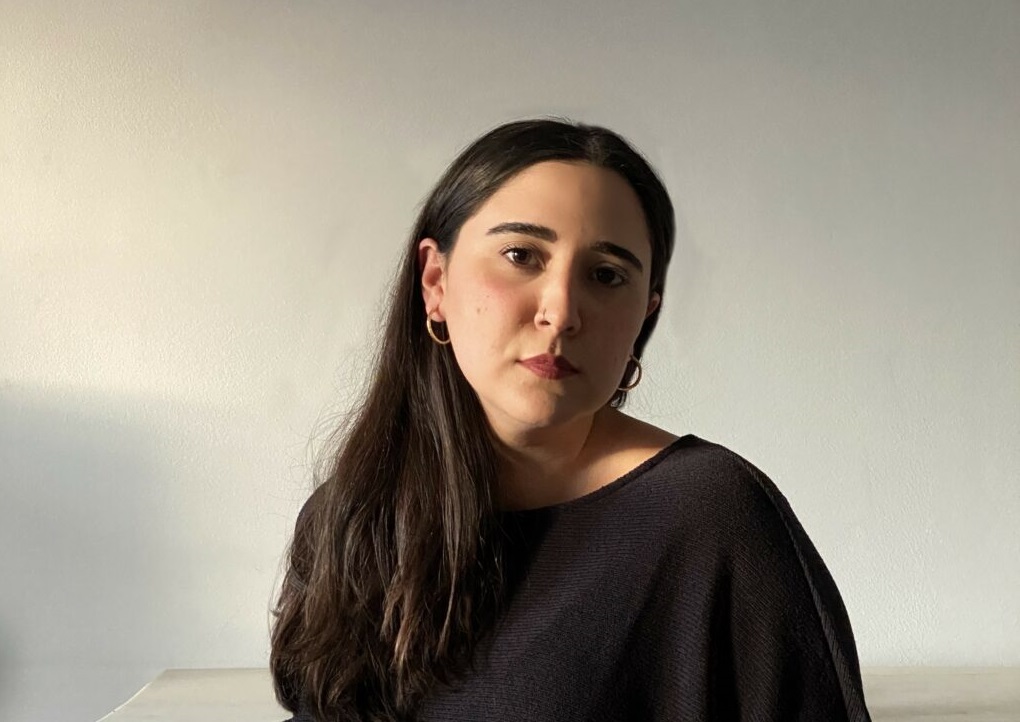
Sexual health and social change: A conversation with Nour Emam of Mother Being
At the end of 2019, Nour Emam launched Mother Being, an Instagram account providing support and services in fertility, birth and early motherhood, and sexual health. Since then, Nour has posted on the account daily, offered and organized classes on sexual and reproductive health, and launched an Arabic language podcast. Mother Being’s audience has grown to over 1.4 million people across different platforms. Nour is one of the more famous among a swell of online content creators who say they want to change the status quo when it comes to women.
After graduating with a degree in applied arts from the German University in Cairo, Nour, now 29, did a master’s degree in sonic arts at Goldsmiths University in London. In 2015, she began her first career as a musician, performing techno and electronic music. She continued to perform while pregnant with her now two-year-old daughter Safiyya, playing two shows in Belgium in the final months of her pregnancy and a final performance in Cairo two weeks before giving birth. It was after Safiyya’s birth that Nour sought out training to become a doula and sexual and reproductive health educator through organizations in Canada and the UK. Mada Masr spoke with Nour about her larger project, her ideas for social change, and mothering while running a business.
This interview has been edited for clarity.
Mada Masr: How would you describe your project, which offers free content as well as paid courses? What do you think has been achieved? And what would you still like to see happen in the area of sexual and reproductive health?
Nour Emam: Other than being a sexual and reproductive health educator and a doula, I also see myself as an entrepreneur. Mother Being is not just a social media platform. I strongly believe that social media is a wonderful tool to connect with an audience and to create trust between myself and the people who follow me. But ultimately, it is a tool for me to attract clients and customers who want to invest in the courses I offer, and in the end, this is my actual source of income.
But if I were to describe what Mother Being is today, it is a femtech company, a registered company that aims to spread education and awareness about sexual and reproductive health. While the main focus is on women, there is also content directed at men, young adults and children entering adolescence. This is all contained on a digital platform independent from social media, where people can go and interact with each other and learn together. We are currently in the process of building this platform. Like any startup, the first phase takes a very long time. We are looking to Masterclass as a model, it’s a site where you can purchase a monthly or yearly subscription and access a wide array of videos and courses taught by top experts in every field. When we launch, Mother Being will be known in the Middle East as a school for everyone interested in sexual and reproductive health.
The free content will always be available, and it is one of our priorities that this content remains useful and accessible for free on social media. There may be free short courses every now and then, but for the most part, courses will be offered as part of a paid subscription through which you’ll be able to log on and find new and updated courses.
I won’t be the only one teaching. There will be doctors, teachers and other trainers who are experts in their fields, all available on one platform. This way, people don’t need to get lost in Google searches. If you have a question, you’ll know where to go to get this information from trusted experts.

I tend to forget, but when I look at the number of followers Mother Being has across platforms — 1.4 million on Instagram, Facebook and Tik Tok — I have a hard time processing it. If I really internalized the number of people who watch me, I’d be terrified. But this means that there is interest. People are extremely hungry for this kind of information. I see this during births, or when young women stop me in public as if I’m [famous actress] Mona Zaki, or when I receive the messages we get on a daily basis, sent by men and women just saying thank you, thank you for what you do, thank you for the change. One woman messaged me to say that she took my course and then was able to get pregnant. Another said that she got married and didn’t experience any pain [during intercourse].
These are all indicators that a shift is taking place, a ripple effect, meaning every woman who learns something will teach those around her, and this awareness will expand and become amplified. This is not because I think I’m amazing, but an explosion of awareness has already begun. Who could have dreamed that we would watch discussions about the hymen on Egyptian television?
One of my hopes is that, through some lobbying of the health and education ministries, we can start training physicians and nurses on how to deal with women, and also that sexual and reproductive health courses become mandatory in both public and private schools. The only way to deal with issues like female circumcisions and sexually transmitted infections is through awareness and education, and the government needs to make this mandatory. We can start applying specific training programs for physicians and nurses on how to deal with women.

MM: How do you run your business and how do you choose the team that works with you? What does work look like on a daily basis?
NE: It started with just me last year. I would create courses and run the page by myself until I reached a point where I realized that I needed help. At that time — last December — Shahd and Fayrouz joined the team, and have been with me since. And in October, our team grew to six people.
Because I have absolutely no background in business or marketing or social media, the learning curve has been quite harsh. We have been learning how to market this product, how to sell something to people without making them feel like we are trying to sell them something, and how to create new courses. We always try to find the best method to keep the wheel turning, and for us as a team to be working in the most efficient way possible. Of course, it has not been perfect. We don’t have our own space; we all work remotely.
Over time, the workflow became clearer, and roles became more clearly defined. This was difficult and took a lot of time, but we have begun to reach an identifiable shape as a six-member team. We may also bring in a menopause coach to address the gap that exists when it comes to this phase of reproductive health. We began to expand so that we can transition to the next phase as a team, whether in terms of the digital platform we are building, or in seeking investments or grants. This is what we will be working on for the next six months. We officially registered as a company at the beginning of this year.
MM: You are also a mother to a little girl. How do you manage the difficult demands of motherhood with your work at Mother Being? Do you feel that the two roles complement one another?
NE: Like many working mothers, I always feel like I’m falling short on both ends. I try my best to reconcile the two roles, to be there when my daughter returns from nursery, but it is still difficult, particularly because this is not just a job. It’s something I think about while eating, drinking and sleeping. So, it’s tough for me to switch off, especially because I have an obsessive and perfectionist personality, and I’m always analyzing and nitpicking at the work in my mind. It’s my greatest struggle and the biggest issue I face every day.
At the same time, I’m grateful that my husband is among the men who believe that a father must be present and must help, and that parenthood is a shared responsibility. But still, regardless of what we ideally profess, the gender roles are there. So, you find that in spite of yourself, no matter who you are married to or what the father is like, much of the responsibility still falls on you. This is also because the child is more attached to the mother, so she wants me to bathe her and she wants me to do everything. So, there isn’t enough space for truly shared responsibility. This is even more difficult when founding a startup because it’s very time consuming and mentally draining, and everyone I've spoken to with this kind of experience has told me that you have to be ready because you are about to enter a whirlpool that you may not emerge from for two years, without realizing where the time went. Of course, it’s scary, because one feels guilty. I feel like I am falling short as a mother. This struggle is between me and myself, and I will never be able to say that I can fully reconcile between motherhood and work, or that I am able to do it in the best way possible.

I can see that I am learning, and my horizons are expanding more and more because of the community around Mother Being. Many of them are parenting and motherhood coaches, so there is always an exchange. We began to touch on the issue of sexual education for children, so people began to ask me about how I raise my daughter. This makes me take time to reflect on how I want to raise her. Sometimes, I will hear a story, which leads to a discussion between me and my husband. So we start thinking: what if the same thing comes up with Safiyya? Or What about sexual harassment or assault? All topics are relevant and all topics can be applied to raising a child, to motherhood, and to my daughter in a direct or indirect way.
MM: You mentioned in previous interviews that it was your experience with postpartum depression that led you to create Mother Being. Can you tell us how you managed to overcome this difficult experience? And how did you turn it into this important project?
NE: For starters, I don’t feel that I’ve overcome anything. I always say I got distracted. Meaning, I distracted myself from what I was going through when I began my doula training. I became busy with my daughter and with being a doula, and then I thought I should start a business. So, maybe, somehow, I managed the most difficult period of it, but postpartum depression and anxiety may be one of the most difficult things to completely resolve. I can now say that, three years later, I have recovered. Postpartum depression is very tricky, and it is not like other kinds of depression. People around a new mother can be unaware of it, on the outside it can look like the mother is preparing food on time, keeping the house neat and like everything is fine, but on the inside, you are experiencing something very different. It takes a long time to realize that you are not okay, that you are not able to be happy.
It took me maybe seven months before I reached a period of suicidal ideation — beginning with the thought that I’m bad for my daughter, to thinking that my daughter and husband would be way better off without me, and that I’m a miserable mother and they could find someone better. I reached a very bad place, which could have been better avoided if those around me had the awareness needed to notice it early on: if someone could have detected that I wasn’t okay, if someone could have said “let me help, let me carry some of the load, I’ll take her, you go out,” if someone could force me to take a break. But that didn’t really happen.
This is one of the things I worked on a lot at the beginning of Mother Being. I worked with many new mothers who were in a low mode. I would help them find a healthier way to live. I wasn’t a substitute for a mental health professional, but I was extra support for the mother. I saw a lot, and what I can say is that one of the factors that most affect mothers’ wellbeing is the absence of sufficient support after birth. This includes everything: from someone to hold the baby, someone to change the baby’s diapers, someone to get up with the mother at night, or someone to cook for her or help keep the house clean — because she cannot carry all of that alone. Other than the fact that she has just given birth, she is a changed human being. She is going through a very difficult transition between who she was, who she is becoming, and who she is now. The common thinking is that you are not the first or last person to have a baby, so what is wrong with you? There’s this attitude of: We all gave birth and we are fine. It’s just like when people who were hit when they were children grow up and say, “it’s no big deal, I was beaten a lot, I'm totally fine.”
This was the main driver [toward the project], along with therapy. My therapist told me I needed to find something to love that is separate from motherhood. And then I started thinking that I didn’t want anyone to go through the experience I had gone through.
MM: What are the knowledge bases and sources that you use for the content that you offer on sexual and reproductive health?
NE: My first sources were the ones we were given in training courses. I refer back to many books that I have, and the internet is a great tool. People think we are discussing specialized medical issues, but what we are talking about is general knowledge. We are not discovering the atom here in terms of the information that we offer. But we are very careful. If we read a fact somewhere, we make sure to check it against several sources, to check its reliability. If the information is verified in all the sources, then it is a reliable fact. If we find different opinions on an issue, then we refer to medical professionals. I always like to check medical research. Pop Med, studies done by the World Health Organization, papers published in medical journals. Fayrouz, our lead researcher, writes the content that we put out. If there is something that I am going to talk about, we look at it together, or she prepares the sources and I read them. It shortens the process for me so that I don’t get lost in all of it by myself.
MM: There are more resources and knowledge in your field in English, rather than Arabic. Most of the content you create on Mother Being is now in Arabic, perhaps to address this barrier. Can you tell us more about that?
NE: In the beginning, Mother Being was in English, because I had studied all these topics in English, so it was natural for me to speak in English. But with the MeToo movement in Egypt and the Ahmed Bassem Zaki case, we woke up one day to find that we had jumped from 5,000 followers to 20,000. People started criticizing me, saying “you are an Egyptian in Egypt, why aren’t you speaking in Arabic?” I knew from the beginning that I should be speaking and writing in Arabic, but my Arabic writing is not strong.
It was a grueling learning curve, especially before Fayrouz and Shahd joined. I needed to teach myself to speak and write about these terms in Arabic in a way that wasn’t too clinical.
Of course, I made tons of spelling mistakes. There were terms that I wasn’t sure I was using correctly, which just didn’t come easily. There was a time in the beginning when I was teaching myself to say “vagina” and “clitoris” in Arabic and I was pronouncing them incorrectly until someone taught me to say [the Arabic word for] “clitoris” the right way, someone from the community. Then I sat in front of the mirror practicing saying “vagina, vagina” in Arabic, and I got myself used to feeling like it was just like any other word and that it should not bother me. And why should the Arabic word for vagina bother me, when the English “vagina” didn’t? So, I really had to confront myself. This is also one of the things that creates distance between me and my body, when I am unable to speak about my body in my mother tongue. When you say nose, eyes, and ears in Arabic but then say vagina in English … no, we have to just keep going, Arabic does not stop at the belly button.

We are going to talk normally in the language we were raised with and we won’t be scared. The problem is that the terms are not used because we do not speak of these body parts, we call them “the sensitive area”. This separates us, both men and women, from this part of our bodies because no one talks about it. No one is going to say “your vagina” in Arabic or “your penis” in Arabic, even though if we just used the words, they would become normalized, instead of calling genitals bubu and kuku and mimi and lulu and things like that.
Arabic is for reaching people. What do I gain if I only address people who are graduates of private universities and such — even though many of them do not have awareness either? I want to spread this awareness in the whole Middle East, and [many] Middle Easterners speak Arabic. So, I have to push myself and leave my comfort zone to reach the people who need this information.
MM: Some people find the content you offer to be shocking. What kind of reactions do you get? And how do you deal with them?
NE: Last year if I read a mean comment, my whole day would be ruined. But over time, I’ve gotten tougher skinned. I do get upset when someone starts arguing with us in an aggressive and misinformed way, and they don’t want to understand our point of view at all. We don’t see many disparaging comments or hateful messages from men, we see them from women, surprisingly. Most of our followers are women. You feel a little betrayed, that you’re making sacrifices and taking risks in order to come out and say the things you say, and then you find that those trying to bring you down are women. But over time these things have stopped affecting me as they did at first.
MM: Over the last year, there was a powerful wave of feminist campaigning against sexual violence, and this created some sort of societal change. You took part in these campaigns, specifically when you addressed the issue of marital rape. Did these campaigns help people realize the importance of sexual education? How can this be made available on a wider, more institutional scale?
NE: There was a collective release. Everyone said at the same time enough of this filth, the sexual violence and everything related to it, from female circumcision to marital rape. The lightbulb went on for everyone. We began to hear stories we had never heard before on platforms such as Assault Police and Speak Up. We saw and read testimonies from real people, people we might now, in levels of detail that we had never heard before. So even if not everyone thinks we need sex education now, at least people saw that we have a problem that needs to be addressed.
We need to solve this problem legally or through awareness. Of course, it is not going to be easy, even just to include sex and reproductive health education in schools. And this is the position from which we as a company are trying to contribute to solving this problem, whether temporarily or on a continual basis. We want to fill this gap until the government comes up with another solution. Even if the government decided to apply the basics of sexual and reproductive education, then we would still be the organization or entity that offers continuing education.
Nobody wants to take the time to explain anything to women. Even doctors whom women pay sometimes refuse to answer questions. So, we want to be the bridge. We want to connect women with good doctors, to useful educational content, to answer their questions. And we have become sure over the past year and nine months that the market wants courses like this. The education industry, especially online education, is booming, and people have begun to believe that investing in their knowledge is important.

تقارير ذات صلة
‘I’ll never give vaginal birth a chance again:’ Chronically incapacitated health sector leads to world’s highest C-section rate
The availability of Egyptian doctors stands at just 8.6 doctors for every 10,000 patients.
The pandemic and the search for medical care while pregnant
Hospitals, once the safest place to give birth, have become highly dangerous
A remote displacement camp in the Syrian desert, now more isolated than ever
“We feel as if every road has been shut in our faces.”
Your support is the only way to ensure independent, progressive journalism survives.
You have a right to access accurate information, be stimulated by innovative and nuanced reporting, and be moved by compelling storytelling. Subscribe now to become part of the growing community of members who help us maintain our editorial independence.
Join us