
Midnight in Cairo: A Conversation with Raphael Cormack
Throughout the 1920s, a sense of unease bristled on the pages of the Egyptian press. Women, conservatives warned, stood at the precipice of unbridled power, breaking gender norms and taunting hapless men with shortened dresses (or no dresses), razor-sharp tongues, and callous indifference. Flick through the pages of al-Fukaha, a satirical magazine circulating in Egypt at the time, and the pulse of flapper-induced palpitations is hard to miss. The magazine’s cartoons - depicting women as gold-diggers, pretty and remorseless - belied an angst wrought by the “roaring twenties” and the freedom of women it ostensibly nurtured.

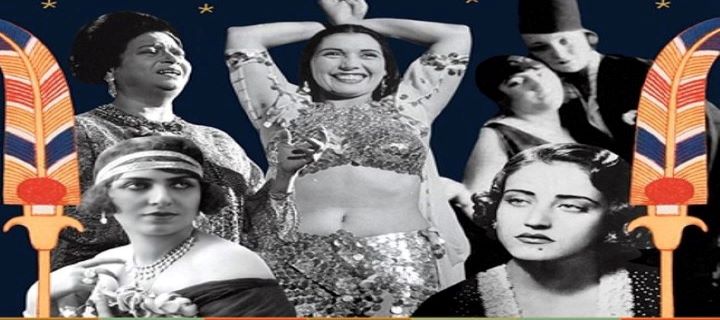
The threat, of course, was overblown. But in some quarters the roaring twenties had certainly arrived, beckoning, as it did globally, a world of sexiness, possibility and playful decadence. At the forefront of this world were the divas of Egypt’s nightlife, bursting onto the national stage as stars at the beginning of an era of mass media. They danced with bare bellies, picked fights with high society, performed in drag, and teased audiences with lyrics that would give Mae West a run for her money: “come here, my duckie” trilled Mounira al-Mahdiyya, the biggest star of the 1920s , who reportedly also kept a monkey and a snake as pets and sent thugs to rough-up critics of her performances. But aside from their eccentricities, these women pioneered new genres of music, theatre, film, and writing, and became cultural-icons across the region. Whilst well-known in the Arabic-speaking world through TV interviews, bio-pics, and biographies, they remain virtually unknown anywhere else.
In Midnight In Cairo: The Divas of Egypt’s Roaring Twenties Raphael Cormack finally brings the stories of these women to English-speaking readers. Meticulously researched, and drawing from an array of primary source material, the book sheds light on a select pantheon of stars, piecing together their life-stories and exploring their contributions to Egypt’s cultural life as well as to the wider debates about women’s place in society. In the field of Middle East Studies, Midnight in Cairo revives a fast-paced and refreshing genre of historical storytelling, where gossip, scandal, and eccentric characters propel the narrative forward. But under the authorship of Cormack, the result is also controlled; the book is a good frolic without the nostalgia, it is glitzy without losing sight of the realities that women suffered in a deeply misogynistic world.

In this book, Cairo also emerges as a global city whose nightlife rivaled that of Paris or Berlin, where jazz rippled through the entertainment district and the cocaine trade swarmed in its back street, where dance-floors shook to the Charleston and revolution brewed in the streets. Certainly, Midnight in Cairo is about a city in the midst of social change and an entertainment industry expanding to unimaginable heights. But ultimately, it tells the stories of the women who broke all the rules and helped animate one of the most dynamic periods in Egypt’s history.
These past weeks, I exchanged notes with Raph, and asked him about the process of writing the book, historical storytelling, and the place of these divas in the history of feminism. I also asked him which diva he thinks would make the best and worst party guest.
Many years ago, you researched theatrical adaptations of Sophocles’ Oedipus Tyrannos in Egypt. How did you go from Oedipus on Egypt’s national stages to the divas of Cairo’s 1920s nightclub scene?
R: The playwrights, actors, and critics who were interested in Sophocles during the early 20th century – George Abyad, Tawfiq al-Hakim, Taha Hussein to name some of the most prominent – were obsessed with creating a “high quality”, morally improving, respectable national culture. They saw the theatre as a school for the masses. While doing this work, I found out about another theatrical movement that thrived at the time: a popular vaudeville revue theatre. Although the respectable mainstream theatre worried about it, the public loved it.

There have recently been a lot of scholarship on how this popular drama and performance was busy creating a national identity of its own – I’m thinking of Ziad Fahmy’s Ordinary Egyptians and Carmen Gitre’s Acting Egyptian. I found myself increasingly drawn into this world, particularly because of the compelling stories and flamboyant personalities that filled it.
I wanted to try to write a book that would capture some of these amazing lives. Rather than focus on the academic arguments and scholarly minutiae, I wanted to see what it would look like to write a book guided by these stories in all their exuberance, glitz, and excitement.
Your book would have read very differently had you gone down the academic path. So, what did it look like to move historical storytelling away from academic form? Did anything surprise you in the process?
R: There was something about the material that just did not seem to fit a traditional academic model. These are the stories of women working in an industry based on performance and everything about their biographies is extravagant, entertaining and larger than life. It felt that too much academic measuring of truth, dissection, and explicit analysis risks killing them. These women’s stories and public lives were a part of their performance, so I wanted to try to recreate that feeling. And, of course, I also wanted to make reading the book fun.
As I was writing the book, I was also reading two other books that move away from traditional academic forms – Saidiya Hartman’s Wayward Lives, Beautiful Experiments, which looks at the transgressive lives of Black women in early 20th century America and Iman Mersal’s On the Track of Enayat al-Zayyat, about her attempts to research the life of a forgotten 20th century Egyptian novelist. Both of these books use the gaps in the record that mainstream academia has often decried to turn them into something amazing. Although their subjects are very different from mine, their examples were a big inspiration to cast off the usual mold. It may well be no coincidence that these books all deal with women in the 20th century. Perhaps there is something about women’s lives which evades an academic form largely constructed with men in mind.

In Midnight in Cairo, you paint an incredible picture of the 1920s, describing it as an era on the precipice of radical change, and positioning Cairo firmly within the global geography of the ‘roaring twenties.” In your book, Cairo emerges as a global city, a nodal point in an international network of trade, entertainment, drugs and revolution. Why do you think the 1920s is an important era in the modern history of Egypt and the Arabic speaking world, and how do you think your book adds to the literature on the era?
R: I think that all these things are part of the appeal of the 1920s in general: it is a time when radical change seemed possible, when the world was becoming much more global and interconnected. Outside the Arab world, Cairo is seldom included in this popular memory of the “roaring ‘20s” and, if it ever is, the Arabic speaking culture of Egypt is largely excluded. I wanted to show that Egypt and Cairo was a part of this whole story.
But there were also many things happening in Egypt that make this time period particularly interesting there. Above all, the 1919 revolution and Egypt’s subsequent independence led to a period of huge political, cultural and artistic change. People were debating huge questions about feminism, socialism and religion and some were coming up with unexpected answers. This atmosphere of change is the background to all of the stories in the book. In the lives of the stars we see the tangible results of the increased visibility of women, the fundamental questioning of class structures, and the growth of downtown Cairo as a meeting place.
As you have shown, the cabaret and night scene drew women from all over the region. How did you go about selecting the divas you focused on, and how did you decide on the structure of the book?
R: Picking the women to focus on was a difficult task. There were others who could have featured more prominently – Fatheyya Ahmed, Behiga Hafez, etc. I tried to use a wide spectrum of the female stars of the period to weave a patchwork. So, I chose women who were prominent in different genres (theatre, cinema, singing, dancing, journalism) to give as full a picture as possible. I also chose people whose lives give an insight into some of the issues of being a female star in Cairo’s 1920s. For instance, in Om Kalthoum and Mounira al-Mahdiyya, we see two women whose stories shed a lot of light on the construction of female celebrity in Cairo at the time. In Fatima Rushdy and Fatima Sirri in particular, we see how relationships with men could form such an important (and often difficult) part of these women’s lives. With Rose al-Youssef and Badia Masabni, the question of independence, both financial and creative, comes to the fore.

All these women led intersecting lives and their stories complement and inform each other. The similarities in their biographies are very striking. To take just one example, with the exception of Om Kalthoum, almost all their fathers died when they were young children, no doubt often contributing to their decisions to enter the entertainment business. By setting their stories alongside each other I hope to build a full and multi-faceted picture of Cairo’s nightlife.
But there were still some problems with choosing who to put in the spotlight, which I was not able to surmount. I was guided by the available sources – largely the contemporary entertainment press and later memoirs. Many women’s lives fell between the cracks of history. Some worked for many years in cabarets and theatres but never became stars; their stories barely made an impact on the press, beyond short notices or minor details of their lives. Others, who were unquestionably famous at the time, did not leave behind memoirs and their lives remain hard to tell – people like Nadira, Mary Mansour, Ihsan Kamel, for instance. In some cases this is because their life stories were hard to fit into the nationalist framing of Egypt’s entertainment industry that was prominent in the 1950s and 1960s when many of the stars’ memoirs were being published. In other cases, there are more specific reasons. For instance, Heba Farid, the granddaughter of Naima al-Misriyya, has been doing a lot of work to reconstruct her life. Naima’s career was cut short when her new son-in-law insisted she stop performing on stage and she, like so many others, languished on the margins of history until recently.
Often the lives of these women are shrouded in rumor, scandal, embellishment and in some cases like Rose al-Yusuf, an obsession to keep her private life under wraps. How did you, in the process of writing the book, deal with the multiple levels of rumor and secrecy, embellishment and silences? How do you disentangle fact from fiction, sensationalism from publicity stunts?
R: Every woman who became a celebrity in the 1920s and 1930s had to negotiate the gossip mills in the press. They might have chosen different ways to engage but it was an unavoidable presence. Some, like Rose al-Youssef and Om Kalthoum, worked hard to maintain a wall protecting their private lives. But, particularly in the case of Om Kalthoum, it led to the press making insinuations based on tiny bits of evidence. Others, like Mounira al-Mahdiyya, openly courted the press and seemed to revel in the rumors that were spread about her and the subversive public image she got from them.
As a historian, therefore, I cannot ignore this gossip either – especially as archival sources for this period are so scarce. However far-fetched some of the rumors are, they were part of life in Egypt’s entertainment business at the time. As with most gossip, the strict truth (or otherwise) is almost impossible to ascertain but it is undeniable that it was part of the whole atmosphere of Cairo at the time. Both audiences and stars would have known this gossip and it was part of their public persona (even if it bore little relation to the facts of their private lives). So, for anyone interested in what it would have been like to go out in Cairo at the time, we must know about these stories, though in some of the more extreme cases, we must include a note of skepticism.
The stories, myths and gossip which I had more problems with were the things that only really appeared decades after they were supposed to have happened. There is a tendency for all kinds of stories to accrue around larger than life figures like the ones featured in the book, often following a similar pattern. Except in a few specific cases, I have tried to ignore gossip when I cannot find any versions of it from the time.
Your book evokes a bohemian atmosphere of gender-bending and taboo-breaking creativity. Yet you’re careful not to impose certain interpretations on the actions of these women. How do feminist and queer theories, for example, help shed light on, but also obscure the lives of these women?
R: One of the most striking things about the female performers of the 1920s and 1930s is the prevalence of gender-bending and cross dressing. You see it on stage, as women like Fatima Rushdy dressed up as men to take male parts. You also saw it in places like the 1938 film Bint al-Basha al-Mudir, where Assia Dagher gets a job in a wealthy family by dressing up as a man, prompting a love scene between her and the daughter. But it is also happening off stages. You can see it everywhere in the entertainment press. Women dressed up as men and sent their photos into the press as publicity shots. Mounira al-Mahdiyya was the most prolific but she was far from the only one. Almost everyone would do it.
In many ways queer theory is a very helpful way to interpret this. At its most basic level, all cross dressing is a way to poke at gender boundaries and suggest that “male” and “female” are not such rigid categories. This is clearly part of what is going on in 1920s and 1930s Egypt. I would put it together with the panic that is also happening in the press about challenges to traditional gender roles, the growing presence of women in the public sphere, and so on. It is one aspect of the intense debate about gender that is happening in Egypt at the time.
However, we should be careful, as you say, not to impose our own categories on the people of 1920s Cairo. Although so much of it seems familiar, it was also very different in many ways. We should not assume that the ways people perceived, for instance, gender and sexuality was the same as how we do now.
Likewise, we should not necessarily assume that instances of gender-bending in early 20th century Egypt were doing the same thing. For example, Om Kalthoum was famously dressed as a boy by her father when she performed as a child. To me, (and Om Kalthoum’s own interpretation backs this up) this seems like an attempt to hide or diffuse the power of her femininity and disguise her. This seems to bear little relation to the photos that Mounira al-Mahdiyya sent to the press in the 1920s, when she was at the height of her fame, playfully dressing in a suit and a tarbush.
You are careful in your book not to romanticize the period or the lives of the women you chronicle. You describe the harrowing violence many women suffered, often at the hands of men. Throughout the book, there are also the recurring characters of lurking wealthy men stalking women from the audience, and the opportunistic male colleagues sabotaging careers. How did you reconcile the tensions between themes of female emancipation and realities of violence, exploitation and misogyny?
R: This is not a period where being a woman would have been easy. I think it is important to remember that women in the 1920s in Egypt had nothing close to the rights that women in the 2020s do. From moralistic articles in the press that focused overwhelmingly on women to the men in audiences who saw performers as sexually available to them, the female stars of this period were stuck between many competing problems. It must have taken considerable strength and courage for any of them to survive and thrive as they did.
I think the most powerful way to demonstrate this is through the stories of the women, which speak for themselves. Each woman’s experiences were slightly different but they all negotiated the same issues – briefly put, patriarchy.
You describe a showdown between Egyptian feminist icon Huda al-Shaarawi and one of the leading singers of the period, and describe a very funny incident when Rose al-Youseff scandalized the banker Talaat Harb by frolicking in her swimsuit at the beach. In general, how did conservative Egyptians respond to the image of the Egyptian flapper? Did the nightlife of Cairo precipitate any calls for regulation? And when did things begin to change? When did the risqué tunes of this era go silent?
R: The nightlife scene described in this book was, in my view, a counter-culture. That is part of what makes it so interesting. Even if now a lot of these stars have become part of the Egyptian national performance canon, this was not necessarily the case at the time. There was a huge amount of backlash against the perceived decadence of the nightlife scene (particularly the cabarets and vaudeville theatres).
It was in this period that a system of censorship for popular songs was first set up - ironically presided over by a former songwriter, Yunus al-Qadi, who wrote some of the famously risqué songs of the 1910s and 20s. There was a constant push and pull between the stars of this nightlife and bourgeois respectability.
In many ways, it is striking how little has changed since then. We can still see many of the same struggles happening now as the forces of “respectability” fight against counter-cultural entertainment. And now, just as it was then, women are thrust to the centre of this struggle.
Where would you place the divas in the history of Egyptian feminism?
R: A big implicit question there is whether these divas should be part of the history of Egyptian feminism at all. In my view they absolutely should. They were women, often with little or no formal education, who managed to take control of their lives, have successful careers, and leave a mark on the world.
But they are part of a different history of Egyptian feminism than the one that is usually told. They did not attend conferences, nor campaign for female education. Their lives were their feminist action.

The relationship between the more mainstream feminism of people like Huda Shaarawi, Ceza al-Nabarawi and the Egyptian Feminist Union (EFU) was complicated. I have tried hard in the book not to turn this into a battle between two strands of feminism where you have to pick a side. But there are often tensions between them. The mainstream of feminism was largely run by women in the elite, who had many of the prejudices of their class. Yet, it was these women who made some real tangible steps towards progress for Egyptian women as a whole.
These divas, on the other hand, were ordinary women who threw themselves into the public eye at a time when it was just becoming possible. They must have inspired many women with their example but on a day to day level they could be accused of selfishness. A more mainstream feminist from the EFU could say that they did little to help anyone but themselves, even profiting off an industry that exploited many other women.
It is a far from simple question!
Your book pops with amusing anecdotes and stories. Was there a story you wished you included but had to leave out?
R: So many! Some stories were really great but I had to leave them out because I could not confirm them. For instance, it is said that during the 1919 revolution Mounira al-Mahdiyya went to visit one of her fans who had been imprisoned and tried to get him released. When the British told him that she could only visit him if they were husband and wife, she married him on the spot. This story (and versions of it) are told quite a lot but it seems pretty unreliable, particularly as she was married to Mahmoud Gabr at the time.
I also wanted to include a whole chapter about the foreign tours that singers and theatrical troupes went on. In the end, I just incorporated the stories into individual chapters but there is a lot more to be said about how this nightlife culture traveled across the Arab world and diaspora during this period. One story that I could not put in happened when Naguib al-Rihani was on tour in North Africa. Some of the dancers in his troupes had been having a good time in Tunis and didn’t want to go on the next leg of the tour to Algeria. They decided to lock themselves in their room so they wouldn’t have to take the train. Al-Rihani, thinking he had them beat, packed their luggage on the train and left without them. But the dancers had one more trick up their sleeves. They phoned ahead to Algiers, where the train was bound, and had al-Rihani arrested for stealing their bags.
If you could invite one diva to a party in Cairo today, who would it be and why?
R: Shafiqa al-Qibtiyya, the model for so many of the divas who came after her but one whose life is shrouded in a combination of myth and mystery. I would like to know what she was like in person.
Who would you definitely not invite?
R: Mounira al-Mahdiyya. You want to get an invite to one of Mounira’s parties on her houseboat on the Nile but not to invite her to one of your parties because she would end up taking it over.

Midnight in Cairo will be out in Egypt in July 2021 with AUC Press, and was recently published by Saqi books in the UK and by Norton in the US. An Arabic translation of the book is on the horizon.

Ifdal Elsaket
Ifdal Elsaket is assistant director and program coordinator of Arabic Studies and Islam at the Netherlands-Flemish Institute in Cairo. She has a PhD in history from the University of Sydney…
Raphael Cormack
Raphael Cormack is a writer, editor, translator and academic. He has a PhD in Egyptian Theatre from the University of Edinburgh and has edited two collections of short stories translated…
تقارير ذات صلة
Doria Shafik: A life recovered
Shafik’s life resists simple categorization
Iranian protester: Young generation does not have our fears, tomorrow will be shaped by their courage
"We must be unpredictable and conquer public spaces"
Sexual health and social change: A conversation with Nour Emam of Mother Being
"I have to push myself and leave my comfort zone to reach the people who need this information"
Your support is the only way to ensure independent, progressive journalism survives.
You have a right to access accurate information, be stimulated by innovative and nuanced reporting, and be moved by compelling storytelling. Subscribe now to become part of the growing community of members who help us maintain our editorial independence.
Join us