
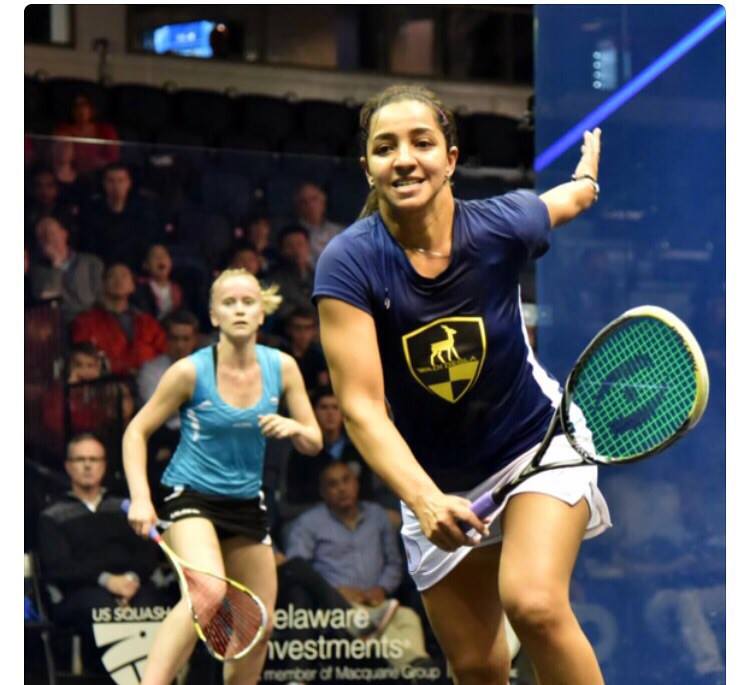
Dominating the courts: Egypt’s first female number one squash champion
Mohamed al-Shorbagy, an Egyptian squash champion, posted a picture with Raneem al-Welily after she made history by becoming Egypt’s first-ever female world number one in squash last September.
“How many selfies have you seen of two world number ones playing the same sport and not just from the same country but also from the same city?” he asked.
The answer would be: Not many.
The two Alexandrians stand at the top of women’s and men’s squash, leading a combined total of 10 Egyptians ranked in the top 10 in both tours. Such dominance cannot go unnoticed.
While Egypt has a storied history in squash, from the glory days of Abdel Fattah Abu Taleb in the 1960s to the current generation of Shorbagy, Ramy Ashour and the recently retired “maestro,” Amr Shabana, Welily’s ascent to the summit of the women’s rankings has much greater significance.
Welily was born and raised in Alexandria and initially got into squash following the footsteps of her brother Tameem, who is three years her senior. Since it rained a lot in the Mediterranean city, their parents thought squash – predominantly played indoors – would be an ideal sport for Tameem.
“There was a U19 Egyptian team that had just won a world title so my parents felt it was a sport Egypt could achieve something in. So he started a year before me and I would go watch,” recalls Welily. “Some people say that me watching him play had a huge impact on my talent. One day my brother’s coach let me try it out and I’ve been playing ever since. I was six at the time.”
She moved to Cairo in 2007 and started training at Wadi Degla Club under the tutelage of Haitham Effat and Ahmed Faragallah. Last year in May, she married Tarek Momen, a fellow Egyptian squash player ranked number 12 internationally.
Not only is she the first woman from Egypt to rank number one in the sport, Welily did it by ending Nicol David’s staggering nine-year reign.
David, one of the most dominant figures in sports in general, not just squash, had been the world champion for 109 consecutive months and Welily spent more than a third of her life looking up to the Malaysian star and trying to get as close as possible to her in the rankings.
Last June, Welily found out that she was about to achieve the unthinkable. The 26-year-old was informed that mathematically, she would replace David at the top when the September rankings came out.
“Even though calculation-wise it was set, I still wanted to wait until it was official on the Professional Squash Association [PSA] website, to see it with my own eyes and believe it,” recounts Welily.
Since 2006, only one name had occupied the top spot – Nicol David – and Welily was finally changing that.
Welily says being a “sore loser” is one of her biggest assets because “every loss stings and makes me stronger.”
David and Welily share a long history, some of which was very painful for the Egyptian. Last December, playing her first World Championship final, Welily had four match points against David but ended up losing to her, at her home club in Cairo, Wadi Degla, and in front of her home crowd.
“Going into the match I never thought I’d have four match points and still lose,” admits Welily.
“I thought I was either going to win or I was going to lose. But losing this painfully was never a scenario in my head. It was a very, very hard point in my life.”
Welily remembers being angry and promising herself not to lose to David again. “So believe it or not this is what motivated me to get to number one,” she says.
The athlete takes much pride in the fact that Egypt is ruling the sport on both the men’s and women’s circuits.
“The fact that it’s the first time we have two Egyptians ranked world number in squash at the same time is huge. I’m very happy for Mohamed [Shorbagy], ever since he became number one nearly a year ago. I consider him a very close friend and I always take his advice. I listen to him a lot and he always helps me. So reaching this point together is something that really makes me happy,” she says.
Welily laments the lack and inconsistency of media coverage her sport receives in Egypt. While PSA TV have sought out broadcasters to air the semi-finals and finals of all Super Series events – beIN Sports in the Middle East, BT Sport in the UK and Tennis Channel in the United States – Welily says it’s not enough.
“Coverage happens when a huge event happens. But the idea that as a sport, we’re good and this sport needs to be on TV the entire time, no this is not happening. It’s what my sport deserves in Egypt,” she says.
She explains that there are five Egyptian women in the top 10, five Egyptian men in the top 10, and six in the top 20 in both men’s and women’s rankings.
“We’re dominating the sport and we actually have a sport where your country is good, so why don’t TV channels air all these matches?” she asks, explaining that the attention she received was only limited to her number one spot, but nothing else.
“There is no consistency in the coverage. Two weeks ago, Nour al-Sherbini was runner-up in Qatar and Mohamed won the tournament and I haven’t seen it mentioned anywhere.”
The problem is not just in Egypt. Squash is growing across the globe but still does not have mass appeal.
The sport was snubbed by the Olympics yet again last September with another failed bid to be included in Tokyo 2020, leaving the players and fans alike frustrated and disheartened.
“From within, as players and as an association and as a game, we have really improved on so many things just for the sake of the Olympics,” she says.
She believes it is time to put the Olympics aside because “it is clearly not a matter of criteria.”
“They don’t choose based on something. They kept asking us to do this and to improve this, and we did it all yet they still didn’t choose us. So on some level, I feel like, okay, we’ve improved and it’s for our own good, not for their good,” she explains. “We’ve improved, so why stop now? We’re growing, we’re expanding our fan base. Many more people are following squash now and that’s really good for the sport and has nothing to do with the Olympics, whether we make it to the Olympics or not, I don’t care anymore.”
Welily has some suggestions to help squash grab the attention of a wider audience.
“This is something someone told me recently, that person was watching the tennis US Open final and straight after he was watching the squash US Open. And he said that ‘the picture of the tennis court is so much better than the picture of the squash court’,” she says, explaining that, as athletes, squash players should strive to be more presentable.
“I hate to use this word,” she says. “But, in a way, we need to be stars.“
تقارير ذات صلة
The stories behind Egypt’s Olympic champions
Egyptian weightlifters Sara Samir and Mohamed Ehab won Egypt’s first two bronze medals at the Rio 2016 Olympics, but the years of struggle without state support that preceded their success…
Egyptian swimmers make waves in international competition
A nine-person-strong swim squad walked away from the World Aquatics Championships in Kazan, Russia this week, with the best records ever achieved for Egypt on the international stage. The Egyptian…
The child champions: Egypt gets a head start at squash
Squash is dominated internationally by young Egyptian players. With thousands on the waiting lists for expensive training academies, we ask why are so many attracted to this niche sport.
Your support is the only way to ensure independent, progressive journalism survives.
You have a right to access accurate information, be stimulated by innovative and nuanced reporting, and be moved by compelling storytelling. Subscribe now to become part of the growing community of members who help us maintain our editorial independence.
Join us