
Cairo Photo Week 2025 and the spectacle of scale
Cairo Photo Week 2025 ran its fourth edition from May 8 to 18 with unprecedented scope, threading itself through 14 venues and outgrowing its Downtown Cairo footprint, moving from the historic passageways of the city center to the glossy new Cairo Design District in the Fifth Settlement, Cairo’s posh eastern gated suburb. This geographic migration is notable — not just spatially, but ideologically. It conceptually re-brackets the city, contributing to the branded articulation of a new “Egypt” (as opposed to “Masr”). The shift is emblematic of the “now,” exemplifying how culture, under the guise of creative industry, lubricates the machinery of real estate speculation and urban development, operating fluidly within the ecology of private and public (read: state) interests.
The dense 36-page program is dizzying: over 20 exhibitions, a hundred events, talks, panels, workshops, guided tours, portfolio reviews, networking mixers and institutional partners, including World Press Photo, Getty Images, National Geographic and Vogue. Sessions range from photobook-making and fashion shoots to interior photography and curating as a career path. Events unfold across familiar and reactivated sites — Kodak Passageway, Cinema Radio, and, by the sound of it, one of the architectural highlights of this edition, the Chapel at Collège de La Salle.
Algorithmically persistent on Instagram, Cairo Photo Week’s marketing strategy manufactures a sense of momentum. One recurring prompt on my feed is: How do you see Cinema Radio? Famously a thousand-seat venue with ornate modernist interiors, Cinema Radio was a cultural landmark of 20th-century Egypt, entwined with icons like Umm Kulthum. Developed by private investors in the 1930s, it was nationalized under Gamal Abdel Nasser and later managed by state-run entities such as Misr Film and the Misr Company for Sound, Light and Cinema. After decades of decline following the fragmentation of Egypt’s film industry in the 1970s, it shuttered in the early 2000s. Al-Ismaelia for Real Estate Investment acquired it in 2009 as part of a broader push for urban redevelopment in central Cairo. In recent years, it has been sporadically reactivated for events — including Cairo Photo Week — though often used more as an aesthetic backdrop than a site of cultural memory.
Today, the gutted renovation of Cinema Radio — surrounded by a curated mix of upscale bars, cafés, bookstores, and artisanal crafts — signals more than a repurposing of space. It marks a shift in function: culture is no longer simply symbolic capital, but an active node in the gentrification networks and speculative value Downtown Cairo now presents. Tapping into heritage-as-image, faux-vintage, or “authentic” aesthetics is central to this process. The question that circles my attention is how photography itself, paradoxically, is capable of erasure.

The prevailing impression across most venues is that this is an exhibition in reverse — where the spaces of display, mostly derelict apartments, crumbling houses, and neglected upper floors scattered across Downtown, become the actual object of interest. But the spaces aren’t merely ruins, they’re curious finds: hidden flats at the end of labyrinthine stairwells, dusty rooftops overlooking the Sha'ar HaShamayim Synagogue, mosques and churches and satellite dishes, exhibition rooms improbably wedged in time. Navigating them feels like a dérive through semi-forgotten spaces, where surprise, disorientation and wonder replace the neutral distances of the white cube. The photographs themselves — occasionally stirring a nostalgic pleasure in decay, in what one might call “age-value” — are, for the most part, poorly presented. Technically, the standards are low. For a festival that claims a serious engagement with photography, it is striking how little care is given to the materiality of the medium. Perhaps this signals a broader absence — of field-specific knowledge, of aesthetic sensibility, of formal training or appreciation. Or perhaps it is simply neglect, or the predictable consequence of limited resources: the lack of equipped studios, infrastructure, funding — all of which feels especially jarring against the festival’s colossal claims of scale. Its sheer number of shows and events suggests abundance, while the quality often signals vacancy.
Thematically, the festival appears diffuse. There are gestures toward storytelling, cultural memory, urban transformation, travel, artificial intelligence, advertising, “the archive.” On occasions, there are references to Gaza. “Heritage” recurs as a through-line, as does the impulse to reclaim Egyptian identity through the image. As with previous editions, the emphasis on professional development and creative entrepreneurship sits comfortably within an emerging national narrative — nothing about the curatorial ethos feels politically unruly.
What am I looking for? Lina asked, mid-edit.
What I am looking for is a curatorial ethos that confronts the conditions of image-making, that asks not just what is shown, but how, where and to what end — one rooted in political urgency rather than branding. I am looking for a curatorial process that privileges inquiry over spectacle, and critique over content, a space where photography isn’t just practiced, but politicized — where the image is not merely exhibited, but interrogated.
I want a pedagogy of the image, not its commodification — something closer to what Kaja Silverman names when she writes of the photograph’s capacity to teach us to see differently, not to reflect the world as it is, but to reshape our relation to it. That’s the bar, and for now, it remains unmet.
Reading the program, I imagined my itinerary beginning with L’Égypte by renowned Swiss-photographer Fred Boissonnas at the Goethe Institute, which I read — in the context of this festival — as a primer on how photography and sovereignty converged in early 20th century Egypt. Commissioned by King Fouad I, Boissonnas’ images were part of a national branding effort: a stylized Egypt crafted for both domestic pride and international consumption. Photographs here function as instruments of heritage-making, embedded in a visual regime where statecraft and colonial optics entwine, images as tools of nationhood. Boissonnas’ photographic campaigns across the Mediterranean blended documentary precision with a romantic nationalist lens, framing landscapes and monuments through a colonial gaze that aestheticized national and imperial identities.
Where it really began was at Beit Bab al-Louq, a family-owned house, long inherited, divided among multiple shareholders, like many downtown properties, left unused for decades. Once leased as part of the American University in Cairo’s extended premises, it has stood empty for as long as I can remember. For the festival, I learned that an Egyptian curator, a member of the family, had taken it upon herself to offer the building as a venue — rent-free.
The gesture felt like a throwback to the early 2000s, when exhibitions often unfolded in old, decaying buildings, the kind of surreal, makeshift happenings once held at the Viennoise, now revived and rebranded as Mazeej on Mahmoud Bassiouni Street: part boutique hotel, part A-class rooftop bar and restaurant.
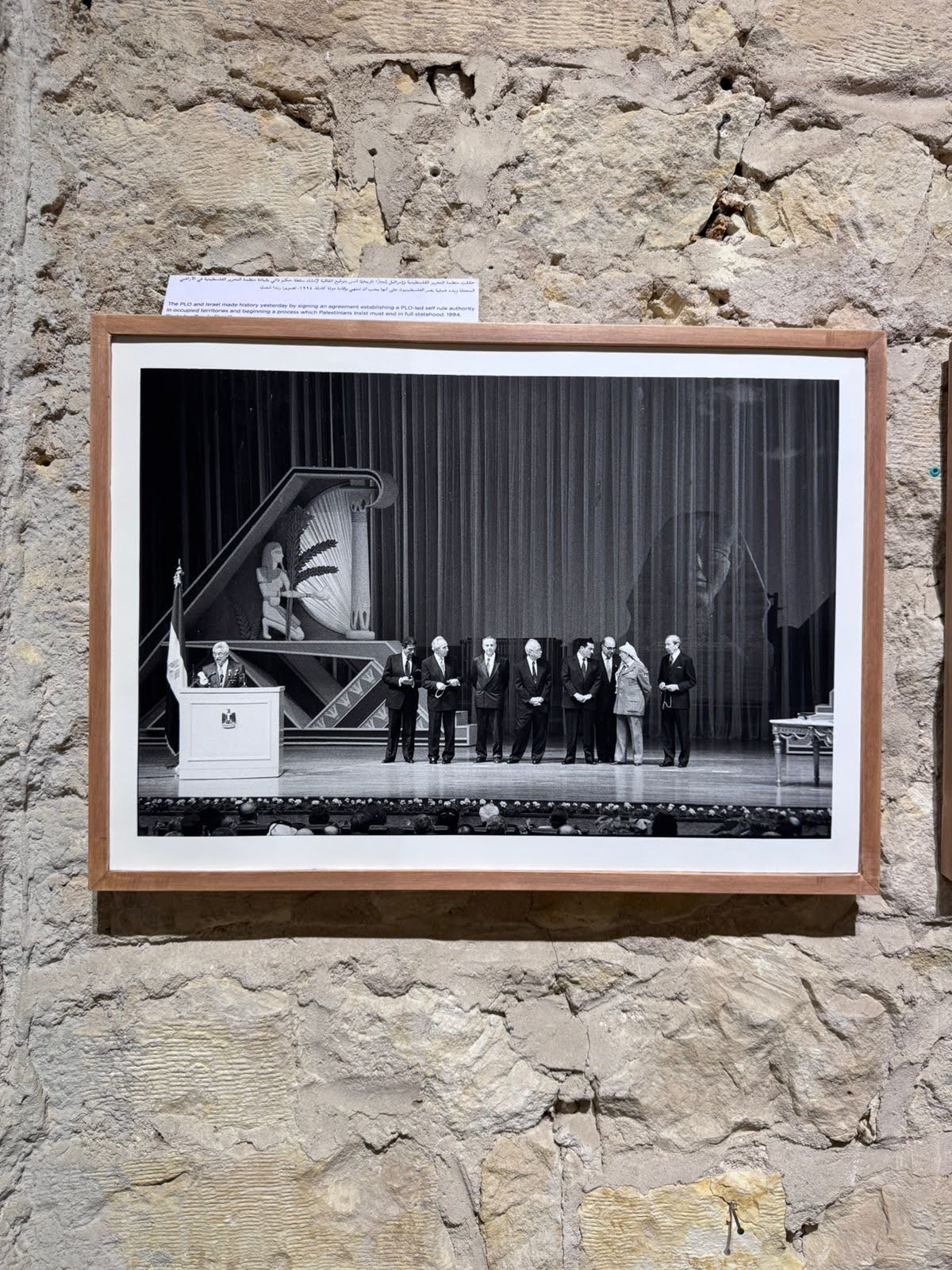
Beit Bab al-Louq now hosts several exhibitions. Among them, Al-Qāhirah 90 by renowned Palestinian-Egyptian photographer Randa Shaath stands out as a quiet temporal and critical pivot. Shot in the 1990s, before Downtown’s high-end rebranding had reframed heritage as real estate, her black-and-white photographs document the city’s streets, markets and workers. Shaath’s lens, characteristically observational and unassuming, captures the textures of Cairo just before the speculative turn, when belonging had not yet been entirely flattened into property value. There is a trace of the real, of the uncurated and unexpected, in her images. And yet, Cairo appears strangely subdued, rendered familiar, almost docile.
The top floor of the house, reached by a narrow, winding staircase (a feature that recurs across several venues), transports us half a century back. The Lifespan of a Face presents a collection of anonymous, mid-20th-century studio portraits. Stripped of captions and context, these photographs resist resolution. They gesture toward photography’s mnemonic force, rites of passage captured, now untethered from personal history. The exhibition, functioning as metaphor, reflects the festival’s relationship to its surroundings: what is remembered, even when nameless; what remains, even when context slips away.
The space itself, one room opening into another, is dense with architectural detail. What lingers most is the faded grandeur, the quiet theatricality of the space. Black bar lights are carefully installed, perhaps unintentionally, forming a more compelling installation than the photographs they illuminate.
Rushing across the city, with only four hours for my gallery crawl, I stopped briefly in the contested “now.” Presented at Tamara Haus, Taste of Downtown by Yehia al-Alaily, a commercial photographer working across food, travel and lifestyle, centers on iconic restaurants and bars — spaces where Cairenes have wined and dined for generations. The images, drawn from his book Downtown Cairo: The Stories and the Stories Within, gesture toward the thème du jour, the convergence of hotels and gastronomical landmarks, both historical and fading: the Windsor, the Carlton, the old Stella Bar and the renovated Carol.
But the exhibition’s location, a concept store that epitomizes Downtown’s transformation into curated desire, adds another register. Here, it’s not a crumbling building repurposed for art, but a sleek, expensively restored interior where the photographs sit beside contemporary designer furniture, more ornament than anchor. Taste of Downtown, in the end, felt like a good excuse to visit Tamara Haus itself, a curious glitch of contemporary wealth nestled amid the dust and noise of the city’s old heart.
Understated in the program and entirely unexpected, I found myself delighted to stumble into the Shourbagy Building (Villa Victoria) at 16 Adly Street. Originally named the Davies Bryan Building, it anchors a key intersection overlooking Adly, Mohamed Farid, and Abdel Khaleq Tharwat streets. Designed in 1910 by Welsh architect Robert Williams, its red brick façades and Neo-Islamic doorways mark it as a Downtown landmark. Acquired by Al-Ismaelia for Real Estate Investment in 2008 and renovated in 2015, it now houses creative venues like Villa Violette and Villa Victoria. Its rooftop, long sought after for its sweeping views, has doubled as a set for films, music videos, and more.
The rooftop, its makeshift rooms stacked above the original structure, feels like a pastiche lifted from literature (The Yacoubian Building comes to mind). The exhibition unfolds with moments of disorientation: portraits and studio shots mingle with what seems like photographic residue, visual leftovers. There’s also a dose of kitsch, at one point, a stripped-down soundtrack of a Maroon 5 song drifts through the space, pairing oddly with the spectral presence of a ballerina figure. The optical illusion of faded midcentury wallpaper is either heartwarming or dazzling, depending on where you stand.
The Visual Trilogy Exhibition is a surprising find: an archive of photographer Ahmed Badawy’s work that forms part of a larger preservation effort dedicated to the late artist, whose images span from the mid-1950s onward. One room delivers a strange and sobering shift: rarely,if ever, seen large-format photographs of Gamal Abdel Nasser’s funeral procession. After so many portraits, so many personal family images, the sudden appearance of public grief — of crowds in the street — lands with force, a vague and eerie reminder of another kind of sentiment, another kind of mass.
There’s a cluster of busy shows at the Ismailia-owned cultural hub, formerly the Townhouse quartiers. Amid the noise, the most understated exhibition is also the most compelling. The Dinosaur: A Tribute to Yasser Alwan, curated by Nadia Mounier, is a quiet, poignant monographic survey of the late photographer Yasser Alwan (1964–2022). His work resists the spectacle economy that dominates the region’s image politics. Alwan refused “crisis photography,” turning his lens instead to Cairo’s laborers, vendors and everyday inhabitants, those who rarely appear in the frame unless tragedy calls them into view. His photographs affirm the dignity of the ordinary, without embellishment or spectacle.
I had seen hundreds, maybe thousands, of photographs across the festival: some curious, some striking, most poorly printed or amateurishly mounted. The Dinosaur was the first moment I felt I’d come into the presence of a photographer, proper.
The postscript to my experience is this: the narcissism of the artistic impulse, and of the curation, is staggering. I’ve never encountered a city so consumed by its own image. A recursive spectacle: Cairo and Egypt presented to Cairenes and Egyptians, in Cairo and in Egypt. It loops endlessly — a neverending false horizon in a hall of mirrors magnifying its own cultural capital, economically and politically.
The inevitable line of flight leads far from Downtown and into the Fifth Settlement, to the Cairo Design District, where A Kind of Magic, curated by Hala Elkoussy, takes place. Had I had more time, I would have ventured there. The exhibition marks the first solo show of cinematographer Abdel Salam Moussa, Elkoussy’s longtime collaborator. Presented as a three-screen, nine-speaker installation, the work is a cinematic reassemblage, drawing fragments from some of his works: Moga Harra, Harag wa Marag, and Afrah al-Qobba.
Though I haven’t seen A Kind of Magic, I imagine it to be immersive, emotionally saturated and quietly disorienting. The work proposes a kind of proposition — a theory or metaphor — for how the syntax of contemporary art seeps into commercial cultural space. Cinema refracted through the structures of design; montage absorbed into atmosphere. Once a political method for rupturing narrative, montage here softens, becomes ambient. The invitation is one of engulfment, and sometimes, I too want to stop thinking and simply surrender.
The ongoing photo competition — organized by Al-Ismaelia for Real Estate Investment, Cairo Photo Week, and its founding institution Photopia — calls for submissions described in superlatives: abstract, imaginative, bold, unexpected. This language is not incidental. Language, like cities, arrives weighted with history. “Abstraction,” for instance, carries political and art historical freight from the early 20th century and post-Second World War avant-gardes. Absorbed into institutional and market discourse, such terms become easily upcycled. What resonates with me is how “revitalization” doesn’t stop at brick and mortar, it thrives on vocabulary, selectively decontextualized.

To understand Cairo Photo Week is also to reckon with its political function, how it participates in shaping not just art scenes, but consensus. Rather than returning to the ideological clarity of the Nasserist project, what we see today is something more diffuse. Italian Marxist thinker and political prisoner Antonio Gramsci developed the concept of cultural hegemony to explain how consent to power is manufactured not only through coercion but through everyday cultural life. Political theorist Sara Salem reads the 1950s–1960s as a rare instance of Gramscian hegemony in Egypt: a moment when domination was secured not only through coercion, but through mass participation, cultural education and the production of consent. Infrastructure — cultural, industrial, social — was mobilized in the name of national development, and art was folded into this vision.
Today’s cultural paradigm has shifted, but it still bears the imprint of that same political mentality. The rhetoric is no longer explicitly about building the nation-state, but it remains fixated on development, on spectacle, scale and the illusion of forward motion. Repression persists, but it no longer needs to be central; it operates in the periphery, estranged and disavowed. What dominates now is a kind of aesthetic intoxication — what Walter Benjamin called Rausch — a state of mesmerized movement that dulls critique, substitutes velocity for vision, and cloaks authority in the language of progress.
Raymond Williams helps us name this shift. Hegemony’s power lies in its unrecognizability — what is happening feels natural, commonsensical and inevitable. For Williams, culture is not a mirror of power but a site where meanings are made and remade, the dominant absorbs both the residual (the past, reanimated as heritage) and the emergent (new forms, still in flux). Take Cairo Photo Week: it reanimates Downtown Cairo’s cultural memory and sets a vibe. It absorbs emergent practices — street photography, visual storytelling, informal pedagogies — into a language of innovation and creative economy.
This is not hegemony in Gramsci’s full sense, but something more agile. Think of it as hegemony-lite. It performs cultural leadership without ideological coherence, generating consent not through belief, but through aesthetic saturation. Initiatives like Cairo Photo Week — and others, with Art D’Égypte as another prime example — render authoritarianism photogenic, and paradoxically, depoliticized. They reframe national heritage through glossy exhibition and hyper-curated urban experiences, critique is fully subsumed by ambience, and political contradiction ceases, as we brace for a future of visual cohesion. We end up with a moodboard (for sale) of a “modern meets traditional” Egypt, Instagrammable, eminently sponsor-friendly and sterilized of dissent.
The cultural neutrality that plagues much of Egypt’s art scene today isn’t accidental. It is often expressed by the very architects of this new cultural economy — entrepreneurial, optimistic, aligned with the language of innovation and applied art. Cairo Photo Week’s self-description leans on “anti-specialization” and “youth empowerment,” terms echoing state soft power and NGO-ese alike.
During the nascent years of the festival, Photopia’s founder, Marwa Abou Leila, has spoken of the conscious pivot away from politics after 2011. Since then, the festival has grown steadily with state support, becoming a seasonal feature of Cairo’s new, corporate-aligned cultural infrastructure. Cairo Photo Week boasts numbers: 750 attendees, 250 hours of “education,” 100+ talks. Metrics don’t produce meaning and quantitative success is something to be wary of, insofar as scale outshines its historical precedent by design.
Cairo Photo Week is emblematic of a renewed cultural momentum that fills a vacuum left by the disintegration of independent institutions in the last decade. It is one of the more visible manifestations of contemporary cultural infrastructure in Egypt. As with much of Downtown Cairo’s development, the festival’s narrative situates itself in a continuum: cultural decline in the 1980s–2000s, followed by a sudden revival, conveniently skipping the early 2000s. Yet this period saw the rise of an insurgent art scene in Downtown Cairo. Around the corner from Cinema Radio, Townhouse Gallery and the Factory Space hosted the first PhotoCairo in 2002. Its founders, Negar Azimi, William Wells and Hala Elkoussy — imagined the camera not as a professional tool, but as a means of commoning, of visual resistance.
Today, those precedents are barely acknowledged. Local curators, such as Ismail Fayed, have called for historicizing PhotoCairo, and I agree. Without delving into full critique, I want to say this: the separation of photography, image-making and art from politically attuned aesthetics did not happen overnight. I’m still grieving the dismantling of even the smallest public sphere that once congregated around the arts, where critical thought and collective imagining tried to take shape. The erosion of art spaces post-2013 created the vacuum now filled by cultural platforms that are pragmatic, professional and often depoliticized. What was once a fragile space for democracy is now reframed as democratization, a term that too often signals diluted discourse, market-friendly content and entrepreneurial logics of success.
The festival contributes to a sanitized, professionalized visual field. Its apolitical posture is political. It has consequences for what kinds of public education, memory, and discourse are possible. This is not to say critique is impossible, but it is increasingly marginalized. Events with political undertones are framed as “human interest.” Talks on photojournalism rarely address state violence. Critical practices persist, but they struggle to compete with the scale and gloss of the spectacle.
This year, Cairo Photo Week secured official patronage from both the Ministry of Culture and the Ministry of Tourism & Antiquities — marking a new turn in its alignment with state power. The event now operates not only with corporate and embassy backing, but also under the auspices of Egypt’s key cultural and tourism authorities.The state has made its stake clear.
Cairo Photo Week’s collaboration with Al-Ismaelia for Real Estate Investment and Dakhli West El Balad is part of a broader trend: art as marketing. Culture as rebranding. Cinema Radio, Kodak Passage, and now the Cairo Design District are not just venues — they’re assets in a financial imaginary. Downtown Cairo is being re-scripted as global, profitable and chic (fluctuating between Belle Epoque and baladi chic). And the state is an eager shareholder. I can’t escape the observation of how this dovetails with the recent Supreme Court ruling abolishing Egypt’s old rent laws, accelerating and institutionalizing gentrification as policy.
With some distance, I don’t seek to critically delegitimize Cairo Photo Week or the economic opportunities it opens for photographers, influencers, designers, and students. But I do want to mark the shift from art as inquiry to image as industry. This transition is not neutral.
This year, fringe calls for boycott emerged, including corporate sponsors like Nestlé (on the BDS list) and EU institutions criticized for their silence on Gaza. These gestures remain on the margins, but they register.
The question is whether art, as a spectacle, still has room for refusal or if it even cares to resist.

Sarah A. Rifky
Sarah Rifky is a curator and writer based in Cairo, Egypt. She is the co-founder of the Beirut art initiative.
تقارير ذات صلة
Lara Baladi’s Cosmovision
In Cosmovision, Lara Baladi breaks down photography’s cadre into a discursive unfurling of her becoming from 1996 to 2011, autobiographically performing the logic of the white cube. Shown at Tintera,…
Doria Shafik: A life recovered
Shafik’s life resists simple categorization
In pursuit of filling art-historical cracks: Chafik Charobim and missed opportunities
Hana Elhaddad considers the effectiveness of the retrospective's curatorial framing
Your support is the only way to ensure independent, progressive journalism survives.
You have a right to access accurate information, be stimulated by innovative and nuanced reporting, and be moved by compelling storytelling. Subscribe now to become part of the growing community of members who help us maintain our editorial independence.
Join us