
Ali Abdel Mohsen’s new artworks still scream out “WHY?”
I was first assaulted by Ali Abdel Mohsen’s drawings in 2010. I wandered innocently into his first solo show, A Voice From the Clouds, at Cairo's Darb 1718, to be met by grotesque humanoids torturing, devouring and screaming at one another. One piece in particular struck me: A slug-like creature looks out at a faceless scissor-armed being, which has just amputated part of the slug’s body. With a look that mixes panic, despair and apathy, the slug yells out “Why?” (Or as I hear it in my head, WHHHYYYY???!!!)

Three solo shows later, that initial why, a declaration of protest against the violent senselessness of our existence, still reverberates throughout Abdel Mohsen’s work, currently on display at downtown Cairo's Mashrabia Gallery in his fourth solo show, Slow War.
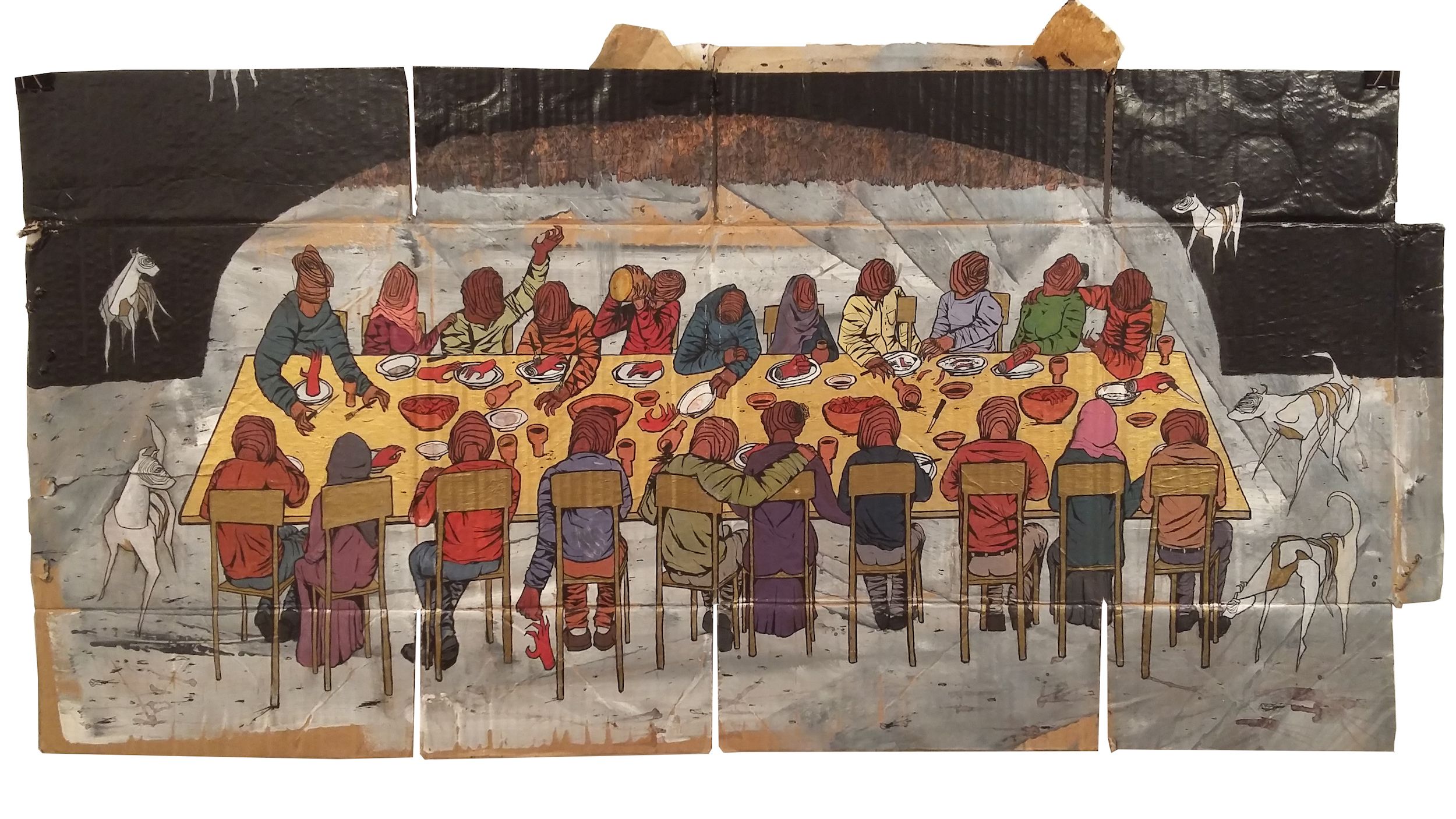
The twenty-one untitled works are drawn in the artist’s signature style, using ink and paint on flattened cardboard boxes to depict grotesque humanoids in an urban environment, building on his 2012 show Razor Sharp Teeth and his 2013 show This is a Dream Come True.
These new works show a remarkable development in Abdel Mohsen’s draughtsmanship, but his personal palette seems to have settled on the angry-orange and blood-spatter hues of his last exhibition and his concerns are very much the same. The drawings scream out the artist’s disdain for authority, his critique of mindless obedience, his scorn of religious symbols. Violence is ubiquitous; his characters enact it on themselves and each other. The city is a monster, it melts onto us, seeps into us, we recoil from it in horror. I am reminded of Mohamed Rabie’s dystopian novel Otared (2015).

Abdel Mohsen’s work eschews subtlety in favor of impact. The symbolism he employs could not be more overt, with one of the largest pieces greeting visitors in the entryway showing two massive humanoids literally playing chess with their tortured human pawns. But if you look closely at this apocalyptic world, you see the myriad worlds that it contains, the small scenes that construct the larger dramatic event. On the chessboard, a woman shields a child from a beating by one of the Anubis-like dispensers of punishment, another bows her head and reads from a holy book, a man raises his hands imploringly at his master, and the chess game goes on.
His scenes unfurl slowly, exposing their fractal structure, revealing that the larger tragedy is comprised of many similar, smaller injustices. Some pieces are constructed in several panels, like unholy polyptychs, their intricacy and depth evoking Heironymous Bosch’s Garden of Earthly Delights — in Abdel Mohsen’s case, a landscape of otherworldly horrors.
This play of distance and closeness reminds us that our reading of a scene can change dramatically depending on where we stand. But that shift is something the artist himself doesn’t seem to have experienced when it comes to Cairo. Abdel Mohsen has been living between here and the US for the past few years, but his work is still very much situated in the urban landscape of this city with its uneven buildings jutting out like jagged teeth, its rooftop satellite dishes ever-ready to receive brainwashing messages. Forlornly, I wonder whether Cairo is an incurable condition. We abstract it, deconstruct it, portray it, but we carry its endemic violence with us wherever we go.

In 2010, Abdel Mohsen’s work was a pertinent response to the daily horrors we experienced, a state of collective revulsion where the personal and the public were inextricably linked and equally upsetting. Discarded and disused, cardboard boxes served as the canvas on which to trace our traumas, vast cityscapes reminded us of our status as a speck in the system.
But now, seven years, three exhibitions, two uprisings and a huge massacre later (addressed head-on in his last exhibition, This is a Dream Come True), I wonder whether this form still serves the message of Abdel Mohsen’s work. The battles we wage now are more insidious, less overt. Many artists, activists and writers have retreated from the public sphere, preferring to delineate their private selves from the public, viewing the clamorous protests of the past five years as an inept tool to fight an oppressive, overarching system. These days, there is less blood to spill and more bile to swallow. But bile is no less bitter than blood, and the visceral subject matter and urgent pen strokes of the artist’s work serve as a reminder of that.
As the pool of people crying out against the system shrinks, and art that continues to make a fuss about the status quo is less and less visible, Abdel Mohsen's work seems to retain a spirit that, for me, belongs to 2011 or 2012 at best. Perhaps that is why, despite the limited path it recurrently orbits, I never tire of it. Because while many, myself included, lament our stagnant, desperate state but go on with our lives as usual, someone still recognizes the urgency of remembering to scream out, in protest and disbelief, a resounding “WHY?”

Lara El Gibaly
Lara El Gibaly is a Cairo-based journalist and writer working in television, print, and performance.
تقارير ذات صلة
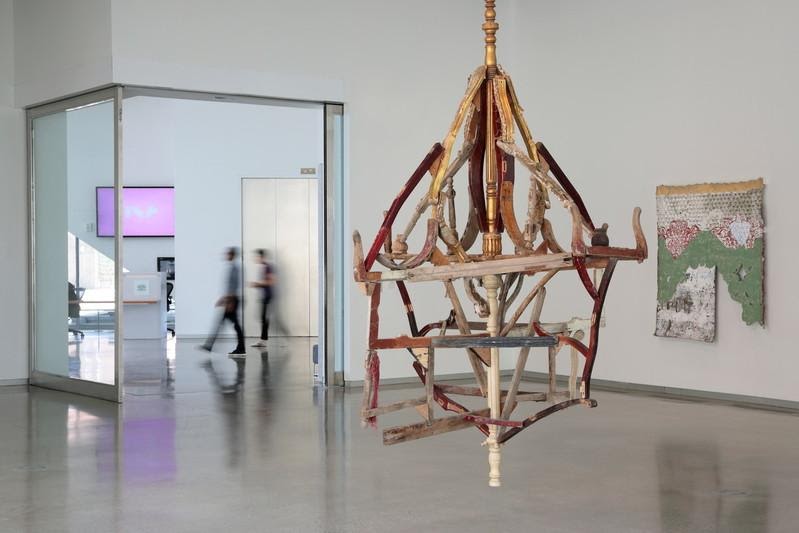
On leaving heaven: Ibrahim Ahmed’s show at Virginia Commonwealth University
“It Will Always Come Back to You” is the first retrospective exhibition of Ahmed's work

Video | Street bling
As Ramadan ends, Mada Masr takes to the streets to enjoy the colorful decor while it lasts!
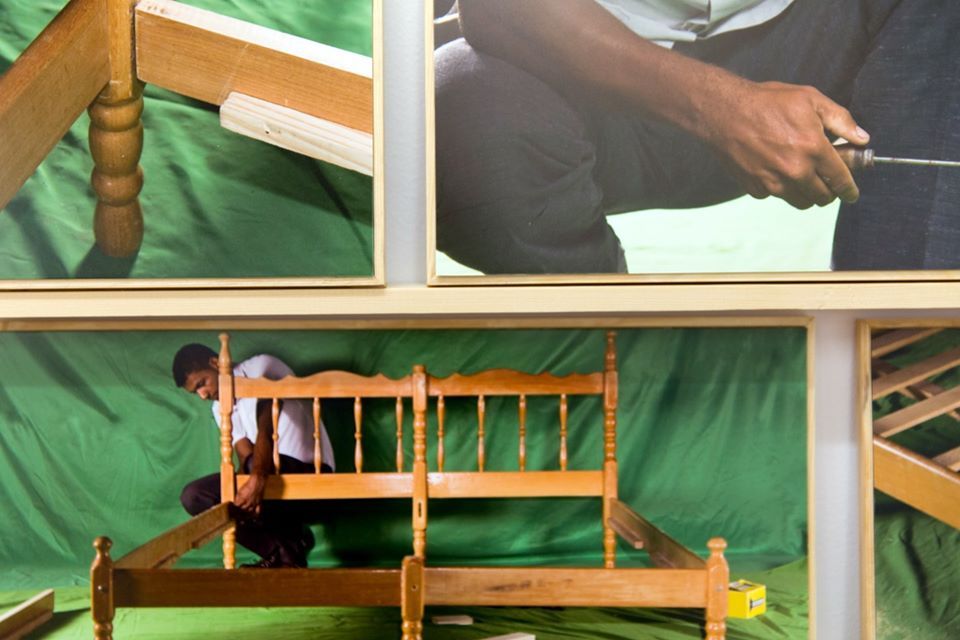
Subtle intimacies: On Gypsum Gallery’s “Codes of Coupling”
The works on display expose the intimate nature of everyday spaces we mindlessly occupy.
Your support is the only way to ensure independent, progressive journalism survives.
You have a right to access accurate information, be stimulated by innovative and nuanced reporting, and be moved by compelling storytelling. Subscribe now to become part of the growing community of members who help us maintain our editorial independence.
Join us